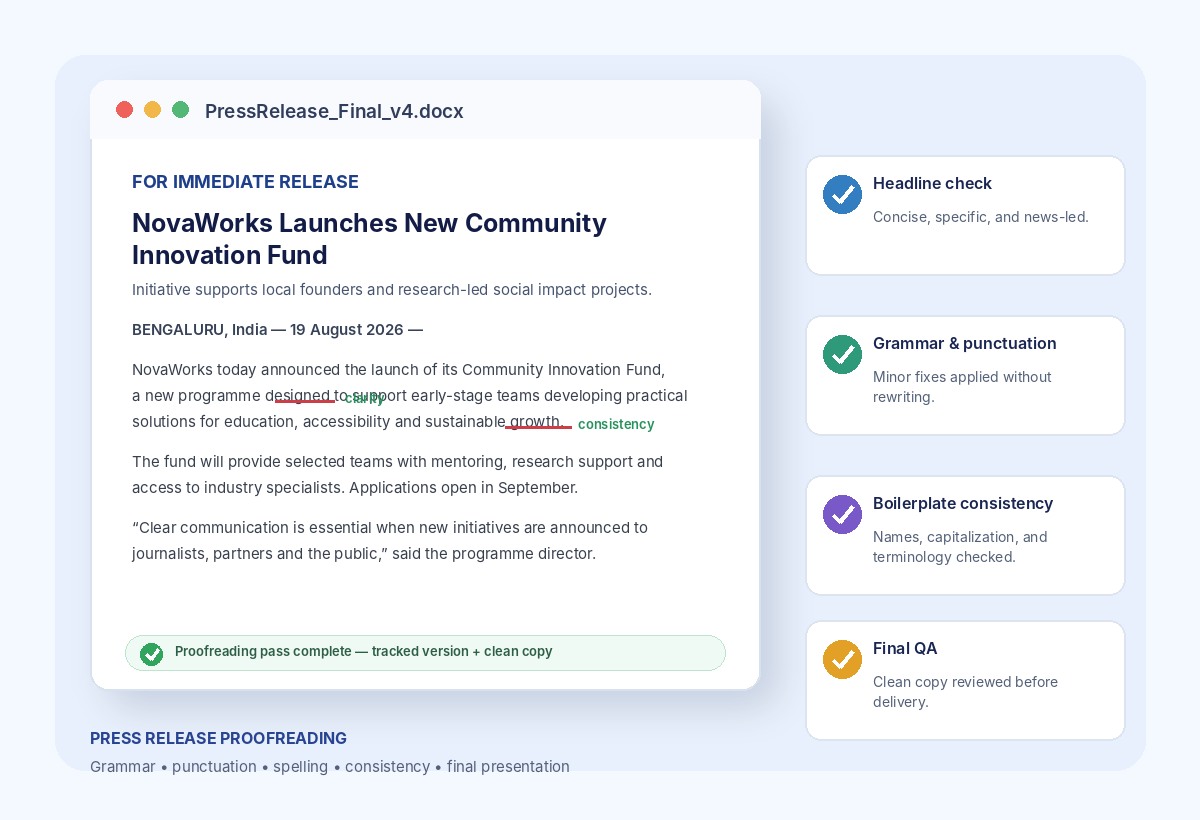
Press Release Proofreading Service for Clear, Polished Media Copy
★★★★★4.8 rating from Researchers, Authors, Students, and Scholars
A focused final-stage proofreading service for press releases that are already drafted and approved in substance. We review language accuracy, visible consistency, quotes, names, boilerplate, contact details, and presentation without turning a proofreading pass into a full rewrite.
Correct grammar, spelling, punctuation and typographical errors before the release is distributed.
Headline, dateline, quote, boilerplate, and media-contact consistency checks
Names, titles, capitalization, abbreviations, and terminology reviewed for consistency
Light clarity corrections while preserving approved messaging and claims
Service-specific final proofNear-final release copy with targeted language and consistency checks
Headline Precision
Titles, punctuation, capitalization, and readability
Language Accuracy
Grammar, spelling, punctuation, and typos
Release Consistency
Names, terms, quotes, boilerplate, and formatting
Final QA
One last review before media or stakeholder distribution
Press Release Proofreading Plans & Pricing
Proofreading is a final-stage service, so the plans are sized around release length and consistency workload rather than adding unrelated writing features. The approved message stays intact while errors and presentation issues are corrected.
Essential
For one standard release that is already approved for content and needs a final language check.
From ₹1,500
One press release up to 800 words
Spelling, grammar, punctuation and typo correction
Headline, names, titles and media-contact consistency check
Clean corrected copy for final approval
Typical delivery: 1–2 business daysReview allowance: 1 clarification pass
Rewriting, substantive editing, fact verification against external sources, distribution and same-day emergency delivery are not included in proofreading plans unless separately scoped.
1
Press Release Proofreading Coverage & Process
The page structure follows a clear service journey: what is checked, how the proofreading pass progresses, and the standards applied before the final release copy is returned.
What We Proofread
Core press release components that commonly need a final language and presentation check.
Headline & Subheadline
Check grammar, punctuation, capitalization, wording consistency, and obvious readability issues in the release title and supporting line.
Body Copy
Proofread the announcement for spelling, punctuation, grammar, typos, repeated words, and light sentence-level clarity issues.
Dateline & Opening
Review the dateline, opening sentence, location wording, and introductory details for internal consistency and presentation.
Executive Quotes
Check quote punctuation, speaker attribution, names, titles, and obvious wording issues without changing the intended message.
Names, Titles & Terms
Flag inconsistencies in company names, product names, job titles, capitalization, abbreviations, and recurring terminology.
Boilerplate
Proofread the standard company description so recurring wording, capitalization, punctuation, and brand terms remain consistent.
Media Contact Details
Check visible spelling, punctuation, labels, phone/email presentation, and repeated contact information for consistency.
Final Presentation
Review headings, spacing, bullets, labels, emphasis, and other visible formatting for a clean final-stage handoff.
Proofreading is a final-stage service. If the release still needs message development, major restructuring, positioning changes, or new content, a deeper editing or writing scope should be agreed separately.
Our 10-Step Proofreading Process
A structured sequence that keeps the review focused on final-stage language, consistency, and presentation.
Press Release Final Proof
01
Receive the near-final press release
02
Confirm the proofreading scope
03
Review headline and subheadline
04
Check dateline and opening paragraph
05
Correct grammar, spelling, and punctuation
06
Review quotes, names, titles, and terms
07
Check boilerplate and contact details
08
Review formatting and document consistency
09
Run a final proofreading quality pass
10
Prepare the proofread version for delivery
Checks We Apply
Proofreading decisions are based on the supplied copy, intended style, and visible release structure.
Language Accuracy
Grammar, spelling, punctuation, articles, prepositions, and obvious typographical errors.
Consistency
Capitalization, abbreviations, numerals, terminology, names, labels, and repeated wording.
Release Structure
Headline, dateline, opening, quotes, boilerplate, contact details, and final presentation.
Message Preservation
Corrections stay at proofreading depth rather than turning into substantive rewriting.
Readability Flags
Awkward or ambiguous wording can be flagged when a light correction may improve clarity.
Final QA
A last pass checks that corrections are cleanly applied and presentation remains consistent.
2
What We Deliver, Where It Fits & Who It Helps
Press release proofreading is suited to communications teams that already have the core announcement drafted and need a careful final language and consistency review before distribution.
What We Deliver
Practical final-stage review outcomes.
Corrected grammar, spelling, punctuation, and typos
Consistent names, titles, abbreviations, and recurring terms
Reviewed quotes, boilerplate, and media-contact presentation
Cleaned heading, spacing, bullet, and label consistency
Queries where wording or source-of-truth information needs client confirmation
Press Release Areas of Expertise
Corporate Announcements
Product & Service Launches
Funding & Financial Updates
Leadership Changes
Partnership Announcements
Research & Insight Releases
Events & Milestones
CSR & ESG Updates
Issue / Response Statements
Public & Non-profit News
Who We Help
Teams that publish or distribute press releases.
Startups & founders
Growth-stage companies
Enterprises
PR & communications agencies
Non-profits & associations
Public-sector teams
3
Flexible Engagement Models & Release Channels
Use the service for a single announcement or a group of related releases. The proofreading scope stays focused on the supplied release copy and its final publishing context.
Engagement Models
Choose the workflow that best matches your release calendar.
Single Release
One near-final press release that needs a focused final proofreading pass.
Campaign Batch
A set of related releases requiring consistent language, terminology, and presentation.
Recurring Support
Ongoing proofreading for teams that publish press releases regularly.
Agency Collaboration
Proofreading support for agency-prepared releases before client or media distribution.
Integrated Communication Channels
Proofread the release copy in the form prepared for the channel where it will be published, sent, or shared.
Newswire-ready release copy
Company newsroom / website
Media outreach attachment
Investor / stakeholder announcement
Internal announcement version
Social or executive excerpt derived from the release
Need pricing or turnaround? Share the release length, file format, deadline, and time zone in the enquiry form. Press Release Proofreading starts at ₹1,500 for one press release up to 800 words. The higher plans cover deeper or larger review requirements, and the final quote depends on the submitted scope and deadline.
The review narrows from broad language accuracy to final presentation so the release is clean, internally consistent, and ready for the client’s final approval and distribution workflow.
From Draft to Final Proof
Five progressively tighter review layers.
Language Accuracy
Release Consistency
Message Preservation
Presentation Check
Final QA
Key Proofreading Checks
What the final review pays attention to most.
✓Headline, subheadline, dateline, and opening consistency
✓Grammar, spelling, punctuation, articles, and prepositions
✓Names, titles, product terms, abbreviations, and capitalization
✓Quote punctuation and speaker attribution presentation
✓Boilerplate, media-contact labels, and repeated terminology
✓Bullets, headings, spacing, emphasis, and visual consistency
✓Light clarity fixes that do not change the approved meaning
✓Final check for clean application of corrections
What You Get
Delivery is agreed around the submitted file type and confirmed scope.
Proofread Release +
The press release copy with agreed proofreading corrections applied.
Review Version +
When the file format supports it, changes can be presented in a review-friendly format so corrections are visible.
Clean Copy +
A clean version can be prepared after the proofreading corrections are incorporated and the delivery format is confirmed.
Editor Queries +
Questions can be flagged where a name, title, factual detail, or intended wording needs confirmation rather than assumption.
Consistency Notes +
Important recurring style or terminology inconsistencies may be highlighted for the communications team’s final decision.
Final QA Check +
A concluding proofreading pass reviews whether corrections and visible presentation are consistent across the supplied copy.
5
Why Choose This Press Release Proofreading Service
The focus is disciplined final-stage review: correct what is wrong, flag what is uncertain, keep approved messaging intact, and return copy that is easier to review and distribute.
Final-stage focus
The service is positioned for near-final release copy that needs careful correction and consistency review rather than a rewrite.
Message-preserving edits
Proofreading changes are kept proportionate so the announcement’s meaning, claims, and approved messaging stay intact.
Release-aware review
Checks reflect the visible structure of a press release, including headline, dateline, quotes, boilerplate, and media contacts.
Review-friendly delivery
Corrections are presented clearly so communications teams can review the final wording efficiently.
Clear scope
The enquiry captures the release format, approximate word count, deadline, and specific concerns before work begins.
Consistent presentation
A final pass looks across repeated names, terminology, capitalization, spacing, and formatting for a cleaner handoff.
6
Common Issues, Proofreading Example & Quick FAQs
A proofreading pass should make small, precise corrections visible without implying a deeper rewrite or changing the approved news angle.
Common Press Release Issues
Examples of final-stage problems worth catching before distribution.
Headline capitalization or punctuation inconsistencies
Typos in names, job titles, product names, or locations
Quote punctuation and attribution problems
Repeated words, missing words, or awkward sentence fragments
Inconsistent spelling style, abbreviations, numerals, or terminology
Dateline, boilerplate, and media-contact presentation errors
Formatting drift between headings, bullets, spacing, and labels
Illustrative proofreading example
Before & After
A light proofreading intervention corrects the sentence without rewriting the announcement.
Before proofreading
Northstar Labs announce its new platform, which will help teams to improves project reporting , and reduce duplicated updates.
After proofreading
Northstar Labs announces its new platform, which will help teams improve project reporting and reduce duplicated updates.
This is a fictional example created only to show proofreading depth. It is not a client testimonial, case study, or claim about results.
Frequently Asked Questions
Quick answers to common service-scope questions.
What is a Press Release Proofreading Service?+
It is a final-stage language and presentation review for near-final press release copy. The focus is on grammar, spelling, punctuation, typographical errors, consistency, and light clarity corrections while preserving the intended message and approved claims.
Is proofreading the same as rewriting a press release?+
No. Proofreading is lighter than rewriting or substantive editing. It corrects surface-level language and consistency issues and may flag unclear wording, but it should not rebuild the announcement, change the communications strategy, or introduce new claims.
What parts of a press release can be proofread?+
A proofreading pass can cover the headline, subheadline, dateline, opening paragraph, body copy, executive quotes, names and titles, boilerplate, media-contact details, and visible formatting supplied in the document.
Can you check executive quotes?+
Yes. Quote punctuation, attribution, names, job titles, obvious grammar issues, and internal consistency can be reviewed while keeping the speaker’s intended message intact.
Do you fact-check claims in the press release?+
Proofreading is not the same as independent fact-checking. Obvious inconsistencies can be flagged, but factual claims, dates, figures, legal statements, approvals, and source verification should be confirmed by the client or an appropriate subject-matter owner.
Scope, suitability, fact-checking boundaries, English style, delivery format, pricing, turnaround, and the information to provide with your release.
What is a Press Release Proofreading Service?+
It is a final-stage language and presentation review for near-final press release copy. The focus is on grammar, spelling, punctuation, typographical errors, consistency, and light clarity corrections while preserving the intended message and approved claims.
Is proofreading the same as rewriting a press release?+
No. Proofreading is lighter than rewriting or substantive editing. It corrects surface-level language and consistency issues and may flag unclear wording, but it should not rebuild the announcement, change the communications strategy, or introduce new claims.
What parts of a press release can be proofread?+
A proofreading pass can cover the headline, subheadline, dateline, opening paragraph, body copy, executive quotes, names and titles, boilerplate, media-contact details, and visible formatting supplied in the document.
Can you check executive quotes?+
Yes. Quote punctuation, attribution, names, job titles, obvious grammar issues, and internal consistency can be reviewed while keeping the speaker’s intended message intact.
Do you fact-check claims in the press release?+
Proofreading is not the same as independent fact-checking. Obvious inconsistencies can be flagged, but factual claims, dates, figures, legal statements, approvals, and source verification should be confirmed by the client or an appropriate subject-matter owner.
Can you proofread a release written in UK or US English?+
Yes. If a preferred English style is specified, the proofreading pass can apply that convention consistently across spelling, punctuation, capitalization, and related language choices.
Do you check names, titles, and brand terms?+
The proofreading pass can check visible consistency in names, titles, product names, capitalization, abbreviations, and recurring brand terminology. The source-of-truth wording should be supplied when exact brand styling matters.
What should I send with my press release?+
Send the latest near-final editable copy, the intended publication or distribution context, your preferred English style, any brand or style guidance, the required deadline, and any terms, names, or sections you want checked carefully.
How much does press release proofreading cost?+
A fixed price is not stated on this page. Use the enquiry form to share the release length, format, deadline, and requirements so the request can be reviewed.
What is the turnaround time?+
A fixed turnaround is not stated on this page. Share your deadline and time zone in the enquiry so feasibility can be reviewed against the document length and scope.
Will I receive a clean final copy?+
The delivery format should be agreed with the enquiry. A review version showing corrections and a clean copy are appropriate delivery formats for proofreading when the submitted file type supports them.
Can you proofread multiple releases for one campaign?+
You can submit details for multiple related releases in one enquiry. The scope can then be reviewed for document count, consistency requirements, and deadline.
Ready to Send a Cleaner, More Consistent Press Release?
Share your near-final release, approximate word count, required deadline, preferred English style, and any names, titles, or brand terms that need special attention.
Provide enough information to understand the release length, publishing context, language style, deadline, and specific proofreading concerns before the scope is reviewed.
What We Need From You
The latest near-final release and a few practical details make it easier to assess the request without guessing at scope, timing, or pricing.
Release copy & length
Share the latest editable text or describe the approximate word count and file format.
Deadline & time zone
Provide the exact date, time, and time zone you are working toward.
English & style preference
Specify UK or US English and any company, agency, or client style guidance that should control the proof.
Source-of-truth terms
Call out approved names, titles, product styling, abbreviations, or wording that should not be altered.
Press Release Proofreading Enquiry
Send Your Release Details
Use the form to describe the release, deadline, preferred English style, and any sections or terminology that need special attention.