Crisis Executive Communication Service for Clear, Controlled Leadership Messaging
★★★★★4.8 rating from Researchers, Authors, Students, and Scholars
When an issue is moving quickly, leaders need communication that separates facts from uncertainty, keeps approved messages consistent and gives each stakeholder group the information it needs. Contentxprtz helps structure the message architecture, executive wording, Q&A, approval flow and communication materials around the situation you are managing.
Holding statements and executive messages grounded in confirmed facts
Audience-specific communication for employees, customers, media and other stakeholders
Q&A, spokesperson briefing and sensitive-topic response lines
Approval-ready drafts, version discipline and a clear next-update structure
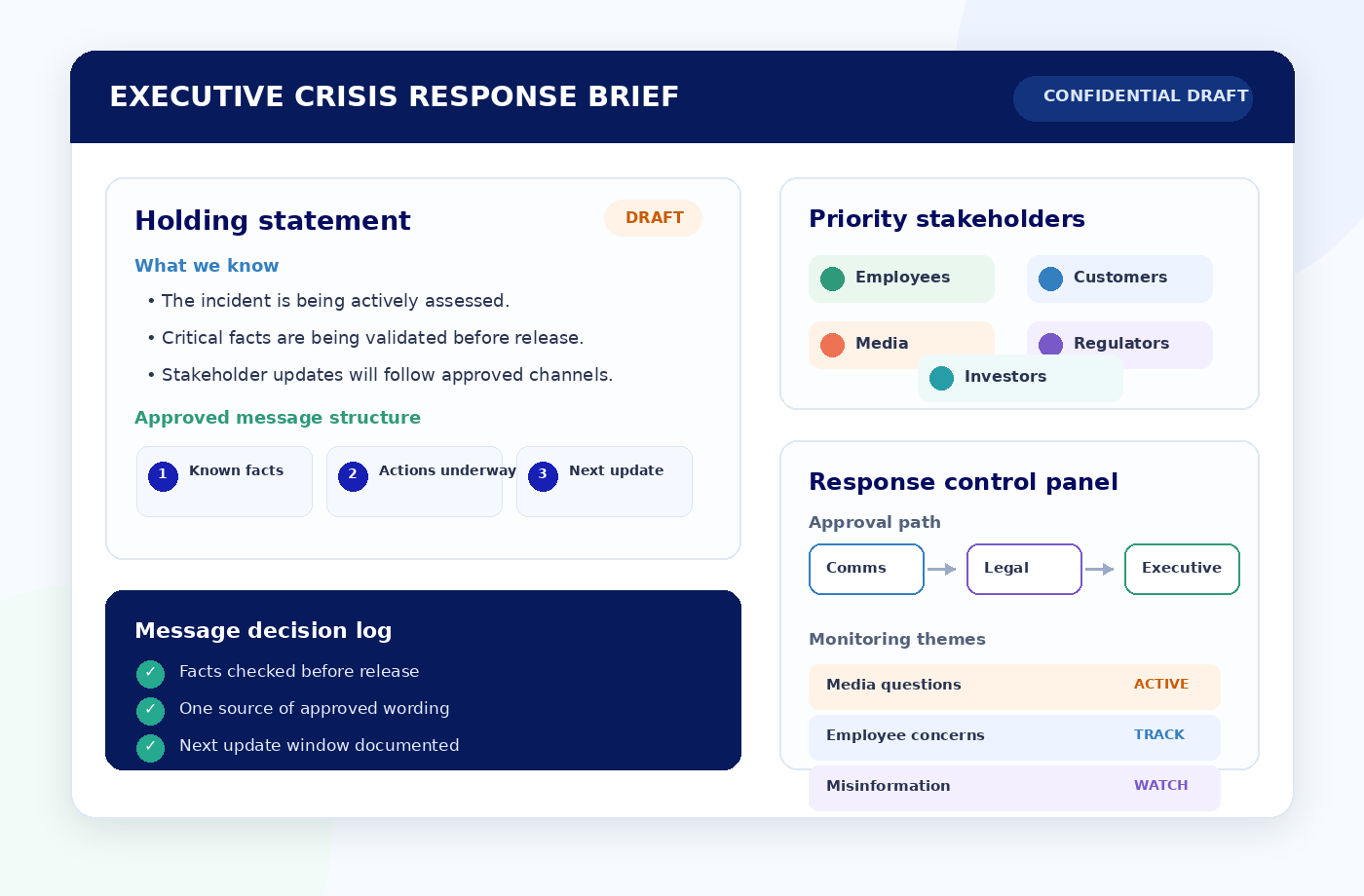
Illustrative crisis communication working view: confirmed facts, stakeholder priorities, approvals and update control.
Message DisciplineOne clear fact base and approved wording across channels.
Executive AlignmentMessages structured for leadership, legal, risk and communication review.
Stakeholder ClarityAudience-specific language without changing the underlying facts.
Response VisibilityTrack questions, message updates, channels and decision points.
Crisis Executive Communication Project Pricing
Executive crisis communication usually combines several high-sensitivity assets and a controlled approval path, so a project minimum is more credible than a flat per-document fee.
Projects from ₹45,000
Suitable for
A defined leadership-response package for an active issue, emerging risk or high-scrutiny stakeholder situation.
Rapid review of the situation brief, known facts and communication risks
Core executive message architecture and proof-point structure
Defined leadership assets such as executive note, holding statement or talking points
Difficult-question and response-guidance support where included in scope
Alignment of approved messaging across agreed stakeholder channels
Structured review and handoff for the named approval path
Active incident intensity, number of leadership assets, legal or risk-review complexity, out-of-hours response and ongoing monitoring can materially change the final quotation.
1
Crisis Communication Services, Process & Working Methods
A structured response combines the right communication outputs, a controlled approval path and practical tools for maintaining message consistency while the situation evolves.
Our Crisis Executive Communication Services
Communication outputs are selected according to the incident, audiences, decision stage and approval requirements.
Holding Statements
Fact-based initial wording that acknowledges the situation without speculation.
Executive Messages
CEO, leadership, town-hall and internal messages aligned to the core response.
Stakeholder Updates
Audience-specific updates for employees, customers, partners and other priority groups.
Media Q&A
Anticipated questions, approved answer lines, bridging points and issue guidance.
Response Briefs
Leadership-ready summaries of known facts, unknowns, actions and communication decisions.
Message Houses
Core narrative, proof points, audience adaptations and phrases to avoid.
Spokesperson Briefing
Talking points, difficult-question preparation and message-reinforcement prompts.
Update & Monitoring Briefs
Communication status, emerging questions and required message updates.
Our 10-Step Crisis Communication Process
The process is designed to make assumptions visible, keep approvals controlled and give each message a clear purpose.
01Situation IntakeCapture the issue, decision context and next communication point.
02Facts & UnknownsSeparate confirmed information from items still being validated.
03Stakeholder PrioritiesIdentify who needs to know what, in which order and through which channel.
04Message ArchitectureDefine the core narrative, proof points, actions and next-step language.
05Draft CommunicationsPrepare holding statements, executive notes, Q&A and audience messages.
06Review & ApprovalRoute drafts through the agreed executive, legal, risk or policy reviewers.
07Channel PlanMap the approved message to internal, external and direct stakeholder channels.
08Release SupportPrepare final versions, spokesperson points and sequencing notes.
09Questions & UpdatesTrack emerging questions and update approved messaging as facts change.
10After-Action ReviewCapture communication lessons, reusable messages and preparedness actions.
Tools & Working Methods
Use the tools already available to your team, supported by a disciplined communication workflow.
Message LibraryApproved statements, Q&A and stakeholder versions.
Response DashboardQuestions, channels, updates and decision visibility.
Stakeholder MatrixPriority audiences, needs, owners and channel sequence.
Approval TrackerVersion status, reviewers, comments and sign-off points.
Update CadenceDocument when audiences should hear from the organisation again.
Monitoring InputsIncorporate available media, social and stakeholder signals into updates.
2
What We Deliver, Where We Help & Who Uses the Service
Crisis executive communication is not one generic statement. It is a coordinated set of messages, audiences, reviewers and channels built around the actual issue.
What We Deliver
✓Holding statement or initial response line
✓Executive email, memo, script or town-hall notes
✓Stakeholder-specific message set
✓Media Q&A and spokesperson briefing
✓Message house and key proof points
✓Channel sequencing and update plan
✓Issue/question log and response updates
✓After-action communication review where included
Areas of Crisis Communication Expertise
Cyber & Data Incidents
Operational Disruptions
Leadership Changes
Workforce Announcements
Regulatory or Public Scrutiny
Reputation & Misinformation
Product or Service Issues
Transactions & Restructuring
Safety or Sensitive Incidents
Who We Help
CEOs & Executive Teams
Corporate Communications & PR
Legal, Compliance & Risk
Security, Technology & Operations
People & HR Leaders
Boards & Investor Relations
3
Engagement Models & Communication Channels
Choose a focused incident engagement or a broader preparedness and executive-messaging scope. Channel planning is adapted to the audiences that actually matter in the situation.
Engagement Models
Incident-Specific Support
Focused communication work for a defined live issue, set of audiences and required outputs.
Executive Message Package
A coordinated set of leadership messages, Q&A, stakeholder updates and briefing notes.
Advisory Retainer
Ongoing access for planned issues, scenario refinement and recurring executive communication needs.
Preparedness Workshop
Message frameworks, stakeholder mapping, role clarity and draft templates for priority scenarios.
Scope, pricing and working schedule: Crisis Executive Communication Project starts from ₹45,000 for a defined engagement. Final pricing depends on the approved deliverables, complexity, review path and timeline. Typical delivery for the starting scope is Typical focused project: 3–7 business days. Larger, approval-heavy or urgent requirements may need a different schedule, confirmed before work begins.
Media StatementsHolding statements, press lines and Q&A
Website & DigitalService notices, updates, FAQs and web statements
Social ChannelsApproved posts, responses and correction messaging
Regulators & PartnersDirect updates coordinated with authorised reviewers
Board & InvestorLeadership briefs, board updates and investor messaging
4
Communication Impact, Measures & Deliverables
The goal is disciplined communication through the lifecycle of an issue: understand the situation, align the message, reach priority audiences, maintain control and capture learning.
Our Crisis Communication Funnel
Situation Awareness
Message Alignment
Stakeholder Reach
Response Coordination
Recovery & Learning
Key Performance Indicators
Select measures that fit the channels and decision context rather than forcing one universal crisis metric.
✓Time from verified fact to approved communication
✓Message consistency across stakeholder versions
✓Priority audience and channel coverage
✓Volume and themes of unresolved questions
✓Adherence to agreed update cadence
✓Corrections or message changes required after release
✓Media, social or stakeholder themes where data is available
✓Actions captured through the after-action review
What You Get
Crisis communication strategy & channel plan
Holding statement & key message house
Executive scripts, emails & talking points
Media Q&A & spokesperson briefing
Stakeholder matrix & audience messages
Monitoring & response update brief
Decision log & approval-ready versions
After-action communication review where scoped
5
Why Clients Choose This Communication Approach
The approach is designed for executive decision-making: controlled facts, clear audiences, visible approvals, practical communication outputs and measurable follow-through.
Structured Response
Facts, audiences, messages and decision points are made explicit.
Executive-Ready Writing
Concise language designed for leaders speaking under pressure.
Audience-Specific
One approved fact base adapted to stakeholder needs and channels.
Approval Discipline
Clear versioning and reviewer input reduce conflicting drafts.
Measurable Follow-Through
Track questions, update cadence, message changes and coverage.
Clear Handover
Reusable briefs, message records and actions support the next response.
6
Typical Crisis Scenarios & Executive Communication Principles
The exact content changes by situation, but the communication discipline stays consistent: verified facts, clear decisions, audience relevance, controlled approvals and a defined next update.
Scenario Examples
Cyber or Data Incident
Build an initial statement around confirmed facts, customer or employee guidance, operational actions, regulatory review points and the next update window.
Operational Disruption
Coordinate service-status language, executive context, customer updates, internal instructions and escalation responses without creating conflicting versions.
Leadership or Workforce Change
Align executive rationale, employee messaging, manager talking points, external stakeholder language and anticipated questions.
Public Allegation or Misinformation
Separate verified facts from claims, define response thresholds, prepare correction language and maintain a decision record for message changes.
“
In a crisis, the strongest executive message states what is known, what is being done, what the audience needs next and when they should expect another update.
This is a communication principle for structuring a response, not a claim that every crisis requires the same wording or channel plan.
These answers explain how the service can be scoped without inventing fixed pricing, turnaround commitments or unsupported guarantees.
What is a Crisis Executive Communication Service?+
It is structured communication support for leaders handling a high-pressure issue. The work can include message architecture, holding statements, executive messages, stakeholder updates, Q&A, approval-ready drafts, channel planning and communication updates.
What types of situations can the service support?+
Typical situations include operational disruptions, cyber or data incidents, leadership changes, workforce announcements, regulatory or public scrutiny, product or service issues, reputational allegations, safety incidents and fast-moving misinformation.
Can you help when all the facts are not yet confirmed?+
Yes. The communication can clearly separate confirmed facts, unknowns, actions underway and the next update point so leaders can communicate without speculating.
Do you prepare holding statements?+
Yes. A holding statement can be prepared around confirmed facts, the organisation’s immediate actions, stakeholder guidance and the next communication point.
Can you draft messages for the CEO or senior executives?+
Yes. Executive emails, town-hall talking points, leadership statements, internal messages and stakeholder-specific scripts can be prepared in a consistent message architecture.
Can the service include media Q&A and spokesperson briefing?+
Yes. The scope can include anticipated questions, approved response lines, bridging points, sensitive-topic guidance and spokesperson preparation materials.
How are legal, compliance or risk reviewers handled?+
Drafts can be structured for reviewer input, version control and approval tracking. Contentxprtz can incorporate approved changes, while legal, regulatory or compliance advice remains the responsibility of the client’s authorised advisers.
Can one crisis message be adapted for different audiences?+
Yes. A core message house can be translated into audience-specific communications for employees, customers, media, partners, regulators, investors or other stakeholder groups while keeping the approved facts consistent.
Does the service include media or social monitoring?+
The engagement can incorporate client-provided monitoring inputs, public-source observations and defined tracking measures. Access to any paid monitoring platform or proprietary data source is confirmed separately as part of scope.
How is confidential information handled?+
The working process is designed to minimise unnecessary sharing and keep crisis drafts, stakeholder information and unpublished material within the agreed communication workflow.
How quickly can work begin?+
Timing depends on the situation, available facts, required outputs, approval path and stakeholder complexity. The working schedule is confirmed after the initial scope review rather than using an unsupported fixed turnaround claim.
What information should I provide at the start?+
Share the situation summary, confirmed facts, known unknowns, priority audiences, existing statements, key decision-makers, legal or policy constraints, desired channels and the next communication deadline or decision point.
How is pricing determined?+
Pricing is confirmed after the required deliverables, stakeholder groups, channels, review process, urgency and engagement model are understood. Crisis Executive Communication Project starts from ₹45,000 for a defined engagement. Final pricing depends on the approved deliverables, complexity, review path and timeline.
Need an Executive-Ready Message for a High-Pressure Situation?
Share the situation, confirmed facts, priority audiences and next decision point so the communication scope can be assessed.
Tell Us What Is Happening and What Must Be Communicated Next
Provide enough context to understand the issue, the audiences involved, the current approval position and the next communication deadline or decision point. Avoid including information that is not necessary for an initial scope discussion.
Situation & confirmed facts
Briefly explain what has happened, what is verified and what remains uncertain.
Priority audiences
Identify employees, customers, media, regulators, investors, partners or other groups that need communication.
Review & approval path
Note which executive, legal, risk, compliance or communication reviewers must approve the message.
Next communication point
Share the deadline, meeting, publication window or decision event that the communication must support.
Crisis Executive Communication Service
Request a Scope Review
The initial request helps assess the required communication outputs, audiences, review process and working schedule.