Source Content Review
Identify the purpose, mandatory messages, definitions, conditions, exceptions and source language that must remain accurate.

Turn dense public-facing content into information people can scan, understand and act on—without casually rewriting approved policy meaning, mandatory conditions or important exceptions.
Plain-language adaptation supports clearer communication. Final policy, legal, regulatory and organisational approval remains with the relevant content owner.
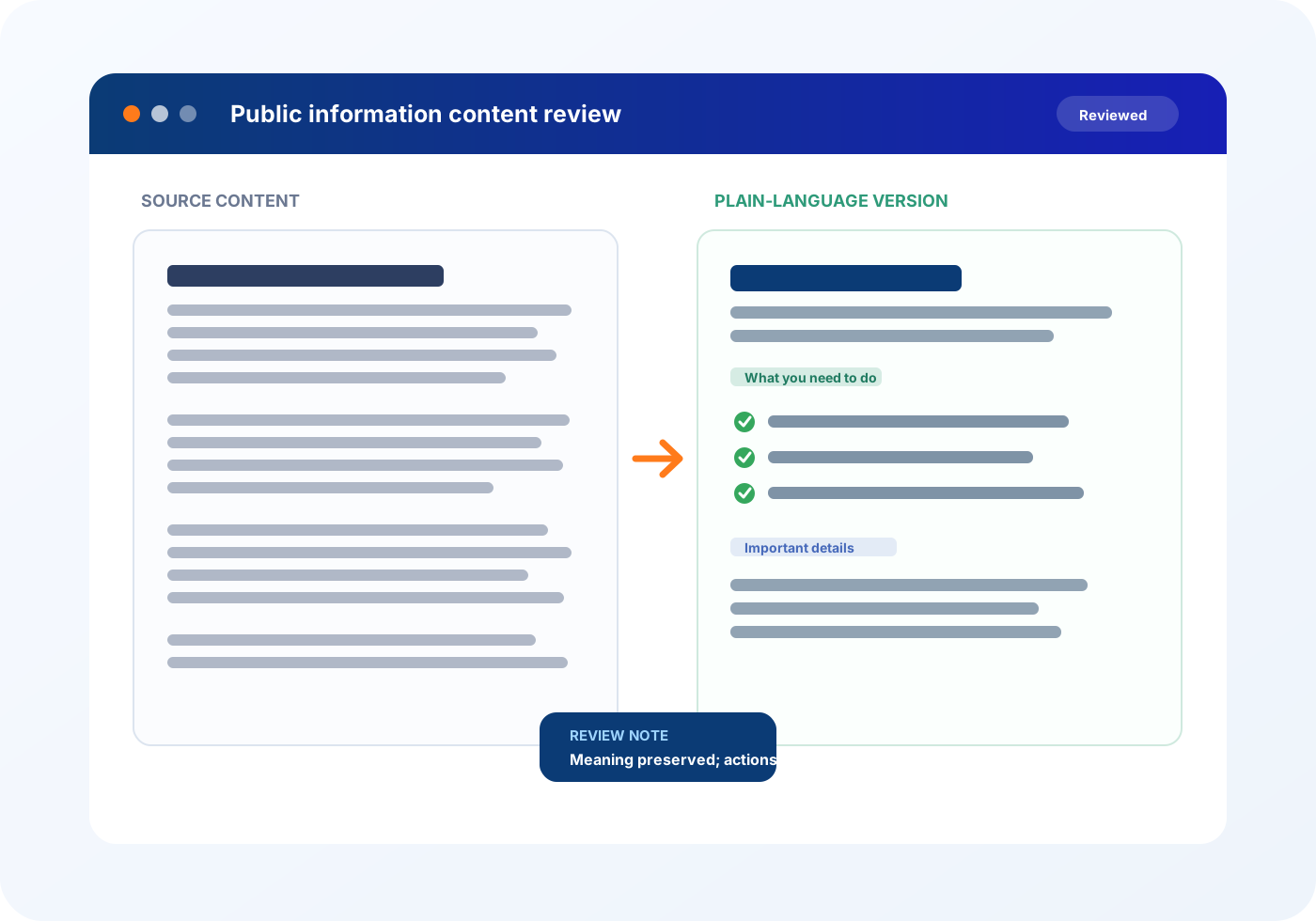
Meaning-preserving adaptation scope
Plain-language adaptation requires more intervention than proofreading, so the starting price covers a complete rewrite-and-structure pass while preserving the approved source meaning.
for up to 4,000 words of source content
Best fit: Public notices, instructions, guidance, eligibility information, FAQs or service pages that are accurate but too dense, technical or difficult for the intended audience to use.
When the quote changes: Complex regulated text, multi-format adaptation, multilingual work, user testing, large content libraries or extensive client-side approval cycles are scoped separately.
Plain-language adaptation is more than swapping difficult words. It brings together source review, audience context, information architecture, sentence-level rewriting, consistency checks and a review trail that helps content owners see what changed.
Identify the purpose, mandatory messages, definitions, conditions, exceptions and source language that must remain accurate.
Clarify who the reader is, what they need to know and the actions they should be able to complete after reading.
Reduce avoidable jargon, long sentence structures, nominalisations and indirect phrasing while maintaining the intended meaning.
Reorganise headings, labels, lists and content sequence so readers find purpose, eligibility, steps, deadlines and support information quickly.
Apply supplied terms, approved names, defined words, labels and recurring messages consistently across the adapted content.
Cross-check that required statements, cautions, conditions and exceptions have not been dropped during simplification.
Flag unclear source wording, possible meaning changes and decisions that should be confirmed by the policy or content owner.
Prepare the adapted version and, where required, tracked changes, comparison copy or reviewer notes for the client's approval process.
The workflow keeps source authority visible from the start. Each stage narrows the gap between what the organisation needs to communicate and what the public needs to understand and do.
Confirm purpose, audience and intended reader action.
Review source meaning, conditions, jargon and complexity.
Plan headings, sequence, actions and supporting detail.
Rewrite for clear language, direct sentences and usable flow.
Compare adapted wording against the approved source.
Flag ambiguity, missing context or meaning-sensitive decisions.
Apply feedback, terminology and final content-owner decisions.
Deliver the clean adaptation and agreed review materials.
Public information often carries policy detail, legal conditions, operational instructions and institutional terminology at the same time. A controlled adaptation process can improve usability without treating simplification as an excuse to remove important meaning.
The goal is not to make every sentence short or remove all technical terms. The goal is to make the information easier to navigate, easier to understand and easier to act on while keeping the necessary substance.
Long, indirect or heavily nominalised wording is recast into more direct, readable sentences.
Purpose, eligibility, actions, conditions, deadlines and support information are easier to locate.
Reader tasks are expressed with clear verbs, visible steps and enough context to act confidently.
Lists, labels and section breaks replace dense blocks where the content is naturally task based.
Approved terminology and recurring labels are applied consistently to reduce reader confusion.
Potentially meaning-sensitive changes are identified for review instead of being silently simplified.
Applicants desirous of availing the aforementioned assistance are required to furnish the prescribed documentation prior to the date stipulated in the notification.
To apply for this assistance, send the required documents before the deadline shown in the notice.
The adaptation can be shaped by the public-information format, the authority of the source material, the intended audience and the organisation's own content constraints.
These examples illustrate where the service can be useful. They are representative scenarios, not customer case studies, performance claims or testimonials.
A long notice contains eligibility rules, exclusions, dates and document requirements. The adaptation separates these into clear sections without removing conditions.
A service guide explains who can use the service, what it provides and how to access it. The adaptation leads with reader tasks, steps and support information.
Repeated questions and policy explanations are reorganised around what users ask, with consistent terminology and direct answers that remain linked to the approved source.
Examples above are illustrative and do not represent named clients, measured outcomes or service guarantees.
The most useful starting point is the latest approved source, the intended audience and the decisions that must remain with the relevant policy, legal or content owner.
Answers to common questions about scope, meaning preservation, source material, audience adaptation, deliverables, digital formats, terminology, pricing and turnaround.
It is the process of rewriting and restructuring approved public-facing information so people can understand the message, required actions, conditions and next steps more easily, while preserving the source meaning and required detail.
Suitable material can include public notices, service guides, application instructions, policy summaries, eligibility information, FAQs, web pages, letters, forms, programme information and other public-facing content.
The service is designed to preserve approved source meaning. Where wording is ambiguous or a simplification could alter meaning, the issue is flagged for client review rather than guessed or silently changed.
Yes. The source material can be used as the authority for the adaptation, together with any approved terminology, definitions, mandatory statements and review instructions supplied by the client.
Yes. Audience context can guide vocabulary, sentence length, explanation depth, information order and the way actions or eligibility requirements are presented.
Deliverables can include a plain-language version, a tracked or comparison version showing changes, reviewer notes where meaning needs confirmation, and a clean copy for the client's final approval workflow.
No. Plain-language adaptation also considers headings, information hierarchy, sentence structure, action sequencing, labels, lists, repeated concepts, definitions and the placement of important conditions or exceptions.
Yes. Plain language does not require casual language. The tone can remain formal, respectful and institutionally appropriate while removing avoidable complexity and making the message easier to use.
Yes. Client-supplied terminology, style guidance, approved phrases, naming conventions and mandatory statements can be treated as content constraints during adaptation.
Yes. The service can adapt public information for document and digital formats, including web content, FAQs, instructions, form guidance and service information, provided the required source content is supplied.
Contentxprtz public information plain-language adaptation starts from ₹7,000 for up to 4,000 words. The starting scope includes meaning-preserving rewriting, information-hierarchy improvements, reviewer queries where needed and two consolidated revisions, with typical delivery in 5–7 business days.
Send the latest source content, intended audience, required output format, deadline, mandatory wording or terminology, relevant style or accessibility requirements, and any sections that need particular attention.
Share the source content, intended public audience, required output format, deadline and any wording or review constraints that must be respected. The material can then be reviewed for scope and feasibility.
Send the approved or current version that should be treated as the meaning reference.
Explain who needs the information and what they should understand or do after reading it.
Identify definitions, legal or policy language, disclaimers, labels or statements that must remain fixed.
Share the required date and whether the output needs legal, policy, accessibility or other internal review.
Specify document, web page, FAQ, form guidance, letter, email, service guide or another public-facing format.
Provide enough context for the source material, intended audience and required output so the adaptation requirement can be assessed accurately.