Policy Issue Scoping
Clarify the problem statement, decision context, audience, geography, policy domain, research questions and boundaries before evidence collection begins.

Turn a policy question, programme challenge, regulatory issue or institutional priority into a clear research paper or concise policy brief built around traceable evidence, comparative analysis and decision-focused recommendations.
Focused evidence-review minimum
Policy research is scoped around the decision question and evidence burden. The entry price therefore buys a complete focused evidence-review module rather than an arbitrary number of research hours.
for one focused policy research question
Best fit: Policy teams that need a structured evidence base before drafting a brief, paper, options note or recommendation document.
When the quote changes: Large systematic reviews, primary data collection, interviews, multi-country comparison, quantitative analysis or continuous monitoring require a separate research scope.
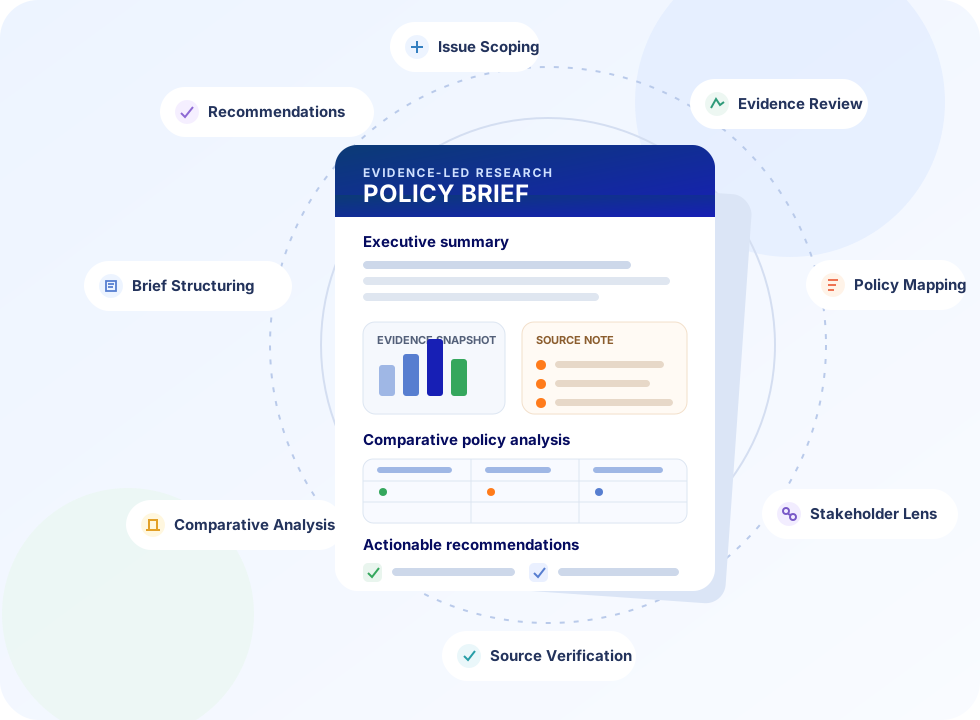
A policy paper or brief needs more than a collection of sources. The research has to define the question, connect evidence to the policy context, compare relevant approaches, surface implications and present recommendations in a form the audience can act on.
Clarify the problem statement, decision context, audience, geography, policy domain, research questions and boundaries before evidence collection begins.
Organise relevant studies, institutional reports, official materials and supplied sources into themes that directly answer the policy question.
Compare approaches across jurisdictions, institutions or programmes using a common analytical framework so similarities, differences and trade-offs are visible.
Map the actors, mandates, interests, implementation responsibilities and documented stakeholder perspectives that shape the policy environment.
Structure relevant policy instruments, schemes, rules, guidelines and institutional documents into a clear map of what applies to the research question.
Shape the evidence into a concise executive format with context, key findings, options, implications, risks and recommendations suited to decision makers.
Maintain a usable trail from statements and evidence to the materials reviewed, with citation-ready references where required by the assignment.
Translate the analysis into practical options and recommendations while making the evidence, assumptions, trade-offs and implementation considerations explicit.
The workflow moves from the policy question to a reviewed, source-traceable document. Each stage is designed to reduce ambiguity and keep the research aligned with the final decision or communication need.
Define purpose, audience, context and expected output.
Set questions, boundaries, source types and comparison criteria.
Gather and organise relevant evidence and policy materials.
Compare findings, identify patterns, gaps and implications.
Connect evidence into a coherent policy narrative.
Build the paper or brief around audience and decision needs.
Check logic, source traceability, consistency and clarity.
Provide a structured final document and agreed supporting material.
The page structure follows an institutional policy-service model: research discipline on one side, the document itself at the centre, and the organisations that use policy evidence on the other.
The final package is shaped by the agreed assignment. These are common outputs for policy-paper and policy-brief research rather than fixed inclusions for every engagement.
Structured narrative matched to purpose and audience
Key findings organised by theme or question
Policies or approaches compared on common dimensions
Roles, interests and institutional relationships where relevant
Traceable list of evidence and materials used
Decision-focused options, implications and next steps
The infographic supplied for this page places institutional policy work across governance, compliance, programme design, monitoring, research and partnerships. The service can be scoped around the relevant domain and source set for the assignment.
Specific policy or legal-source research should be scoped against the current authoritative material required for the assignment.
Instead of generic case studies or unsupported outcome claims, these examples show the kinds of policy-research problems the service can be configured to address.
For a leadership or board audience that needs a concise view of the issue, evidence, options and implications.
For an organisation that has multiple reports, studies or policy documents and needs the evidence synthesised into one coherent analysis.
For teams evaluating how different jurisdictions, institutions or programmes address the same policy challenge.
Policy research can influence institutional decisions, so the document should make its evidence base, analytical steps and limitations easy to review.
Materials reviewed can be recorded in a consistent source list or evidence matrix so the research path remains visible.
Key factual statements and analytical claims can be checked against the sources used before the final draft is prepared.
Findings are interpreted against the policy, programme, institutional or geographic context instead of being transferred mechanically.
Structure, terminology, logic, citations, headings and recommendation flow are reviewed for consistency and readability.
Share the policy question, intended audience, geography, source material and decision context. The assignment can then be scoped around the research depth and document format you actually need.
Discuss Your RequirementQuestions to help define the right document, evidence base and research scope before an assignment begins.
The service can cover issue scoping, evidence review, policy and regulatory mapping, comparative analysis, stakeholder perspectives, synthesis, brief structuring, source traceability, and recommendation development. The exact scope should be confirmed from your research question and intended audience.
A policy brief is usually a concise decision-focused document that distils evidence, options, implications, and recommendations. A policy paper is generally broader and can provide more context, analysis, comparison, and supporting evidence. The final structure should match the purpose and audience of the assignment.
Yes. Existing materials can be used as the starting evidence base when supplied. They can be reviewed alongside additional sources where the agreed assignment requires wider research or comparison.
Yes, where comparative analysis is part of the agreed scope. The comparison can be organised around common dimensions such as policy intent, eligibility, implementation model, governance, funding, monitoring, safeguards, or documented outcomes.
The research workflow can include source logging, citation-ready references, and checks that statements are traceable to the materials used. Final legal, regulatory, or organisational decisions should still be validated against the latest authoritative source where required.
Yes. The document can be structured for a leadership audience with an executive summary, decision context, key evidence, options, implications, risks, and recommendations, while keeping supporting detail in the main analysis or appendices.
Yes, where the requirement is research, synthesis, policy analysis, or documentation. The service is not a substitute for formal legal advice, statutory interpretation by qualified counsel, or regulatory approval.
Useful inputs include the policy question, intended audience, geography, sector, preferred document type, existing source material, required frameworks, desired depth, citation style if any, and the decision or action the document is intended to support.
Yes. Stakeholder mapping and documented stakeholder perspectives can be incorporated when evidence is available. If primary interviews or consultations are required, that should be agreed separately as part of the assignment scope.
Yes. Depending on the assignment, the deliverable can include concise comparison tables, evidence matrices, policy-option frameworks, stakeholder maps, source logs, or recommendation summaries to support the written paper or brief.
Contentxprtz policy paper and brief research projects start from ₹18,000 for one focused policy question, including a structured review of up to 20 priority sources and a concise evidence synthesis. Typical delivery is 7–10 business days.
Confidential or unpublished materials should be shared only through the designated service process. The page and enquiry workflow are designed to collect only the information needed to understand the assignment before detailed files are exchanged.
Provide enough context to understand the research question, audience and expected document. Pricing and timing can then be scoped against the actual assignment rather than assumed on the page.
The more clearly the decision context is explained, the easier it is to define a useful research scope.
What issue should the paper or brief clarify, compare or help decide?
Identify leadership, board, donors, programme teams, government, regulators or other intended readers.
State the jurisdiction, sector, programme area or institutional setting to be researched.
Note any reports, policies, source lists, datasets, concept notes or previous drafts already available.
Share the preferred document type, approximate length, required style and target date if already known.
Share your contact details and assignment context. Detailed confidential materials can be exchanged through the appropriate service process after the initial scope is understood.