Executive Summary Editing
Sharpen purpose, findings, significance, limitations and recommended actions so senior readers can understand the report quickly.

Refine the language, structure and presentation of development-sector reports without changing the evidence behind them. We edit for clearer executive summaries, stronger results narratives, consistent terminology, readable tables and figures, and professional delivery to donors, boards, partners and wider stakeholders.
Impact-report editing starting scope
The starting scope is sized for a meaningful edit of a short-to-medium development report while preserving programme meaning, donor terminology and evidence supplied by the client.
for up to 6,000 words
Best fit: Impact, donor, programme, M&E or research reports that are drafted but need clearer narrative, stronger consistency and transparent editorial changes.
When the quote changes: Substantive rewriting, major structural repair, evidence verification, multi-author harmonisation and long annexes are assessed separately.
What We Do
From an executive summary to an annex, the service focuses on the parts of an NGO or development report that most affect clarity, credibility and usability for decision-makers.
Sharpen purpose, findings, significance, limitations and recommended actions so senior readers can understand the report quickly.
Improve how outputs, outcomes, indicators and learning are described, with careful wording around evidence and attribution.
Review titles, labels, captions, units, terminology and cross-references for consistent and reader-friendly presentation.
Edit the narrative against supplied templates and reporting instructions while preserving programme facts and required terminology.
Strengthen logical flow between methodology, indicators, findings, lessons, limitations and recommendations.
Improve research narrative, section coherence, evidence signposting, citation presentation and interpretation language.
Refine policy briefs, annual reports, institutional publications and governance-focused documents for clarity and consistency.
Check headings, terminology, abbreviations, numbers, references and recurring labels across sections and appendices.
Our Process
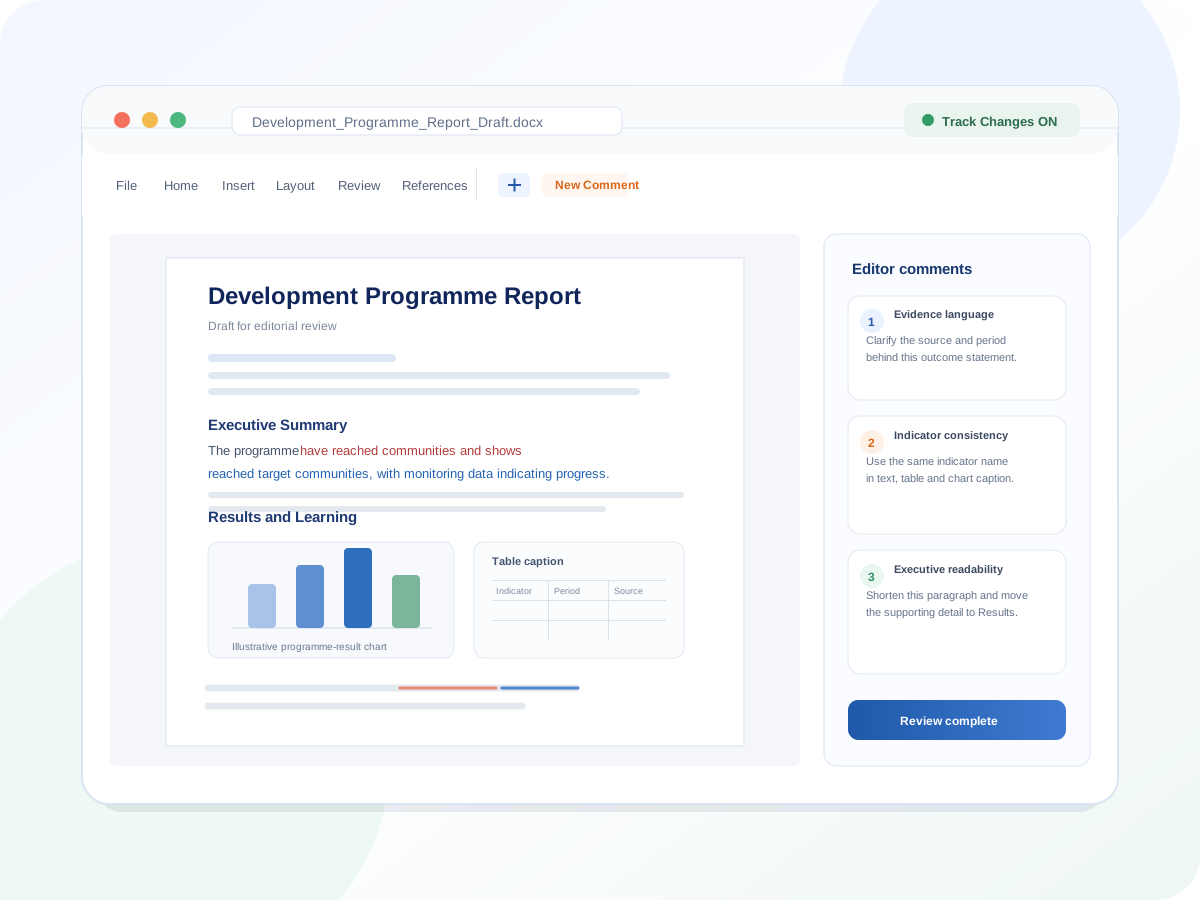
The workflow separates editorial improvement from author decisions, making it easier to review changes and resolve comments before the final report is shared.
Review report purpose, audience, template and priorities.
Identify language, flow, consistency and presentation issues.
Set the editorial approach for sections and recurring terms.
Revise language, structure and readability with tracked changes.
Review labels, figures, tables, references and internal consistency.
Flag unclear evidence, missing context or author decisions.
Check the edited report for editorial completeness and consistency.
Return reviewable files and resolve agreed editorial queries.
Development reports often combine narrative, evidence, indicators, visual data and multiple stakeholder requirements. The editing approach keeps those elements connected rather than treating the document as isolated sentences.
What You Receive
The deliverables are designed to help the report owner understand what changed, what still needs author input and how the final document reads as a whole.
A document that makes editorial revisions visible for author review.
A readable version reflecting accepted editorial changes for final review.
Queries where evidence, context, terminology or author decisions need attention.
Editorial checks across headings, abbreviations, terminology and recurring labels.
Presentation checks for tables, figures, captions and cross-references in context.
Editorial improvements are separated from substantive author decisions.
The editor can follow the materials you supply. Frameworks and templates are treated as editorial inputs, not as a substitute for technical, audit, legal or regulatory assurance.
Editing Examples
These are illustrative examples of editorial intervention. They show language and reporting improvements, not real client data or outcomes.
Why it changed: Grammar was corrected and the causal claim was softened so the sentence reflects evidence more carefully. The editor would flag the data source or period if it is not clear in the report.
Why it changed: Generic wording was replaced with specific signposting so senior readers can understand the report’s purpose and contents quickly.
Why it changed: Consistent labels reduce ambiguity and make it easier for readers to connect narrative claims with the report’s visual evidence.
Use the sample links to review related editorial work, or share your document details for a scope assessment.
Share the report type, audience, word count, reporting template, priority sections and deadline. The requirement can then be assessed for the appropriate editing scope.
Discuss Your ReportThe service is designed around transparent editing, careful handling of the author’s meaning and practical report usability.
Questions about scope, evidence handling, templates, tracked changes, tables, references, pricing and turnaround.
It is an editorial service for reports produced by NGOs, foundations, development programmes, policy teams, research organisations and similar institutions. The edit focuses on language, clarity, structure, consistency, evidence presentation, tables and figures, references, and reader-friendly reporting while preserving the organisation’s intended meaning.
Typical documents include annual and impact reports, programme reports, donor and grant reports, monitoring and evaluation reports, baseline or endline reports, research and evidence reports, policy briefs, learning reports, case studies, evaluation reports, and institutional publications.
Yes. If you provide the relevant template, reporting instructions, style guide, terminology list or other requirements, the edit can be aligned editorially to those supplied materials. The service does not replace legal, regulatory, audit or donor-compliance advice.
No. The editorial objective is to improve how findings are communicated, not to invent or alter evidence. Where a statement is unclear, internally inconsistent or appears to need a source, the editor can flag it for author review rather than silently changing the underlying claim.
The editing review can check presentation consistency across tables, figures, captions, labels, units, terminology and cross-references when those items are included in the supplied document. It is not an independent statistical or financial audit of the underlying data.
Yes. These high-visibility sections can be edited for clarity, logical sequencing, concision, audience relevance, consistency with the main report and stronger signposting of evidence, findings, limitations and recommended actions.
Yes, when the report and supporting materials supply the terminology to follow. The edit can improve consistency across indicators, outputs, outcomes, activities, results statements and learning language without redefining the organisation’s technical framework.
The page is designed around a transparent editing workflow. The enquiry can request an editable version with tracked changes and a clean edited copy, with editor comments used where clarification or author action is needed.
The editorial review can improve citation and reference presentation consistency when the report contains references or a supplied style requirement. Source verification, fact-checking and research validation should be requested separately if needed.
Contentxprtz NGO and development report editing starts from ₹8,000 for reports up to 6,000 words. The service includes tracked changes, a clean edited copy and one consolidated revision, with typical delivery in 5–7 business days.
Contentxprtz NGO and development report editing starts from ₹8,000 for reports up to 6,000 words. The service includes tracked changes, a clean edited copy and one consolidated revision, with typical delivery in 5–7 business days.
Send the latest editable draft where possible, along with the intended audience, report purpose, deadline, donor or organisational template, style guide, terminology preferences, required citation style and any sections you want the editor to prioritise.
NGO and development report editing starts from ₹8,000 for up to 6,000 words, with typical delivery in 5–7 business days. Share the report, audience, editorial depth and deadline so longer or more complex work can be scoped accurately.
Annual report, impact report, donor report, M&E report, policy brief, evaluation report or another development-sector document.
Tell us whether the report is for a donor, board, funder, partner, regulator, public audience or internal decision-making.
Mention any donor template, style guide, terminology list, citation requirement or reporting framework you need followed.
Provide the required date and the sections that need the most editorial attention.
Complete the form below so the document can be assessed for editing scope and deadline feasibility.