Grammar & Typo Errors
Incorrect verb forms, articles, spelling, or duplicated words interrupt clarity.
Example: “This Policy apply…”Professional final-stage proofreading for privacy policies, terms and conditions, terms of use, cookie notices, disclaimers, and related web documents. We correct language and presentation issues, improve document-wide consistency, and flag editorial ambiguities while preserving your intended meaning.
Small language and consistency errors can make public-facing policies look unreliable, confuse readers, or create avoidable questions during internal review and web publication.
Incorrect verb forms, articles, spelling, or duplicated words interrupt clarity.
Example: “This Policy apply…”Capitalized terms may vary between sections or related policy pages.
Example: “Service” vs “service”Sections, lists, or clauses can become inconsistent after revisions.
Example: 4.1 followed by 4.3Internal references may point readers to the wrong section or label.
Example: “see Section 8” after renumberingMissing commas, colons, or list punctuation can make sentences harder to parse.
Example: inconsistent list separatorsHeadings, bullets, dates, capitalization, and spacing may vary across pages.
Example: mixed heading caseLong blocks, awkward line breaks, or inconsistent labels can reduce scanability online.
Example: uneven headings and listsA focused final-stage review for language correctness, consistency, and presentation across individual pages or related policy-document sets.
The editor focuses on surface-level correctness and document-wide consistency. When a sentence appears ambiguous, a defined term is unclear, or a correction could alter intended meaning, the issue can be flagged as an editorial query for your review rather than silently changed.
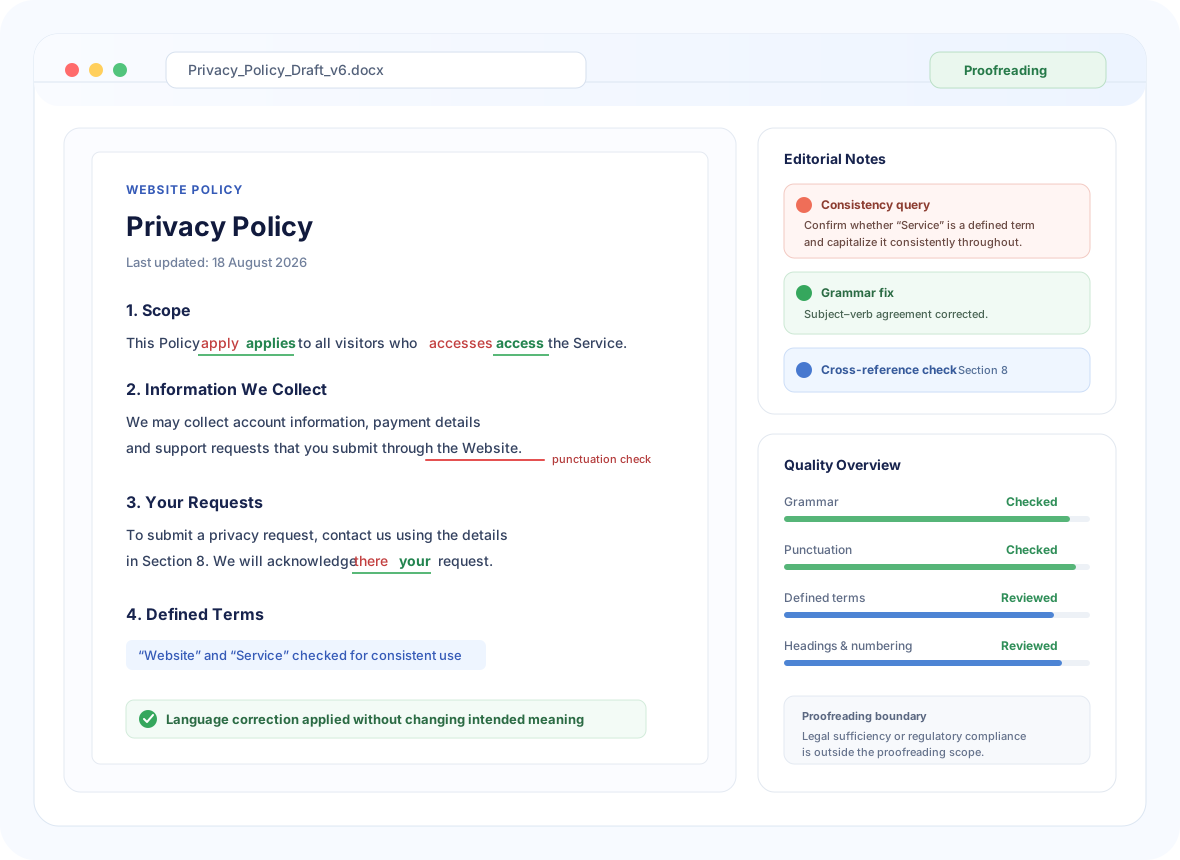
Examples below illustrate the depth of proofreading: precise corrections, consistency checks, and queries where meaning should be confirmed by the document owner.
1. Scope
This Policy apply to all visitors who accesses the Service.
3. Your Requests
We will acknowledge there request and respond using the contact details provided.
8. Contact us
Questions about this privacy policy can be sent to the address below.
1. Scope
This Policy apply applies to all visitors who accesses access the Service.
3. Your Requests
We will acknowledge there your request and respond using the contact details provided.
8. Contact us Us
Questions about this privacy policy Privacy Policy can be sent to the address below.
1. Scope
This Policy applies to all visitors who access the Service.
3. Your Requests
We will acknowledge your request and respond using the contact details provided.
8. Contact Us
Questions about this Privacy Policy can be sent to the address below.
✓ Surface-level corrections resolvedChoose the right level of review by separating language correction from deeper editorial rewriting and legal or regulatory assessment.
The service is suitable for near-final public-facing documents that already contain the intended legal or policy content and need a careful editorial pass.
When several pages share definitions, contact details, headings, or recurring clauses, reviewing them together helps identify editorial inconsistencies that are easy to miss when each page is checked in isolation.
A structured path from document submission to final proofread delivery, with scope boundaries kept clear throughout the process.
Share the files, webpage copy, related policy pages, and editorial instructions.
ReceivedWe assess format, length, consistency needs, requested schedule, and proofing depth.
In ReviewThe project is assigned for careful language and presentation review.
In ReviewGrammar, spelling, punctuation, typography, and local consistency are checked.
In ProgressDefined terms, headings, numbering, labels, and obvious internal references are reviewed.
In ProgressA final editorial pass checks that corrections and presentation are consistent.
Quality CheckReceive the agreed tracked, clean, and query files in the confirmed working format.
DeliveredDelivery format is confirmed during scope review. Where the working file supports tracked edits, these are typical proofreading deliverables.
Corrections visible for transparent review and approval.
Working file formatA polished version with accepted proofreading corrections reflected.
Working file formatComments for ambiguous wording, inconsistent defined terms, or points needing owner confirmation.
Comments / notesA concise record of recurring presentation or terminology issues when they materially affect the project.
Where applicableProofreading can be applied to public-facing policy copy across different website and digital publishing environments. The service remains editorial rather than legal or regulatory.
Industry context may affect terminology and house style, but proofreading does not replace specialist legal, compliance, regulatory, medical, financial, or other professional review.
Policy drafts, internal instructions, unpublished updates, and related client information are treated as confidential service material through the designated workflow.
Document content, instructions, and unpublished policy revisions are handled as confidential project material.
Use the agreed submission and delivery route for document transfer and project communication.
Files should be available only to the team members required to perform or manage the proofreading project.
Tracked, clean, and query files are returned through the agreed project-delivery process.
No fixed turnaround is assumed for this service. Scheduling is confirmed after the documents and requested proofreading scope are reviewed.
For planned publication dates where the document set can be reviewed in the normal production queue.
For tighter publication windows, subject to document volume, complexity, and editor availability.
For urgent needs where a feasible scope and delivery plan can be confirmed after assessment.
Turnaround depends on word count, number of pages or related documents, file condition, formatting complexity, requested cross-document consistency checks, and the required editorial depth. Timing is confirmed only after scope review.
Pricing is scoped to the actual document set and requested proofreading requirements, so no fixed price is displayed on this page. A custom quote is based on the reviewed project scope.
Total amount of text that requires proofreading.
Single page, multiple policies, or a connected policy set.
Surface correction only or broader consistency and query review.
Tables, lists, defined terms, nested numbering, and cross-references.
Required capitalization, spelling, layout, or brand conventions.
Deadline, publication timing, and available review window.
You receive a scope-based quote after the submitted information is reviewed. No price, discount, per-word rate, or turnaround is implied on this page.
The value is a cleaner, more consistent final document while keeping the distinction between editorial proofreading and legal review explicit.
Remove distracting language errors before publication.
Check recurring capitalization and terminology across documents.
Catch obvious section-label and numbering mismatches.
Improve headings, lists, spacing, and scanability for publishing.
Tracked changes make proofreading decisions easy to review.
Editorial support is kept separate from legal or compliance assessment.
Common questions about proofreading scope, document types, legal-review boundaries, deliverables, scheduling, and quotes.
The service can be used for privacy policies, terms and conditions, terms of use, cookie policies, website disclaimers, refund or returns policies, acceptable-use policies, accessibility statements, shipping policies, and other public-facing policy or legal-information pages.
No. The service is editorial. It checks language, consistency, presentation, and obvious cross-reference issues. It does not assess legal sufficiency, enforceability, regulatory compliance, or whether a document meets the requirements of a particular jurisdiction.
The proofreading scope is designed to correct surface-level language and consistency issues while preserving intended meaning. If wording appears ambiguous or a correction could affect meaning, the editor can flag it for author review instead of silently rewriting it.
Yes. Defined-term capitalization, terminology, recurring labels, abbreviations, and similar consistency points can be checked across the supplied document set.
Proofreading can include consistency checks for headings, list numbering, section references, labels, and obvious internal cross-references in the supplied files.
Yes. Provide your house style, spelling preference, terminology list, capitalization rules, or other editorial instructions with the documents so they can be applied consistently.
Yes. You can provide Word files, PDFs for reference, exported webpage copy, or clearly organized text from web pages. The most suitable working format can be confirmed during scope review.
No. Legal or regulatory compliance review is outside the proofreading scope. The editor can correct language and consistency, but a qualified legal professional should assess jurisdiction-specific legal requirements.
The delivery format is agreed during scope review. Where the working format supports tracked changes, the project can include a marked-up version for review and a clean proofread version, along with editorial queries where clarification is needed.
Scheduling depends on word count, number of documents or pages, document condition, formatting complexity, requested consistency checks, and deadline requirements. Timing is confirmed after the material is reviewed.
Quotes are based on the amount of content, number of related documents, proofreading depth, file and formatting complexity, consistency requirements, and requested schedule. A custom quote is provided after scope review.
Yes. Related pages can be reviewed together when cross-document consistency matters, for example terminology, capitalization, section naming, contact details, and repeated standard wording.
Share the document type, approximate word count, number of related pages or files, preferred spelling or house style, deadline, and any consistency concerns you want the editor to focus on.
A clear scope helps us assess the project accurately without assuming a fixed price or turnaround.
Provide enough information for the project to be assessed for proofreading depth, consistency requirements, format, and schedule.