Source-Conscious Drafting
Legal propositions linked to source support and authority fit.

Build a stronger legal memorandum from the issue question through the conclusion. We support clear issue framing, rule synthesis, authority-led analysis, fact application, counterarguments, citation presentation, and final review while keeping assumptions and uncertainty visible.
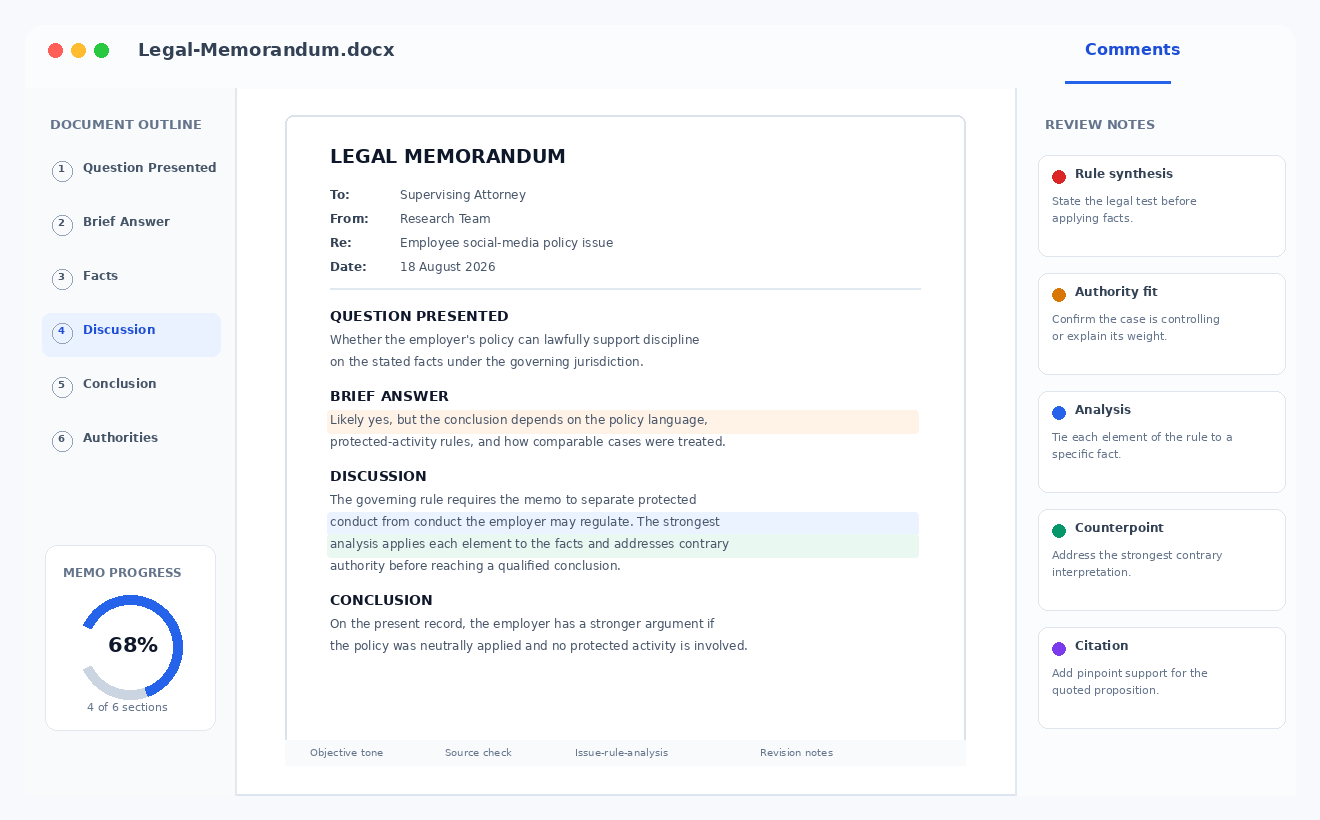 Illustrative legal memorandum review interface
Legal propositions linked to source support and authority fit.
Matter details are used only for the agreed writing or review scope.
Rule, application, counterpoints, and uncertainty kept distinct.
Clear comments identify analysis, source, structure, and citation gaps.
Memo writing is a research-led assignment, so a credible price must reflect issue framing, authority work and analytical drafting rather than a simple per-word rate. The project minimum covers one clearly defined question with a bounded source and drafting scope.
Suitable for: A short-to-medium research memorandum developed from a clear question, supplied facts and an agreed jurisdictional scope.
When the quote changes: Multiple issues, comparative jurisdictions, large authority sets, complex factual records, formal opinion requirements and accelerated deadlines increase the project quote. Priority or express scheduling may be available after scope review.
Service boundary: The deliverable is research and writing support, not a signed legal opinion or substitute for qualified counsel’s professional judgment.
A legal memorandum can look polished and still be weak if the issue is framed too broadly, the rule is detached from authority, the analysis jumps from facts to conclusion, or important contrary material is ignored.
The question presented is too broad, assumes the answer, or mixes several legal issues.
Cases are summarized one by one without extracting a usable governing rule or test.
Legal propositions, quotes, or factual assertions lack clear source support or pinpoint references.
The issue is whether the employer may discipline the employee for online speech under the governing law. The memo should first identify the applicable legal test and authority hierarchy, then distinguish protected conduct from conduct the employer may regulate.
Instead of stating that the employer "clearly wins," the analysis should apply each element to the facts, identify assumptions, explain the weight of the authorities, and address the strongest contrary interpretation or adverse authority.
The conclusion should use calibrated language that reflects the current record and should flag facts or source questions that still require confirmation before the memorandum is relied upon.
The memo relies on background or persuasive material without explaining controlling authority or weight.
The rule is stated correctly, but the discussion does not tie its elements to concrete facts.
Uncertainty, missing facts, competing interpretations, or adverse authority are not acknowledged.
Support can be scoped to one stage or to the full memorandum workflow. The exact deliverables depend on your brief, available sources, jurisdiction, draft status, and requested level of research or review.
Clarify the task, audience, jurisdiction, assumptions, and required legal question.
Turn a broad problem into precise, neutral questions the memo can answer.
Identify source gaps, authority hierarchy, search themes, and verification priorities.
Group authorities by proposition, rule element, exception, and precedential weight.
State the governing test, elements, exceptions, definitions, and material standards clearly.
Connect each legal element to specific facts and explain why the comparison matters.
Test the analysis against alternative readings, adverse authority, and missing facts.
Check citation presentation and memo formatting against supplied style instructions.
Review consistency, objective tone, unsupported leaps, open questions, and final clarity.
A strong memorandum needs both construction and challenge. Writing support develops a disciplined memo; reviewer support tests whether the reasoning, sources, and conclusions can withstand scrutiny.
Build a memo architecture that follows the legal question rather than a case-by-case summary.
Organise authorities into a usable test, elements, exceptions, and supporting propositions.
Apply specific facts to specific rule elements and explain relevant comparisons or distinctions.
Use calibrated conclusions, neutral phrasing, and explicit treatment of uncertainty.
Move from outline to rule synthesis, analysis, and a coherent full memorandum.
Check whether the question is neutral and the rule actually answers the issue presented.
Flag missing controlling authority, weak source fit, stale assumptions, or unexplained persuasive sources.
Find conclusory statements, skipped rule elements, factual gaps, and weak comparisons.
Identify alternative readings, adverse authority, exceptions, and arguments the draft should address.
Check consistency, citations, caveats, organisation, and whether the conclusion matches the analysis.
From the first question to the final review, each stage should narrow uncertainty and make the legal reasoning easier to audit.
Define the task, audience, jurisdiction, and legal question.
Organise factual inputs, authorities, and open verification needs.
Break the problem into precise, answerable legal issues.
Build the governing test from appropriately weighted authority.
Apply each part of the rule to the facts and authorities.
Test adverse authority, alternative readings, and missing facts.
Calibrate the answer and check citation presentation.
Review logic, caveats, consistency, sources, and presentation.
The goal is not simply to make the sentence sound better. Reviewer comments should expose what is legally missing and help the final version state a narrower, better-supported conclusion.
“The employee was fired after posting online, so the company violated the law.”
The memo should identify the legal test, explain which authority controls, apply each element to the relevant conduct, and distinguish any protected activity before reaching a conclusion.
“On the stated facts, the stronger view is that the employer may discipline the conduct if the policy is lawfully applicable and the post is not protected under the governing rule. The result remains sensitive to the policy language, the employee’s purpose, and the jurisdiction’s treatment of comparable conduct.”
Illustrative writing example only. It is not legal advice and does not state the law of any particular jurisdiction.
A defined workflow keeps the scope transparent and gives the memo a clear path from materials review to final delivery.
Share the legal question, facts, jurisdiction, sources, draft, template, and instructions.
Confirm whether you need research, drafting, review, citation work, or a combination.
Match the task to the legal research and writing requirements confirmed in scope.
Develop the agreed sections and record source, logic, citation, and verification notes.
Receive reviewer comments on issue framing, authority, analysis, citations, and open questions.
Complete the agreed final check for coherence, caveats, sources, citation presentation, and readiness.
The same core discipline applies across different memo contexts: define the issue, build the rule from authority, apply the rule to facts, test counterpositions, and state a measured conclusion.
Legal writing quality is checked in layers so that structure, legal reasoning, authority support, reviewer risk, and final presentation are not treated as the same problem.
Legal memoranda can contain unpublished, personal, strategic, or commercially sensitive material. The engagement should be scoped and handled with clear boundaries around access, use, and review.
Use matter materials only for the agreed research, writing, editing, or review purpose.
Keep access limited to the people needed to complete the confirmed scope.
Track supplied authorities, research notes, citation questions, and verification points transparently.
Client drafts, templates, research notes, and internal material remain the client’s work product.
Separate writing support from legal advice and preserve questions that require client or lawyer judgment.
This service does not use an unsupported fixed price or turnaround. Scope is assessed from the actual legal question, research depth, memo status, source materials, citation requirements, and scheduling needs before a quote is confirmed.
A quote should be based on the materials and confirmed scope. Published pricing guidance now starts at ₹12,000 for the baseline scope described above. Final pricing is confirmed after the actual document, complexity, requested depth and delivery requirements are reviewed.
Focused review of an existing memorandum with structured comments on logic, authority, citations, and presentation.
Support from issue framing and research planning through rule synthesis, analysis, and a complete draft where agreed.
Target a difficult section such as rule synthesis, adverse authority, counteranalysis, or a complex factual application.
End-to-end review of structure, analysis, source support, citations, caveats, and final readiness.
Use the enquiry form to share the legal question, draft status, jurisdiction, source materials, approximate length, and deadline for a scope-based quote.
Delivery timing is confirmed only after the scope is reviewed. Scheduling can be organised around a normal review path, an accelerated priority request where capacity allows, or staged milestones for larger or research-heavy memoranda.
Best when the memo can follow the normal research, drafting, review, and revision sequence after scope confirmation.
Accelerated handling may be possible for urgent matters when scope, source availability, research depth, and capacity permit.
For larger or multi-issue memoranda, work can be sequenced by research, rule synthesis, analysis, draft, and review checkpoints.
Turnaround depends on memo length, legal complexity, research depth, jurisdiction, number of issues, source quality, revision requirements, deadline, and reviewer availability. A delivery commitment should be confirmed before work begins.
Answers to common questions about legal memo scope, research, review, citations, confidentiality, pricing, scheduling, and the boundary between writing support and legal advice.
Scope can include review of the brief or research question, issue framing, memo structure, legal research planning, authority synthesis, rule development, fact-to-rule analysis, counterargument review, citation and formatting checks, and reviewer-style revision notes. The exact work is confirmed from the materials and requirements you provide.
Yes. When drafting support is part of the confirmed scope, the service can help turn a project brief, fact pattern, research question, source pack, or existing outline into a structured memorandum. The memo remains grounded in the materials, jurisdiction, and authorities supplied or agreed for research.
Yes. Review-only support can focus on issue framing, objective tone, rule synthesis, use of authority, depth of analysis, counterarguments, organisation, citations, and final readability without rebuilding material that is already working well.
Research support can be included when agreed in the scope. The research approach depends on the jurisdiction, legal question, source access, supplied authorities, and the level of verification required. Any limitations should be identified before drafting begins.
The jurisdiction and authority hierarchy should be provided at the start. The service can then organise the memo around the applicable legal framework and distinguish controlling, persuasive, contrary, or background authorities as appropriate to the confirmed research scope.
Yes, where the required style guide, institutional instructions, court rules, firm template, or sample format is supplied. Citation presentation and formatting can be checked against those instructions as part of the confirmed scope.
The memo is structured to separate the governing rule from application, identify assumptions, address material contrary authority or counterarguments, distinguish uncertainty from stronger conclusions, and use calibrated language that reflects the available facts and sources.
Verification depends on the agreed research scope and source access. The review can flag unsupported propositions, missing pinpoints, questionable authority fit, inconsistent citations, and places where the client should confirm current law or source status before relying on the memo.
Pricing is scope-based. It depends on factors such as memo length, number of legal issues, research depth, jurisdiction complexity, condition of the source materials, drafting versus review requirements, citation and formatting work, revision depth, and scheduling priority. A quote is provided after the brief is reviewed.
Turnaround is confirmed only after the memo length, research depth, number of issues, source materials, revision scope, and deadline are reviewed. Standard, priority, or milestone-based scheduling may be available depending on scope and capacity.
Client materials should be treated as confidential work product and handled only for the agreed service purpose. Access should be limited to the people required for delivery, and sensitive facts should be shared only when necessary for the requested analysis.
No. This is research, writing, editing, and review support. It does not create a lawyer-client relationship or replace advice from a qualified lawyer who can assess the full facts, current law, professional duties, and jurisdiction-specific requirements.
Share enough information to assess the legal writing scope without disclosing more sensitive detail than necessary at the initial enquiry stage.
The clearer the brief, the easier it is to determine whether you need research, drafting, review, citation work, or a combination.
State the question presented and whether the memo is for internal, academic, research, compliance, or another professional use.
Identify the jurisdiction and any cases, statutes, regulations, secondary sources, or research notes already available.
Share approximate memo length, number of issues, deadline, time zone, and whether milestone delivery would be useful.
Tell us whether you have a brief, outline, partial memo, complete draft, or only a fact pattern and research question.
Include any template, style guide, institutional instructions, court requirements, or sample memo format.
Share your contact details and a concise description of the memorandum requirement. Avoid including unnecessary privileged, confidential, personal, or highly sensitive information in the initial form.
Contentxprtz provides research, writing, editing, and review support. This page does not provide legal advice, create a lawyer-client relationship, or guarantee a legal, academic, professional, or court outcome. Clients remain responsible for source verification, current-law checks, professional duties, institutional rules, and final use of the memorandum.