₹6,000
for one document up to 3,000 words
Best fit: A pleading, brief, affidavit, written submission or witness statement with settled legal positions but uneven language or presentation.

Improve language, organisation, consistency, citations, cross-references, and professional presentation across litigation documents while keeping legal judgment, substantive positions, and filing decisions under counsel control.
Language, structure, numbering, and presentation
Visible revisions and focused queries
Presentation checks against supplied style
Limited-access editorial workflow
Editing support, not legal advice
Litigation editing is priced against a defined document because chronology, citations and cross-references can make two files of the same length very different. The starting scope covers one drafted litigation document needing language and consistency work before counsel’s final substantive review.
Best fit: A pleading, brief, affidavit, written submission or witness statement with settled legal positions but uneven language or presentation.
When the quote changes: Multiple related documents, large exhibit sets, intensive citation checking, substantial restructuring and urgent filing windows are scoped separately. Priority or express scheduling may be available after scope review.
Service boundary: Editing does not change case strategy or replace counsel’s responsibility for authorities, legal positions and filing decisions.
Litigation drafts often become difficult to review when language, chronology, defined terms, citations, numbering, and multiple document versions evolve at the same time. Editorial review makes those presentation issues visible without replacing counsel's legal judgment.
Long sentences and layered qualifications can obscure the intended point.
Party names, agreement names, and labels may change across sections or files.
Paragraph, exhibit, schedule, and section references may drift during revision.
The applicant submits that the relevant correspondence was not clearly connected with the notice should be read together with the notice and the chronology in Schedule 2. The draft also refers to the same agreement as “Agreement”, “contract” and “Principal Agreement”, creating avoidable inconsistency across the document.
Short forms, pinpoint references, punctuation, and citation sequence may be inconsistent.
Dates and event sequence may read unclearly even where the underlying facts are settled.
Placeholders, duplicated text, outdated labels, and unresolved comments can survive late revisions.
The service is designed for document-focused editorial support across common litigation materials. Scope is agreed from the files and instructions you provide; legal merits, advice, strategy, factual verification, and authority selection remain outside editorial review.
Editorial review for structure, headings, numbering, defined terms, grammar, consistency, and professional presentation in litigation-facing documents.
Sentence and paragraph refinement for clarity, flow, concision, and consistent terminology without altering counsel-controlled legal positions.
Review of organisation, transitions, signposting, repetition, and internal cross-references so complex arguments are easier to follow.
Language and presentation editing focused on readability, chronology, terminology, formatting, and consistent references to people, events, and exhibits.
Consistency review across requests, responses, schedules, definitions, numbering, dates, and repeated terminology in document-heavy workflows.
Professional editing for letters, position statements, internal memoranda, and litigation-related correspondence where precision and tone matter.
Checks for labels, numbering, exhibit references, schedule references, internal links, placeholders, and presentation consistency.
Presentation-level review of citations, short forms, pinpoint references, tables of authorities, and supplied style-guide conventions.
Different documents need different levels of editorial intervention. A focused line edit improves the text itself; a broader editorial review also checks consistency, structure, document mechanics, and unresolved presentation risks across the file.
Corrects grammar, punctuation, awkward phrasing, and unnecessary wordiness.
Improves readability, tone, concision, and internal consistency without legal redrafting.
Flags inconsistent terminology, repeated phrases, and avoidable duplication.
Keeps language edits transparent for counsel or internal reviewer approval.
Raises questions where a wording choice could change meaning or needs context.
Checks headings, signposting, paragraph order, section flow, and document readability.
Reviews shared terms, party names, dates, exhibits, schedules, and repeated references.
Checks formatting consistency against supplied citation or client requirements.
Flags placeholders, duplicate text, outdated numbering, unresolved comments, and formatting residue.
Prepares the file for counsel's final substantive and filing review.
From intake through the final clean copy, the editorial workflow is designed to keep document changes visible, reviewable, and aligned with the instructions supplied by your legal team.
Scope, documents, priorities
Versions, names, references
Clarity, concision, tone
Flow, headings, signposting
Presentation consistency
Ambiguity and counsel checks
Numbering, placeholders, formatting
Editorially polished version
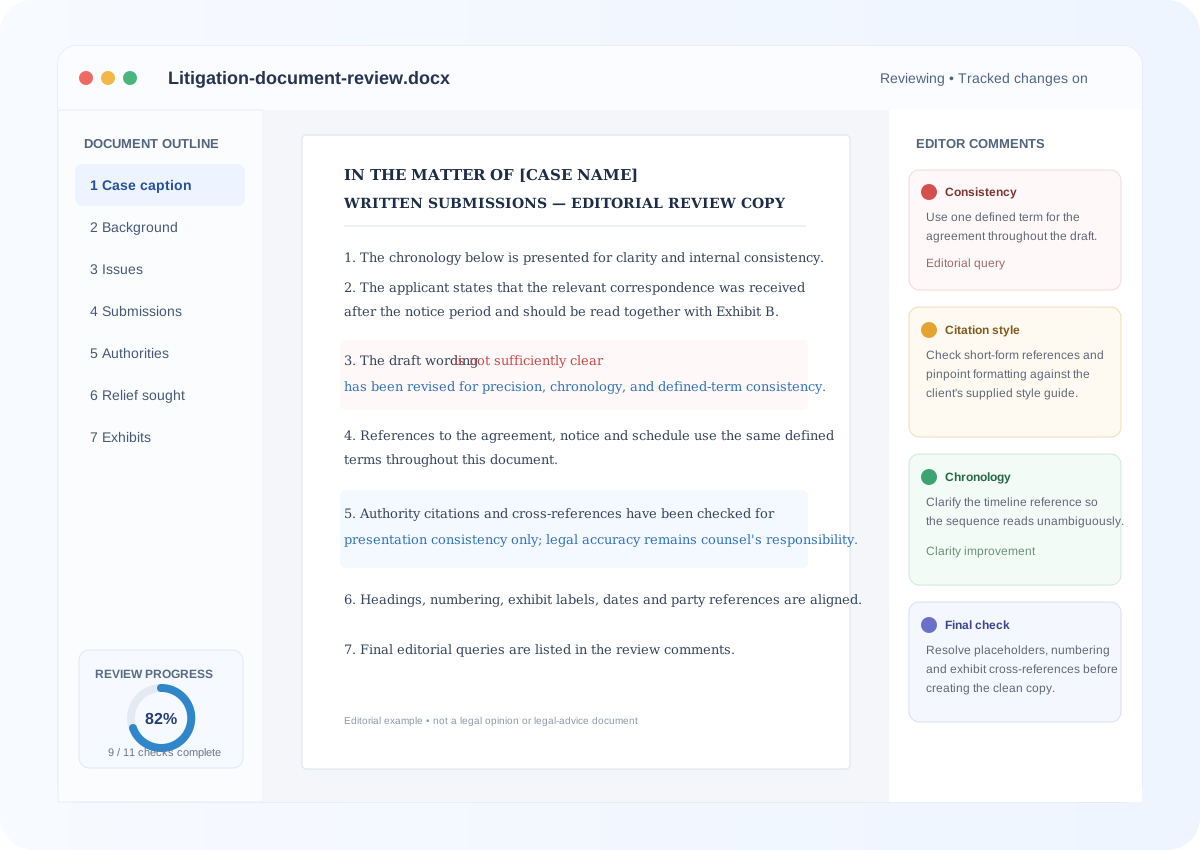
The example below shows the editorial depth: wording is clarified, defined terms are standardised, and review comments identify points that should be confirmed by counsel rather than silently changed.
The respondent did not comply with the notice and the agreement was terminated soon after. The correspondence and notices are attached and should be read together.
The respondent did not comply with the notice did not respond within the period stated in the Notice dated [date], and the Agreement was terminated thereafter.
The respondent did not respond within the period stated in the Notice dated [confirmed date], and the Agreement was terminated thereafter. The relevant correspondence is reproduced at Exhibit [confirmed reference].
A clear scope and version-control process helps keep late-stage litigation document editing efficient, especially where several files, reviewers, and internal deadlines are involved.
Share the document, instructions, deadline, and any supplied style or filing requirements.
We assess editorial depth, document length, complexity, citation needs, and delivery feasibility.
The work is matched to an editor suited to professional, legal-style document editing.
Language, flow, consistency, formatting, defined terms, and cross-references are reviewed in context.
Tracked revisions and concise editor queries flag ambiguity, missing context, or items requiring counsel review.
Resolved text is checked for presentation consistency before tracked and clean copies are prepared.
The editing scope can be applied to individual documents or coordinated document sets. Suitability depends on the material, your instructions, and the distinction between editorial work and counsel-controlled legal review.
Quality control is built around editorial consistency and reviewability. It does not certify legal correctness; it helps surface document issues that can otherwise be missed during repeated drafting and version changes.
Litigation material can be sensitive. The editorial workflow should therefore stay tightly scoped, minimise unnecessary access, and respect your organisation's own rules for sharing confidential or privileged material with external service providers.
Documents and instructions are treated as confidential service material within the agreed workflow.
Access should be limited to the people required to complete and coordinate the editorial work.
Use only submission channels and sharing methods approved for your document sensitivity.
Your original work, strategy, and legal positions remain yours; editorial changes are provided for review.
Editorial support improves document presentation; counsel retains legal judgment and filing responsibility.
Published pricing guidance now starts at ₹6,000 for the baseline scope described above. Final pricing is confirmed after the actual document, complexity, requested depth and delivery requirements are reviewed.
Planned after scope, document length, complexity, and required checks are assessed.
Urgent requests may be considered subject to document scope and editor availability.
Large or multi-file matters can be sequenced around agreed review checkpoints.
These questions explain the editorial scope, boundaries, confidentiality considerations, citation review, pricing logic, and scheduling for litigation document editing.
The service focuses on editorial improvement: grammar, syntax, clarity, concision, paragraph flow, defined-term consistency, headings, numbering, citations and cross-references, document presentation, tracked changes, and editor queries where wording or context needs confirmation.
No. The service is editorial, not legal. It does not provide legal advice, determine legal merits, replace counsel, or independently change substantive legal positions. Counsel remains responsible for legal accuracy, strategy, authorities, factual assertions, and filing decisions.
Yes, these are suitable document categories for editorial review where the objective is clearer language, stronger organisation, consistent terminology, accurate presentation, and cleaner formatting rather than legal advice.
The page workflow is designed around transparent editorial revision. Tracked changes show the edits, while a clean copy can be prepared after the editing pass so the document is easier to review and progress internally.
We can review citation presentation for consistency, short forms, pinpoint style, cross-references, and alignment with a supplied citation or court style guide. Legal validity, authority selection, and substantive citation accuracy remain the responsibility of counsel.
Yes. The workflow can be used for a single document or a coordinated set of litigation documents, provided the editing scope, reviewer responsibilities, document naming, and version-control expectations are clearly defined at intake.
Edits are framed to improve language and presentation while preserving the supplied legal meaning. When a proposed wording change could affect interpretation, scope, chronology, or a defined term, the safer editorial approach is to flag it for counsel review rather than silently rewrite it.
Yes, when a style guide or filing-format instruction is supplied, the editorial review can check relevant presentation elements such as headings, numbering, spacing, defined terms, citation format, and document consistency against those instructions.
Yes. Related documents can be reviewed for consistent party names, defined terms, dates, exhibit labels, section numbering, citations, and repeated phrases where the shared scope is made clear.
Published pricing guidance now starts at ₹6,000 for the baseline scope described above. Final pricing is confirmed after the actual document, complexity, requested depth and delivery requirements are reviewed.
Turnaround is confirmed after scope review. Scheduling depends on document length, complexity, the number of files, required editing depth, citation or formatting checks, deadline, and editor availability.
Priority or milestone-based scheduling may be considered subject to scope and availability. Share the exact deadline, time zone, filing or internal-review milestones, and which documents are highest priority so feasibility can be assessed.
Documents and instructions should be handled as confidential service material, with access limited to the people required for the agreed editorial workflow. Do not submit information through channels your organisation has not approved for external sharing.
Share the document type, approximate word or page count, number of related files, deadline and time zone, required editing depth, citation or formatting style, any supplied court or firm instructions, and the main issues you want the editor to focus on.
Tell us what documents you need edited, how many files are involved, the approximate length, deadline, citation or formatting requirements, and the main editorial concerns. The scope can then be assessed without assuming unsupported pricing or turnaround.
State whether the work involves pleadings, motions, briefs, affidavits, witness statements, correspondence, or a related document set.
Provide the exact requested delivery time and any internal review or filing milestones.
Explain whether you need line editing, full editorial review, or consistency checks across multiple related files.
Include any supplied court, firm, client, citation, or document-style instructions that should guide presentation checks.
Highlight clarity, chronology, defined terms, citations, numbering, exhibits, cross-references, or version-control issues.
Share enough information for us to assess editorial scope and scheduling. Sensitive documents should only be shared through channels approved by your organisation.