₹6,000
for up to 2,000 words of document-development support
Best fit: A short notice, policy, correspondence, internal memorandum or similar document developed from supplied facts, instructions and source material.

Get structured writing and reviewer-style support for agreements, policies, notices, legal correspondence, research memoranda, compliance documents, and other legal content. We help organise the document, strengthen clarity, improve internal consistency, and prepare a professional draft for your review or legal counsel.
Writing support does not replace jurisdiction-specific legal advice. Documents intended to create legal rights or obligations should be reviewed by a suitably qualified lawyer before use.
Writing support is priced by the defined document objective and the amount of source material that must be converted into a coherent draft. The baseline covers a practical first-draft assignment from a clear brief, not open-ended legal drafting or advice.
Best fit: A short notice, policy, correspondence, internal memorandum or similar document developed from supplied facts, instructions and source material.
When the quote changes: Complex agreements, litigation material, extensive research, multiple source files, long documents or urgent deadlines are scoped separately. Priority or express scheduling may be available after scope review.
Service boundary: Writing support does not provide jurisdiction-specific legal advice; documents intended to create legal rights or obligations should be reviewed by qualified counsel.
Legal writing often becomes difficult when facts, clauses, defined terms, cross-references, and business requirements are spread across multiple sources or are expressed inconsistently.
The document does not clearly state what it is intended to cover, exclude, or achieve.
Duties, timelines, approvals, or responsibilities are written in language that can be interpreted more than one way.
The same concept is described with different wording, capitalisation, or labels across the document.
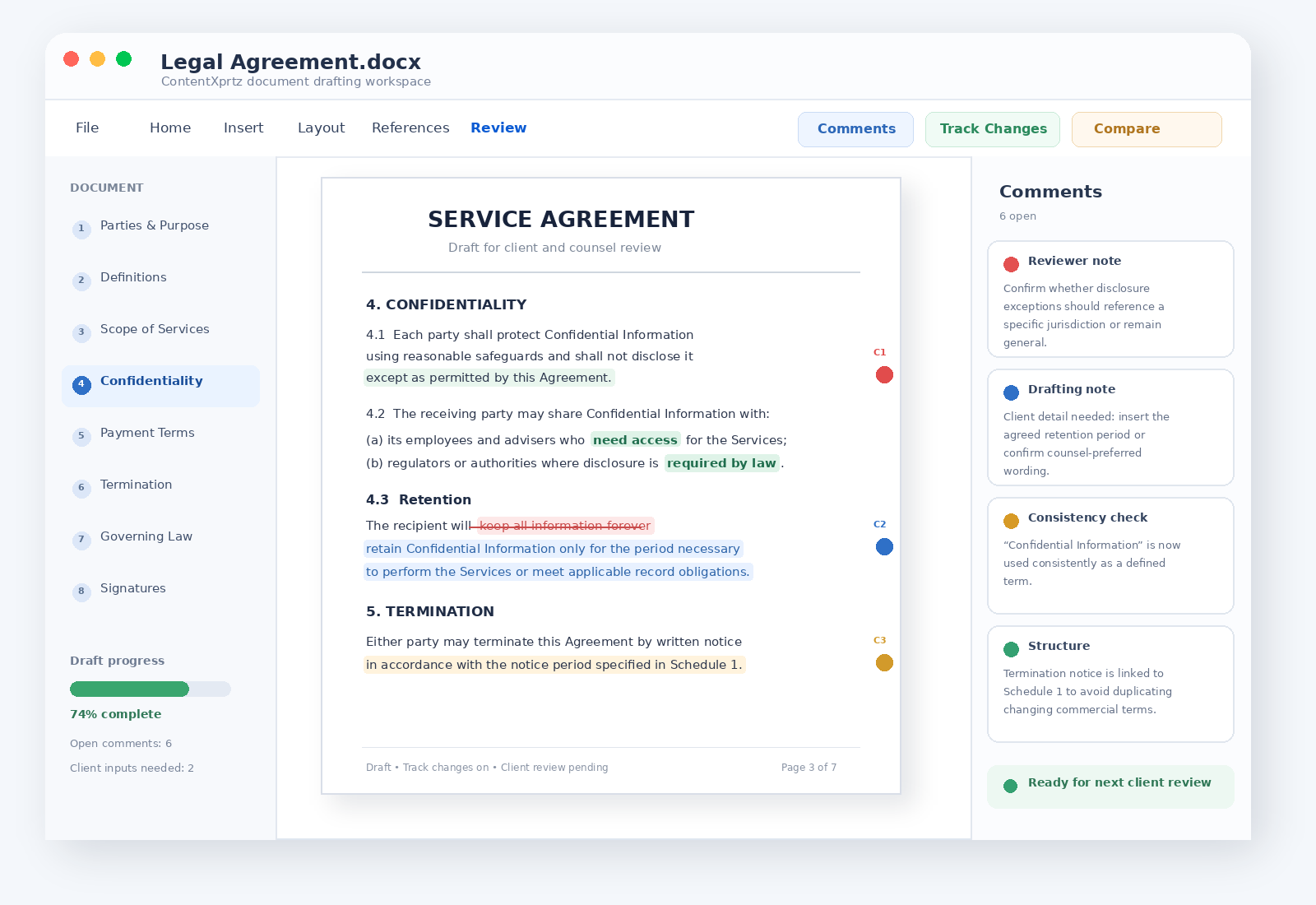
Each party must protect Confidential Information and limit disclosure to people who need access for the Services.
The recipient will keep all information forever retain information only for the required service or record period.
Termination notice applies in accordance with Schedule 1, avoiding duplicated commercial terms.
Reviewer comments flag where the client or legal counsel must confirm jurisdiction-specific or factual details.
Party names, dates, commercial details, notice periods, or approval requirements are incomplete.
Related provisions are separated, repeated, or arranged in a sequence that is hard to follow.
Numbering, schedules, headings, references, and internal links do not line up cleanly.
Support is tailored to the document you provide or the brief you want developed, with emphasis on writing quality, structure, consistency, reviewer visibility, and professional presentation.
Organise the purpose, audience, facts, requested clauses, template rules, and reviewer instructions before drafting begins.
Build a logical hierarchy of sections, clauses, schedules, headings, and supporting content that fits the document’s purpose.
Develop or refine wording from the project brief, source material, template, business requirements, and client-provided facts.
Check whether recurring names, roles, concepts, labels, and defined terms are used consistently throughout the document.
Review internal clause references, schedules, annexures, section numbers, and related provisions for presentation consistency.
Reduce awkward phrasing, repetition, unnecessary complexity, and unclear transitions without making legal-effect assumptions.
Standardise headings, subheadings, clause numbering, lists, tables, schedules, spacing, and visual hierarchy.
Flag missing information, unclear assumptions, unresolved client choices, or wording that should be confirmed with legal counsel.
Prepare a clean document for client review, internal approval, or lawyer verification after the agreed writing scope is complete.
Separate writing and document-development tasks from decisions that require jurisdiction-specific legal advice or formal legal approval.
Some clients need help building a document from a brief; others already have a draft and need a structured review. The support path can be scoped around either starting point.
From initial requirements to a clean review-ready draft, each stage keeps the writing process visible and makes client decisions easier to track.
Purpose, parties, facts, required outcomes.
Templates, notes, policies, prior drafts, comments.
Sections, clauses, schedules, information order.
Build or refine the wording and document flow.
Flag missing details, options, reviewer queries.
Apply client, internal, or lawyer-provided feedback.
Terms, numbering, references, presentation.
Clean draft prepared for approval or counsel verification.
This simplified example shows the writing journey from an unclear clause to reviewer feedback and a clearer client-review version. It is an illustration of writing support, not legal advice for a specific jurisdiction.
A structured workflow keeps the brief, source material, revisions, and reviewer decisions organised from the first submission through the final handoff.
Share the purpose, draft, source documents, template, reviewer notes, and required date.
We assess the requested writing depth, missing inputs, document complexity, and review boundaries.
The work is matched to the document type, writing scope, and required level of document support.
The document is drafted or revised with comments, consistency checks, and clear author-action points.
Client, internal-review, or lawyer comments can be incorporated within the agreed revision scope.
A final writing and presentation check is completed before the draft is returned for client or counsel approval.
The service can be scoped for a wide range of legal and compliance-oriented documents when you can provide the facts, purpose, source materials, and any required template or reviewer instructions.
Writing support for commercial, service, confidentiality, and other agreement formats based on supplied requirements.
Structured wording and presentation support for policies, terms, notices, and internal or external requirements.
Professional structure, clarity, tone, chronology, and formatting for formal written communication.
Organisation and writing support for issue summaries, research notes, case comparisons, and memorandum-style documents.
Clearer structure and consistency for governance, control, compliance, procedure, and regulatory-support documentation.
Writing and presentation support using client-supplied facts and instructions, with factual and legal verification retained by the client or counsel.
Support for employee-facing or internal documents based on the organisation’s supplied policy, template, and legal-review requirements.
Document-development support for business or property-related content when the required facts and review instructions are supplied.
The writing workflow separates document structure, language clarity, consistency, reviewer flags, and final presentation so that each layer can be checked deliberately.
Legal documents can contain sensitive commercial, personal, or strategic information. The engagement should use only the files and data needed to complete the agreed writing or review task.
Share only the document and supporting material needed for the requested engagement.
Document access should be limited to people required for the assigned writing and review workflow.
Keep versions, reviewer notes, client inputs, and final drafts organised throughout the engagement.
Your original facts, business content, source materials, and supplied documents remain attributable to you or their respective owners.
Writing feedback is separated from legal advice, legal representation, and jurisdiction-specific legal approval.
This service does not use a fixed catalogue price or fixed turnaround claim in the service scope. Scope, quote, and scheduling are therefore confirmed after reviewing the actual document and requirements.
Planned delivery for a well-defined brief with regular review and feedback timing.
Faster scheduling may be considered for urgent requirements, subject to scope and expert availability.
Useful when a larger document should move through agreed stages, reviewer inputs, or internal approval points.
Answers to common questions about legal-document drafting support, review boundaries, confidentiality, pricing, scheduling, revisions, and client inputs.
Share the document type, purpose, current draft status, reviewer instructions, and the support you need. The request can then be assessed for scope, missing inputs, scheduling feasibility, and the most appropriate writing approach.
Tell us what the document is, who will use it, and what you need the writing to achieve.
Provide the current draft, company template, source material, prior versions, or reviewer notes where available.
Specify whether you need first-draft support, detailed revision, reviewer comments, formatting, or a focused clause review.
Tell us whether the document will be reviewed by your lawyer, legal team, compliance team, manager, or another decision-maker.
Provide enough detail for the service to be scoped accurately. Sensitive personal data that is not required for the writing task should be removed before submission where practical.