Data-Led Storytelling
Narrative shaped around the supplied performance evidence

Turn financial, operational, KPI, segment and non-financial source data into a coherent annual-report story. We help structure the narrative, explain supported movements, connect commentary to source tables, and refine the final copy for internal review and publication workflows.
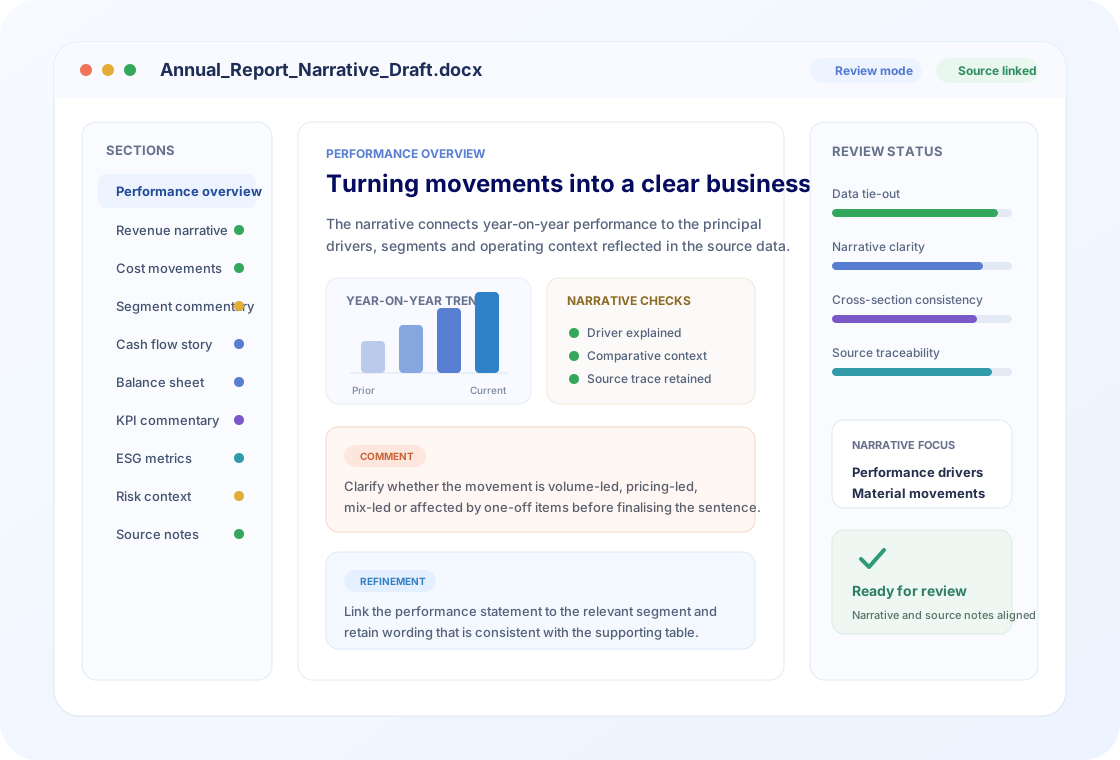
Narrative shaped around the supplied performance evidence
Designed for sensitive draft reports and source material
Keep review comments linked to the evidence supplied
Working draft, clean copy and review-ready support files
Pricing is tied to the amount of performance narrative to be developed, not to a generic annual-report package, so the starting scope remains easy to budget and easy to expand.
Suitable for: Annual reports with approved data and source notes that need a clearer explanation of KPIs, movements, segments, and performance drivers.
Additional business units, extensive source reconciliation, new research, or a materially larger KPI set is quoted after the reporting pack is reviewed.
Common issues arise when the data, the business explanation and the written narrative are developed separately. The service is designed to help bring those elements together without inventing unsupported drivers or conclusions.
Data is presented, but the reader cannot see the main business message or the material movement behind it.
Year-on-year or plan-versus-actual movements are stated without enough context about the supported drivers.
Charts, tables and narrative use different labels, definitions or emphasis, making review and reconciliation harder.
Different contributors write sections independently, creating uneven terminology, narrative depth and reporting style.
Reviewers cannot easily see which table, pack or management input supports a particular narrative statement.
Material changes surface near finalisation because narrative, numbers and disclosures were not reviewed together early enough.
The scope can be tailored to the sections and source packs you provide. The structure below shows a typical end-to-end narrative journey rather than a fixed package or guaranteed list for every engagement.
Audience, purpose and sections in scope
Statements, packs, tables and notes
Definitions, labels and comparatives
Identify narrative-relevant changes
Use supported business explanations
Connect group and segment context
Balance-sheet movement narrative
Operating, investing and financing context
Operational, people or ESG data supplied
Structure review-ready explanation
Match wording to visible evidence
Tone, terminology and repeated metrics
Connect narrative to supplied disclosures
Retain trace for reviewer follow-up
Annotated and clean versions as agreed
This representative example shows the kind of narrative refinement the service can provide. It is illustrative and does not contain client data.
“Revenue increased year on year. Costs were also higher. The core segment performed better, but another segment was weaker.”
Revenue increased year on year, supported by stronger performance in the core segment. The draft then separates the supported drivers of the revenue movement from the reasons for higher operating costs.
Revenue increased year on year, with the core segment providing the principal positive contribution. Operating costs also increased, and the final narrative explains the supported drivers separately so the reader can distinguish performance growth from changes in the cost base.
Annual-report data narrative work goes beyond surface presentation. It combines source interpretation, structured commentary development and cross-section consistency where those elements are included in the agreed scope.
| Support dimension | Formatting review Structure & presentation | Language editing Grammar & style | Full annual report data narrative support Source-to-narrative development |
|---|---|---|---|
| Performance-story framing | × | × | ✓ |
| Material movement interpretation from supplied data | × | × | ✓ |
| Driver hierarchy and comparative context | × | Limited | ✓ |
| Segment and KPI narrative alignment | × | Limited | ✓ |
| Grammar, clarity and corporate tone | Limited | ✓ | ✓ |
| Table, chart and heading consistency | ✓ | Limited | ✓ |
| Source-to-narrative review notes | × | × | ✓ |
| Cross-section terminology consistency | Limited | ✓ | ✓ |
| Clean narrative handoff | × | ✓ | ✓ |
| Best for | Presentation consistency | Language polish | Complete data-to-narrative reporting support |
The service can be scoped to a full annual report or to specific narrative sections and supporting corporate-reporting outputs.
A staged workflow helps keep the reporting brief, source material, narrative development and review comments organised from initial scope through final handoff.
Share the sections, source packs and requirements.
Confirm reporting objectives, complexity and feasibility.
Match the work to the reporting and writing requirement.
Build the section logic and driver hierarchy.
Develop copy with source-aware review notes.
Cross-check narrative against supplied evidence.
Align terminology, tables, charts and source notes.
Provide agreed working and clean versions.
The strongest narrative is built from complete, approved source material. Share only the files relevant to the agreed scope and identify any content that is preliminary or awaiting management approval.
Review is designed to check the narrative as writing and as a representation of the supplied reporting evidence. Final accounting, audit, legal and management approvals remain with the client and its appointed advisers.
Check hierarchy, flow, section purpose and performance-story logic.
Improve readability, concision, transitions and corporate reporting tone.
Cross-check narrative statements against the source material supplied.
Review KPI names, comparatives, terminology, tables, charts and labels.
Retain reviewer notes where claims require confirmation or source follow-up.
Prepare the agreed final files and confirm open comments are clearly visible.
Annual-report narrative requirements vary by sector, reporting model and the information supplied. The service can be scoped across different corporate reporting contexts without changing the client's responsibility for final disclosures and approvals.
The published starting price above covers the defined entry scope for Annual Report Data Narrative. Larger, deeper, or faster-turnaround requirements are quoted after the actual materials and deliverables are reviewed. Scope, timing and price are confirmed after reviewing the report size, source material, complexity and review requirements.
Final turnaround is confirmed only after the files and requested scope have been reviewed.
The quote can vary based on the amount and complexity of work required.
The service can support narrative development from supplied financial, operational, KPI, segment and non-financial reporting data, including performance commentary, variance explanation, cross-section consistency, source notes and final narrative refinement.
Yes. Source material may include spreadsheets, management reporting packs, financial statements, KPI tables, charts, business-unit notes and prior-year annual-report content, provided the relevant files and instructions are supplied.
The service can cross-check narrative against the source material you provide, but it does not replace audit, accounting sign-off, statutory assurance or management responsibility for the accuracy of the underlying data.
Yes, where the supporting data and driver information are available. Narrative can be structured around material movements, comparative context, segment contribution and management-provided explanations without inventing unsupported causes.
Yes. The same source-to-narrative approach can support management commentary, performance review and MD&A-style sections when the required source data, reporting framework and management inputs are provided.
Yes. Prior reports, style guidance, approved terminology and internal reporting conventions can be used to maintain a consistent house style while improving clarity and structure.
Yes, when the supporting metrics, definitions and approved source notes are supplied. The service can help structure narrative around non-financial indicators while keeping wording aligned to the evidence provided.
Unpublished annual-report material should be handled through the designated project workflow. Share only files needed for the scoped reporting work and raise any NDA, access, retention, deletion, or other file-handling requirements before sensitive documents are submitted.
A custom quote is based on factors such as report length, data volume, number of sections or entities, source-file complexity, number of review cycles, formatting requirements and required delivery timing. Timing is confirmed after scope review.
Depending on the agreed scope, delivery can include an annotated narrative draft, a clean final version, source-to-narrative notes, consistency observations, review comments and a submission or handoff checklist.
Share the reporting sections, source material, approximate length, review stage and target timing. The information helps determine the appropriate narrative scope and whether the requested schedule is feasible.
You do not need to send every file in the first message. Start with enough detail to explain the reporting requirement and the current stage of the annual report.
Identify the annual report, MD&A, performance review or other narrative sections in scope.
Describe the financial statements, KPI packs, charts, segment data and management commentary available.
Share the target delivery date, internal review milestones and time zone.
Highlight performance drivers, KPI consistency, segment narrative, ESG metrics, structure or tone concerns.
Provide your contact details and a concise summary of the annual-report narrative requirement. Sensitive files can be shared through the designated process after the initial scope discussion.
Share your reporting scope, source material and timetable. We can review the requirement and help turn complex performance data into a clearer, more structured annual-report narrative.