Course & Module Copy
Lesson screens, objectives, explanations, summaries, prompts, transitions, and learner instructions.

Improve the language learners see, hear, and act on. We edit digital course screens, scripts, assessments, feedback, narration, microlearning, LMS copy, and supporting learning assets for clarity, consistency, instructional flow, and confident learner action.
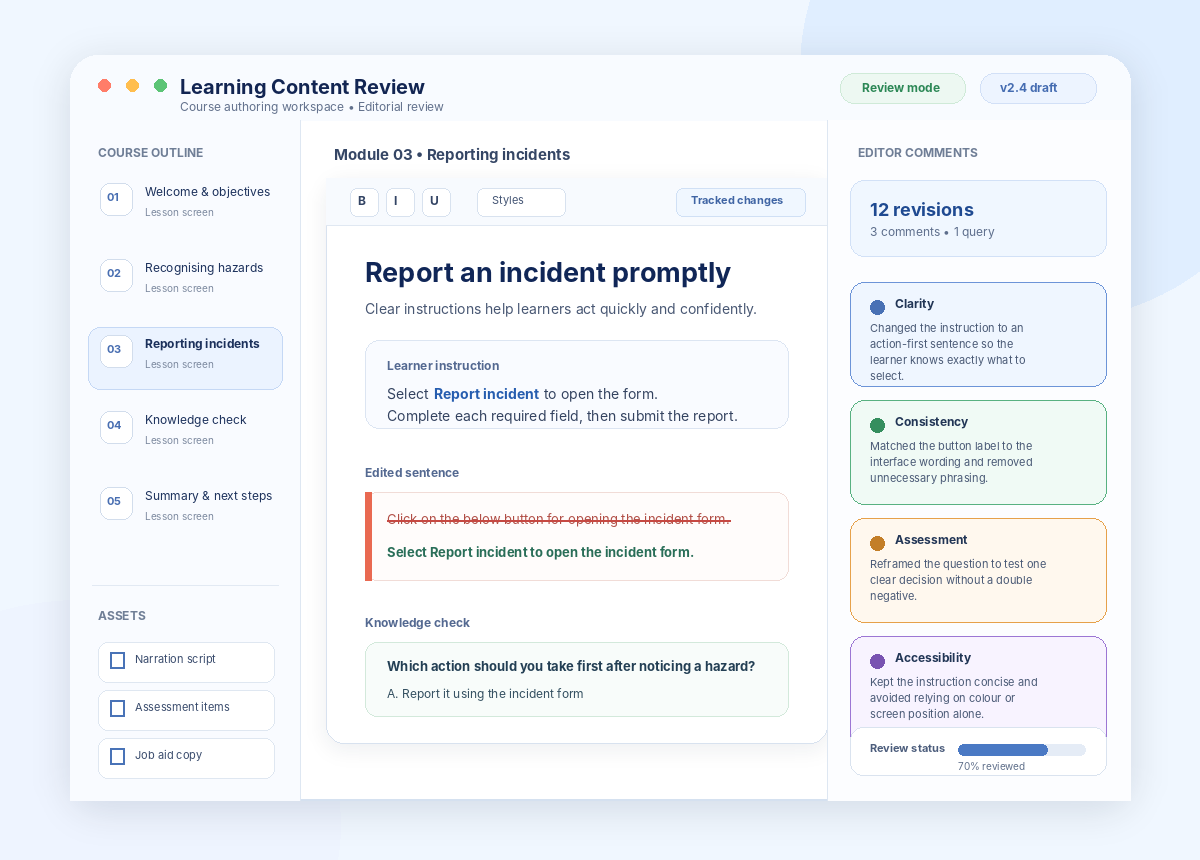
Digital-learning editing is priced by content volume while accounting for short screen copy, instructions, feedback, narration, and recurring interface language across a module.
Suitable for: A drafted module, microlearning set, script pack, or LMS content file that needs clearer learner language and cross-screen consistency.
Technical course QA, functional testing, formal accessibility conformance testing, full instructional redesign, and new content authoring are outside this starting editorial scope.
Editorial support for the learner-facing words that shape digital learning experiences, from lesson screens to assessment feedback.
Lesson screens, objectives, explanations, summaries, prompts, transitions, and learner instructions.
Quiz questions, answer options, instructions, explanations, remediation, and response feedback.
Voice-over scripts, presenter copy, video narration, captions, transcripts, and spoken-language flow.
Short modules, cards, nudges, scenario prompts, knowledge bites, and compact performance-support copy.
Course labels, buttons, navigation text, completion messages, notifications, and learner-facing microcopy.
Facilitator guides, learner handouts, job aids, worksheets, reference sheets, and supporting course materials.
A structured editorial flow keeps the learner experience, source meaning, and review process clear from intake to delivery.
We review the formats, volume, intended learners, style references, assessment content, and priority concerns.
The editorial scope is aligned to the content type, required depth, review workflow, and delivery expectations.
Course copy is refined for language, clarity, consistency, instructions, terminology, tone, and learner readability.
Key revisions are checked against the agreed style, recurring terminology, assessment wording, and cross-module consistency.
You receive reviewable edited content in the agreed working format, with comments or change notes where applicable.
E-learning copy has to do more than read well. It must guide action, stay consistent across screens, support the learning flow, and make assessment wording easy to understand without changing the intended subject meaning.
Actions, explanations, transitions, and prompts are easier to follow.
Terminology, casing, punctuation, labels, and style are aligned.
Questions and feedback are checked for readability and avoidable ambiguity.
Wording is concise, direct, scannable, and appropriate to the intended audience.
Flexible editorial support for common digital learning formats and delivery models.
Screen copy, interactions, prompts, summaries, and completion messages.
Facilitator slides, participant instructions, chat prompts, and session materials.
Copy that connects self-paced content, live sessions, assignments, and resources.
Narration scripts, on-screen text, captions, transcript copy, and callouts.
Concise screen text, push copy, labels, short activities, and microlearning prompts.
Job aids, quick-reference guides, checklists, process cards, and just-in-time learning copy.
The editorial method adapts to the material and audience rather than assuming every course uses the same language style.
The goal is a clearer, more consistent learner experience—not a change to the intended subject-matter meaning.
Editing workflows can be scoped for individual course owners or teams managing larger learning-content pipelines.
Examples show the kind of learner-facing improvement this service can make. They are illustrative editorial examples, not customer content.
Before: “To complete this activity, the participants should click the button below and it will open a new window in which there is a quiz which has 5 questions.”
After: “Select Start quiz to open the five-question knowledge check in a new window.”
Why it changed: shorter, action-first wording; consistent label; fewer unnecessary clauses.
Before: “Which of the following options are not an example of phishing attacks?”
After: “Which option is not an example of a phishing attack?”
Why it changed: removes grammatical friction and makes the task easier to interpret.
Before: “Correct! Because the manager listened to the employee properly, hence the conversation went well.”
After: “Correct. The manager improved the conversation by listening actively and confirming the employee’s concern.”
Why it changed: clearer cause-and-effect wording and a more specific learning point.
Editorial review can combine language accuracy with course-wide consistency checks relevant to digital learning content.
Grammar, punctuation, syntax, sentence clarity, concise expression, and learner-appropriate wording.
Repeated terms, capitalization, labels, abbreviations, voice, and supplied brand or editorial rules.
Instructions, question wording, option parallelism, obvious ambiguity, feedback language, and consistency.
Recurring labels, lesson patterns, naming, transitions, repeated copy, and internal consistency across supplied modules.
Plain-language improvements and instructions that avoid unnecessary dependence on colour, position, or vague directional wording.
Instead of inventing “expert profiles,” this page shows the practical editorial lenses that may be applied to your learning materials.
Actions, prompts, explanations, and transitions are made easier to understand and act on.
Terminology, casing, punctuation, labels, and repeated course conventions are aligned.
Questions, options, instructions, and feedback are reviewed for editorial clarity and consistency.
Unnecessary complexity and wordiness are reduced while preserving essential subject meaning.
Buttons, labels, completion messages, navigation cues, and short prompts are checked in context.
A closing pass checks agreed language, consistency, requested style points, and visible revision quality.
Deliverables are shaped around the file formats and review workflow agreed for the project. The service focuses on making editorial decisions visible and usable by your learning-content team.
Revised course text with agreed language, clarity, and consistency improvements.
Queries or notes where wording, context, terminology, or intended meaning needs stakeholder input.
Editorial improvements to question, option, instruction, feedback, and remediation wording when included.
Recurring terminology, naming, label, capitalization, or style issues that need course-wide attention.
Content returned in the agreed working format with revisions prepared for stakeholder review and approval.
Choose the type of editorial engagement that best matches your course volume and review workflow. Pricing and delivery are confirmed after scope review.
Focused editorial review for one course, module, lesson set, or defined bundle of learner-facing content.
Best for contained projectsCoordinated editing across multiple modules with attention to terminology, labels, tone, and repeated learning patterns.
Best for course consistencyA focused editorial pass on near-final content to catch language, consistency, labels, and learner-facing wording issues before release.
Best for release readinessRecurring editing support for teams producing regular modules, updates, learning campaigns, or content revisions.
Best for continuous productionAnswers to common questions about scope, file formats, assessments, accessibility-conscious wording, review methods, pricing, and delivery.
It is an editorial review of learner-facing digital course content. The work can cover clarity, grammar, tone, terminology, lesson flow, instructions, assessment wording, narration scripts, and consistency across modules while preserving the intended learning meaning.
Typical materials include course screens, module scripts, lesson copy, quiz and assessment items, answer feedback, narration and voice-over scripts, video transcripts, microlearning copy, job aids, facilitator guides, and learner communications.
The practical workflow depends on the format you can provide. Content may be reviewed in exported documents, spreadsheets, slide files, scripts, or other agreed working files, with revisions returned in a reviewable format. Direct platform editing should be confirmed as part of the scope.
Yes. Editorial review can improve question clarity, option consistency, instructions, feedback wording, grammar, and ambiguity. Subject-matter accuracy and formal psychometric validation require the relevant specialist review and should be agreed separately when needed.
No. Content editing focuses on the language and presentation of learning content, including clarity, consistency, learner instructions, and flow. Full instructional design may involve learning architecture, activities, pedagogy, media strategy, and course redesign beyond an editorial scope.
Yes, when you provide the relevant style guide, glossary, terminology list, product naming rules, tone guidance, or representative approved content. Those materials can be used as editorial references during the review.
The editorial review can improve concise instructions, plain-language clarity, descriptive link wording, consistency, and copy that does not depend unnecessarily on colour or screen position. Formal accessibility conformance testing is a separate technical requirement unless explicitly included in scope.
Where the working format supports it, revisions can be shown through tracked changes, comments, annotated copy, or a structured change log so reviewers can understand and approve significant editorial decisions.
Yes. A multi-module review can focus on recurring terminology, labels, tone, capitalization, instructional patterns, assessment wording, and cross-module consistency. The exact workflow depends on the number and format of the source files.
Pricing and delivery are confirmed after reviewing the content volume, file formats, required editorial depth, number of modules or assets, review workflow, deadline, and any additional requirements. This page does not publish a fixed price or turnaround for the service.
Share the approximate word count or module count, content formats, intended learners, deadline, required level of editing, style guide or glossary if available, and any priority concerns such as assessments, narration, terminology, or consistency.
Not automatically. Editorial review covers content and language. Technical LMS behavior, SCORM or xAPI package testing, browser compatibility, interactions, and functional QA should be listed separately if they are required.
Tell us what you need edited, the approximate volume, file formats, learner audience, deadline, style references, and the areas that need the most attention. A fixed price or turnaround is not assumed until the scope is reviewed.
Share approximate word count, module count, and whether the source is in documents, slides, spreadsheets, scripts, or another working format.
Include the target delivery date, time zone, launch timing, and any internal review milestones that affect the workflow.
Provide brand voice guidance, glossary, product naming, writing standards, or approved sample content when available.
Highlight learner instructions, assessment wording, narration, consistency, plain language, microcopy, or cross-module alignment.
Provide enough detail for the project to be reviewed for editorial scope, working format, deadline feasibility, and the most appropriate content-editing workflow.
Share your course formats, volume, learner audience, deadline, and editorial priorities. We’ll use those details to assess the scope of your E-learning Content Editing Service enquiry.