Course Structure & Sequencing
Review module order, prerequisite flow, transitions, concept progression, and whether the learning path is easy to follow.

Evaluate how well your course content, activities, quizzes, rubrics, and learner instructions work together. Our assessment support turns a complex course review into a structured set of findings, priorities, and practical next steps.
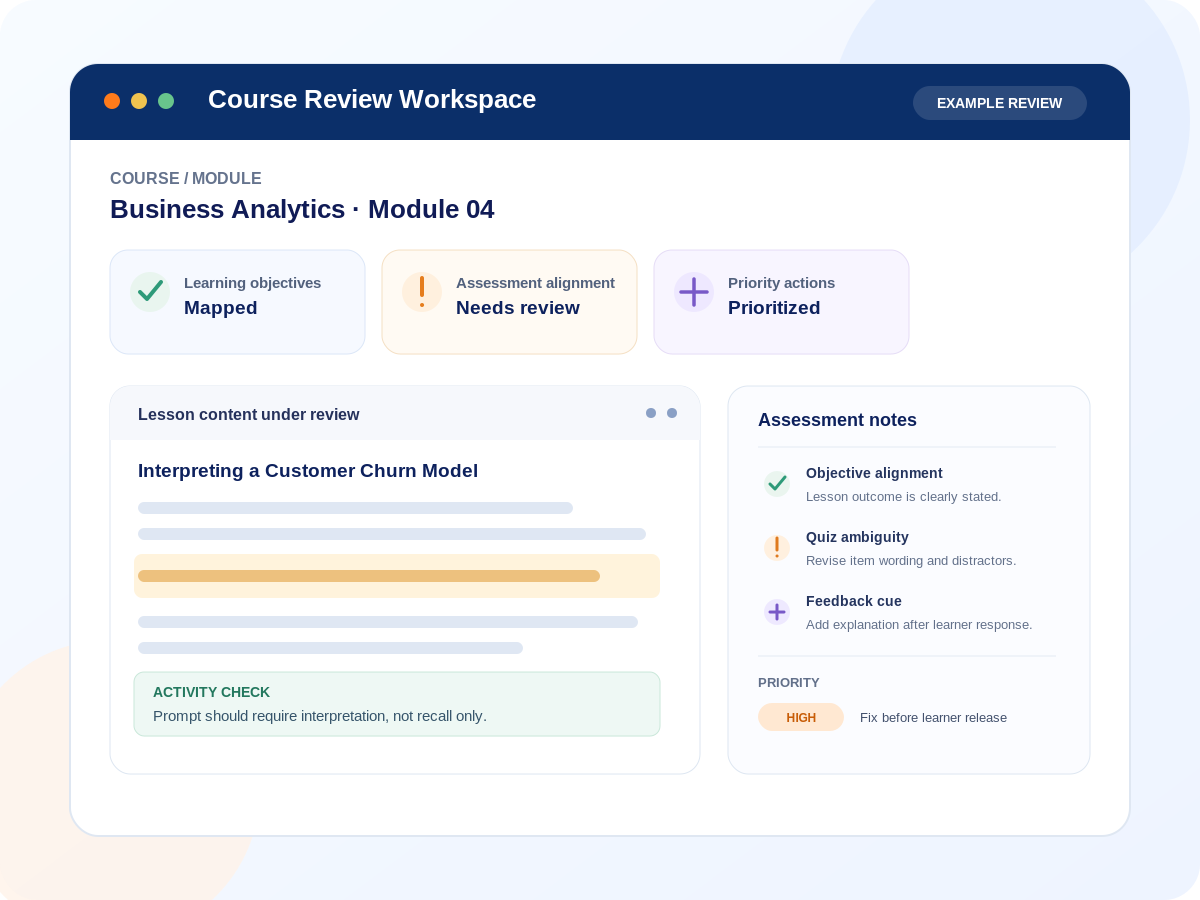
Course assessment support is a connected review of objectives, content, activities, and evidence of learning, so project pricing is more meaningful than a per-word editing rate.
Suitable for: Teams preparing a course for launch, refresh, or internal QA and needing a prioritised view of alignment and learner-facing issues.
Full course rewriting, instructional redesign, accessibility conformance testing, LMS testing, or large multi-course portfolios require a separate quotation.
A course-content assessment can focus on the full learning journey or a defined quality question. The review is shaped around the materials, objectives, and standards you supply.
Review module order, prerequisite flow, transitions, concept progression, and whether the learning path is easy to follow.
Map stated outcomes against lesson content, examples, activities, and the evidence learners are expected to produce.
Check quizzes, assignments, prompts, criteria, and rubrics for clarity and consistency with what the course teaches.
Identify unclear directions, overloaded explanations, missing context, weak examples, or tasks that may confuse learners.
Review visible learner-facing issues such as readability, content density, instruction cues, navigation logic, and presentation consistency.
Run a final content-quality pass before release to surface high-priority gaps, consistency issues, and implementation actions.
A clear review sequence keeps the assessment anchored to your course goals and makes the final recommendations easier to implement.
Confirm course purpose, learner profile, objectives, materials, and the review questions that matter most.
Connect objectives to lessons, activities, assessments, rubrics, and the expected evidence of learning.
Review content and assessment assets against the agreed criteria, noting gaps, ambiguity, and misalignment.
Organize findings by importance and implementation need so your team can plan revisions efficiently.
Provide the agreed assessment outputs with clear recommendations and next-step guidance for your production team.
Course QA becomes more useful when comments are connected to learning goals, assessment evidence, and practical implementation priorities.
Instead of treating each lesson in isolation, the review looks at how content, activities, instructions, and assessments work together across the learner journey.
The service can be scoped around a single learning asset or a broader course-level quality review, depending on what your team needs to decide.
Focused review of one lesson or unit.
End-to-end review across modules and assessments.
Check assessment criteria and scoring guidance.
Review question clarity and objective fit.
Review learner-facing content in delivery order.
Prioritize issues before learner release.
The review connects detailed content observations to the larger decisions your course team needs to make.
Course-content assessment is useful wherever learning materials need a documented quality review before launch, revision, migration, or scale.
Review courses, modules, and assessment materials against supplied academic requirements.
Assess internal learning content for alignment, clarity, and implementation readiness.
Review learner-facing course assets before release or during product-content improvement cycles.
Evaluate course consistency across lessons, facilitators, activities, and assessments.
Get an independent review layer for structure, objectives, activities, and assessment design.
Turn review findings into an actionable revision queue for writers, editors, and producers.
Review learning and assessment assets against the criteria or competency map you provide.
Validate how expert knowledge has been translated into learner-facing content and assessment tasks.
A useful assessment should show not only what is wrong, but also why it matters and what the course team can do next.
Recommendations can be written so content owners, instructional designers, assessment writers, and LMS teams understand which action belongs to them.
The exact rubric can be adapted to your requirements, but these lenses provide a practical structure for a balanced course-content assessment.
Are course goals and learner outcomes clear enough to guide design decisions?
Does the material explain, sequence, and reinforce the intended concepts effectively?
Do activities give learners meaningful opportunities to apply what they are learning?
Do quizzes, tasks, and rubrics collect evidence that matches the intended outcomes?
Are instructions, navigation cues, terminology, and presentation consistent for the learner?
These examples are demonstrations of review logic, not claims about any specific client or course.
The learner is taught to use a process, but the assessment only asks for definitions.
The task requires prior knowledge that the current module has not yet explained.
The prompt says “analyze” without specifying format, depth, evidence, or evaluation criteria.
Terminology varies across lessons and may make the course feel less coherent.
Learners can see whether they were correct but receive little guidance for correction.
Important steps are buried inside a long paragraph rather than presented as a usable sequence.
Choose a review scope based on the decision you need to make. Pricing and turnaround are not shown because no page-specific figures were supplied for this service.
Use for a pilot module, revised unit, high-priority lesson, or representative sample.
Discuss scope →Review the learning journey across modules, activities, assessments, and learner instructions.
Request a review plan →Focus on quizzes, assignments, performance tasks, scoring criteria, and evidence of learning.
Review assessment assets →Use a repeatable review framework across recurring content releases or planned revision cycles.
Discuss an ongoing model →Common questions about scope, learning-objective alignment, quizzes, rubrics, accessibility, deliverables, and the materials needed for a structured course review.
It is a structured review of course materials to identify how well lessons, activities, assessments, rubrics, instructions, and supporting resources align with the intended learning goals. The output focuses on clear findings, priorities, and practical recommendations rather than rewriting the entire course by default.
The review can cover lesson text, module outlines, slide decks, worksheets, activities, case studies, quizzes, assignments, rubrics, instructor notes, learner instructions, and LMS-ready content. The exact review scope should be agreed from the materials you provide.
Yes. A focused module review can be used when you want to validate a pilot lesson, a revised unit, a high-priority assessment, or a representative sample before expanding the review to the full course.
Yes. Objective-to-content alignment is a core review lens. The assessment can flag objectives that are not sufficiently taught, content that is not clearly tied to an objective, or objectives that are difficult to demonstrate through the current activities and assessments.
Yes. Questions, tasks, assignments, and rubrics can be checked against the stated learning objectives, the level of learner performance expected, clarity of instructions, and whether the assessment evidence is consistent with what the course teaches.
The primary service is assessment and recommendation. Small examples may be suggested to demonstrate a clearer direction, but substantial rewriting, redevelopment, or net-new course creation should be scoped separately if required.
Yes. The review can examine whether concepts are introduced in a logical order, whether prerequisite knowledge is handled appropriately, whether transitions between modules are clear, and whether activities reinforce the progression of learning.
Yes, when included in the agreed scope. The assessment can flag readability, instruction clarity, content density, navigation cues, alternative ways of presenting information, and other learner-experience issues visible in the supplied course materials.
Typical outputs can include an assessment summary, an annotated review, a scoring or review matrix, prioritized issues, and an action plan. The final deliverables should match the agreed scope and the formats of the materials you submit.
Share the course or module files, intended learner profile, learning objectives or outcomes, assessment materials, platform or delivery format, any internal rubric or quality standard, and the specific concerns you want the assessment to prioritize.
Yes. If you provide an internal checklist, accreditation framework, style guide, competency map, or QA rubric, the review can be structured around those supplied requirements in addition to the agreed assessment criteria.
Findings can be grouped by importance and effort so your team can distinguish issues that should be addressed before release from improvements that can be scheduled for a later revision cycle. The exact priority labels can be adapted to your workflow.
Share the course format, learner audience, number of modules or assets, learning objectives, assessment materials, review priorities, and any internal QA framework you want us to follow.
Course assessment is most effective when the reviewer understands what the course is trying to achieve and how your team will use the findings.
State whether you need one module, the full course, assessment assets, or a defined content set reviewed.
Share the intended audience, level, learning goals, competencies, or outcomes.
Include quizzes, assignments, rubrics, answer keys, or performance criteria if they are part of the review.
Provide any internal QA rubric, accreditation framework, style guide, or content governance requirements.
Submit the core details below so the request can be assessed for scope and the most suitable review approach.
Turn learning objectives, lessons, activities, quizzes, and rubrics into a structured review plan with findings your course team can act on.