Question Stems
Clarify wording, command verbs, sentence structure and unnecessary complexity while preserving the intended assessment purpose.

Refine assessment questions, instructions, answer options, keys, rationales, rubrics, scoring guides and item-bank language so learners, candidates and reviewers can focus on what the assessment is intended to measure.
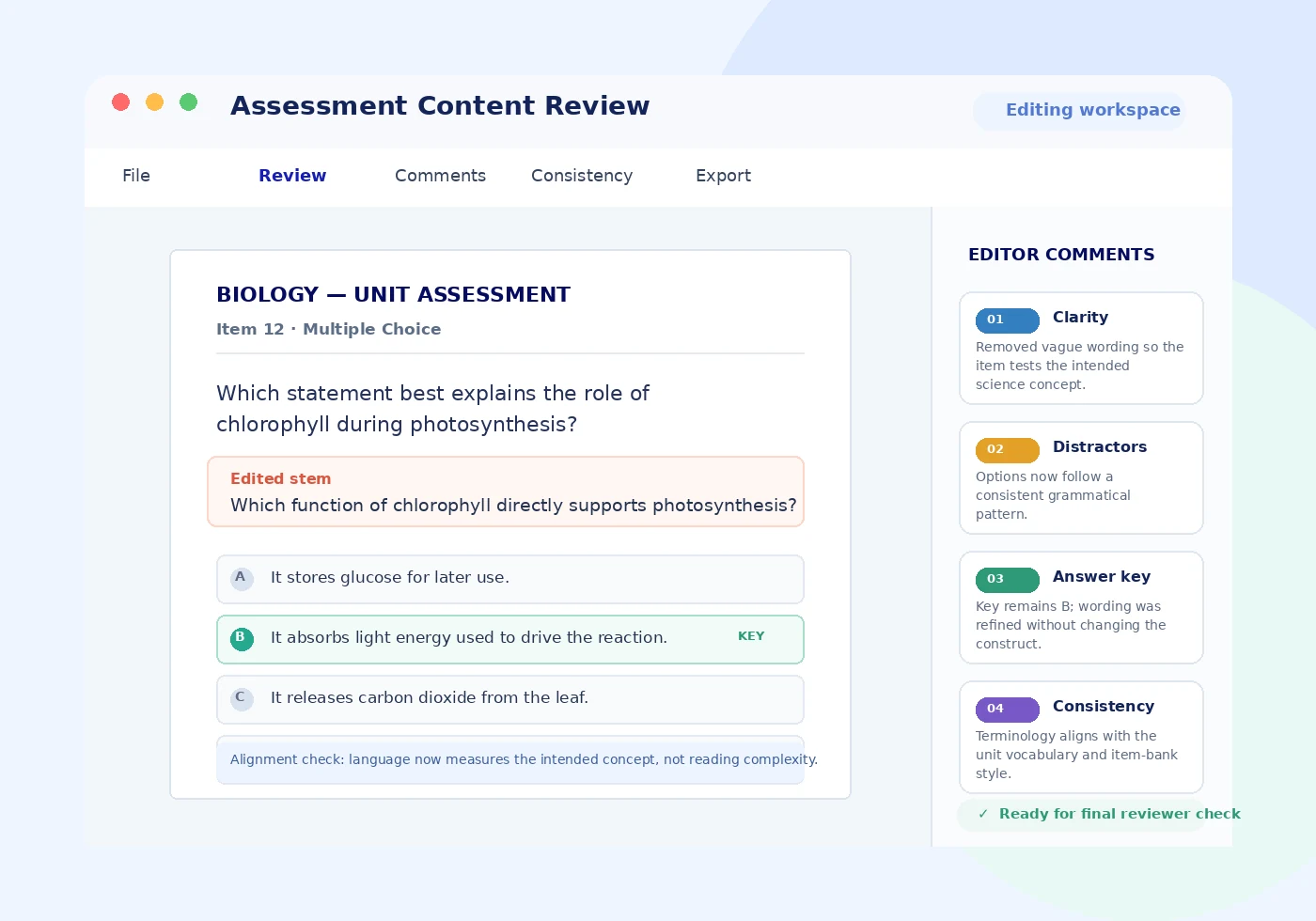
Editing is priced around the size and complexity of the item set so you can improve clarity and consistency without paying for unnecessary assessment redevelopment.
Suitable for: Existing quizzes, tests, item banks, keys, rationales, or rubrics that need language-level refinement and consistent presentation.
This starting scope is editorial. New item writing, answer re-keying, psychometric validation, subject-correctness certification, or extensive restructuring is scoped separately.
A focused editorial service for the language and presentation of assessment materials, from individual questions to larger item banks and scoring resources.
Clarify wording, command verbs, sentence structure and unnecessary complexity while preserving the intended assessment purpose.
Improve grammatical parallelism, consistency, readability and stem-to-option fit without silently changing the keyed concept.
Edit learner, candidate and reviewer instructions for clear actions, consistent terms and easier navigation through the assessment.
Review answer-key labels, explanations, model answers and feedback text for wording, alignment and consistent presentation.
Refine criteria, descriptors and scoring notes so evaluators can interpret the language more consistently.
Apply agreed conventions across terminology, punctuation, numbering, option formatting, instructions and feedback patterns.
A transparent review journey from scope and reference materials through tracked editing and final author or reviewer checks.
Review the assessment type, audience, purpose, item set and any supplied style or curriculum guidance.
Identify the required editorial depth, recurring style rules and areas that need author or subject-expert attention.
Refine stems, options, instructions, rationales, rubrics and related assessment language with tracked revisions.
Check document-wide terminology, formatting patterns, editorial comments and cross-item consistency.
Provide the reviewed working file and a clean version where the file format and project workflow support both.
The same editorial principles can be adapted to different assessment environments and delivery formats.
Short checks, practice questions and classroom or e-learning quizzes.
Unit, term, semester, entrance or formal examination content.
Large question repositories that require consistent editorial rules at scale.
Practice sets, learner worksheets and formative assessment materials.
Knowledge checks, module assessments, feedback and branching question text.
Candidate-facing assessment content, instructions and scoring-related text.
Editorial coverage can be shaped around the files and components included in your assessment workflow.
The goal is a clearer editorial presentation that supports consistent interpretation and review.
Assessment content editing can support teams that create, review, publish or deliver formal and informal learning assessments.
A realistic example of how editorial changes can reduce language ambiguity without replacing subject-matter validation.
Deliverables are shaped by the file format and review scope, with emphasis on transparent edits and practical author or reviewer follow-up.
Assessment content revised in the supplied working format where supported.
Visible editorial changes where the document format supports track-changes workflows.
Queries for wording, meaning, inconsistency or issues that require author or expert judgment.
A clean version can be supplied when compatible with the project file and agreed workflow.
Document-wide attention to recurring terminology, option style, instructions and formatting patterns.
Editorial flags for content that should be confirmed by the appropriate subject or assessment specialist.
The editorial review looks beyond isolated grammar fixes to identify recurring language and presentation patterns across the assessment.
Grammar, syntax, word choice, punctuation and sentence-level clarity.
Consistent phrasing and grammatical form across answer options and repeated item types.
Terminology, capitalization, numbers, abbreviations, labels and formatting conventions.
Clear directions that match the response type, scoring method and assessment workflow.
Visible flags when meaning, correctness or construct-related decisions should not be made silently.
Choose a practical editorial setup based on the size, frequency and collaboration needs of your assessment project.
Focused editing for one exam, quiz, worksheet, practice test or assessment package.
Discuss scope →Consistent editing across a larger set of assessment items using agreed editorial rules.
Request a review →Recurring editing for teams that release assessment content continuously or in scheduled cycles.
Discuss workflow →Editorial collaboration for multi-author assessment programmes, publishers and learning teams.
Get project guidance →Practical answers about scope, files, editorial boundaries, item banks, rubrics, answer keys and getting started.
It is an editorial review focused on the language, clarity, consistency, structure, instructions, answer options, rationales, scoring guidance, and presentation of assessment materials. The service improves how assessment content is expressed while preserving the intended knowledge, skill, or construct being assessed.
The service can be used for quizzes, exams, item banks, worksheets, practice tests, e-learning checks, certification assessments, diagnostic assessments, answer keys, explanations, rubrics, and related learner or reviewer instructions.
Yes. Editing can cover question stems, answer-option grammar and parallelism, distractor clarity, ambiguity, repetition, unnecessary clues, terminology consistency, and alignment between the stem and the available responses. Subject-matter correctness should still be confirmed by the appropriate content expert.
Yes. Answer keys, model answers, explanations, feedback text, and rationales can be reviewed for wording, consistency, internal alignment, and readability. Editorial review does not replace subject-matter validation of the correct answer.
The editor can flag wording that appears to create unintended reading difficulty or ambiguity, but the service does not silently redesign the intended difficulty or construct. Any change that could materially affect what an item measures should be highlighted for author or subject-expert review.
Yes. Rubric criteria, performance-level descriptors, scoring notes, point allocations, and reviewer instructions can be edited for clearer wording, parallel structure, consistent terminology, and easier application by markers or evaluators.
Yes. Batch editing can focus on repeated style issues such as capitalization, punctuation, option formatting, command verbs, terminology, numbering, feedback labels, and instruction patterns across a set of assessment items.
Yes. Provide your style guide, sample approved items, curriculum terminology, house rules, template, or reviewer instructions. These materials help the editor apply your required conventions consistently.
This page describes editorial review rather than independent subject-matter verification. Editors can flag apparent inconsistencies or unclear content, but factual correctness, curriculum alignment, psychometric validity, and final answer-key approval should remain with the relevant subject or assessment specialists unless separately agreed.
Where the working file format supports it, the editing workflow can use tracked revisions and comments so you can see what changed and why. A clean reviewed version can also be prepared for final author or reviewer use.
Send the assessment file, intended learner or candidate level, assessment purpose, any style or curriculum guidance, answer keys and rationales where relevant, required terminology, and specific concerns you want the editor to prioritise.
Use the enquiry form on this page and describe the assessment type, approximate number of items or word count, file format, required review depth, supporting guidelines, and deadline. The team can then review the scope before confirming an appropriate service approach.
Share the type of assessment you are working on, the approximate number of items or word count, the file format, any style or curriculum guidance, and the areas you want the editor to prioritise.
Provide enough detail for the team to understand the editorial scope before confirming the most appropriate service approach.