Market-Aware
Language adapted to the target locale and buying context.

Adapt product content for the language, terminology, search behaviour, marketplace rules, and buying expectations of each target market—without losing the meaning, product facts, or brand intent of your source content.
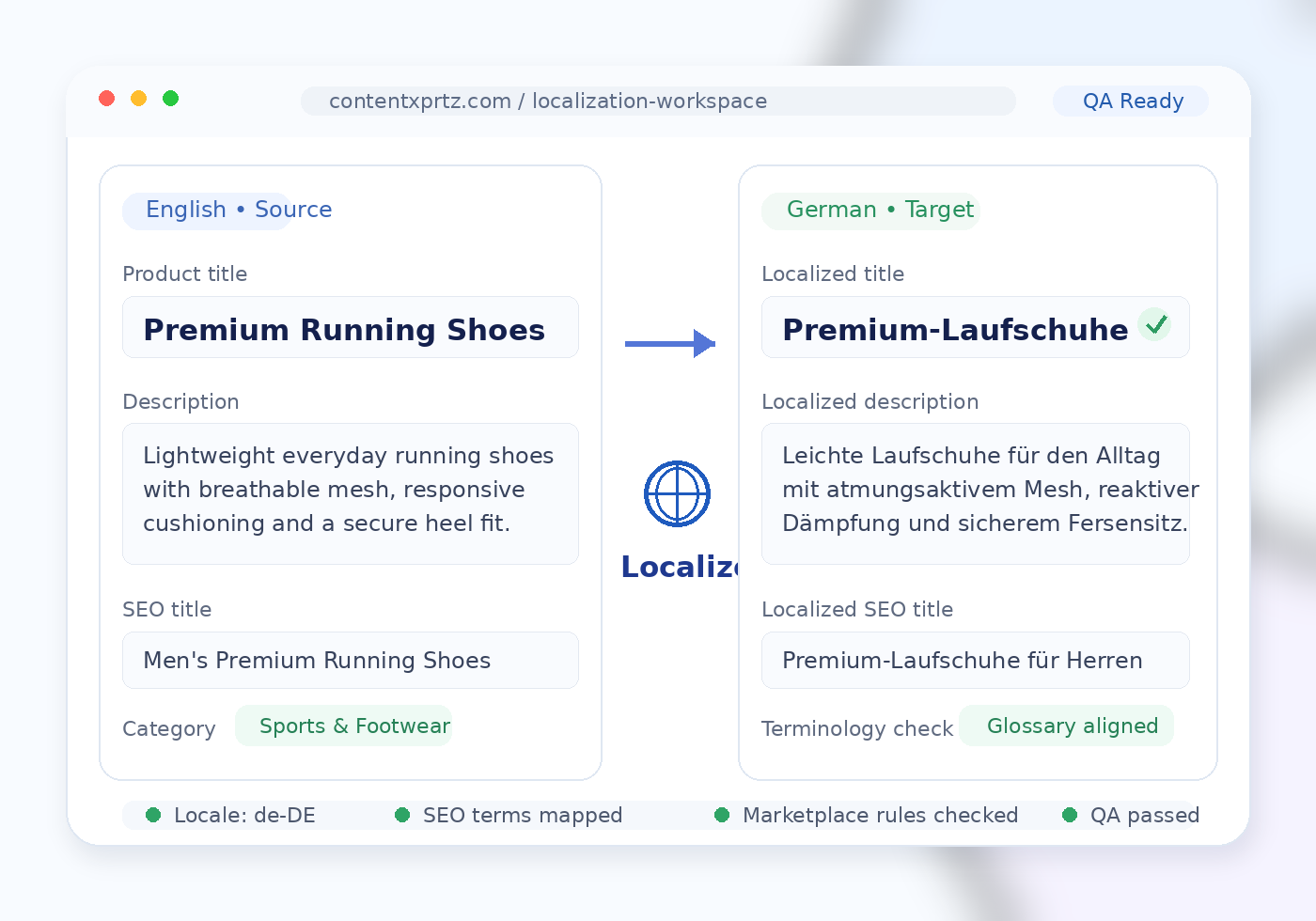
Language adapted to the target locale and buying context.
Search terms can be mapped for local discovery.
Glossaries and naming rules support consistency.
Review checkpoints can cover language, meaning and fit.
Content can follow supplied field and marketplace rules.
Scope-based checks support clean, reviewable delivery.
Product localization is priced by target language and source volume so the work can cover language, terminology, attributes and local search context as one controlled deliverable.
Suitable for: For a focused batch of product titles and descriptions being adapted for one target market.
Additional words, specialist languages, large catalogues, image text, legal content, multi-market SEO research and express turnaround are quoted separately.
Localize benefit-led descriptions, feature language, product naming, and shopper-facing details for the target market.
Adapt collection introductions, category copy, navigation language, and keyword themes while keeping the product hierarchy clear.
Localize titles, bullets, descriptions, and listing fields to supplied marketplace conventions, limits, and content requirements.
Adapt page titles, meta descriptions, keyword language, headings, and supporting copy to the search terms used in the target market.
Keep product attributes, terminology, units, field labels, and specification language consistent with the supplied source data and locale rules.
Adapt text supplied for product images, banners, comparison graphics, and visual merchandising while respecting available space.
Localize launch messaging, promotional emails, offer copy, and product-focused campaigns for local tone and customer expectations.
Adapt educational buying content, comparison language, selection criteria, and product recommendations for a target-market audience.
Localize product questions, help text, care guidance, usage information, and support content with clear market-appropriate wording.
Adapt short-form product messaging, social captions, review-response templates, and community content when those assets are included in scope.
Review products, source fields, target locales, channels, brand rules, and project priorities.
Identify product names, approved terms, recurring attributes, do-not-translate items, and tone guidance.
Where SEO is in scope, map target-market search language to the right products, categories, and metadata.
Adapt copy for language, local phrasing, buyer context, product meaning, brand intent, and field purpose.
Apply supplied field limits, marketplace rules, content structures, labels, and output formats.
Check terminology, source alignment, formatting, locale rules, SEO elements, and agreed content requirements.
Return localized content in the agreed format, with review notes or revisions handled within the confirmed scope.
Helpful inputs: source copy, product data, target locales, marketplace or CMS templates, brand and terminology guidance, SEO keyword data where available, field limits, and any legal or compliance wording that must remain unchanged.
Lightweight everyday running shoes with breathable mesh and responsive cushioning.
Leichte Laufschuhe für den Alltag mit atmungsaktivem Mesh und reaktiver Dämpfung.
Defined product set, locales, channels, outputs, and review scope.
Recurring localization batches for new products, updates, or seasonal ranges.
Structured waves for larger catalogues, product families, or marketplace expansion.
Localized product and promotional content for launches or market campaigns.
| Phase | Content | Focus |
|---|---|---|
| 01 | Product Data | Source integrity & field mapping |
| 02 | Terminology | Brand, product & attribute rules |
| 03 | Product Copy | Market-aware localization |
| 04 | SEO Fields | Target-market search language |
| 05 | Channel Format | Marketplace / CMS requirements |
| 06 | QA & Review | Consistency, meaning & delivery |
Product content localization adapts ecommerce copy for a target market rather than translating words in isolation. It considers local terminology, buyer expectations, search language, channel rules, units, formatting, and brand voice.
The scope can include product titles and descriptions, category and collection pages, marketplace listings, feature bullets, specifications, SEO metadata, FAQs, buying guides, promotional copy, and other product-facing content supplied for the project.
SEO localization can be included when the project requires it. The workflow can map target-market search terms, adapt titles and metadata, and keep localized copy readable rather than inserting source-language keywords mechanically.
Yes. Brand glossaries, approved terminology, product naming rules, tone guidance, and do-not-translate lists can be incorporated into the localization brief and quality checks.
Channel-specific requirements can be included when you provide the applicable marketplace rules, templates, field limits, naming conventions, and formatting requirements.
They are reviewed against the target-market brief and the product data you provide. Any required conversion or formatting rule should be confirmed in the project instructions before localization begins.
Catalogue-scale work can be structured in batches using source files, field mappings, terminology rules, review checkpoints, and consistent delivery formats. The practical workflow depends on catalogue size and source-data quality.
Language coverage should be confirmed during scoping for the target markets you need. Share the source language, requested locales, content volume, and channel requirements so availability can be assessed accurately.
A project glossary, approved product vocabulary, recurring phrase rules, attribute conventions, and review checkpoints can be used to keep repeated terminology consistent across a catalogue.
Review can include language quality, terminology consistency, factual alignment with the supplied source, formatting, field constraints, SEO elements, and target-market or channel instructions included in the brief.
Timing depends on the number of products, source quality, requested locales, content types, channel requirements, and review process. A delivery plan can be confirmed after the scope is assessed.
Pricing depends on the agreed scope, such as content volume, number of locales, source format, complexity, SEO requirements, terminology work, and review needs. A quote can be prepared after the project requirements are reviewed.
Share the source language, target market or locale, product-content scope, approximate volume and any terminology or channel requirements in the service details field.
Share your product types, source language, target locales, content volume, channel requirements, and any brand or terminology guidance. We can review the scope and discuss the right localization workflow for your catalogue.