SaaS & Product Teams
Explain features, workflows, settings, and common user tasks.

Turn product knowledge, policies, workflows, and recurring customer questions into useful help-centre articles, knowledge-base content, FAQs, troubleshooting guides, and step-by-step support documentation that users can follow.
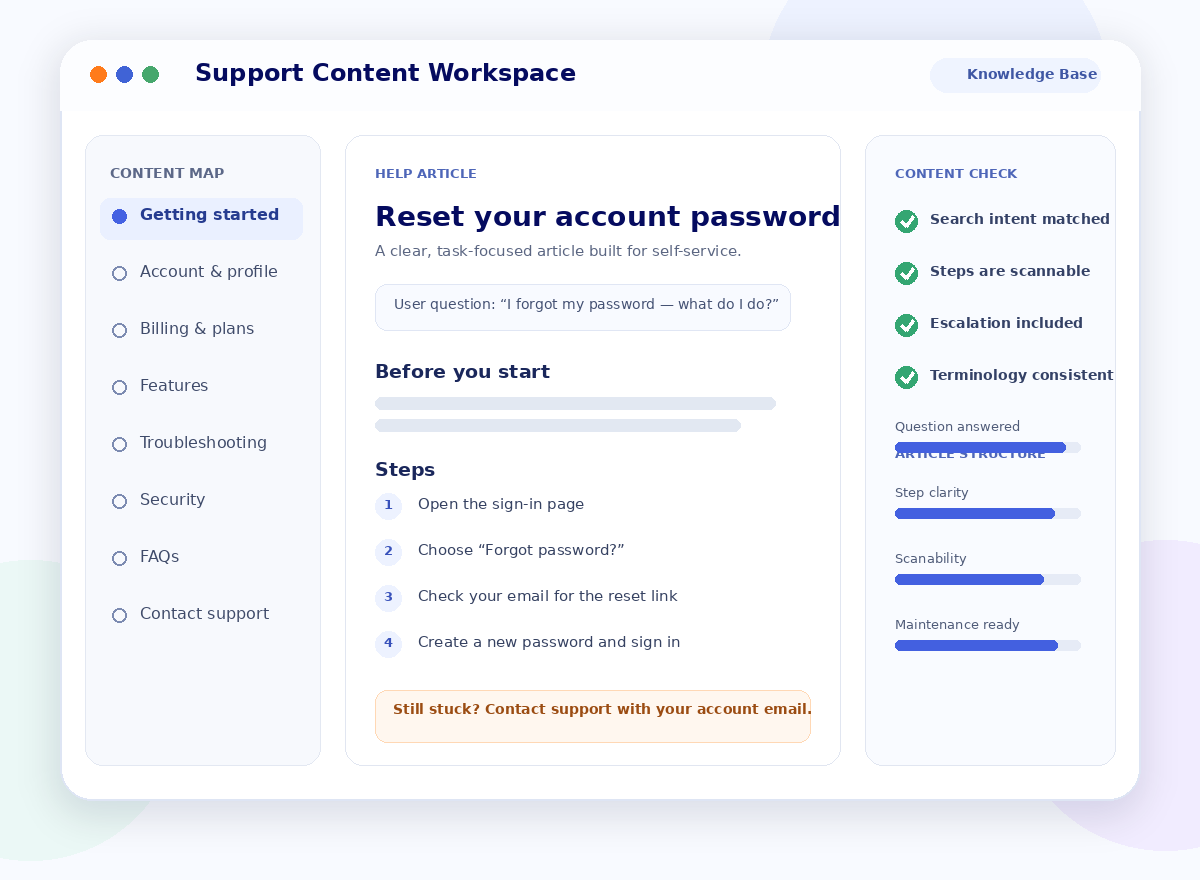
The starting package covers a small set of task-based support content created from supplied product, process or policy sources, with enough room for real troubleshooting and step-by-step guidance.
Starting price
From ₹6,000
for up to 3 new support articles or approximately 3,000 words
Suitable for: Three focused help articles, FAQs or troubleshooting pieces built from usable source material.
Outside the starting scope: Product support operations, visual asset production and help-center implementation are quoted separately.
Faster delivery: Priority writing can be considered when source steps and approval contacts are available at kickoff.
Contentxprtz help and support content writing starts from ₹6,000 for up to three new support articles or about 3,000 words, including structured drafting and two revision rounds.
Explain features, workflows, settings, and common user tasks.
Turn repeated questions into structured self-service answers.
Clarify processes, eligibility, documents, next steps, and policies.
Support buyers, sellers, providers, or partners across key journeys.
Answer ordering, delivery, returns, account, and product-help questions.
Present approved user guidance clearly while keeping rules and caveats visible.
Task-based articles that answer a specific user question and guide the reader to a clear outcome.
Organised topic coverage for users who need dependable reference information across a product or service.
Concise answers built around genuine user concerns, eligibility questions, definitions, and next steps.
Diagnostic content that helps users identify likely causes, complete checks, and know when to contact support.
Step-by-step content for first-time setup, key workflows, repeatable tasks, and product adoption moments.
Release, feature, in-app, chatbot-source, and internal reference content prepared from approved product information.
Review users, support questions, workflows, source material, and content gaps.
Group questions by task, journey, topic, product area, or support intent.
Set article purpose, information hierarchy, terminology, and reusable structure.
Create concise answers, steps, notes, prerequisites, and escalation guidance.
Check the draft against provided product, policy, workflow, and brand references.
Provide clean, structured content that is ready for review, transfer, and maintenance.
Help content works best when it is written around the user’s next action, not around internal product language alone. Our approach keeps clarity, structure, consistency, and future maintenance in view.
These are illustrative content formats, not client case studies. They show how different support needs can be organised so users quickly understand what to do next.
Task-based articles for password resets, profile updates, verification, access, and account recovery.
A symptom-to-resolution guide covering checks, likely causes, fixes, and the point where support should take over.
Prerequisites, numbered actions, expected results, useful notes, and a clear next step after completion.
Short, direct answers that keep conditions, exceptions, eligibility, and escalation information visible.
Tip: The most useful support content starts with a specific user question or task and ends with a clear outcome, next action, or escalation path.
Plan and write an initial set of support articles from supplied product and service material.
Rewrite outdated, unclear, duplicated, or inconsistently structured help content.
Create support guidance for approved feature changes, workflows, and user-facing updates.
Add or update help content as new questions, features, and support needs emerge.
Share your publishing environment and template constraints so the content can be structured for easier transfer and review.
Instead of publishing more content for its own sake, build each article around the moment a user is trying to understand something, complete a task, or recover from a problem.
Use specific titles, familiar terms, direct openings, and clear topic grouping so users can recognise the right article without reading everything.
Separate prerequisites, steps, expected results, cautions, and next actions so the article can be followed while the user is completing the task.
Make escalation conditions visible so users know what information to collect, which channel to use, and when the issue needs direct support.
Practical answers about scope, content types, source material, terminology, troubleshooting, product launches, publishing environments, pricing, and turnaround.
It is a professional writing service focused on the content users rely on when they need to understand a product, complete a task, solve a problem, or decide when to contact support. Typical deliverables can include help-centre articles, knowledge-base pages, FAQs, troubleshooting guides, step-by-step tutorials, and support-ready product guidance.
The service can cover help-centre and knowledge-base articles, setup and onboarding guidance, account and billing help, troubleshooting content, feature how-tos, process explanations, FAQ collections, policy or eligibility guidance, escalation instructions, and structured content for self-service support experiences.
Yes. Existing support content can be reviewed for clarity, duplication, structure, terminology, scanability, and gaps. The resulting scope can focus on selective rewrites, a broader content refresh, or a reorganised set of articles based on the material you provide.
Yes, when you provide the relevant terminology, style guidance, approved language, product references, and examples. Those materials help keep article wording consistent with your product interface and customer communications.
Yes. Troubleshooting content can be structured around symptoms, likely causes, checks, step-by-step actions, expected results, and a clear escalation path when self-service steps do not resolve the issue.
Yes, if you provide the source material. Repeated customer questions, ticket themes, chat transcripts, internal notes, and existing articles can be used to identify practical FAQ topics without inventing product-specific answers that are not supported by your documentation.
Yes. Product notes, screenshots, workflows, approved messaging, and release information can be turned into user-facing help content that explains what changed, who it affects, how to use it, and where users should go for further help.
Articles are organised around the user’s task or question, with descriptive headings, concise introductions, numbered steps where appropriate, short paragraphs, meaningful labels, and clearly separated notes, cautions, prerequisites, and escalation guidance.
The writing can be structured around the words users are likely to search, while keeping titles and headings natural. Search intent, article naming, internal linking opportunities, and related-question coverage can be considered when the source material supports them.
Content can be delivered in a structured format that is straightforward to transfer into your help centre, knowledge base, product documentation, in-app help, chatbot knowledge source, or internal support library. Share your publishing constraints so the output can be organised accordingly.
Useful inputs include your product or service overview, target users, existing help content, screenshots or workflows, approved terminology, policy rules, common support questions, escalation paths, brand or style guidance, and any launch or review deadline.
Contentxprtz help and support content writing starts from ₹6,000 for up to three new support articles or about 3,000 words, including structured drafting and two revision rounds. Scope depends on factors such as the amount of source material, number and complexity of articles, research or product familiarisation required, level of restructuring, review cycles, and delivery priorities. Share your requirements to request an assessment.
Share what you are building, the support questions you need to address, the source material available, and the content you want created or improved. The details help define a sensible writing scope without guessing at product facts.
Provide enough context for us to understand the writing task and the source material you can share.