Brief-Based Scope
Content is developed around the audience, goal, topic, format, and requirements you provide.

Turn a topic, keyword set, content brief, or rough idea into a clear blog article built around the reader’s search intent. The service can support planning, structure, drafting, on-page SEO, internal-link opportunities, metadata, editorial refinement, and a clean final handoff.
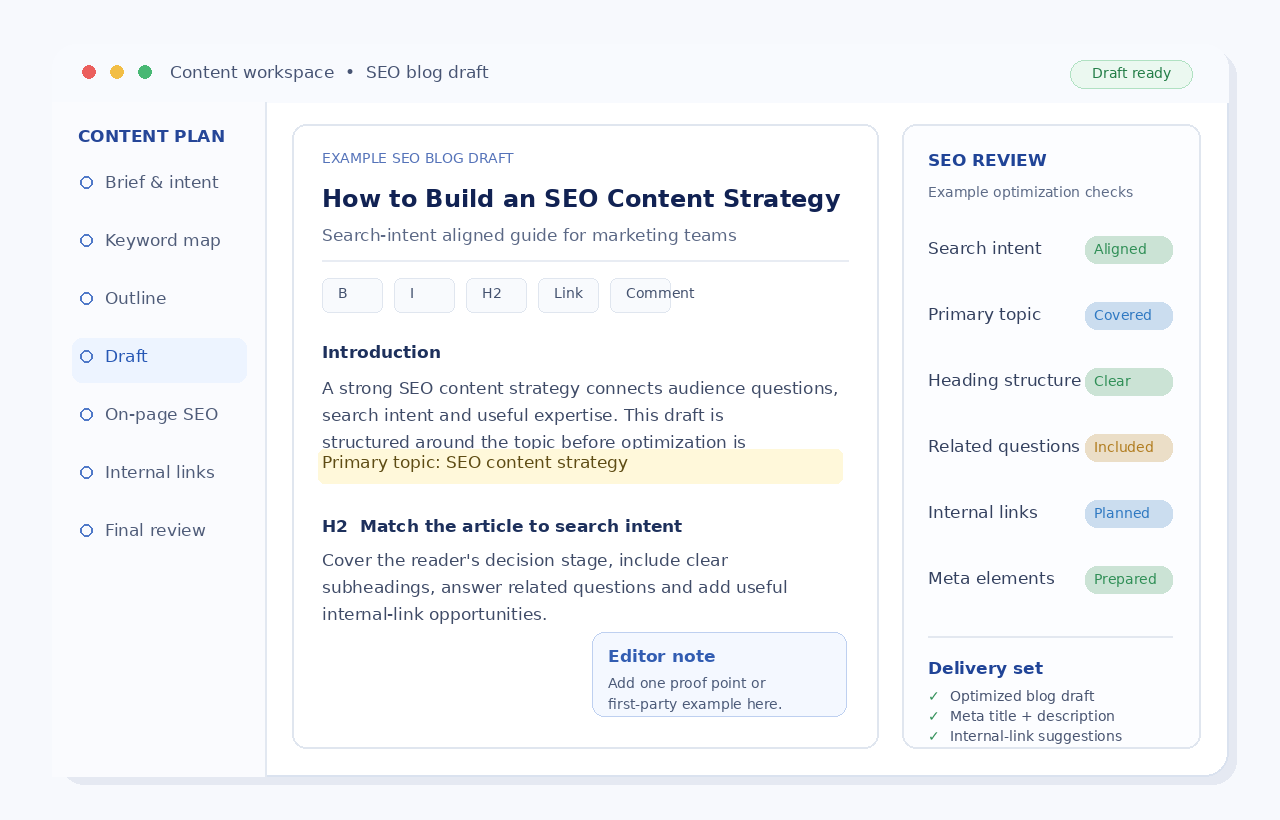
Content is developed around the audience, goal, topic, format, and requirements you provide.
Article direction considers what the reader is trying to understand, compare, solve, or decide.
Drafts are checked for flow, headings, clarity, topic coverage, and agreed SEO elements.
Receive the agreed draft and supporting SEO notes in a format ready for your review or publishing workflow.
Choose by research depth and article complexity rather than by word count alone. Each plan produces a complete, original article for a defined search intent.
Quick pricing answer: Contentxprtz SEO Blog Writing Service starts at ₹2,500 for one article up to 1,000 words.
For a straightforward informational topic with a clear brief and limited source complexity.
For competitive business topics needing deeper research, stronger structure and internal-link thinking.
For specialist, evidence-heavy or thought-leadership-style topics where depth and source handling matter.
Interviews, original surveys, specialist SME review, regulated-topic compliance review, CMS publishing, or article lengths beyond the stated limits are scoped separately.
Useful SEO content needs more than a keyword in the title. These are common weaknesses the service is designed to identify during planning, drafting, and review.
The article targets a phrase but does not answer the type of question or decision behind the search.
Important subtopics, objections, examples, or related reader questions are missing from the content.
Headings do not create a clear information path, making the article harder to scan and understand.
Keywords are forced into sentences instead of being used naturally within useful topic coverage.
The article informs the reader but does not connect naturally to a next step, relevant offer, or supporting page.
Metadata, internal-link ideas, headings, or publishing notes are not prepared with the final draft.
The exact scope is confirmed from your brief. A complete engagement can move from topic framing through a publication-ready content handoff without treating SEO as a last-minute keyword pass.
A representative example of how a broad topic can become a focused, search-intent aligned article plan and then a cleaner final draft.
Topic: “Write a blog about project management software for small teams.”
The topic is broad, the reader is undefined, and there is no clear search intent, article angle, supporting subtopics, or next step.
Working angle: “How small teams can choose project management software without overcomplicating their workflow.”
A focused article now addresses a defined reader, a clear evaluation problem, logically ordered subtopics, internal-link opportunities, and an appropriate next step.
SEO blog writing combines content development with search-focused planning and on-page handoff. Proofreading and general writing solve different parts of the problem.
| Support Dimension | Proofreading | General Blog Writing | SEO Blog Writing Service |
|---|---|---|---|
| Topic & audience framing | × | Limited | ✓ |
| Search-intent alignment | × | × | ✓ |
| Keyword/topic mapping | × | Limited | ✓ |
| Outline & heading architecture | × | ✓ | ✓ |
| Full article drafting | × | ✓ | ✓ |
| On-page SEO elements | × | Limited | ✓ |
| Internal-link opportunities | × | Limited | ✓ |
| Meta title & description | × | Optional | ✓ |
| Grammar & readability review | ✓ | ✓ | ✓ |
| Best fit | Final language check | Reader-focused article draft | Search-focused blog development |
The writing approach changes with the reader’s purpose. Share the intended content type, audience, offer, and desired action so the structure can be matched to the job the article must do.
A practical sequence keeps the brief, search purpose, writing, optimization, and editorial checks connected instead of treating each as a separate last-minute task.
Share topic, audience, goal, keywords, sources, and deadline.
Clarify article requirements, depth, format, and expected handoff.
Define the main search need, related questions, and coverage.
Build the heading structure and logical reader journey.
Write the article around usefulness, clarity, evidence, and tone.
Review topic use, headings, links, metadata, and on-page elements.
Check flow, readability, consistency, brief alignment, and polish.
Provide the agreed blog draft and supporting optimization notes.
Better inputs make the article more specific to your audience and publishing goal. You can still enquire with an early idea if your brief is not yet complete.
The final review checks the article against the confirmed brief and the SEO elements actually included in the engagement.
Audience, topic, objective, tone, format, and required messaging.
The article answers the main reader need rather than merely repeating a keyword.
Headings and supporting sections are checked for gaps and unnecessary overlap.
Agreed keyword use, headings, links, metadata, and on-page notes are reviewed.
Clarity, grammar, readability, consistency, tone, and sentence flow are refined.
Files and visible deliverables are checked against the confirmed scope before handoff.
SEO blogs can be planned for different business contexts. Provide the product, service, market, terminology, and compliance constraints that writers need to understand.
The published SEO Blog Writing Service plans above start at ₹2,500 for one article up to 1,000 words; larger or specialist requirements are confirmed after scope review.
Final timing depends on article count, length, research depth, optimization scope, revisions, and deadline.
Scope can include planning, intent alignment, keyword mapping, outlining, drafting, on-page SEO elements, internal-link suggestions, metadata, editorial review, and final handoff.
Yes. Existing briefs, keywords, source materials, brand guidelines, internal-link targets, and publishing instructions can be used where supplied.
No. Writing can improve relevance and on-page readiness, but rankings depend on many factors outside the article itself.
Contentxprtz SEO Blog Writing Service plans start at ₹2,500 for one article up to 1,000 words. Both are assessed from article count, length, research depth, optimization requirements, revisions, and deadline.
Answers to practical questions about scope, keywords, briefs, on-page SEO, links, metadata, rankings, content refreshes, pricing, turnaround, and the information needed to begin.
The service can cover brief clarification, audience and search-intent alignment, keyword mapping, outline development, blog drafting, heading structure, on-page SEO elements, internal-link suggestions, metadata, editorial review, and final delivery according to the confirmed scope.
SEO blog writing connects the article to a defined search need as well as the reader. It considers search intent, topic coverage, heading structure, keyword placement, related questions, internal-link opportunities, metadata, readability, and editorial quality rather than treating the post as copy alone.
You can provide an existing keyword list or brief. If you do not have one, describe the topic, audience, offer, and goal so the keyword and topic requirements can be scoped before drafting.
Yes. Existing briefs, keyword maps, brand guidelines, source materials, internal-link targets, competitor references, and publishing instructions can be used as inputs where supplied.
Yes. Share the intended reader, awareness or decision stage, product or service context, and desired action so the article structure and tone can be aligned with that purpose.
Metadata can be included as part of the confirmed SEO blog writing scope. If you need specific length, brand, or CMS rules followed, provide them with the brief.
Yes, when relevant internal URLs, target pages, or site context are supplied or agreed for review. Recommendations can be marked directly in the draft or delivered as notes.
No. SEO blog writing can improve content relevance, structure, usefulness, and on-page readiness, but rankings and traffic depend on many factors outside the writing itself, including competition, site authority, technical SEO, links, indexing, and search-engine changes.
A custom quote can be based on article length, research depth, topic complexity, number of articles, keyword and brief requirements, optimization depth, source handling, revisions, and deadline. The published SEO Blog Writing Service plans above start at ₹2,500 for one article up to 1,000 words; larger or specialist requirements are confirmed after scope review.
Turnaround is confirmed after the article count, length, research depth, optimization requirements, and deadline are reviewed. Urgent requirements should be stated in the enquiry so feasibility can be assessed before confirmation.
Yes. Existing articles can be reviewed for search intent, structure, topic gaps, outdated passages, keyword use, headings, internal links, metadata, and editorial clarity when content refresh work is included in the agreed scope.
Useful inputs include the topic, target audience, content goal, keywords or brief if available, brand or tone guidelines, product or service context, source material, internal-link targets, reference examples, preferred format, and deadline.
Share the blog requirement, target audience, topic or keywords, preferred length, content goal, deadline, and any supporting material. The scope can then be reviewed before price and turnaround are confirmed.
Describe what the article should cover and who needs to read it.
Share keywords, search intent, existing brief, or SEO instructions if available.
Include tone, product or service positioning, claims, and preferred calls to action.
Provide research, source materials, internal URLs, and examples that should inform the article.
State approximate length, file format, CMS requirements, article count, and deadline.
Submit enough context for the writing and SEO scope to be assessed accurately.
Share your topic, audience, keywords or brief, and publishing goal. We’ll use those inputs to scope a useful, structured, search-ready blog writing engagement.