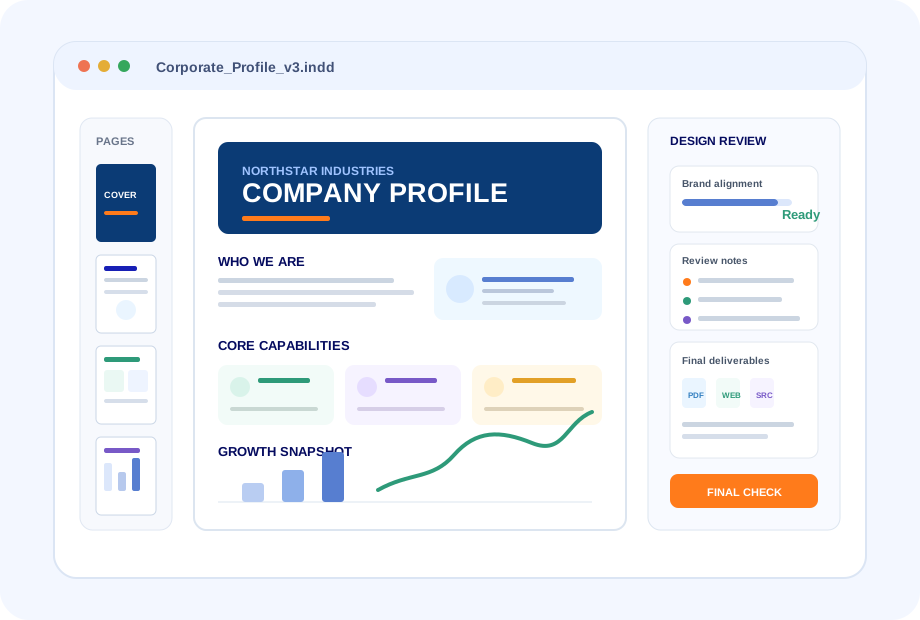
Corporate Profile Design Service for a Clear, Credible Business Story
★★★★★4.8 rating from Researchers, Authors, Students, and Scholars
Turn scattered company information into a structured, brand-aligned corporate profile that is easier for clients, partners, procurement teams, investors, recruits, and other stakeholders to understand. The service combines content architecture, page planning, visual design, review refinement, and final delivery preparation.
Clear company story and page hierarchy
Brand-aligned visual system across the profile
Structured presentation of services, capabilities, people, and proof
Review-ready draft and final preparation in the agreed format
Visual direction built around the brand assets and constraints you provide.
Structured Storytelling
Sections and pages organised so the business is easier to understand.
Review & Refinement
A clear feedback stage before final preparation and handoff.
Confidential Handling
Project information is treated as confidential service material.
Pricing & delivery
Corporate Profile Design Service Pricing & Delivery
The first commercial step for Corporate Profile Design Service is bounded for up to 8 designed pages. This keeps the offer clear for the following requirement: Businesses with approved profile content that need a concise, professional credentials document for clients, partners, tenders or introductions.
Starting Scope
From ₹8,000
for up to 8 designed pages
Suitable for: Businesses with approved profile content that need a concise, professional credentials document for clients, partners, tenders or introductions.
Cover and inner-page visual direction
Up to eight brand-aligned profile pages
Layout of supplied services, capabilities and proof points
Basic chart, icon and image treatment using provided assets
Print-ready PDF plus editable source file when agreed
Why Corporate Profiles Lose Attention or Credibility
A profile can contain accurate information and still be difficult to use. These are common presentation problems the design process is intended to identify and resolve.
Unclear Company Story
The profile lists facts but does not explain what the business does, who it serves, or why the information matters.
Weak Positioning
Services, capabilities, or differentiators appear without a clear hierarchy, making the business difficult to understand quickly.
Inconsistent Visual Identity
Colours, typography, imagery, spacing, and page treatments do not feel like one coherent brand system.
Information Overload
Dense paragraphs, long lists, and unstructured data make important messages harder to scan and remember.
Missing Proof & Context
Credentials, capabilities, process information, case material, or supporting business data are present but not framed clearly.
Poor Page Flow
Sections appear in a weak sequence, so the profile feels assembled rather than intentionally designed for the reader journey.
2
What This Corporate Profile Design Service Covers
The exact project scope depends on your material, but the service journey can cover the full path from brief and content architecture through design, review, and final preparation.
01
Brief & Objective
Target audience, purpose and desired action
02
Content Audit
Existing material, gaps and duplication
03
Story Structure
Company narrative and page sequence
04
Brand Alignment
Logo, colours, type and visual rules
05
Cover & Opening
First impression and positioning
06
About the Company
Background, mission and business context
07
Services / Products
Clear capability presentation
08
Leadership / Team
People and role presentation
09
Process / Capabilities
How the business works or delivers
10
Credentials
Approvals, memberships or proof supplied by you
11
Case / Project Content
Structured examples where source material exists
12
Data & Infographics
Charts, figures and business data supplied
13
Visual Refinement
Spacing, imagery and layout consistency
14
Review & Revisions
Consolidated feedback and refinement
15
Final Preparation
Approved export and handoff
Ready to move forward with Corporate Profile Design Service?Purchase the service and continue with your project brief, files, and delivery requirements.
A corporate profile project typically moves from unstructured source material to an organised design draft and then to a clean, consistent final profile.
Before — Rough Company Content
“We need a company profile. Our website has some information, our brochure is old, and the service descriptions were written at different times.”
No clear content hierarchyMixed visual stylesDense text and repeated informationWeak page sequence
→
During — Structured Design Draft
Company Story & Capabilities
Clarify positioningReduce text densityStrengthen visual hierarchyStandardise brand styles
→
After — Polished Corporate Profile
NORTHSTAR INDUSTRIESCompany Profile
Focused business storyConsistent design systemClear services and capabilitiesReview-ready final structurePrepared for agreed delivery format
4
What Makes This Different from Simple Formatting or Template Design
Formatting can improve appearance. A full corporate profile design engagement also considers content order, business story, information hierarchy, brand consistency, and how the pages work together.
Support Dimension
Basic Formatting Surface presentation
Template-Based Layout Pre-set structure
Full Corporate Profile Design End-to-end profile development
Company story & content architecture
×
Limited
✓
Page sequence & information hierarchy
×
Limited
✓
Brand-specific visual direction
Limited
Variable
✓
Services, capabilities & proof presentation
×
Limited
✓
Custom charts, diagrams & data layout where supplied
×
Limited
✓
Stakeholder review & design refinement
Limited
Variable
✓
Final consistency & export checks
Basic
Basic
✓
Best for
Existing layout needing cleanup
Fast content placed into a fixed structure
Complete corporate profile development
5
Corporate Profile Types Supported
The same design principles can be adapted to different business-profile formats depending on audience, content depth, and intended use.
Company Profile
A general business overview for clients, partners, procurement, recruitment, and introductions.
Startup Profile
A concise profile that explains the business, offer, team, traction inputs, and market-facing story.
Corporate Brochure
A visually led profile or brochure combining brand presentation, capabilities, and company information.
Capability Statement
A focused document presenting services, strengths, credentials, processes, and relevant business information.
Agency Profile
A service-led profile for creative, digital, consulting, marketing, technology, or professional-service agencies.
Manufacturing Profile
A structured profile for facilities, capabilities, processes, products, quality information, and operational strengths.
Institutional Profile
A formal profile for organisations, educational institutions, associations, foundations, or public-facing entities.
Investor / Partner Overview
A company overview designed to present the business clearly before deeper financial or investment materials are shared.
Ready to move forward with Corporate Profile Design Service?Purchase the service and continue with your project brief, files, and delivery requirements.
Prepare the approved profile in the agreed export or handoff formats.
7
What You Need to Share & What You Receive
Better source material and a clear brief reduce avoidable rework. Deliverables are then prepared according to the project scope confirmed before design begins.
What You Need to Share With Us
Share the latest approved information and assets wherever possible.
Brand assets
Logo files, brand guidelines, colours, fonts or approved typography information.
Company content
Existing profile, website copy, brochures, decks, notes, service/product information, and company background.
People & imagery
Approved leadership/team information, photographs, product images, project images, or other visual assets.
Proof material
Credentials, certifications, awards, memberships, client marks, case information, or figures only where you are authorised to use them.
References
Examples of profiles or visual directions you like, together with what you want to borrow or avoid.
Deadline & use case
Target date, primary audience, intended channel, printing requirements, and any format constraints.
Logo / Brand GuideExisting ProfileCompany CopyImagesCharts / DataReferences
What You Receive
The final handoff follows the scope agreed for your profile project.
Structured profile draft
A logically organised profile with a clear page sequence and design treatment.
Review-ready design
A draft version prepared for consolidated stakeholder feedback.
Refined final profile
The approved design after agreed revisions and quality review.
Agreed export formats
Final files prepared in the formats confirmed for the project.
Supporting notes
Key handoff or revision notes where they are part of the agreed scope.
Source / alternate files where scoped
Editable source or additional variants only when they are included in the confirmed project scope.
Ready to move forward with Corporate Profile Design Service?Purchase the service and continue with your project brief, files, and delivery requirements.
Check that supplied names, figures, labels, and source content are carried into the design consistently.
6
Final Export Check
Check page order, link behaviour where used, image quality, file naming, and the agreed output package.
9
Business Contexts & Confidentiality
Corporate profiles can be adapted to different business environments while company information, draft documents, and project materials remain part of a controlled service workflow.
Business Contexts We Can Design Around
The format can be adapted to business context and audience rather than forcing every company into one template.
Technology & SaaSProfessional ServicesManufacturing & EngineeringHealthcare & Life SciencesEducation & TrainingFinance & Business ServicesReal Estate & ConstructionRetail & Ecommerce
Confidentiality & File Handling
Business information may include unpublished plans, internal data, client references, project material, or commercially sensitive content.
Project material should be treated as confidential service information throughout submission, design review, and delivery.
Only share client logos, photographs, credentials, figures, or third-party materials that you are authorised to use.
If your organisation has specific NDA, access, retention, or review requirements, state them during the enquiry so they can be assessed before work begins.
The reference Contentxprtz service architecture includes data-security controls and an information-security management framework.
Your company story, source files, and business data should remain controlled project material—not decorative content reused outside the agreed workflow.
Ready to move forward with Corporate Profile Design Service?Purchase the service and continue with your project brief, files, and delivery requirements.
The published Corporate Profile Design Service starting price above is ₹8,000 for up to 8 designed pages; larger or specialist requirements are confirmed after scope review. Scope, schedule, and deliverables are confirmed from the actual project requirements.
Turnaround Options
Delivery is planned around page count, content readiness, design complexity, review cycles, and your target date.
Standard Planning
For a normal project schedule with time for content organisation, design development, review, and refinement.
Priority Request
For an upcoming deadline where a faster schedule is needed and feasibility can be confirmed after scope review.
Urgent Request
For tight timelines. Availability and a realistic delivery date must be confirmed before work begins.
Custom Scope Factors
The published Corporate Profile Design Service starting price covers the stated eight-page scope; larger profiles are quoted from the actual page count and design workload.
Number of pages or required sectionsCondition and completeness of source contentDesign depth and brand complexityCharts, diagrams or visualisation requirementsReview and revision scopeDelivery formats and target schedule
Project-based scopeQuote prepared after requirements review
Common questions about scope, content, branding, revisions, timing, pricing, confidentiality, and deliverables.
What does the Corporate Profile Design Service include?+
The service is structured around content organisation, visual hierarchy, page planning, brand-aligned layout, graphic treatment, review refinement, and preparation of the approved profile for the agreed delivery format. The exact scope is confirmed from your brief and source material before design begins.
Can you design a profile if I only have rough company information?+
Yes. Rough notes, an existing brochure, website copy, pitch material, or internal documents can be used as starting material. The first step is to organise the available information into a clear profile structure and identify any gaps that need your input.
Does the service include content writing?+
Content structuring and copy refinement can be included where they are part of the confirmed scope. If you need substantial new copy, interviews, research, or long-form writing, mention that in the enquiry so it can be scoped separately rather than assumed.
Can you follow our existing brand guidelines?+
Yes. Share your logo, colours, typography rules, visual guidelines, and approved brand assets. The profile can then be developed within those constraints rather than introducing an unrelated visual direction.
What corporate profile formats can be designed?+
The page structure can be adapted for company profiles, capability statements, corporate brochures, startup overviews, institutional profiles, agency profiles, manufacturing profiles, and other business-profile formats where a structured branded document is required.
Can an existing corporate profile be redesigned?+
Yes. An existing profile can be audited for structure, readability, visual consistency, page flow, outdated sections, and presentation problems before a revised design direction is developed.
How many revisions are included?+
Revision scope should be confirmed in the quotation because it depends on the project size, design stage, and agreed deliverables. The workflow on this page includes a review-and-refinement stage, but it does not assume an unlimited number of revision rounds.
How long will the design take?+
Turnaround depends on page count, source-material readiness, content gaps, brand complexity, review cycles, and the final delivery requirements. Share your target date in the enquiry so feasibility and a realistic schedule can be confirmed before work begins.
How is Corporate Profile Design Service priced?+
Pricing is provided as a custom quote because the work varies by page count, content readiness, design complexity, required infographics or data visualisation, revision scope, and delivery requirements. The published Corporate Profile Design Service starting price above is ₹8,000 for up to 8 designed pages; larger or specialist requirements are confirmed after scope review.
What files should I share to get started?+
Useful inputs include your logo and brand guidelines, existing company information, website or brochure copy, service or product details, leadership information, approved photographs or illustrations, business credentials, charts or data, and any reference profiles you want the team to consider.
Will my company information be treated confidentially?+
Company information, draft documents, instructions, and other project materials should be handled as confidential service information through the designated submission, working, review, and delivery process.
What will I receive at the end?+
You receive the approved corporate profile in the delivery format agreed for the project, together with any review notes or additional files included in the confirmed scope. Source-file or alternate-format delivery should be specified during scoping if it is required.
Corporate Profile Design Enquiry
Request a Corporate Profile Design Quote
Share the type of profile you need, approximate page count, current source material, brand assets, intended audience, deadline, and any important content or file requirements. The scope can then be reviewed before pricing and scheduling are confirmed.
Current material
Existing profile, website copy, brochure, deck, company notes, or other approved source content.
Brand direction
Logo, colours, typography, brand guide, examples, or visual restrictions.
Audience & purpose
Who will read the profile and what should they understand or do after reading it?
Deadline & format
Target date, print/digital use, page expectations, and required delivery formats.
Helpful to include: estimated page count, whether the content is complete, whether you need copy refinement, existing brand assets, reference examples, and your target date.
Request a Quote
Tell Us About Your Corporate Profile
Provide enough detail for the design requirement, content condition, schedule, and deliverables to be assessed.
Ready to Strengthen Your Corporate Profile?
Share your company information, current profile, audience, and target date. The next step is to define a clear scope for content structure, visual design, review, and final delivery.