Submit Draft
Share your latest SOP and application instructions.
Professional SOP editing for structure, narrative flow, program fit, goals, language, and final consistency.
Turn a developed Statement of Purpose draft into a focused application document that explains where you have been, why this program matters, and where you want to go—without replacing your experiences or inventing claims.
A transparent editing journey from your current draft to a polished Statement of Purpose that is easier to follow, more specific, and better aligned with the application prompt.
Share your latest SOP and application instructions.
Identify the editing depth, constraints, and priorities.
Review logic, sequence, motivation, fit, and goals.
Improve paragraph order, emphasis, and transitions.
Refine clarity, tone, grammar, wording, and concision.
Flag missing facts, weak support, and author decisions.
Review consistency, mechanics, and stated requirements.
Receive the revised document for your final review.
Statement of Purpose editing is most useful when your draft contains the core facts and experiences, but the argument, emphasis, sequencing, or language still needs careful refinement.
Each edit is guided by the document in front of us. These are the areas commonly reviewed when they are relevant to your draft and application instructions.
Reduce generic openings and make the reason for your chosen direction easier to understand.
Connect relevant studies, projects, or turning points to the next stage of your application.
Clarify why selected work, research, internships, or activities matter to the story you are telling.
Improve the connection between accurate program-specific details and your stated goals.
Make short- and long-term goals more concrete, proportionate, and logically connected.
Improve sequence, paragraph purpose, transitions, and the progression of ideas across the SOP.
Refine wording so the document sounds professional, natural, specific, and easy to follow.
Address awkward phrasing, wordiness, weak sentence construction, and repetitive expression.
Correct grammar, punctuation, spelling, capitalization, tense, and obvious consistency issues.
Review the visible draft against the prompt, stated word limit, and instructions you provide.

The goal is transparency: you should be able to see what changed, understand the reasoning behind important edits, and know where your own factual input is still required.
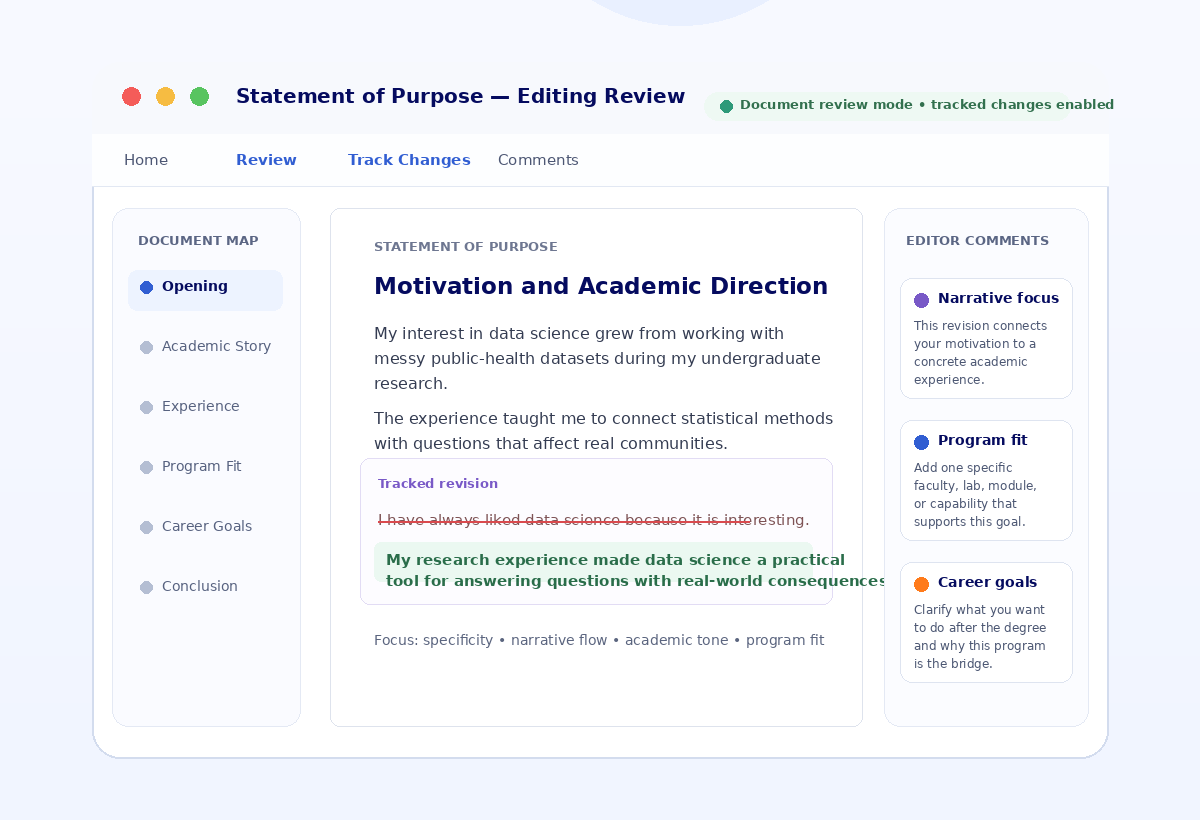
Before: I have always been interested in computer science because technology is important.
After: A campus accessibility project showed me how software design choices can directly shape whether people can use essential services.
Why it changed: The revision replaces a generic claim with a concrete experience and a clearer reason for the applicant’s interest.
Before: Your university is prestigious and has excellent professors, so it is my first choice.
After: The program’s applied analytics curriculum fits my goal of strengthening the bridge between statistical modelling and operational decision-making.
Why it changed: The revised sentence focuses on a relevant connection instead of relying on praise that could apply to many universities.
Before: After my degree, I want a good job and to become successful in my career.
After: After graduation, I plan to work in product analytics before moving toward roles that combine experimentation, customer insight, and product strategy.
Why it changed: The goal becomes more specific, sequential, and easier for an admissions reader to evaluate.
The editing approach is designed to improve the document without replacing the applicant. Your experiences, claims, and decisions remain yours; the editor focuses on how clearly and effectively they are communicated.
Share your draft, application prompt, word limit, and deadline so the editing scope can be reviewed.
Discuss Your RequirementIf your document needs a different level of intervention, these existing ContentXprtz editing services provide useful comparisons for language-focused, structural, developmental, or copy-editing requirements.
Compare the wider range of ContentXprtz editing options.
Explore →For developed academic documents needing language, clarity, tone, and consistency editing.
Explore →For deeper paragraph flow, organisation, expression, and presentation support.
Explore →For documents requiring major improvements in organisation, coherence, and argument presentation.
Explore →For higher-level guidance on organisation, idea development, sequencing, and manuscript effectiveness.
Explore →For structurally complete documents needing detailed sentence correction and style consistency.
Explore →Answers to common questions about the scope, process, documents, revisions, and practical requirements for SOP editing.
The service focuses on improving the clarity, structure, narrative flow, academic or professional tone, program-fit explanation, career-goal presentation, sentence quality, grammar, consistency, and overall readability of an existing Statement of Purpose. The precise scope depends on the condition of the draft and the editing depth agreed for the document.
Editing is intended to strengthen your own draft while preserving your experiences, intentions, voice, and factual claims. Where a passage is unclear or underdeveloped, the editor may suggest restructuring or leave a comment asking for information that only you can provide rather than inventing content on your behalf.
Yes. The opening can be reviewed for relevance, specificity, tone, and connection to the rest of the Statement of Purpose. Edits can reduce generic wording and help the introduction lead naturally into your academic background, experience, motivation, or future direction.
Yes, if your draft already contains the program-specific facts you want to use. The editor can improve how those details connect to your goals and background. If important information is missing, comments can identify where you may need to add accurate details about the curriculum, faculty, research environment, facilities, or other relevant program features.
The editing approach can be adapted to different application contexts, including undergraduate, postgraduate, MBA or professional programs, scholarships, and research-oriented applications. The emphasis changes according to the purpose of the document and the audience evaluating it.
The editing workflow is designed around transparent revisions. Tracked changes help you see wording and structural edits, while comments can explain important decisions, flag missing context, or identify areas where your own input is needed before the document is finalised.
Yes. Repeated ideas, abrupt transitions, weak sequencing, and disconnected paragraphs can be refined so the Statement of Purpose develops a more coherent progression from motivation and background to program fit and future goals.
Word-count reduction can be considered when you share the required limit and the current draft. The editor can tighten repetition and unnecessary wording, but any substantial removal of content should preserve the facts and priorities you want the application to communicate.
Yes. Language-level review can address grammar, spelling, punctuation, sentence clarity, awkward phrasing, word choice, consistency, and tone while keeping the document appropriate for an admissions audience.
Yes, but each Statement of Purpose should be treated as a separate document when the program, university, prompt, word limit, or required emphasis changes. Share the relevant instructions for every version so the differences can be handled accurately.
Send the latest editable draft together with the university or program name, the exact prompt or instructions, the required word or character limit, your deadline and time zone, and any specific areas you want the editor to review closely. If you have multiple versions, label them clearly.
The price and delivery schedule are confirmed after the draft and requirements are reviewed. Relevant factors can include the document length, the current condition of the writing, the depth of editing required, the number of versions, the application instructions, and the requested deadline.
Share the current draft, program information, prompt, word limit, deadline, and the areas you want improved. The scope, quote, and delivery schedule can then be assessed for your specific document.
The more precise your application context is, the easier it is to assess the editing depth without making assumptions about your goals or requirements.
Send the editable version you intend to work from.
Include the specific application destination for this version.
Copy the exact instructions, questions, or character limit.
State the actual submission deadline so feasibility can be reviewed.
Note concerns such as structure, clarity, fit, goals, tone, word count, or grammar.
Provide your contact details and document context below. You can share the actual file when the enquiry moves forward.
Get professional editorial support for narrative flow, program fit, goals, tone, clarity, and final presentation.