Environmental & Sciences
Environmental Sciences Research
This sample image could not be loaded. Please try again.
Environmental & Sciences

Get chapter-by-chapter guidance, supervisor-style insights, and reviewer-style feedback that help you strengthen your research, clarify your argument, respond to comments, and prepare your thesis for submission and defence.
Thesis Supervisor & Reviewer Support is priced from ₹7,500 per chapter or review cycle. The entry engagement covers chapter-level critical review together with research-question and argument feedback; work beyond that defined scope is assessed separately.
Full-thesis review, multiple supervisor cycles, viva preparation, detailed statistical review, or very long chapters require a broader quote. A shorter deadline for Thesis Supervisor & Reviewer Support can be assessed after the working files and requested scope are reviewed; accelerated delivery is confirmed only when feasible for that assignment.
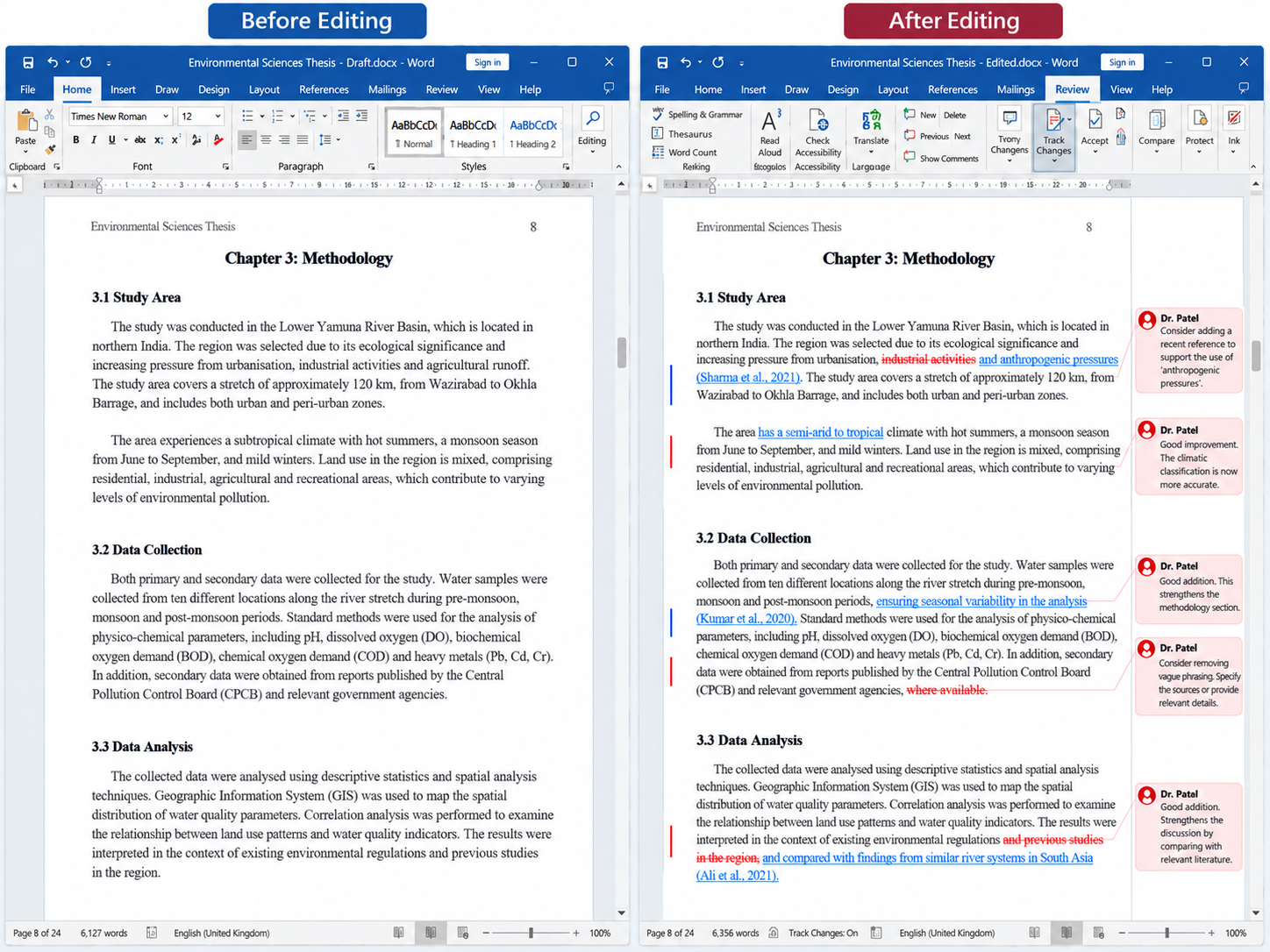
Choose a subject field on the left to view its corresponding before-and-after thesis sample. Each sample demonstrates reviewable improvements in language, structure, presentation and academic clarity while keeping the researcher’s original work and meaning central.
Environmental Sciences Research
Reviewer feedback often comes down to the same core issues: focus, coherence, evidence, methodological clarity, and presentation. We surface these issues in context so you know what to revise and why.
The rapid advancement of technology has significantly impacted consumer behaviour. This study aims to explore the factors affecting intention to use mobile payment systems among university students. Various factors such as ease of use, usefulness and security were examined. Data were collected via online survey and analysed using statistical methods.
The literature suggests several adoption drivers; however, the chapter must explain how the selected variables connect to the research questions. The relationship between the analysis method and the stated hypotheses should also be made explicit.
Support can be scoped around a specific chapter, a milestone, selected reviewer comments, or the complete thesis journey.
Research problem, objectives, feasibility, and scope.
Sharper questions and alignment to objectives.
Detailed feedback on purpose, flow, and organisation.
Themes, synthesis, gaps, and evidence integration.
Design, sampling, instruments, procedures, and rationale.
Result clarity, evidence use, and interpretation logic.
Connections to findings, literature, questions, and contribution.
Citation presentation, consistency, and guideline alignment.
Prepare explanations for methods, findings, limits, and contribution.
Choose developmental guidance when you are still building the thesis, critical reviewer-style assessment when you want a rigorous challenge, or combine both across different stages.
Helps you improve and build a stronger thesis over successive drafts.
Encourages logical progression of ideas across chapters.
Checks consistency between objectives, questions, methods, and claims.
Highlights unclear expression, weak transitions, and academic tone issues.
Supports revision and development across milestones.
Identifies strengths, weaknesses, gaps, and areas requiring defence.
Challenges methodology, analysis choices, and conclusion strength.
Flags unclear claims, unsupported statements, and likely reviewer concerns.
Checks whether claims and interpretations are supported by the cited evidence.
Helps prepare the thesis for supervisor, examiner, or external reviewer scrutiny.
Feedback can enter at one point or follow your thesis through multiple academic milestones.
Define scope, significance, feasibility, and research direction.
Build strong foundations and identify meaningful gaps.
Present research design, methods, and instruments clearly.
Explain results, patterns, and analytical choices accurately.
Interpret findings and connect them to literature and objectives.
Clarify contribution, limitations, implications, and future work.
Improve citation consistency and reference presentation.
Review final readiness and prepare for likely discussion areas.
Feedback is attached to specific text and organised into clear revision actions rather than delivered as vague general advice.
Several studies have investigated the relationship between social media use and academic performance among students. According to Smith (2025), time spent on social media can negatively affect concentration. However, some research argues that these platforms can also provide educational benefits if the purpose and context of use are clearly defined.
The use of social media is increasing rapidly. It is widely used by students for communication and entertainment. Many factors influence its impact. This section should move from broad description toward a clearer synthesis of themes, disagreement, and the specific gap the study will address.
Social media has both positive and negative effects on students. Many studies show different results. This study will examine these effects.
While social media affects educational outcomes differently across studies, the chapter now distinguishes patterns in concentration, collaboration, and study behaviour.
The revised paragraph synthesises evidence, identifies areas of disagreement, links the literature to the research question, and makes the chapter's contribution easier to evaluate.
A structured review sequence keeps scope, feedback, revisions, and final checks clear from the start.
Share the chapter or thesis, objectives, guidelines, and existing feedback.
We assess material, priorities, review depth, and the required engagement format.
Work is allocated according to subject fit and reviewer availability.
Text is reviewed in context with comments, questions, and revision actions.
Key issues are grouped into a practical revision roadmap and priority list.
Follow-up review can assess revisions and readiness before submission or viva.
Support is adapted to the thesis format, academic level, subject requirements, institutional guidance, and the type of feedback you need, subject to appropriate expert availability.
Depending on scope, the engagement may focus on annotated files, structured reviewer notes, chapter comments, revision planning, readiness checks, or viva preparation.
In-context notes, queries, and highlighted revision areas.
Summary of strengths, gaps, risks, and recommendations.
Line-level and section-level comments for each reviewed chapter.
Prioritised sequence of changes to guide your next draft.
Concise overview of major risks, strengths, and next actions.
Final checks against scope, consistency, and supplied requirements.
Every review is organised as a sequence of academic checks so feedback remains coherent instead of becoming a collection of isolated comments.
Our role is to provide structured feedback and academic review support while you retain authorship, research responsibility, and final decision-making.
Files are treated as unpublished academic material.
Work is shared only as needed for the selected engagement.
Review stages are managed through a controlled process.
Your ideas, research, and conclusions remain yours.
We provide feedback, not institutional approval or guaranteed outcomes.
Supervisor and reviewer support starts from ₹7,500 per chapter or review cycle. Full-thesis review, repeated feedback cycles, and deeper specialist review are quoted after the document and support depth are assessed.
Timelines depend on thesis length, complexity, review depth, and current reviewer availability. The schedule is confirmed after scope review.
Planned review for normal project schedules after material and scope have been assessed.
Faster scheduling for urgent needs where suitable reviewer capacity is available.
Review arranged around agreed thesis milestones or chapter-delivery stages.
Answers to common questions about scope, feedback style, academic boundaries, review depth, scheduling, and preparation for submission.
It is structured academic feedback that helps you evaluate chapter clarity, research alignment, methodology presentation, evidence use, argument flow, references, revisions, and submission readiness while you remain responsible for the research and final thesis.
Yes. The service can be scoped to a single chapter, selected chapters, milestone reviews, or a full-thesis assessment depending on your requirements.
Supervisor-style support focuses on developmental guidance, research alignment, structure, academic writing, and progressive improvement. Reviewer-style support focuses on critical assessment, methodological rigour, evidence strength, submission risks, and readiness for examination or external review.
No. This service provides independent academic feedback and revision guidance. It does not replace an appointed supervisor, examiner, institutional approval process, or the author's academic responsibility.
Yes, where the required subject expertise and materials are available. Review can assess clarity of research design, sampling, instruments, procedures, analysis presentation, interpretation, and alignment with the research questions without fabricating data or results.
Citation and reference consistency can be reviewed against the material and style guidance you supply. The review can flag missing, inconsistent, or unclear citation presentation for author correction.
Provide the chapter or thesis draft, your research questions or objectives, relevant supervisor or reviewer comments, institutional guidelines, citation style, and any specific concerns you want the reviewer to prioritise.
Yes. The service can help organise comments, identify required actions, map revisions to chapters, and improve the clarity of your response while the final academic decisions remain yours.
Viva or defence preparation can be included when requested, such as reviewing likely discussion areas, strengthening explanations of methods and findings, and preparing for questions based on your submitted thesis.
Pricing depends on the length and scope of the thesis or chapter, number of chapters, review depth, level of critique and detail required, deadline, and any additional support such as follow-up review or viva preparation.
The schedule is confirmed after the material and scope are reviewed. Timing depends on document length, complexity, review depth, current reviewer availability, and whether standard, priority, or milestone-based scheduling is requested.
No. The service provides independent feedback intended to help you strengthen the thesis and prepare more effectively, but academic approval, examination results, and viva outcomes are determined by your institution and examiners.
Share enough detail for us to understand the thesis stage, review depth, deadline, and the type of supervisor or reviewer support you need.
Proposal, chapter draft, complete thesis, revision stage, pre-submission, or viva preparation.
Briefly explain the subject area, research question, and methodology where relevant.
Include comments that need to be addressed, prioritised, or interpreted.
Provide university instructions, citation style, expected submission date, and any milestone constraints.
We will use your information to assess scope and scheduling. Pricing and turnaround are confirmed only after the material and requirements are reviewed.