Robotic language
Generic transitions, stiff constructions and predictable phrasing that make prose sound mechanical.

Reduce robotic phrasing, repetitive sentence patterns, awkward transitions and avoidable text overlap while preserving your ideas, evidence, citations and intended meaning.
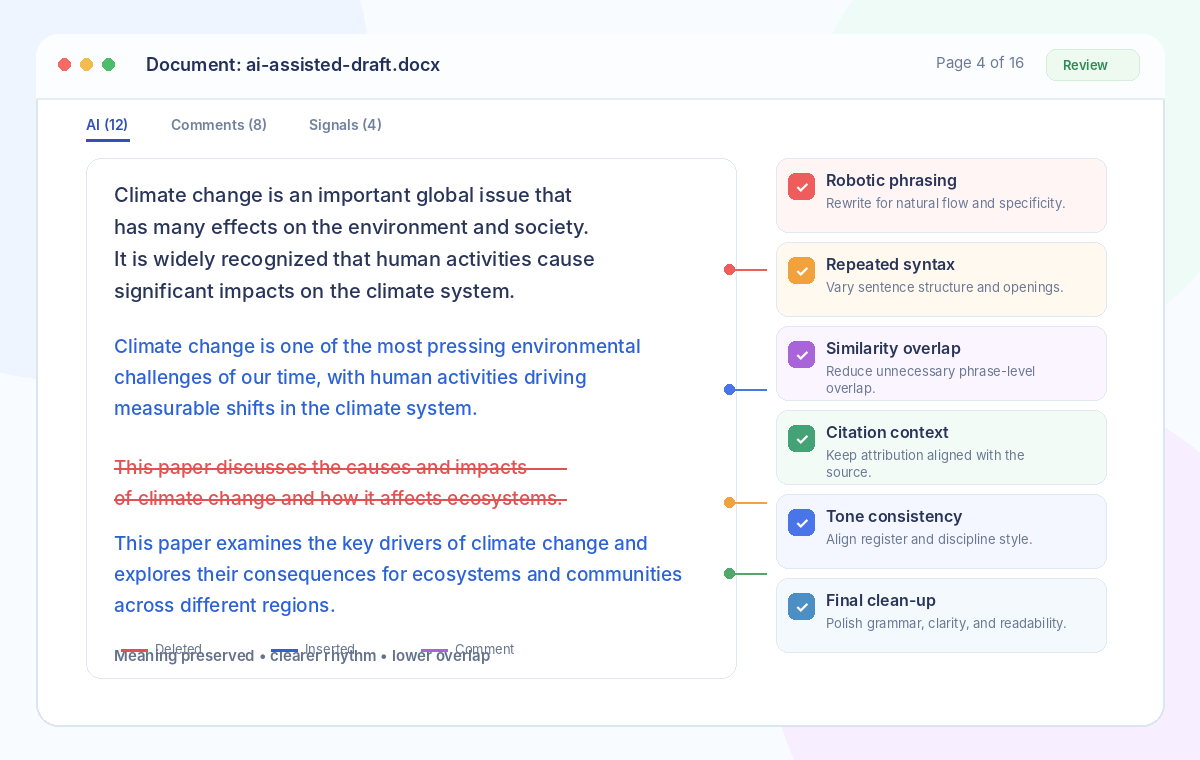
See revisions clearly and review every material edit.
Replace generic phrasing with context-specific, natural language.
Controlled file access and secure transfer practices for sensitive drafts.
Receive a polished copy alongside the tracked-changes version.
The starting price for AI & Similarity Revision is ₹2,500 per 1,000 words requiring revision. It provides a practical first scope for similarity and AI-flag review from the supplied report and human rewriting for clarity and natural expression without forcing larger assignments into a fixed package.
Heavy technical rewriting, missing citations, extensive source verification, very high flagged-word counts, or urgent delivery can change the quote. No detector score or plagiarism outcome is guaranteed. A shorter deadline for AI & Similarity Revision can be assessed after the working files and requested scope are reviewed; accelerated delivery is confirmed only when feasible for that assignment.
The review targets patterns that make writing feel formulaic, repetitive, overly similar to source phrasing or inconsistent with the document's intended voice.
Generic transitions, stiff constructions and predictable phrasing that make prose sound mechanical.
Repeated openings, sentence lengths, transitions or structures that flatten the natural rhythm of the document.
Unnecessary phrase-level overlap that can be rewritten without distorting the underlying idea or attribution.
It is important to note that climate change is a global issue. Many studies have shown that it affects the environment in many ways. In addition, researchers believe that more studies are needed to understand its impacts. The results indicate that the effects can be serious, but the passage does not yet explain which effects, for whom, or in what context.
Connections between sentences or sections that rely on filler rather than clear logical relationships.
Shifts between overly formal, conversational, vague or discipline-misaligned wording.
Attribution that no longer aligns cleanly with the revised sentence or surrounding claim.
A combined editorial pass addresses sentence patterns, similarity, tone, citation context and final polish rather than treating each issue in isolation.
Review robotic phrasing, repeated openings, formulaic transitions and predictable sentence rhythm.
Vary syntax, clause order, sentence length and transitions while keeping the original point intact.
Strengthen specificity, clarity and discipline-appropriate voice without flattening your authorial style.
Reduce avoidable wording overlap through genuine re-expression rather than surface-level synonym swapping.
Keep claims, quotations and attribution in context when surrounding wording is changed.
Proofread grammar, punctuation, terminology and local consistency after the deeper revision is complete.
The method focuses on how the writing actually reads: rhythm, specificity, transitions, clause balance, voice and contextual detail.
Mix sentence length and structure to avoid repeated templates and mechanically even pacing.
Replace vague claims with concrete details already supported by the document and its sources.
Use transitions that state the real logical relationship instead of filler connectors.
Adjust clause order and grouping where long, uniform sentence patterns reduce readability.
Recover a natural, credible register that fits the author's purpose and discipline.
Connect claims to the surrounding evidence, definitions and discussion already present in the draft.
This example illustrates the depth of revision: not just grammar correction, but more specific wording, varied syntax and clearer logical flow.
The rapid development of technology has had a significant impact on society. Technology plays a crucial role in our daily lives and has many benefits. However, there are also some challenges that come with its use. It is important to understand these impacts in order to create a better future.
Digital technology now shapes how people communicate, study and access information in everyday life. Its benefits include faster information exchange and wider access to services, but those gains also bring challenges such as privacy concerns, unequal access and changing digital-literacy demands. A clearer assessment therefore requires both the practical benefits and the social costs to be considered together.
The workflow keeps the revision transparent: you can inspect the editorial changes and also receive a clean version for your final review.
Artificial intelligence is becoming more popular in education. It has many benefits such as saving time and helping students learn better. Many schools are using AI tools to improve teaching and learning.
Artificial intelligence is increasingly integrated into education. It can reduce routine workload, support personalized learning and improve access to feedback, but those benefits depend on how tools are selected and used.
Artificial intelligence is increasingly integrated into education. It can reduce routine workload, support personalized learning and improve access to feedback, but those benefits depend on how tools are selected and used.
The AI and similarity service sits between final-stage language cleanup and broader advanced editing: it goes deeper than typo correction but remains focused on the wording and originality issues visible in the draft.
| Feature | Language Cleanup | AI & Similarity Review | Advanced Editing |
|---|---|---|---|
| Primary focus | Grammar & clarity | Natural wording & avoidable overlap | Deeper content improvement |
| Grammar & punctuation | ✓ | ✓ | ✓ |
| Sentence variation | Basic | Comprehensive | Expert-level |
| Originality improvement | Limited | High | Very high |
| Structural intervention | Minimal | Moderate | Extensive |
| Citation handling | Check obvious issues | Standardize context after rewrites | Rebuild & optimize presentation |
| Best for | Final polish | AI-assisted or high-overlap drafts | Complex manuscripts needing deeper intervention |
The review follows the document from front matter through the main discussion and supporting elements so tone, terminology and revision depth remain consistent.
A seven-step workflow takes the document from scope review to line-by-line revision, similarity and tone checks, quality control and final delivery.
Share your document and requirements.
Assess wording, similarity risk and revision depth.
Match the draft to a suitable editor.
Rewrite tracked passages and comments.
Reduce avoidable overlap and refine voice.
Proofread revisions and confirm consistency.
Receive both review-ready versions.
The delivery bundle keeps revisions transparent and gives you a clean file for final use.
The service can be applied to academic, professional and web-based documents when the main need is natural rewriting and similarity-aware review.
Unpublished or sensitive documents require careful handling. The service follows the same controlled document practices used across Contentxprtz editing workflows.
Document access is limited to the people involved in reviewing your request and carrying out the agreed editorial work.
Turnaround depends on word count, revision depth, similarity level and deadline. A specific delivery commitment is confirmed only after the document scope is reviewed.
Best for routine projects where the editor can complete the full review within a balanced workload.
For faster handling when the deadline is tighter and scope review confirms that priority scheduling is feasible.
For urgent deadlines, subject to document length, revision depth and editor availability at the time of review.
Share your deadline and requirements with the document; the review team will recommend the appropriate tier without inventing a delivery time before scope is known.
This service does not have a fixed catalogue price in the service scope, so the page uses a document-specific quote based on the actual work required.
Share the draft, approximate word count, deadline and main concerns. The document can then be assessed for revision depth before a quote is confirmed.
Request a Quote AI and similarity revision starts from ₹2,500 per 1,000 words requiring revision, with typical delivery in 3–4 business days; larger or technically complex files are quoted separately.These questions explain what the service changes, what it preserves and what to expect from scope review, delivery and document handling.
The service reviews robotic phrasing, repeated sentence patterns, awkward transitions, avoidable phrase overlap, tone inconsistency and citation-context issues. Delivery includes tracked revisions and a clean final document, with editorial comments where clarification is useful.
The revision is designed to preserve your intended meaning, argument and supporting references. Editors may flag passages that require author clarification rather than changing substantive claims without context.
Yes. The delivery workflow includes a tracked-changes file, a clean final file and editorial comments or notes where they help explain important revisions.
The editor keeps field-specific terminology in context and focuses on clarity, consistency, sentence structure and tone without replacing necessary technical language simply to make it sound different.
This service uses a custom quote rather than a fixed catalogue price. Scope is assessed using document length, language condition, revision depth, similarity risk, citation density and the requested turnaround tier.
The service follows the site's confidential document-handling process, including controlled file access and secure transfer practices. NDA requests can be raised for review when required.
The service supports essays and assignments, research papers, theses and dissertations, SOPs and personal statements, articles and blogs, business reports, website copy and technical documents.
Yes. You receive a tracked-changes version for transparency and a clean final file for your own final review or submission preparation.
No. AI-detection tools can disagree and change over time, so no specific detector score or “undetectable” result is guaranteed. The service focuses on genuine editorial improvement, specificity, natural phrasing and accurate attribution.
No. The service can reduce accidental or unnecessary wording overlap through genuine rewriting and can flag citation or quotation problems, but it is not intended to conceal copied material or misrepresent authorship.
Standard, Priority and Express review tiers are available as scope-dependent options. A specific delivery commitment is confirmed after the document length, revision depth and deadline are reviewed.
Provide the document or a clear description of it, approximate word count, purpose, deadline, citation style if relevant and any concerns about tone, repeated phrasing, similarity or sections that need deeper rewriting.
Share your document details and deadline. The team can review the likely revision depth, confirm feasibility and recommend the appropriate next step.
The more context you provide, the easier it is to assess the document accurately.
Essay, research paper, thesis, SOP, report, website copy or another document type.
Include the total length or the section range that needs review.
Tell us the deadline and whether Standard, Priority or Express handling is required.
Point out robotic phrasing, repeated syntax, similarity-heavy sections, tone issues or citation concerns.
Share journal, university, brand or style instructions that should be preserved.
Use the form to share your contact details, scope and optional draft file so the request can be reviewed for suitability, depth and deadline feasibility.