Unclear Review Scope
Questions, concepts or boundaries are too broad or poorly defined.

Build a stronger literature review with structured help across review questions, search planning, source screening, evidence organisation, thematic synthesis, gap mapping, citations and academic writing. The scope is tailored to your paper, thesis, dissertation or research project.
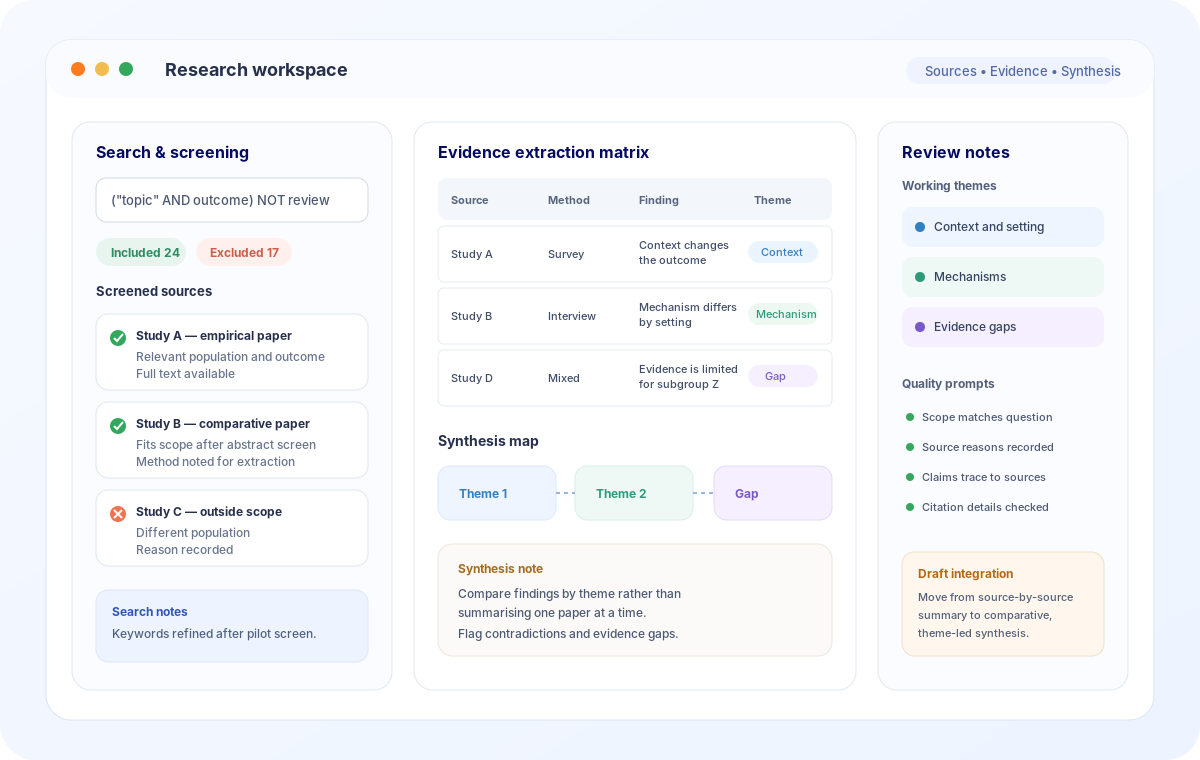
A defined Literature Review Research Support engagement starts at ₹7,500 for one defined search-and-evidence support module. At this level, the work includes review-question and scope refinement and keyword and database-search planning, plus the service-specific checks listed below.
Systematic-review protocols, high-volume screening, full-text extraction, bibliometric analysis, or multi-database reproducible searches are quoted separately. A shorter deadline for Literature Review Research Support can be assessed after the working files and requested scope are reviewed; accelerated delivery is confirmed only when feasible for that assignment.
A literature review is not just a collection of citations. The difficult work is defining scope, finding relevant evidence, judging what matters, connecting studies, and turning that evidence into a coherent academic argument.
Questions, concepts or boundaries are too broad or poorly defined.
Keywords, synonyms or database logic fail to capture relevant literature.
Too many papers are collected without a clear screening method.
Studies are listed one by one instead of compared and synthesised.
Contradictions, limitations and under-studied areas remain unclear.
In-text citations and references are incomplete or inconsistent.
Search, reading, synthesis and writing compete for limited time.
The review should move from isolated study summaries toward comparative synthesis by theme, with claims linked to evidence and clear gaps for future research.
Support can begin with a topic and early notes or focus on a specific stage where your review needs more structure, evidence organisation or academic presentation.
Refine topic, scope, concepts and review purpose.
Map keywords, synonyms, logic and source routes.
Organise inclusion, exclusion and source relevance.
Capture methods, findings, limitations and notes.
Group themes, compare evidence and map gaps.
Develop a coherent narrative around the evidence.
Review citations, references, structure and presentation.
The service can be adapted to different academic stages and document types while keeping the literature review question, evidence base and author requirements at the centre of the work.
Dissertation chapters, doctoral proposals and research manuscripts.
Theses, dissertations, capstones and academic research projects.
Journal papers, grant proposals and research background sections.
Evidence briefs, reports and structured research documents.
Collaborative reviews spanning more than one research domain.
A strong literature review connects sources around themes, agreements, disagreements and gaps. This illustrative example shows the type of structural change that can turn disconnected notes into a synthesis-led academic paragraph.
Theme-led organisation rather than a list of paper summaries.
Comparative language that shows where sources converge or differ.
Claims linked back to evidence and citations selected by the author.
Clearer route from existing evidence to the research gap.
The support journey is designed to make the research trail clearer: first organise the evidence, then synthesise it, then refine the review into an academically coherent section.
Sources may be relevant but the review is still fragmented.
Evidence is captured consistently and grouped around themes or review questions.
The literature review reads as a connected analysis rather than a bibliography in prose.
The exact combination depends on your manuscript, research stage and goals. The service can be scoped narrowly for one task or more broadly across several connected review activities.
A clear workflow keeps the review question, source set, deliverables and author expectations aligned from the beginning.
Send the question, brief, existing review, source list, requirements and deadline.
We identify the review stage, expected depth, source work and deliverables.
The project is matched to appropriate research and academic writing support.
Search planning, screening, extraction, synthesis or writing is completed to scope.
Evidence traceability, consistency, citations and agreed presentation points are reviewed.
You receive the agreed files, notes and action points for final author review.
Deliverables are confirmed before work begins and depend on the selected scope. Typical outputs can include the following review-support files.
Drafted or refined review section with visible editorial changes where applicable.
Structured source fields such as methods, findings, themes and limitations.
Summary of synthesis logic, gaps, questions and author-action points.
Source decisions or screening notes where that work is part of the agreed scope.
Search concepts, keywords, refinements and search-record notes where applicable.
Citation, reference and formatting observations included in the final review.
The review process is designed to make research decisions visible and checkable while keeping project materials limited to the work required for the agreed service.
Question, source set and deliverables align to the brief.
Terminology, themes and source notes remain coherent.
Agreed citation and reference presentation points are reviewed.
Outputs are checked against the confirmed scope before handoff.
Literature review methods and terminology vary by discipline, so the support approach should reflect the subject area, document type and requirements you provide.
Biology, biotechnology, genetics and related areas.
Clinical, public health, pharmacy and health research.
Civil, mechanical, electrical and related fields.
AI, data science, software, networks and cybersecurity.
Psychology, sociology, education and related research.
Finance, marketing, HR, operations and strategy.
Literature, philosophy, linguistics and cultural studies.
Sustainability, climate, ecology and policy research.
Literature review projects vary widely in source volume, research depth and writing requirements. This service therefore uses a custom, scope-based quote rather than a fixed catalogue price.
We assess your review question, source workload, manuscript stage and deadline before confirming the quote.
Request a Scope ReviewKey factors can include:
Availability is confirmed after the source set and scope are reviewed.
Important: no turnaround is fixed until the project requirements are assessed.
The value of the service is in making the review process more explicit, organised and academically coherent—not in replacing the researcher’s responsibility for evidence, interpretation or final submission decisions.
Review questions, boundaries and deliverables are clarified before work begins.
Search, screening and synthesis notes can remain visible and reviewable.
Evidence is organised to support a logical, literature-led academic narrative.
The review is structured around comparisons, patterns, contradictions and gaps.
Citation and reference presentation can be checked within the agreed scope.
Questions and author-action points are surfaced during the review process.
Common questions about scope, search planning, source screening, synthesis, citations, files, pricing, turnaround and author responsibility.
Support can include review-question refinement, search planning, keyword and concept mapping, source-screening organisation, evidence extraction, thematic or comparative synthesis, gap identification, literature review drafting or refinement, citation checks, formatting and review notes. Final scope is agreed from the material and requirements you provide.
Yes. Existing articles, notes, a reference list or a partially written literature review can be used as the starting point. The support can focus on organisation, evidence extraction, synthesis, gap mapping, writing or citation consistency according to the agreed scope.
Yes. Search-planning support can cover concepts, keywords, synonyms, inclusion and exclusion logic, database-selection considerations and a reproducible search record. Access to subscription databases or full texts may still depend on the resources available to you.
The emphasis is on synthesis rather than simply listing study summaries. Sources can be organised by themes, methods, findings, agreements, contradictions and gaps so the review develops a clear academic narrative.
Yes. The service can be scoped for thesis and dissertation chapters as well as research papers, journal manuscripts, proposals and other academic research documents.
The review can map under-studied themes, conflicting findings, methodological limitations and unanswered questions that are visible in the supplied or screened literature. Gap statements are tied to the evidence reviewed rather than invented independently of the sources.
Citation and reference support can be included within the agreed scope, including cross-checking in-text citations against the reference list, presentation consistency and style alignment where requirements are supplied.
Useful inputs include your topic or research question, assignment or journal requirements, academic level, existing manuscript or notes, source list or articles, preferred citation style, target word count and deadline.
This service uses a scope-based quote rather than a fixed page price. The quote depends on factors such as review depth, manuscript length, source volume, search or screening requirements, citation and formatting needs, discipline and deadline.
Turnaround is confirmed after the review scope, source volume and deadline are assessed. Standard, priority or express handling may be discussed where feasible, but no turnaround is fixed until the project requirements are reviewed.
The page is designed around confidential handling and scope-limited review. Share only the files needed for the project and use the enquiry form to discuss any special handling requirements before work begins.
You should review the delivered work, confirm interpretations against your sources and requirements, and make the final academic and submission decisions. The service is intended to support your research and writing process, not replace author responsibility.
Tell us where you are in the review process, what evidence you already have, what still needs to be done, and when you need the work. We can use those details to define a practical scope and quote.
Share your deadline and whether you are planning, screening, synthesising, drafting or revising.
Tell us what databases, articles, notes or reference lists you already have.
Include academic level, target word count, citation style and any assignment or journal instructions.
Identify whether you need search planning, screening, extraction, synthesis, writing, citations or a combined scope.