Unclear Research Questions
Research questions may be broad, weakly aligned to objectives, or difficult to answer with the planned study.

Get structured, chapter-by-chapter academic guidance and critical reviewer feedback across research questions, literature review, methodology, analysis, discussion, citations, formatting, and final submission readiness—while keeping your research, argument, and authorship under your control.
Dissertation Supervisor & Reviewer Support is priced from ₹7,500 per chapter or review cycle. The entry engagement covers chapter-level critical review together with research-question and argument feedback; work beyond that defined scope is assessed separately.
Full-dissertation review, multiple reviewer rounds, viva preparation, detailed statistical review, or very long chapters require a broader quote. A shorter deadline for Dissertation Supervisor & Reviewer Support can be assessed after the working files and requested scope are reviewed; accelerated delivery is confirmed only when feasible for that assignment.
Dissertation problems often connect across chapters. The review focuses on the logic between research questions, literature, methods, results, discussion, citations, and final presentation.
Research questions may be broad, weakly aligned to objectives, or difficult to answer with the planned study.
Chapters may read like separate pieces rather than one connected academic argument.
Important sources or themes may be missing, weakly synthesised, or insufficiently evaluated.
References may be incomplete, inconsistent, or not aligned to the required citation style.
Methods may not clearly justify the design, sampling, instruments, variables, or analysis approach.
Results may be difficult to interpret, connect to research questions, or explain in an academically defensible way.
Sentences may be unclear, overly long, repetitive, or inconsistent in academic tone.
Headings, numbering, tables, figures, captions, margins, and front matter can become inconsistent.
When time is short, the review needs clear priorities, a defined scope, and a practical author-action plan.
The review is designed around the dissertation lifecycle, from refining the research direction to checking the final document for clarity, consistency, and readiness.
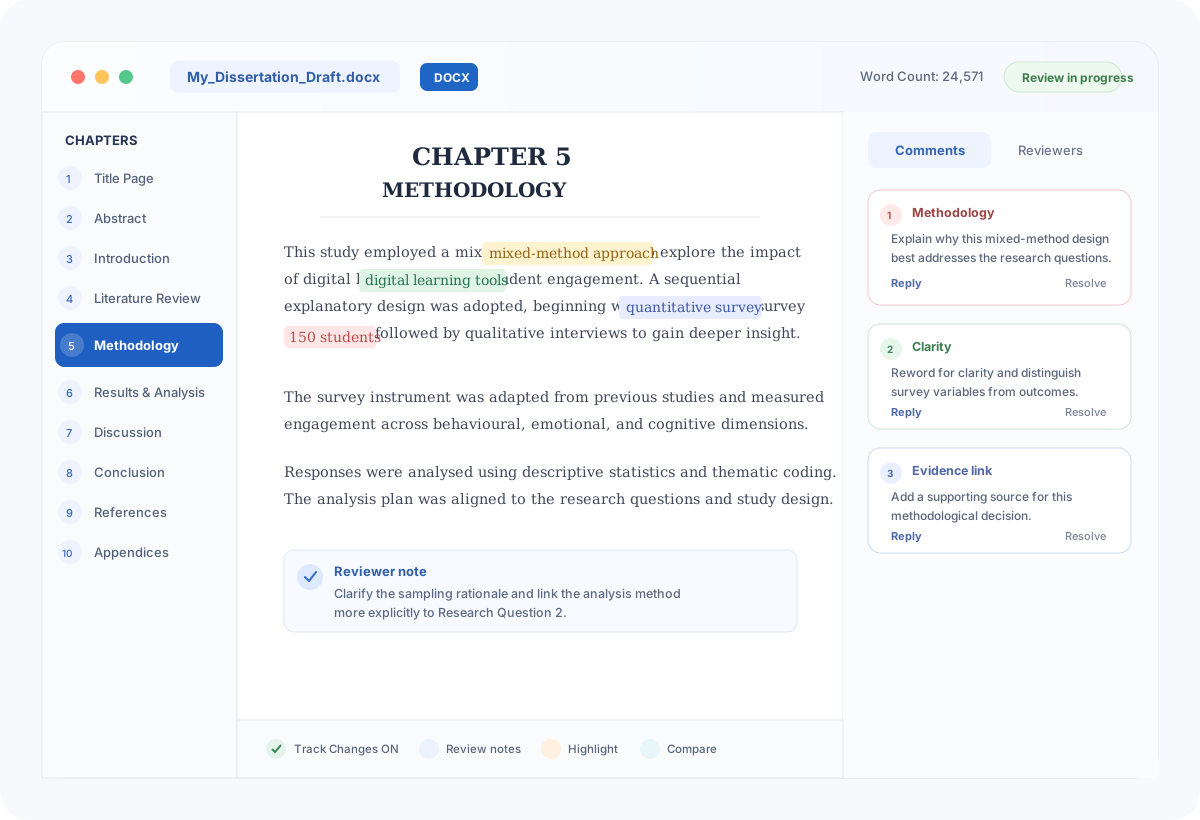
A dissertation review should make the author-action path visible. This example shows how clarity, academic tone, evidence alignment, and method consistency can be surfaced without hiding the reasoning behind the changes.
The results shows that there is a relation between the use of digital learning tools and the students engagement. Many students are happy with these tools and it helps them a lot in studies. The study was conducted with a sample of 150 students from different schools.
The results shows show that there is a significant relationship between the use of digital learning tools and student engagement. Many students are happy with reported that these tools supported their learning experience. The study was conducted with a sample of 150 students from the participating schools.
The results show a relationship between the use of digital learning tools and student engagement. Participants reported that these tools supported their learning experience. The study was conducted with a sample of 150 students from the participating schools.
Choose a broader dissertation review when the issue is not only language. Research direction, methodology, analysis, argument development, and chapter-level logic require a wider review lens.
| What You Need | Dissertation Supervisor & Reviewer | Editing Only | Proofreading Only |
|---|---|---|---|
| Research Direction & Structure | ✓ Full guidance | — | — |
| Literature Review Support | ✓ Strategy & synthesis | Limited | — |
| Methodology & Design Guidance | ✓ Design, sampling, instruments | — | — |
| Data Analysis Interpretation Help | ✓ Results logic & interpretation | Presentation | — |
| Results & Discussion Review | ✓ Interpretation & alignment | Language & flow | — |
| Chapter Development Feedback | ✓ Detailed reviewer comments | Editorial comments | — |
| Academic Editing & Clarity | ✓ Included in review | ✓ Core focus | Final corrections |
| References & Citations | ✓ Completeness & consistency | Presentation check | Obvious consistency |
| Formatting & Style | ✓ Dissertation-wide review | Formatting support | Basic consistency |
| Submission Preparation | ✓ Final checklist & readiness | Clean edited file | Clean proofread file |
The review can follow the whole dissertation or focus on selected chapters, depending on the stage of your work and the feedback you need.
Required front-matter details and presentation.
Purpose, method, results, and conclusion alignment.
Background, problem, aims, objectives, and questions.
Synthesis, critique, themes, evidence, and research gaps.
Design, sample, measures, procedures, ethics, and analysis.
Tables, figures, statistics, coding, and result narrative.
Interpretation, implications, literature links, and limits.
Key findings, contributions, limitations, and future work.
In-text and reference-list consistency and style.
Placement, numbering, captions, callouts, and consistency.
Supporting instruments, forms, data, and extra material.
Reviewer feedback is most useful when it identifies the issue, explains the academic reason, and gives the author a clear revision direction.
Digital learning tools have become increasingly prevalent in education, but their relationship with sustained engagement is not always defined consistently.
The present study therefore evaluates the impact of selected tools on behavioural, emotional, and cognitive engagement across participating students.
A mixed-method design was used to examine both measured patterns and participant explanations, linking the qualitative phase to the quantitative findings.
The chapter should distinguish findings from interpretation and avoid presenting a causal conclusion unless the design and evidence support it.
Where prior studies are compared, the discussion should explain why similarities or differences matter for the research questions rather than listing sources sequentially.
Limitations should be connected to sampling, measurement, context, and study design so the implications remain proportionate to the evidence.
The review is layered so major academic issues are addressed before final consistency and presentation checks.
Check research questions, objectives, chapter purpose, overall coherence, and the alignment between sections.
Review grammar, academic tone, sentence clarity, repetition, terminology, and readability.
Identify in-text/reference-list inconsistencies and chapter-to-chapter terminology or presentation differences.
Check headings, numbering, tables, figures, captions, front matter, appendices, and supplied university requirements.
Confirm unresolved comments, visible inconsistencies, missing elements, and author-action points before handoff.
Files and reviewer outputs are organised so you can see what changed, understand what still needs author attention, and continue revising efficiently.
Comments and in-line feedback on the submitted document or selected chapters.
Visible language or presentation changes where editing is part of the review.
A cleaner reading version after visible editorial markup has been accepted for the handoff copy.
Summary of recurring issues, high-priority concerns, and recommended author actions.
Reference, citation, style, and consistency issues identified during the review.
Document-level checks for headings, numbering, tables, figures, captions, and layout.
Guidance on areas that may need stronger paraphrasing, citation, synthesis, or author verification.
Comments on result presentation, interpretation, tables, figures, or analysis-to-question alignment.
A final author-facing list of unresolved items to confirm before submission.
The service is useful when you need more than a final language check and want structured feedback on research logic, chapter development, methods, interpretation, and academic presentation.
Support with structure, academic writing, research questions, and chapter coherence.
Guidance on literature, methods, analysis, discussion, and final presentation.
Detailed reviewer feedback on argument, methodology, evidence, consistency, and chapter flow.
Review of chapters being prepared in article-style or publication-oriented formats.
Support with academic clarity, terminology, sentence structure, and consistent formal tone.
Structured review when research is being completed alongside professional commitments.
Unpublished research can contain sensitive ideas, data, and intellectual work. The review workflow is designed around controlled access and confidential handling.
Encrypted upload or transfer methods can be used when files are exchanged through the service workflow.
Files are intended to be handled only by the people required for the assigned review process.
Your submitted dissertation, chapters, notes, and reviewer feedback are treated as confidential working material.
Research material is handled with the understanding that it may not yet be public, published, or submitted.
A non-disclosure agreement can be requested when your project or institution requires one.
Turnaround is confirmed after scope review. The practical review timeline depends on the size, depth, condition, and urgency of the dissertation material you submit.
Recommended for most projects where there is enough time for layered review and author revision.
For urgent timelines where the review scope can be prioritised around the most important chapters or issues.
For very urgent or time-sensitive needs, subject to the material, scope, reviewer availability, and current workload.
These questions explain what a dissertation supervisor and reviewer service can cover, what you should provide, and how the review differs from a basic final-stage proofread.
The service supports chapter-by-chapter academic review across research questions, literature review, methodology, data analysis interpretation, results, discussion, conclusion, citations, references, formatting, and final submission-readiness checks.
Yes. You can request focused review of a specific chapter or a broader review across multiple chapters, depending on the material you provide and the stage of your dissertation.
Where the review identifies issues that need author attention, comments can explain clarity, logic, methodology, evidence, structure, citation, formatting, or consistency points so you can revise with a clear rationale.
Yes. Methodology review can examine research design, sampling, instruments, variables, ethics-related presentation, analysis alignment, and the clarity with which methodological choices are explained.
Yes. Review can focus on whether results are presented clearly, interpretations are connected to the research questions, the discussion is logically developed, and claims are appropriately aligned with the reported evidence.
Citation and reference review can identify missing or inconsistent in-text citations, reference-list inconsistencies, and style or presentation issues when the required citation style or institutional guidance is supplied.
Yes. Formatting support can cover headings, numbering, tables, figures, captions, margins, spacing, front matter, references, and consistency with supplied university or departmental requirements.
No. Proofreading is primarily a final language and presentation check. Dissertation supervisor and reviewer support is broader and can include research logic, chapter structure, methodology, analysis interpretation, argument development, and author-action feedback in addition to language and presentation review.
Provide the dissertation or relevant chapters, your research questions or objectives, supervisor or university guidance where available, citation or formatting requirements, and any specific concerns you want the reviewer to prioritise.
Turnaround depends on the word count, number of chapters, topic complexity, data-analysis needs, formatting condition, current workload, and whether standard, priority, or express handling is required. The practical timeline is confirmed after the material is reviewed.
The workflow is designed around controlled file handling, limited access, confidential review, and protection of unpublished research material. An NDA can be requested where required.
No. The service provides independent academic review and guidance to help you improve your own work. Your university-appointed supervisor, research committee, examiner, and institutional requirements remain the authoritative academic decision-makers.
Share the stage of your dissertation, the chapters you want reviewed, your deadline, and any supervisor or university guidance. That information helps define a realistic review scope and turnaround.
Provide the current draft or the chapters that need review.
Include your topic, research questions or objectives, academic level, and discipline.
Share university instructions, supervisor comments, citation style, formatting rules, or marking criteria where available.
Tell us whether your main concern is structure, methodology, analysis, discussion, citations, language, formatting, or final readiness.
Provide enough information to assess review depth, chapter coverage, deadline feasibility, and the most suitable reviewer focus.