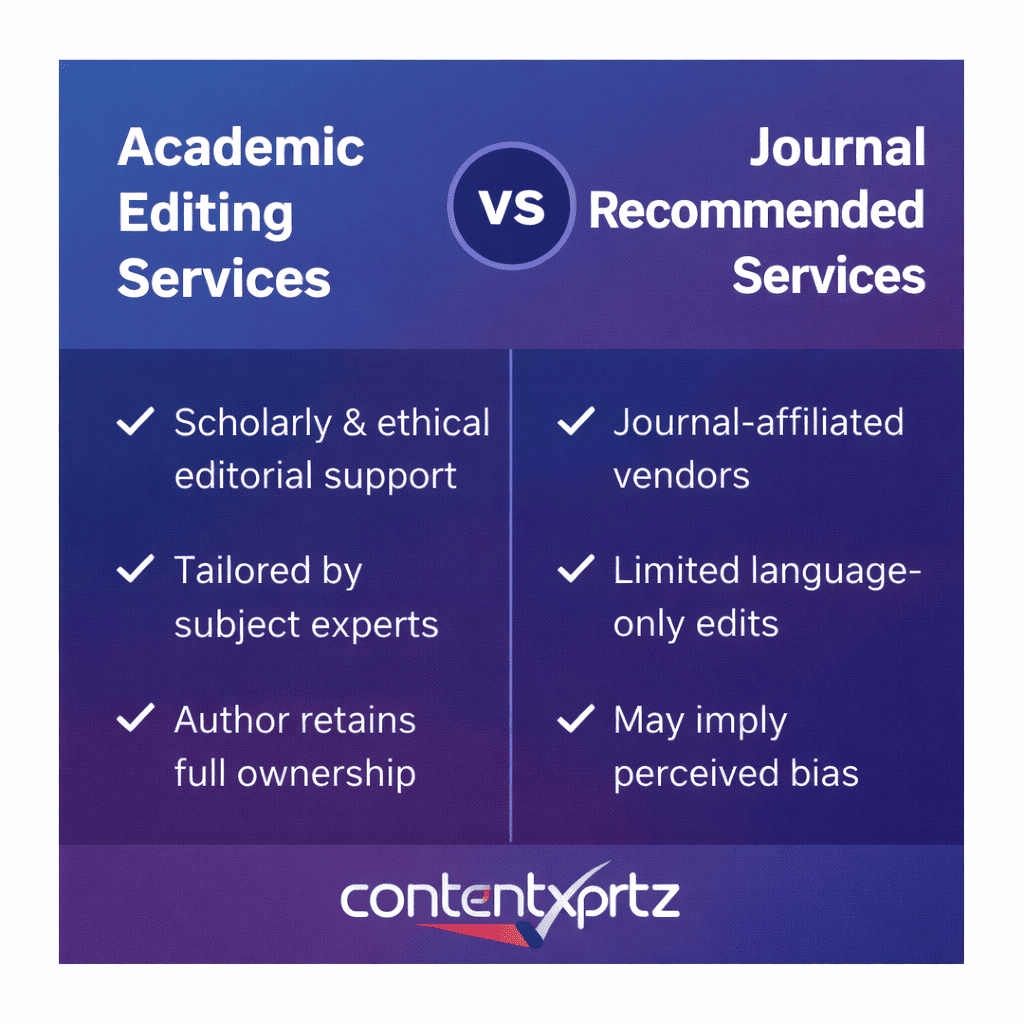

Academic Editing Services vs Journal-Recommended Services: Which Should Researchers Choose?
By Dr. Aanya Mehta
Research Writer & Professional Business Communicator
Choosing between academic editing services vs journal recommended services can be surprisingly confusing, particularly when a submission deadline is approaching and a journal has commented on language, clarity, formatting, or presentation. A researcher may wonder whether using the service mentioned on a journal or publisher website will improve the manuscript’s chances of acceptance—or whether an independent academic editing provider can offer equally suitable, or sometimes more tailored, support.
The most important point is simple: a journal-recommended or publisher-affiliated editing service does not normally give a manuscript preferential treatment in editorial decision-making. Springer Nature, for example, explicitly separates its editing services from journal editorial decisions and states that using those services does not imply that a paper will be selected for peer review or accepted. Individual Nature Portfolio journal pages similarly caution that language editing does not guarantee peer review or acceptance.
That means your decision should usually be based on the actual editorial support your manuscript needs—not on an assumption that one provider has an inside route to publication.
Independent academic editing services and journal-recommended services can both help researchers improve language, readability, consistency, organization, formatting, and scholarly presentation. The differences are more likely to involve scope, editor matching, price, turnaround time, revision policies, communication, subject specialization, and the degree of manuscript-development support available.
The right choice also depends on what your journal has actually said. A message such as “the English should be improved before further consideration” is different from an instruction to comply with a specific formatting requirement. Likewise, a journal that merely links to an editing provider is not necessarily requiring authors to use that provider.
Researchers should therefore read the journal’s instructions carefully, identify the manuscript problem, compare providers on substantive criteria, and retain full responsibility for the research and final submission. Professional editing should strengthen scholarly communication without taking ownership of the researcher’s intellectual contribution.
This guide explains how to make that decision responsibly.
Quick Answer: Academic Editing Services vs Journal-Recommended Services
Independent academic editing services are professional providers selected by the researcher. Depending on the service level, they may help with grammar, academic language, clarity, structure, logical flow, journal formatting, references, responses to reviewers, and other aspects of manuscript presentation.
Journal-recommended services are editing providers mentioned, linked, suggested, affiliated with, or operated by a journal or its publisher. The precise relationship varies. Some are publisher-owned services, while others may simply appear among resources offered to authors.
The critical distinction is that being recommended, affiliated, or linked by a journal does not mean the service controls the journal’s editorial decision. Springer Nature states that its editorial and author-service functions are independent, while Nature journal guidance notes that using language editing does not guarantee acceptance.
Therefore, do not choose an editing provider because you believe payment will influence acceptance. Choose based on:
- The type and depth of editing required
- Subject-area expertise
- Understanding of your target journal
- Editor qualifications and quality controls
- Ethical editing boundaries
- Confidentiality provisions
- Revision or re-editing arrangements
- Turnaround time
- Cost and value
- Your ability to communicate with the editor or support team
If your research paper needs detailed academic-language and structural editing rather than basic proofreading, a specialist research paper editing service may be appropriate, provided the service respects authorship, research integrity, and your responsibility for the final manuscript.
Key Takeaways
- A journal recommendation is not the same as an acceptance advantage. Editorial decisions should remain independent of paid editing services.
- Independent and publisher-affiliated editing services can both be legitimate choices; evaluate the actual service rather than relying on the label.
- Determine whether you need proofreading, language editing, structural editing, scientific or academic editing, formatting, or submission support before comparing providers.
- Never interpret paid editing as a substitute for research quality, sound methodology, originality, appropriate journal fit, or a convincing scholarly contribution.
- Researchers should retain control over arguments, data, results, interpretation, citations, and final wording.
- Check your target journal’s current author instructions because requirements for language assistance, acknowledgements, AI use, formatting, and disclosures can vary.
- Ethical editing should improve communication without secretly replacing the researcher’s intellectual work.
What This Page Covers
This guide explains:
- What “journal-recommended editing service” actually means
- How independent academic editing differs from publisher-linked services
- Whether using a recommended service improves acceptance chances
- How to compare quality, price, expertise, confidentiality, and revisions
- When basic language editing is enough—and when deeper academic editing may help
- Ethical boundaries surrounding professional editing
- Practical scenarios involving first submission, revision, and journal language comments
Table of Contents
- Methodology and Academic Sources
- What Are Academic Editing Services?
- What Are Journal-Recommended Editing Services?
- Academic Editing Services vs Journal-Recommended Services
- Does a Journal-Recommended Service Improve Acceptance Chances?
- Why Journals Recommend Language or Editing Support
- What Type of Editing Does Your Manuscript Need?
- How to Compare Editing Providers
- Ethical Issues Researchers Should Check
- Three Practical Researcher Scenarios
- Common Mistakes When Choosing an Editing Service
- Checklist Before Purchasing Academic Editing
- How Contentxprtz Can Support Researchers
- Summary
- Frequently Asked Questions
- About the Author
- Conclusion
Methodology and Academic Sources
This guide combines established scholarly-editing principles with current guidance from recognized publishing and editorial organizations.
Relevant references include the International Committee of Medical Journal Editors, which distinguishes authorship from activities such as writing assistance, technical editing, language editing, and proofreading; official Springer Nature Editing Service policies describing editorial independence; and author-service guidance published by Nature Portfolio journals.
The ICMJE also emphasizes human responsibility, transparency, accuracy, and confidentiality where artificial intelligence is used in scholarly publishing. Researchers using AI-assisted or human-plus-AI editing should therefore check their target journal’s current disclosure requirements.
No single rule applies to every discipline or journal. Always check the specific journal’s Instructions for Authors, editorial policies, and applicable institutional requirements before submission.
What Are Academic Editing Services?
Academic editing services help researchers improve the way scholarly work is communicated.
The exact scope varies considerably. One provider may offer straightforward English-language correction, while another may provide detailed academic editing that examines clarity, argument flow, terminology, consistency, organization, journal style, tables, references, and areas where the author’s intended meaning is unclear.
Typical academic editing may address:
- Grammar and syntax
- Spelling and punctuation
- Academic tone
- Sentence clarity
- Word choice
- Conciseness
- Logical transitions
- Terminology consistency
- Paragraph construction
- Abstract presentation
- Heading structure
- Internal consistency
- Journal-specific style
- Reference formatting
- Figure and table language
- Reviewer-response language
More extensive academic or scientific editing may also flag weaknesses in presentation, such as an unclear research rationale, unsupported transitions between claims, inconsistency between the abstract and main manuscript, or discussion sections that do not clearly distinguish findings from interpretation.
However, responsible editing should not fabricate results, invent references, manufacture arguments, alter data, or assume intellectual ownership of the work.
Springer Nature’s published ethical standards, for example, explain that its editors do not add substantial novel content and encourage authors to critically review suggested edits rather than surrender control of the manuscript.
Independent Does Not Mean Unregulated or Inferior
An independent editing provider is simply one that you choose outside the journal’s own author-service pathway.
Its quality should be judged on evidence such as:
- Relevant editor expertise
- Transparent scope
- Editing samples
- Quality-control procedures
- Confidentiality terms
- Revision conditions
- Clear distinction between editing and authorship
- Ability to work to journal requirements
- Responsiveness to author questions
The word “independent” tells you little about quality by itself. Some independent academic editing companies specialize deeply in particular disciplines or manuscript types, while others provide broad proofreading.
The correct question is therefore not, “Is the service independent?”
It is:
“Can this service ethically provide the specific editorial intervention my manuscript needs?”
What Are Journal-Recommended Editing Services?
A journal-recommended editing service is a provider that appears in a journal’s or publisher’s author guidance as an option for researchers who want assistance with manuscript preparation.
But “recommended” can describe several different relationships.
A service may be:
- Operated by the same publishing group.
- An affiliated author-service business.
- A commercial partner linked from the journal website.
- One provider among several suggested options.
- Simply mentioned as an example of professional language support.
These arrangements should not automatically be treated as equivalent.
For example, Springer Nature describes its editing service as separate from journal editorial decision-making and states that it does not guarantee publication. A Springer Nature support page specifically addresses situations where a Nature editor suggests language improvement and confirms that subsequent use of its editing service still does not guarantee peer review or acceptance.
Likewise, individual Nature Portfolio journals state that professional language editing may help authors improve English clarity while noting that use of such services does not guarantee selection for peer review or acceptance.
That distinction matters greatly.
A journal may recommend that the manuscript’s language be improved without requiring you to purchase editing from a particular company.
Always read the wording carefully.
Academic Editing Services vs Journal-Recommended Services: Detailed Comparison
The following comparison focuses on practical considerations rather than assuming that either category is universally superior.
| Factor | Independent Academic Editing Service | Journal-Recommended or Publisher-Linked Service |
|---|---|---|
| Who selects it? | Researcher chooses from the wider market | Researcher selects an option mentioned by the journal or publisher |
| Editorial relationship | Normally separate from the journal | May be affiliated with the publisher, but editorial independence should still apply |
| Acceptance advantage | Should not be expected | Should not be expected |
| Service range | May range from proofreading to intensive academic editing | Depends on provider; often language, scientific, formatting, or author support |
| Subject matching | Varies by provider | Varies by provider |
| Journal formatting | Often available | Often available |
| Communication model | May permit direct or mediated editor communication | Depends on service |
| Turnaround options | Often flexible | Depends on provider |
| Pricing | Competitive market; highly variable | Provider-specific |
| Re-editing policy | Varies | Often stated in formal service terms |
| Confidentiality | Must be checked before submission | Must also be checked |
| Best reason to choose | Service scope, expertise, quality, value | Suitable service scope and confidence in provider—not assumed editorial influence |
The practical takeaway is straightforward: compare the service itself, not the prestige of the logo beside it.
A publisher-associated provider may offer excellent editing. An independent academic editing service may also offer excellent editing. Neither label proves that the underlying service is the right fit for your manuscript.
Does Using a Journal-Recommended Editing Service Increase Acceptance Chances?
Not in the sense that researchers sometimes assume.
Professional editing can make a manuscript easier to read and evaluate. Clearer language can help editors and reviewers understand your research without being distracted by avoidable communication problems.
But acceptance depends on much more than language.
Journal editors and peer reviewers may consider factors such as:
- Fit with journal scope
- Importance of the research question
- Originality
- Methodological appropriateness
- Reliability of analysis
- Strength of evidence
- Ethical compliance
- Interpretation of findings
- Engagement with relevant literature
- Reporting quality
- Editorial priorities
Nature Portfolio author guidance states explicitly that using a language editing service does not guarantee peer review or acceptance. Springer Nature likewise states that its journal decisions are independent of whether a paper has been edited by its editing service.
This is an important safeguard for researchers.
Editing can improve presentation.
Editing cannot turn weak research into strong research.
Paying a publisher-linked service should not buy editorial preference.
If any company claims that paying for editing will guarantee acceptance by a specific reputable journal, treat that claim with considerable caution.
Why Do Journals Recommend Language or Editing Support?
Journals want reviewers to be able to understand the research they are evaluating.
Writing problems can make otherwise meaningful work difficult to assess. The issue may be particularly relevant for researchers working in an additional language, although native English-speaking researchers can also need substantial editing.
Nature Portfolio guidance for some journals encourages authors experiencing language difficulties to consider approaches such as colleague review, language-learning resources, or professional editing. The same guidance separates improved communication from any promise of publication.
Wiley’s peer-review guidance also identifies poor writing quality as a potential problem when language or presentation prevents reviewers from adequately assessing the underlying work.
Therefore, when an editor says your manuscript requires language improvement, the message usually deserves attention.
But ask what kind of improvement is actually necessary.
A manuscript may need:
- Basic proofreading
- ESL language editing
- Academic style refinement
- Substantive editing
- Structural improvement
- Technical terminology review
- Journal formatting
- Reference correction
- Scientific presentation feedback
Choosing the correct level of intervention is often more important than choosing the provider whose name appears first on an author-services page.
What Type of Editing Does Your Manuscript Actually Need?
Before comparing providers, diagnose the manuscript.
1. Proofreading
Proofreading is appropriate when the manuscript is already well written and mainly requires final correction.
Typical issues include:
- Typos
- Punctuation
- Spelling
- Minor grammar
- Formatting inconsistencies
Proofreading is usually insufficient when arguments are difficult to follow or sentences require substantial rewriting.
2. Language Editing
Language editing goes beyond typo correction.
It may improve:
- Grammar
- Syntax
- Word choice
- Sentence construction
- Academic tone
- Readability
- Concision
- Consistency
This may be suitable when a journal specifically comments that the English requires improvement.
3. Academic or Substantive Editing
Academic editing may be more appropriate when language problems interact with scholarly presentation.
For example:
Original:
“The results are very important and show many things about the problem which was not clear from previous researchers.”
Improved presentation:
“The findings clarify an aspect of the problem that has received limited attention in previous studies.”
The editor has improved precision and academic tone without inventing a finding.
Substantive editing may additionally highlight:
- Repetitive argumentation
- Poor section sequencing
- Unclear research rationale
- Weak transitions
- Inconsistent terminology
- Overstatement
- Ambiguous interpretation
The researcher must still decide whether each change accurately represents the research.
4. Journal Formatting
Formatting support focuses on conformity with journal instructions.
It may cover:
- Reference style
- Heading hierarchy
- Tables
- Figures
- Word limits
- Abstract format
- Citation style
- Manuscript layout
Formatting can save time, but it does not replace intellectual or language editing.
5. Reviewer-Response Editing
After peer review, authors may need help expressing responses clearly and professionally.
An editor can help improve phrases such as:
Weak:
“We disagree because reviewer does not understand our work.”
More appropriate:
“We appreciate the reviewer’s concern. We have clarified this point in the revised Methods section and explain below why the original analytical approach was retained.”
The underlying scientific response must remain the researcher’s responsibility.
How to Compare Academic Editing Services and Journal-Recommended Providers
Instead of making the decision on brand recognition alone, use a structured evaluation.
Step 1: Identify Why You Need Editing
Start with the journal’s exact feedback.
Was the concern:
- Grammar?
- Readability?
- Organization?
- Scientific presentation?
- Formatting?
- References?
- Response to reviewers?
Do not pay for a broad package when you need one focused service—or choose proofreading when the manuscript actually requires deeper editing.
Step 2: Check the Scope of Editing
Ask what the service actually changes.
Look for clear explanations covering areas such as:
- Grammar
- Syntax
- Academic tone
- Logical flow
- Consistency
- Journal formatting
- References
- Abstract
- Cover letter
- Reviewer responses
Ambiguous labels such as “premium,” “advanced,” or “publication-ready” are less useful than a precise description of the editorial work.
Step 3: Examine Subject Expertise
A manuscript in cardiology, machine learning, finance, linguistics, or qualitative education research may require different editorial knowledge.
Subject expertise becomes particularly important when the editor needs to distinguish between a language problem and legitimate discipline-specific terminology.
Ask:
- How is the editor matched to the manuscript?
- Does the editor understand the field?
- Does the service distinguish language intervention from technical judgment?
- Can the editor flag ambiguity without silently changing scientific meaning?
Step 4: Check Whether Changes Are Reviewable
Researchers should be able to examine substantive editorial changes.
Tracked changes, comments, queries, or another transparent revision system allows the author to:
- Accept appropriate changes
- Reject inaccurate changes
- Clarify technical meaning
- Restore discipline-specific wording
- Learn from recurring language problems
Professional editing is most useful when it supports author judgment rather than replacing it.
Step 5: Assess Confidentiality
Unpublished research may contain:
- Novel findings
- Patient or participant information
- Commercially sensitive material
- Patent-related information
- Confidential datasets
- Grant proposals
- Unpublished methods
Read the provider’s confidentiality and data-handling policies before uploading a document.
AI-assisted services deserve additional attention. The ICMJE’s current guidance stresses confidentiality, transparency, and human responsibility in AI use and warns against placing confidential manuscript material into systems where confidentiality cannot be assured.
Step 6: Understand Re-Editing Policies
A manuscript often changes after:
- Co-author review
- Supervisor feedback
- Peer review
- Journal transfer
- Statistical revision
Check whether the provider offers:
- Free re-editing
- Limited-duration revisions
- Paid additional rounds
- Editing only on unchanged text
- Post-review support
Read the exact conditions rather than assuming that “unlimited revision” covers every kind of rewrite.
Step 7: Compare Cost With Scope
The cheapest service may be adequate for a nearly final manuscript.
It may be poor value if your document actually needs intensive academic editing.
Likewise, an expensive publisher-associated service may be unnecessary if you only need a final proofread.
Compare:
Cost → scope → editor expertise → revision policy → turnaround → expected usefulness
rather than cost alone.
Ethical Academic Editing: Where Should the Boundary Be?
Responsible academic editing improves communication while preserving authorship and research ownership.
The ICMJE lists writing assistance, technical editing, language editing, and proofreading among contributions that, by themselves, do not qualify a person for authorship. Journals may nevertheless have requirements about acknowledgements or contributor disclosures, so authors should check applicable policies.
Ethical editing may reasonably help with:
- Language
- Grammar
- Structure
- Readability
- Consistency
- Presentation
- Formatting
- Identifying unclear passages
- Flagging unsupported wording for author review
It should not become concealed authorship or fabrication.
Researchers should remain responsible for:
- Research design
- Data
- Analysis
- Results
- Interpretation
- Claims
- Citations
- Conclusions
- Final submission
The World Association of Medical Editors has similarly emphasized transparency regarding substantive writing assistance and warns against undisclosed ghostwriting.
What About AI-Assisted Editing?
AI can help with certain language tasks, but the researcher remains accountable for the resulting manuscript.
The ICMJE states that humans are ultimately responsible for checking the accuracy and validity of AI-assisted content and calls for transparency about AI use. Journal policies may differ on what must be disclosed.
Before using any AI-assisted editing service, consider:
- Does the journal permit the proposed use?
- Must it be disclosed?
- How is unpublished material handled?
- Is manuscript content used for model training?
- Will a human editor verify the output?
- Could technical terminology be changed incorrectly?
- Are references or claims being generated rather than merely edited?
Never assume that fluent AI-generated prose is factually correct.
Three Practical Examples
Example 1: A Journal Says the English Must Be Improved
Situation
A doctoral researcher submits a biomedical paper. The editor responds before peer review:
“Please improve the English language throughout the manuscript before resubmission.”
The journal’s author page includes a link to a professional editing service.
The researcher’s confusion
The researcher assumes that paying for the linked service will make the journal more likely to send the manuscript for peer review.
Better approach
The author should first separate two issues:
- The manuscript genuinely needs language improvement.
- The linked provider is one possible way of obtaining that improvement.
The author can check whether the journal explicitly requires a particular service. In many cases, it does not.
Nature Portfolio journal guidance illustrates this distinction by discussing professional language editing while explicitly warning that using such a service does not guarantee peer review or acceptance.
Practical decision
Compare the recommended provider with suitable independent services based on:
- Biomedical editor expertise
- Editing depth
- Turnaround
- Confidentiality
- Price
- Re-editing arrangements
Then select the service that best addresses the language problem.
Example 2: The English Is Correct but the Paper Is Hard to Follow
Situation
An early-career management researcher receives supervisor feedback:
“The grammar is acceptable, but the paper lacks flow. The literature review is repetitive, and the discussion does not clearly connect the findings with the research questions.”
Common mistake
The researcher buys basic proofreading because it is cheaper.
The manuscript returns with corrected punctuation and a few revised sentences—but the central problems remain.
Better approach
This manuscript requires more than proofreading.
A suitable academic editor might:
- Identify repetitive passages
- Improve transitions
- Flag unclear argument sequencing
- Highlight inconsistent terminology
- Query ambiguous statements
- Improve academic tone
- Check whether the discussion clearly communicates the author’s intended argument
The researcher then evaluates every substantive change.
Why this matters
The distinction is not between “journal service” and “outside service.”
It is between the wrong editorial intervention and the right one.
A specialized academic editing service may be more appropriate when the problem involves scholarly communication beyond grammar alone.
Example 3: A Revised Manuscript Needs Reviewer-Response Support
Situation
A researcher receives major revisions with comments from three reviewers.
The research itself can address the requested changes, but the author’s response letter has become defensive, repetitive, and difficult to follow.
Common concern
The researcher wonders whether using the publisher’s editing provider is safer because the paper is already under consideration.
Better approach
The key requirement is a service capable of handling revision-stage academic communication.
An editor may help the researcher:
- Structure point-by-point responses
- Improve professional tone
- Clarify where changes were made
- Remove emotionally defensive wording
- Keep terminology consistent between the response and manuscript
- Flag responses that appear incomplete
The editor should not invent scientific answers to reviewer criticisms.
Why the revised approach works
Reviewer-response editing strengthens communication while leaving scientific decisions with the authors.
If revisions significantly affect the manuscript itself, researchers may also consider appropriate research paper editing support after making their substantive changes.
Common Mistakes When Choosing an Editing Service
Mistake 1: Assuming “Recommended” Means “Required”
A journal may provide a resource without requiring its use.
Better approach: Read the exact author instruction.
Mistake 2: Assuming the Service Influences the Editor
Publisher-linked services should operate independently from editorial decisions.
Better approach: Evaluate editing on its merits, not on presumed access to journal editors. Springer Nature explicitly states this independence.
Mistake 3: Buying Proofreading for a Structural Problem
Grammar correction cannot repair an unclear argument.
Better approach: Diagnose the manuscript before purchasing.
Mistake 4: Choosing Only by Price
A lower quotation may reflect a narrower scope.
Better approach: Compare equivalent levels of editing.
Mistake 5: Ignoring Subject Expertise
An otherwise competent language editor may misinterpret technical language.
Better approach: Check how editors are matched to disciplines.
Mistake 6: Allowing an Editor to Change Scientific Meaning
A smoother sentence is not an improvement if it becomes scientifically inaccurate.
Better approach: Review every meaningful editorial change.
Mistake 7: Expecting Editing to Fix Research Problems
Editing cannot substitute for inadequate methods, unsupported conclusions, unreliable data, weak novelty, or poor journal fit.
Better approach: Resolve research-level concerns with appropriate scholarly or methodological expertise.
Mistake 8: Ignoring Confidentiality
Uploading unpublished research without understanding data handling can create avoidable risks.
Better approach: Review confidentiality terms before sharing files.
Mistake 9: Treating Editing as Ghostwriting
The researcher must remain intellectually responsible for the paper.
Better approach: Use editing to improve communication—not to outsource authorship.
Before-and-After Examples of Appropriate Academic Editing
Example A: Overstatement
Weak:
“Our experiment unquestionably proves that this technique is the best solution for the industry.”
Improved:
“Our findings suggest that the technique may offer advantages under the conditions evaluated in this study.”
Why it is stronger:
The revision uses wording that can be better aligned with the actual evidential limits of a study. The author must still confirm that the revised statement accurately represents the results.
Example B: Unclear Research Purpose
Weak:
“This study is about many problems students experience and different things that can influence them.”
Improved:
“This study examines factors associated with postgraduate students’ engagement with online learning.”
Why it is stronger:
The revised sentence is more specific and easier for a reader to interpret.
Example C: Defensive Reviewer Response
Weak:
“The reviewer is wrong because our method has already been explained.”
Improved:
“We appreciate the reviewer highlighting this issue. We have expanded the Methods section to clarify the rationale for our analytical approach.”
Why it is stronger:
The revision communicates the author’s response professionally without conceding a scientific point unnecessarily.
Decision Guide: Which Service Should You Choose?
Consider the following practical sequence.
Choose an independent academic editing service when:
- You want to compare several providers.
- You need a specialist in your discipline.
- You require a particular depth of academic editing.
- You need tailored support across manuscript stages.
- Price or turnaround flexibility matters.
- You have identified a provider whose scope closely matches your needs.
Consider a journal- or publisher-recommended service when:
- Its editing level suits your manuscript.
- Its editor-matching process fits your discipline.
- Its price and turnaround work for you.
- You are satisfied with its confidentiality terms.
- Its revision policy meets your needs.
- You prefer the service for quality or convenience—not because you expect editorial advantage.
Consider self-editing or colleague review when:
- The manuscript is already strong.
- Problems are minor.
- A qualified colleague can provide objective feedback.
- You have enough time for several revision rounds.
- Journal feedback does not indicate substantial language problems.
There is no academic reason to purchase more intervention than your manuscript requires.
Checklist: Before Paying for Academic Editing
Use this checklist before making a decision.
- Have I identified exactly what is wrong with the manuscript?
- Have I read the target journal’s current Instructions for Authors?
- Does the journal actually require a service, or merely suggest language improvement?
- Am I comparing equivalent editing levels?
- Does the provider explain what editors will and will not change?
- Can the provider match my manuscript with appropriate subject expertise?
- Will I receive changes in a form I can review?
- Does the service preserve my responsibility for scientific content?
- Are confidentiality and data-handling terms clear?
- If AI tools are used, do I understand how my manuscript data will be handled?
- Have I checked whether my journal requires disclosure of AI or professional editorial assistance?
- Does the service offer an appropriate revision or re-editing policy?
- Is the turnaround realistic for my submission deadline?
- Does the price correspond to the actual scope?
- Have I avoided any provider promising guaranteed journal acceptance?
If several answers are “no,” investigate further before uploading your manuscript or making payment.
How Contentxprtz Can Support Researchers
Researchers who already have ownership of their study, arguments, data, interpretation, and conclusions may sometimes benefit from professional help communicating those ideas more clearly.
Contentxprtz positions its academic support around areas such as language editing, clarity, structural review, proofreading, and alignment across manuscript components while preserving the researcher’s responsibility and original intellectual contribution.
Depending on the document and stage of work, relevant options may include:
- Academic editing for scholarly language and communication
- Research paper editing when a manuscript requires detailed editorial attention
- Thesis support where institutional policies permit professional editing
- Dissertation support for researchers working on longer academic documents
Professional assistance is most useful when its purpose is clearly defined.
For example, a researcher may request:
“Please improve academic English and clarity, but do not change statistical interpretations without querying me.”
Or:
“Please review the revised manuscript for consistency with my responses to reviewers and flag discrepancies for my attention.”
These instructions preserve a clear boundary between editorial support and researcher responsibility.
Summary: Academic Editing Services vs Journal-Recommended Services
The decision between academic editing services vs journal recommended services should be based on editorial need, quality, ethics, expertise, confidentiality, price, and service scope—not on the assumption that a journal-linked provider can influence publication.
A journal-recommended service may be convenient and professionally suitable. An independent specialist may offer equally relevant or more tailored support. Neither category is automatically superior.
Most importantly:
- Identify the manuscript problem first.
- Read the target journal’s actual instructions.
- Choose the correct level of editing.
- Verify editor expertise.
- Protect unpublished material.
- Retain control of scientific meaning.
- Review all changes.
- Disclose assistance when required.
- Treat claims of guaranteed journal acceptance with caution.
Professional editing can strengthen how research is communicated. The scientific quality and integrity of the work, however, remain the responsibility of its authors.
Frequently Asked Questions
1. What is the main difference between academic editing services and journal-recommended services?
The main difference is how the researcher encounters or selects the provider, not necessarily the quality or type of editing offered.
An independent academic editing service is chosen by the researcher from providers outside the journal’s own recommended resources. A journal-recommended service appears in the journal’s or publisher’s author guidance or may be affiliated with the publisher.
Both may provide language editing, manuscript editing, formatting, or deeper scientific communication support.
Researchers should not assume that a publisher-linked provider has an editorial advantage. Springer Nature, for example, explicitly states that its editing operation is independent of journal acceptance decisions.
Compare the actual service scope, expertise, confidentiality provisions, turnaround, revision support, and price.
2. When comparing academic editing services vs journal recommended services, which is better?
Neither category is automatically better.
The best option is the provider that offers the appropriate level of ethical editorial support for your manuscript.
If you need intensive subject-specific editing, an independent specialist may fit your requirements particularly well. If a publisher-affiliated service offers the exact editing level, expertise, turnaround, and terms you need, that may be equally appropriate.
Do not base your choice on an expectation of preferential editorial treatment. Official Springer Nature guidance confirms that using its editing service does not determine whether a manuscript is selected for peer review or publication.
Evaluate providers using objective criteria and your target journal’s instructions.
3. Do I have to use the editing service recommended by my journal?
Not necessarily.
A journal may suggest that authors use professional editing without requiring a specific commercial service. Some journals also suggest alternatives such as colleague review or language resources.
Nature Portfolio journal guidance, for example, discusses professional language editing as one option while stating that such services do not guarantee acceptance.
However, journal policies differ. Read the exact wording in the current Instructions for Authors and any communication received from the editor.
If the instruction is unclear, distinguish between a mandatory manuscript requirement and an optional commercial recommendation.
4. Will using a journal-recommended editing service improve my chances of acceptance?
Editing may improve how clearly reviewers can understand a manuscript, but researchers should not expect a journal-recommended provider to create preferential treatment.
Publication decisions depend on the manuscript and the journal’s editorial assessment. Springer Nature explicitly states that its journal decisions are independent of whether authors use its editing service, while Nature Portfolio guidance warns that language editing does not guarantee peer review or acceptance.
A better objective is to use editing to ensure that avoidable communication problems do not obscure the quality of your research.
5. Is academic editing the same as proofreading?
No.
Proofreading usually addresses final surface-level errors such as spelling, punctuation, minor grammar, and formatting inconsistencies.
Academic editing can be broader. Depending on the provider and service level, it may address sentence structure, scholarly tone, clarity, flow, consistency, terminology, organization, and journal-specific presentation.
If your journal says only that there are scattered language errors, proofreading or light language editing may be enough.
If reviewers struggle to follow your argument or the manuscript contains extensive ESL-language problems, deeper editing may be more suitable.
Always examine the provider’s service description rather than relying on the service name alone.
6. Can an academic editor change my research arguments or conclusions?
An editor may flag an argument as unclear or point out apparent inconsistencies, but the researcher should retain responsibility for intellectual content.
Responsible editing should not silently invent interpretations, fabricate findings, alter data, manufacture citations, or introduce substantial new intellectual material under the author’s name.
Springer Nature’s published editing policies emphasize preserving author control and avoiding the addition of substantial novel material.
When an editor queries a scientific statement, treat the query as something for the author to investigate—not as permission to accept an unverified rewrite automatically.
7. Do I need to disclose that my manuscript was professionally edited?
It depends on the journal, discipline, nature of the assistance, and applicable publication policy.
The ICMJE explains that writing assistance, technical editing, language editing, and proofreading alone do not establish authorship, although contributions may need to be acknowledged under relevant journal policies.
The safest approach is to check:
- The journal’s contributor policy
- Acknowledgement requirements
- Professional writing-assistance rules
- Funding disclosure requirements
- AI-use policies, if applicable
Do not assume that every journal follows identical disclosure practices.
8. What should ESL researchers look for in an editing service?
ESL researchers should look for more than basic grammar correction when the manuscript contains recurring problems with scholarly phrasing or clarity.
Useful criteria include:
- Strong English-language editing
- Familiarity with academic discourse
- Subject-area matching
- Transparent tracked changes
- Comments explaining ambiguous passages
- Consistent terminology
- Respect for the author’s intended meaning
- Confidentiality protections
- Clear revision procedures
The goal is not to erase the researcher’s voice. It is to ensure that language does not prevent editors, reviewers, or readers from understanding the research.
9. Is AI editing an acceptable alternative to human academic editing?
Sometimes, but its suitability depends on the task, manuscript sensitivity, institutional rules, and target-journal policy.
AI may assist with grammar or wording, but researchers remain responsible for verifying accuracy. It can misunderstand technical language, alter scientific meaning, introduce unsupported wording, or create confidentiality concerns.
The ICMJE currently emphasizes human accountability, transparency, and confidentiality in the use of AI within scholarly publishing.
For unpublished or sensitive research, examine the tool’s data practices carefully before uploading text.
Where disciplinary nuance is important, human expert review may provide a valuable additional safeguard.
10. When should I consider professional research paper editing?
Professional editing may be useful when language or manuscript presentation is materially interfering with the communication of research and self-editing has not resolved the problem.
Common situations include:
- A journal requests substantial language improvement.
- Co-authors repeatedly identify clarity problems.
- You are writing academically in an additional language.
- The manuscript contains inconsistent terminology.
- Sections do not flow logically.
- A revised paper requires careful consistency checking.
- You need an objective final editorial review before submission.
If these issues describe your manuscript, a specialist research paper editing service can provide editorial support while you retain responsibility for the study, arguments, evidence, citations, and final submission.
About the Author
Dr. Aanya Mehta
Research Writer & Professional Business Communicator
Dr. Aanya Mehta is a research-oriented writer and professional communicator with a strong focus on accuracy, clarity, and evidence-based insight. Her work combines analytical thinking with accessible writing, helping readers understand complex business topics through well-researched, credible, and practical content.
Conclusion: Choose the Editing Your Manuscript Needs, Not the Logo You Recognize
The comparison between academic editing services and journal-recommended services becomes much easier once one misleading assumption is removed: paying a provider mentioned by a journal should not be viewed as a route to preferential publication treatment.
Professional academic editing has a legitimate purpose. It can improve language, clarity, scholarly presentation, consistency, organization, and readability so that readers can evaluate the research more effectively.
But the research still has to stand on its own.
Your methodology must be defensible. Your findings must follow from your data. Your references must be genuine. Your interpretations must be supportable. Your manuscript must fit the journal. And you, together with your co-authors where applicable, remain responsible for the submitted work.
For a manuscript requiring only final corrections, self-editing, colleague review, or proofreading may be sufficient.
For substantial language or communication problems, professional editing may be worthwhile.
If a publisher-recommended service offers the right expertise, scope, confidentiality, timing, and value, there is nothing inherently wrong with selecting it.
If an independent academic editing provider offers a stronger fit for your field or editorial needs, there is likewise no reason to dismiss it simply because its name does not appear on your journal’s website.
Compare services carefully. Read journal policies. Protect research confidentiality. Review every significant edit. Preserve your intellectual ownership.
When deeper manuscript support is appropriate, Contentxprtz’s research paper editing service can help improve academic communication while keeping the researcher’s ideas, evidence, interpretations, and final decisions where they belong—with the researcher.
“At Contentxprtz, we don’t just edit; we help ideas reach their fullest potential.”
