
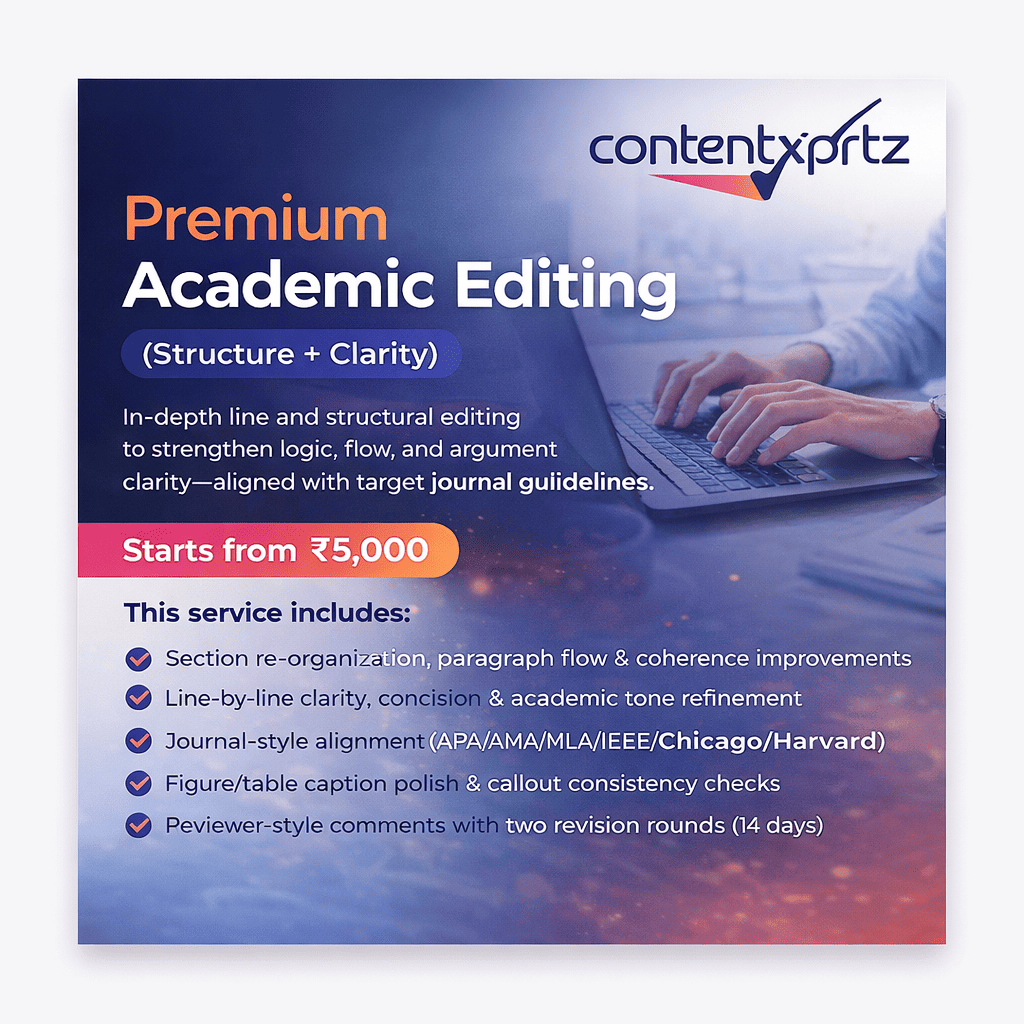
📘 Premium Academic Editing for Stronger, Clearer Research
Structure. Logic. Clarity—refined for journal submission.
Transform your manuscript with ContentXprtz’s Premium Academic Editing (Structure + Clarity) service. We provide in-depth line and structural editing to strengthen your argument flow, improve coherence, and align your work with target journal expectations—without altering your original ideas or authorship.
🔍 What this service offers:
📄 Section re-organization and improved paragraph flow
📘 Line-by-line clarity, concision, and academic tone refinement
🎓 Journal-style alignment (APA / AMA / MLA / IEEE / Chicago / Harvard)
📊 Figure & table caption polish with callout consistency checks
🧠 Reviewer-style comments with two structured revision rounds (14 days)
✨ Ethical. Transparent. Author-owned.
Your research remains 100% original—edited only to enhance clarity, structure, and publication readiness.
💰 Starts from ₹5,000
📩 Message us on WhatsApp to get started today
WhatsApp: https://wa.me/917065013200
🌐 Website: https://contentxprtz.com
#AcademicEditing #PhDSupport #ResearchPublication #JournalSubmission #ManuscriptEditing #PhDScholars #AcademicWriting #ResearchSupport #ScholarlyPublishing #HigherEducation #PostdocLife #PublishOrPerish #ResearchExcellence #JournalReady #ThesisEditing #DissertationSupport #AcademicServices #ResearchHelp #UniversityLife #GraduateStudies #EthicalEditing #AuthorSupport #ResearchCommunity #ScholarsLife
Premium Academic Editing (Structure + Clarity): A Scholar’s Strategic Advantage in High-Stakes Research Publishing
In today’s hypercompetitive academic ecosystem, producing a well-researched manuscript is no longer sufficient. What increasingly separates accepted work from rejected submissions is not only originality or methodology, but how clearly, coherently, and strategically the research is communicated. This is where Premium Academic Editing (structure + clarity) becomes not just a support service, but a decisive academic investment.
For PhD scholars, postdoctoral researchers, and early-career academics, the writing journey is often marked by intense pressure. You are expected to publish in top-tier journals, complete theses within strict timelines, respond to complex reviewer comments, and do all of this while managing teaching, funding constraints, and personal responsibilities. According to recent publishing data, leading journals reject 70–90% of submissions, with language quality, logical flow, and structural weaknesses ranking among the most common non-scientific reasons for desk rejection. Even high-quality research frequently fails to pass editorial screening due to lack of clarity, weak argumentation structure, or inconsistent academic tone.
Globally, research output has grown exponentially. UNESCO reports that the number of active researchers worldwide now exceeds 9 million, while publishers such as Elsevier and Springer Nature process millions of manuscripts annually. However, this growth has not been matched by proportional increases in editorial bandwidth. Editors today expect submissions to be publication-ready at first review, especially in Q1 and Q2 journals. As a result, scholars whose work lacks professional-level structure and clarity are often filtered out early, regardless of the study’s intellectual merit.
For non-native English-speaking researchers, the challenge is even greater. Writing academically correct English is one hurdle; writing persuasive, precise, discipline-aligned academic prose is another. Many scholars spend months revising manuscripts, yet remain unsure why reviewers cite “lack of clarity,” “poor organization,” or “weak academic framing.” These comments often reflect structural issues rather than content flaws.
This is precisely where Premium Academic Editing (structure + clarity) plays a transformative role. Unlike basic proofreading, premium academic editing focuses on macro-level coherence, logical sequencing of ideas, argument development, and discipline-specific academic conventions. It ensures that your research narrative aligns with journal expectations, reviewer logic, and international academic standards.
At ContentXprtz, established in 2010 and trusted by researchers across more than 110 countries, premium academic editing is positioned as an ethical, scholarly collaboration. Our role is not to rewrite your research, but to elevate its communicative power, ensuring that your ideas are presented with precision, authority, and intellectual integrity. Through expert-led structural editing, clarity enhancement, and publication-focused refinement, we help scholars move from research completion to research recognition.
Understanding Premium Academic Editing: Beyond Grammar and Proofreading
Premium academic editing is frequently misunderstood as an advanced form of proofreading. In reality, it is a strategic editorial intervention that operates at the level where journals make acceptance decisions.
What Premium Academic Editing Truly Involves
Premium academic editing addresses the architecture of your manuscript. It focuses on:
-
Logical organization of chapters, sections, and arguments
-
Coherence between research questions, theory, methodology, and findings
-
Clarity in hypothesis development and conceptual framing
-
Consistency in academic voice and disciplinary tone
-
Alignment with journal-specific author guidelines and reviewer expectations
Unlike surface-level editing, this process examines how ideas unfold and why certain sections may confuse readers. Editors trained in academic publishing identify where arguments weaken, transitions fail, or methodological explanations lack transparency.
Structure and Clarity as Editorial Gatekeepers
Editorial boards consistently emphasize that manuscripts must tell a clear scholarly story. According to author guidelines published by Taylor & Francis, clarity of structure directly affects reviewer comprehension and evaluation efficiency. Reviewers often assess dozens of papers each month. A poorly structured manuscript increases cognitive load and reduces goodwill, even when research quality is high.
Premium academic editing reduces this friction by ensuring that:
-
Each section fulfills a clear rhetorical purpose
-
Arguments build progressively rather than repetitively
-
Transitions guide readers logically across sections
-
Terminology remains consistent and discipline-appropriate
Why Structure and Clarity Determine Publication Success
The Cognitive Perspective of Reviewers
From a cognitive standpoint, reviewers evaluate manuscripts under time pressure. Research in scholarly communication shows that clear structure enhances perceived rigor, while ambiguity often signals weak scholarship, even when unintended. Journals published by Emerald Insight frequently emphasize that well-structured manuscripts are more likely to receive constructive reviews.
Premium academic editing anticipates reviewer cognition by optimizing how information is presented, not altering the research itself.
Structural Weaknesses Common in PhD-Level Writing
Even experienced scholars struggle with:
-
Overloaded literature reviews lacking synthesis
-
Methodology sections that describe procedures but not rationale
-
Results sections disconnected from research questions
-
Discussions that summarize findings without theoretical integration
These issues are structural, not intellectual. Premium academic editing systematically resolves them.
Premium Academic Editing vs Standard Editing Services
| Aspect | Standard Editing | Premium Academic Editing |
|---|---|---|
| Focus | Grammar and spelling | Structure, clarity, argument flow |
| Level | Sentence-level | Manuscript-level |
| Journal readiness | Partial | High |
| Reviewer alignment | Limited | Strong |
| Academic positioning | Minimal | Strategic |
For scholars targeting indexed journals, doctoral submission committees, or international publishers, standard editing is insufficient.
Ethics, Authorship, and Academic Integrity
A critical concern among PhD scholars is whether using academic editing services compromises originality or authorship. According to ethical guidelines from the American Psychological Association, professional editing is permissible when it does not alter intellectual ownership or research contribution.
Premium academic editing respects these boundaries by:
-
Preserving author voice and intent
-
Avoiding content fabrication or data manipulation
-
Providing transparent, trackable revisions
-
Supporting, not replacing, scholarly reasoning
At ContentXprtz, all editors adhere to strict publication ethics aligned with COPE and major publisher standards.
When Should Scholars Opt for Premium Academic Editing
Premium academic editing is particularly valuable when:
-
Submitting to Q1 or Q2 journals
-
Revising after major reviewer comments
-
Preparing a PhD thesis or viva submission
-
Converting a thesis chapter into a journal article
-
Writing in English as an additional language
In each case, clarity and structure determine how effectively your research is evaluated.
How ContentXprtz Delivers Premium Academic Editing
ContentXprtz operates through a multi-layered editorial framework:
-
Structural diagnosis of the manuscript
-
Discipline-matched editor assignment
-
Clarity enhancement with tracked changes
-
Journal or university guideline alignment
-
Optional publication strategy consultation
Our services span disciplines including management, engineering, medicine, social sciences, and interdisciplinary research.
Explore our specialized offerings:
Frequently Asked Questions on Premium Academic Editing (Structure + Clarity)
1. How is premium academic editing different from proofreading
Premium academic editing focuses on restructuring arguments, improving logical flow, and enhancing conceptual clarity. Proofreading corrects surface-level language errors. For PhD and journal submissions, structure matters more than grammar alone.
2. Can premium academic editing improve journal acceptance chances
While no service can guarantee acceptance, premium academic editing significantly improves reviewer comprehension, editorial confidence, and manuscript professionalism. These factors strongly influence editorial decisions.
3. Is premium academic editing ethical for PhD theses
Yes. Universities and publishers explicitly allow professional editing when it does not change intellectual content. Premium academic editing supports clarity without compromising authorship.
4. Do editors need subject-matter expertise
Absolutely. Structural clarity depends on disciplinary logic. ContentXprtz assigns subject-specialist editors to ensure conceptual accuracy and field alignment.
5. Should editing be done before or after supervisor review
Ideally after initial supervisor feedback but before final submission. This ensures clarity enhancements align with academic guidance.
6. How long does premium academic editing take
Timelines depend on manuscript length and complexity. Most journal articles require 5–10 working days, while theses may require phased editing.
7. Can premium academic editing help with reviewer comments
Yes. Structural editors directly address reviewer concerns related to clarity, argumentation, and organization, improving resubmission outcomes.
8. Does premium academic editing change my writing voice
No. Ethical editing preserves author voice while enhancing readability and coherence.
9. Is premium academic editing suitable for non-native English scholars
It is especially beneficial. Structural clarity helps overcome language-related biases in peer review.
10. How do I know if my manuscript needs premium academic editing
If reviewers mention lack of clarity, weak structure, or poor flow, premium academic editing is strongly recommended.
Conclusion: Investing in Clarity Is Investing in Impact
In modern academia, what you say and how you say it are inseparable. Premium Academic Editing (structure + clarity) bridges the gap between rigorous research and effective scholarly communication. It transforms manuscripts from technically sound documents into compelling academic narratives that editors and reviewers can engage with confidently.
For PhD scholars and researchers navigating high-stakes publication environments, premium academic editing is not an optional luxury. It is a strategic safeguard against preventable rejection and misinterpretation.
If you are preparing a thesis, revising a journal submission, or seeking professional academic editing services that respect ethics, rigor, and scholarly identity, explore ContentXprtz’s PhD assistance and publication support services today.
At ContentXprtz, we don’t just edit. We help your ideas reach their fullest potential.
