
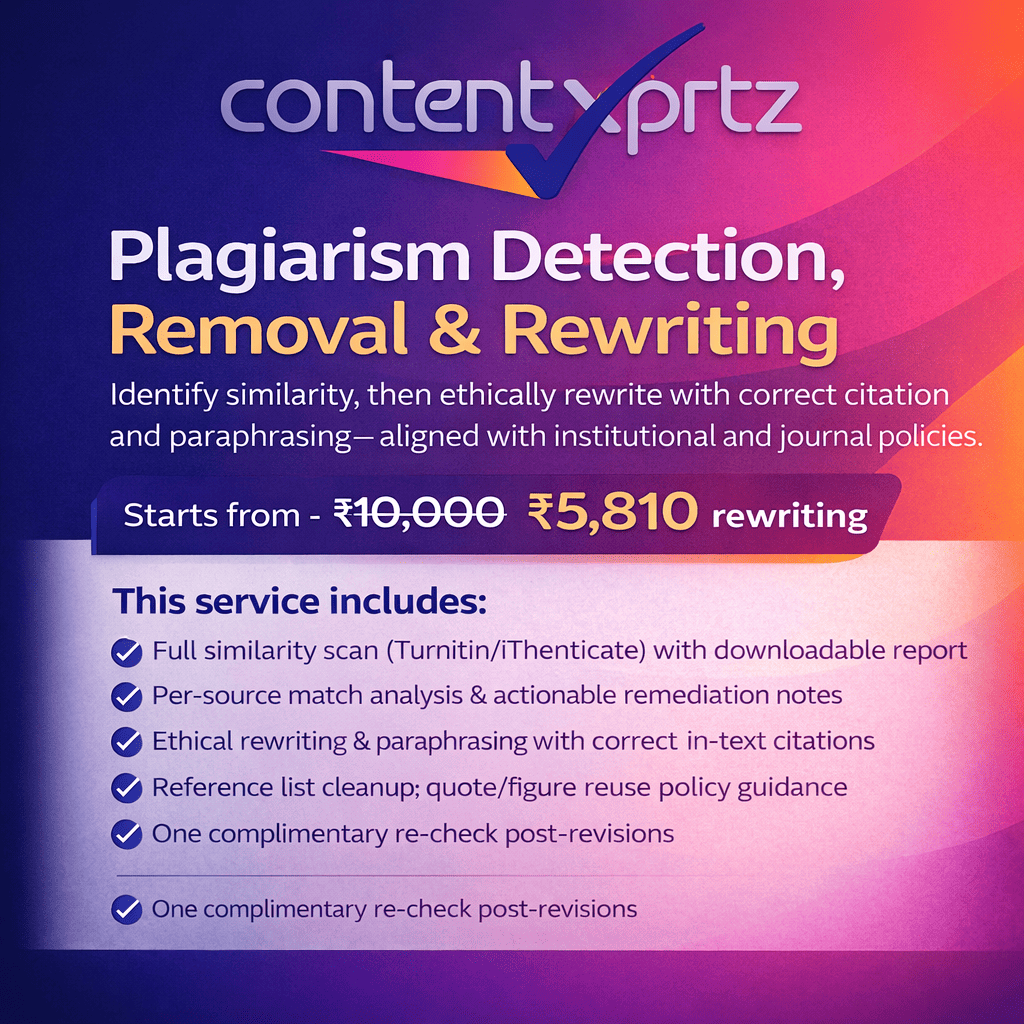
🛡️ Plagiarism Detection, Removal & Ethical Rewriting
Protect your research integrity. Strengthen your manuscript for confident academic submission.
Ensure your work meets institutional and journal standards with professional plagiarism detection and ethical rewriting—without compromising your original ideas or author ownership.
What this service offers:
📄 Full similarity scan (Turnitin / iThenticate) with downloadable report
🧠 Per-source match analysis with clear remediation guidance
✍️ Ethical rewriting and paraphrasing with accurate in-text citations
📘 Reference list cleanup and quote/figure reuse policy support
🎓 One complimentary re-check after revisions
We follow strict academic ethics—no shortcuts, no content fabrication.
Your research remains fully original, transparent, and author-owned.
Starts from ₹10,000
Rewriting support from ₹5,810
📲 Message us on WhatsApp to get started today
WhatsApp: https://wa.me/917065013200
🌐 Website: https://contentxprtz.com
#ContentXprtz #PlagiarismCheck #AcademicIntegrity #PhDSupport #ResearchEthics #JournalSubmission #ResearchWriting #PhDLife #ScholarlyPublishing #AcademicEditing #Turnitin #iThenticate #ResearchSupport #PostdocLife #ThesisWriting #DissertationHelp #AcademicServices #HigherEducation #PublishOrPerish #ResearchScholars #ManuscriptPreparation #UniversityResearch #EthicalResearch #PhDJourney
Plagiarism Detection, Removal & Rewriting: An Academic Integrity Framework for PhD Scholars and Researchers
Introduction: Why Plagiarism Detection, Removal & Rewriting Is No Longer Optional in Academic Research
Plagiarism Detection, Removal & Rewriting has become a non-negotiable requirement for students, PhD scholars, and academic researchers navigating today’s highly competitive and ethically regulated research ecosystem. In the first decade of the twenty-first century, plagiarism was often associated with deliberate misconduct. Today, however, the reality is far more complex and far more human. Even highly ethical researchers frequently encounter plagiarism risks due to paraphrasing challenges, citation inconsistencies, collaborative authorship, language barriers, and increasing pressure to publish quickly.
Across global universities, doctoral scholars face an unprecedented convergence of challenges. Time constraints are intensifying due to shorter PhD completion windows. Publication expectations are rising, with many institutions now requiring multiple Scopus or Web of Science indexed publications for degree completion. At the same time, research costs have increased substantially, from article processing charges to language editing fees. According to data published by Elsevier, global research output surpassed 3.5 million articles annually, intensifying competition and raising editorial scrutiny across top journals. Editors now rely heavily on advanced plagiarism detection software to filter submissions at the desk-review stage.
For non-native English-speaking researchers, the challenge is even greater. Expressing complex theoretical arguments in academically acceptable English while avoiding textual similarity is a persistent struggle. Paraphrasing without distorting meaning requires disciplinary expertise, linguistic mastery, and ethical awareness. As a result, many well-intentioned scholars experience manuscript rejection due to similarity scores, often without clear guidance on how to resolve them.
Plagiarism Detection, Removal & Rewriting is not about manipulating software scores. It is about preserving academic integrity while enabling scholars to communicate their ideas clearly, originally, and responsibly. Ethical rewriting respects intellectual ownership, maintains conceptual accuracy, and aligns with international publishing standards set by organizations such as the Committee on Publication Ethics and the American Psychological Association.
At ContentXprtz, established in 2010, we have worked with researchers across more than 110 countries who share a common goal: to publish ethically, confidently, and successfully. Our experience reveals a critical insight. Most plagiarism issues are not caused by dishonesty. They are caused by structural gaps in academic training, linguistic limitations, and mounting publication pressure.
This article provides a comprehensive, evidence-based guide to Plagiarism Detection, Removal & Rewriting for academic and PhD-level research. It integrates ethical best practices, editorial insights, and practical strategies aligned with global publishing expectations. Whether you are drafting a PhD thesis, revising a journal article, or preparing a book manuscript, this guide is designed to help you navigate plagiarism risks with clarity and confidence.
Understanding Plagiarism in Academic and PhD Research
What Constitutes Plagiarism in Scholarly Writing
In academic research, plagiarism extends far beyond copying text verbatim. Publishers such as Springer and Taylor and Francis define plagiarism as the unacknowledged use of another scholar’s ideas, structure, data, or language. This includes direct copying, mosaic plagiarism, excessive paraphrasing, and self-plagiarism.
Self-plagiarism is particularly misunderstood among doctoral scholars. Reusing portions of previously published work without proper citation can violate journal policies, even when the author is the same. Many PhD candidates unknowingly reuse literature review sections or methodology descriptions, assuming ownership grants automatic reuse rights. In reality, copyright often transfers to publishers after publication.
Why Similarity Scores Matter in Journal Evaluation
Similarity scores generated by tools such as iThenticate or Turnitin are not definitive judgments of plagiarism. However, they play a critical gatekeeping role. According to Emerald Insight editorial guidelines, manuscripts with high similarity percentages are frequently desk-rejected without peer review.
Editors evaluate similarity contextually. A 15 percent similarity score concentrated in the methodology section may be acceptable, while a 10 percent score in the discussion section may trigger rejection. Therefore, Plagiarism Detection, Removal & Rewriting must involve human judgment, not automated rewriting.
Plagiarism Detection: Tools, Interpretation, and Ethical Use
Commonly Used Plagiarism Detection Tools in Academia
Most reputable journals rely on iThenticate, which compares submissions against a vast database of published literature. Universities often use Turnitin for theses and dissertations. These tools identify textual overlap but cannot assess intent, context, or originality of ideas.
Ethical plagiarism detection involves more than generating a report. It requires careful interpretation, section-wise analysis, and disciplinary awareness. For example, legal and medical research often includes standardized language that naturally increases similarity.
Best Practices for Interpreting Similarity Reports
Effective Plagiarism Detection, Removal & Rewriting begins with understanding where and why similarity occurs. High similarity often arises from:
-
Overreliance on source phrasing
-
Inadequate paraphrasing techniques
-
Missing citations
-
Common academic expressions
-
Template-based writing in methodology sections
At ContentXprtz, our academic editors analyze similarity reports line by line, categorizing overlaps into acceptable, revisable, and critical zones. This ensures ethical compliance without compromising scholarly rigor.
Plagiarism Removal: Ethical Strategies That Preserve Research Integrity
Why Automated Paraphrasing Tools Are Risky
Automated rewriting tools may reduce similarity scores, but they often introduce semantic distortion, grammatical errors, and incoherent argumentation. Publishers explicitly warn against machine-generated paraphrasing that alters meaning or introduces inaccuracies. Springer’s author guidelines emphasize that clarity and accuracy outweigh numerical similarity reduction.
Human-Centered Plagiarism Removal Techniques
Ethical plagiarism removal involves:
-
Conceptual rewriting rather than sentence-level substitution
-
Integrating citations appropriately
-
Synthesizing multiple sources into original arguments
-
Reframing sentences while preserving disciplinary terminology
This process requires subject-matter expertise. A biomedical paper demands different rewriting strategies than a humanities manuscript. Our editors at ContentXprtz specialize across disciplines, ensuring accuracy and integrity.
Academic Rewriting: From Similarity Reduction to Scholarly Enhancement
What High-Quality Academic Rewriting Looks Like
Plagiarism Detection, Removal & Rewriting should improve readability, coherence, and academic tone. Rewriting is not cosmetic editing. It is a substantive process that enhances argument flow, strengthens analytical depth, and aligns manuscripts with journal expectations.
Effective rewriting achieves:
-
Reduced similarity without loss of meaning
-
Improved logical progression
-
Enhanced academic voice
-
Compliance with citation styles
For scholars seeking comprehensive academic editing services, rewriting is often integrated with structural editing and language refinement.
When PhD Scholars Need Professional Plagiarism Support
Common Scenarios Requiring Expert Intervention
PhD candidates typically seek Plagiarism Detection, Removal & Rewriting support when:
-
Thesis similarity exceeds university thresholds
-
Journal submissions are rejected due to plagiarism concerns
-
Supervisor feedback highlights paraphrasing issues
-
Collaborative papers create citation complexity
-
English proficiency limits effective rewriting
In such cases, professional guidance ensures timely resolution without academic risk. Our PhD thesis help services address these challenges systematically and ethically.
Ethical Standards and Publisher Expectations
Compliance With Global Publishing Guidelines
Reputable publishers emphasize transparency, originality, and ethical authorship. Elsevier outlines clear plagiarism policies requiring authors to ensure originality before submission. APA guidelines stress proper citation and paraphrasing practices.
At ContentXprtz, all plagiarism-related services align with international ethical standards. We do not manipulate similarity reports. We correct underlying issues through expert rewriting and citation refinement.
Integrated FAQ Section: Plagiarism Detection, Removal & Rewriting Explained
FAQ 1: What is an acceptable similarity percentage for PhD theses and journal articles?
Acceptable similarity percentages vary by institution and publisher. Most universities allow 10 to 15 percent similarity for PhD theses, excluding references and quotations. Journals often expect lower similarity, typically under 10 percent, with contextual evaluation. However, similarity distribution matters more than the overall number. Concentrated similarity in analytical sections raises red flags. Professional plagiarism detection services help interpret reports accurately and guide ethical revisions.
FAQ 2: Can plagiarism occur unintentionally in academic writing?
Yes, unintentional plagiarism is common, especially among early-career researchers and non-native English speakers. It often results from close paraphrasing, missing citations, or misunderstanding self-plagiarism. Ethical academic training focuses on awareness and correction rather than punishment. Plagiarism Detection, Removal & Rewriting services support scholars in addressing these issues responsibly.
FAQ 3: Is plagiarism removal the same as rewriting?
Plagiarism removal is a broader process that may include rewriting, citation correction, and structural changes. Rewriting focuses on expressing ideas originally, while plagiarism removal ensures compliance with ethical standards. Together, they form an integrated academic integrity solution.
FAQ 4: How do journals detect plagiarism?
Journals use plagiarism detection software such as iThenticate to screen submissions. Editors then review reports manually. High similarity often leads to desk rejection. Therefore, addressing plagiarism before submission is critical for publication success.
FAQ 5: Can plagiarism detection tools replace human review?
No. Software identifies overlap but cannot assess context or intent. Human expertise is essential to interpret reports and implement ethical revisions. ContentXprtz combines technology with expert academic judgment.
FAQ 6: Does rewriting affect the originality of research?
Ethical rewriting enhances originality by clarifying ideas in the author’s own voice. It does not change research findings or interpretations. Proper rewriting strengthens scholarly contribution.
FAQ 7: How long does professional plagiarism removal take?
Timelines vary based on document length, discipline, and similarity level. Typically, academic rewriting projects require one to three weeks. PhD theses may take longer. Early intervention reduces delays.
FAQ 8: Is plagiarism removal acceptable to universities?
Yes, when conducted ethically. Universities support plagiarism correction through rewriting and citation improvement. What is unacceptable is deceptive manipulation or misrepresentation.
FAQ 9: Can previously published work be reused in a thesis?
Yes, but with proper citation and permission if required. Self-plagiarism must be managed carefully. Professional academic editors help ensure compliance.
FAQ 10: Why choose professional academic services over self-editing?
Professional services provide disciplinary expertise, ethical assurance, and publication readiness. Self-editing often misses nuanced plagiarism risks. ContentXprtz offers structured, transparent, and ethical solutions.
Why ContentXprtz Is a Trusted Partner for Plagiarism Detection, Removal & Rewriting
Since 2010, ContentXprtz has supported scholars across disciplines and continents. Our services integrate plagiarism detection, academic editing, and publication guidance within a single ethical framework. We work closely with researchers, respecting their intellectual ownership while enhancing clarity and originality.
Explore our dedicated services:
-
PhD thesis help through our PhD & Academic Services
-
Comprehensive Writing & Publishing Services
-
Targeted Student Writing Services
-
Specialized Book Authors Writing Services
-
Professional Corporate Writing Services
Conclusion: Ethical Originality as the Foundation of Academic Success
Plagiarism Detection, Removal & Rewriting is not a corrective afterthought. It is a foundational element of responsible scholarship. As academic standards rise globally, researchers must adopt ethical practices that protect originality, credibility, and intellectual integrity.
By combining expert analysis, ethical rewriting, and publication-aligned editing, scholars can overcome plagiarism challenges without compromising their voice or contribution. ContentXprtz stands as a global partner in this journey, offering experience, transparency, and academic excellence.
Explore our PhD Assistance Services today and move forward with confidence.
At ContentXprtz, we don’t just edit — we help your ideas reach their fullest potential.
