
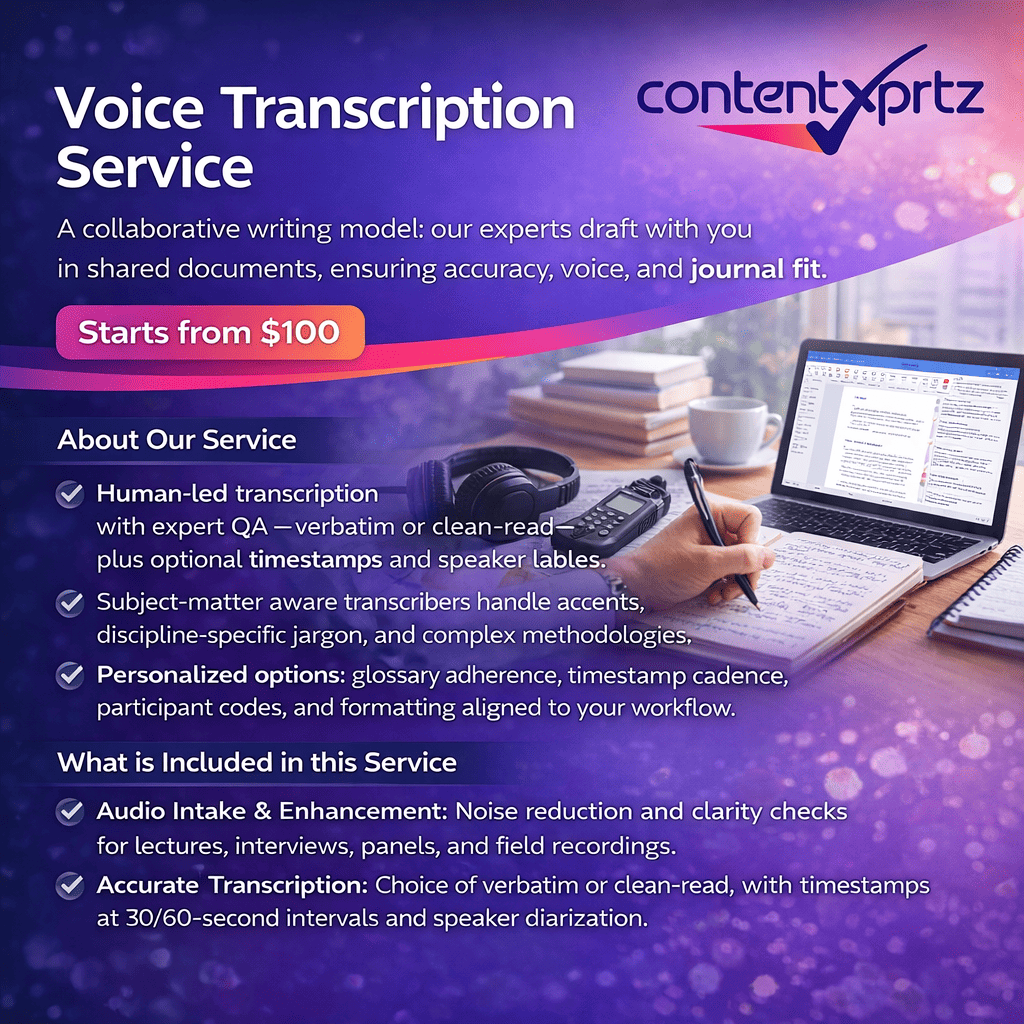
Turn Your Research Audio into Publication-Ready Text 📄
Accurate, ethical transcription built for academic workflows.
With ContentXprtz Voice Transcription Service, your lectures, interviews, and field recordings are transformed into clear, research-ready transcripts—handled by subject-matter-aware experts who respect your voice, data, and methodology.
What you get:
• Human-led transcription with expert QA (verbatim or clean-read)
• Accurate handling of accents, jargon & complex research terms
• Timestamps, speaker labels & participant codes on request
• Quote-ready outputs to speed analysis and reporting
• Secure, confidential delivery aligned to your research needs
Ethical by design. Confidential by default.
Your data, content, and authorship always remain yours.
Starts from $100
Message us on WhatsApp to get started today 👉
WhatsApp: https://wa.me/917065013200
Website: https://contentxprtz.com
📘🎓🧠
#VoiceTranscription #AcademicTranscription #PhDSupport #ResearchWorkflow #QualitativeResearch #AcademicWriting #ResearchMethods #InterviewTranscription #DoctoralResearch #PhDScholars #PostdocLife #HigherEducation #ResearchIntegrity #EthicalResearch #PublicationSupport #DissertationHelp #ThesisSupport #ResearchData #StudentResearchers #SocialScienceResearch #STEMResearch #HumanitiesResearch #JournalPreparation #ContentXprtz
From Spoken Ideas to Scholarly Impact: How a Professional Voice Transcription Service Empowers Academic Research
Introduction: Why Voice Transcription Has Become Essential in Modern Academic Work (400+ words)
For today’s students, PhD scholars, and academic researchers, research no longer happens only at a desk. Ideas emerge during interviews, focus group discussions, lectures, conferences, supervisory meetings, and even while reflecting verbally on complex theoretical arguments. Yet, transforming these spoken insights into structured, publication-ready academic text remains one of the most time-consuming and underestimated challenges in scholarly work.
This is where a Voice Transcription Service plays a critical role.
Within the first year of doctoral research, many PhD scholars discover that qualitative data collection alone can generate hundreds of hours of audio material. Interviews, oral histories, ethnographic field notes, recorded seminars, and expert discussions accumulate rapidly. Converting this spoken material into accurate, readable, and analytically usable text requires not only time but also a high level of linguistic, contextual, and disciplinary sensitivity.
Global research data underscores this challenge. According to UNESCO’s Institute for Statistics, over 8 million researchers worldwide are actively engaged in knowledge production, with a growing shift toward qualitative and mixed-method research designs. Meanwhile, journal acceptance rates in leading publishers such as Elsevier, Springer, Emerald Insight, and Taylor and Francis often remain below 15 percent. In such a competitive environment, inaccuracies in transcription, misrepresentation of participant voices, or poorly structured qualitative data can directly undermine research credibility.
For PhD scholars, the pressure is intensified by rising tuition costs, shrinking funding windows, increasing publication expectations, and tight completion timelines. Many doctoral candidates balance research with teaching, employment, or family responsibilities. Under these constraints, manual transcription becomes not just inefficient but academically risky.
A professional Voice Transcription Service addresses this problem by converting spoken academic content into precise, well-structured text that can be directly used for analysis, coding, thesis chapters, and journal submissions. When executed by academic specialists rather than generic transcription tools, such services preserve meaning, context, and disciplinary nuance.
At ContentXprtz, established in 2010 and trusted by researchers across more than 110 countries, voice transcription is treated as a scholarly process rather than a mechanical task. The goal is not merely to convert audio into text, but to ensure that every transcribed word strengthens the academic integrity of the research it supports.
This article offers a comprehensive, evidence-based exploration of how a professional Voice Transcription Service supports academic writing, PhD research, and publication success. It is designed for students, doctoral scholars, and researchers seeking reliable academic support that aligns with ethical publishing standards and global journal expectations.
Understanding Voice Transcription in an Academic Context
What Is an Academic Voice Transcription Service?
A Voice Transcription Service in academia refers to the systematic conversion of spoken academic material into written text, following scholarly accuracy, contextual integrity, and research ethics. Unlike generic transcription tools, academic transcription accounts for discipline-specific terminology, theoretical language, methodological rigor, and participant sensitivity.
Academic voice transcription commonly includes:
-
Qualitative research interviews
-
Focus group discussions
-
Classroom lectures and seminars
-
Supervisor feedback sessions
-
Conference presentations
-
Oral examinations and viva recordings
-
Expert panel discussions
In qualitative research, transcription is not a neutral step. According to guidance from the American Psychological Association, transcription accuracy directly affects data reliability, coding validity, and interpretive rigor. Errors at this stage can propagate through analysis and weaken the entire research design.
Why Automated Tools Are Not Enough for Scholarly Work
Automated speech-to-text tools offer speed, but they lack contextual intelligence. They struggle with accents, discipline-specific jargon, overlapping speech, and nuanced meaning. More importantly, they cannot ensure compliance with academic standards or ethical research practices.
Leading academic publishers such as Elsevier and Springer emphasize transparency and methodological clarity in qualitative research reporting. A flawed transcription can compromise both.
A human-led, expert-reviewed Voice Transcription Service bridges this gap by combining linguistic expertise with academic judgment.
Why PhD Scholars and Researchers Rely on Professional Voice Transcription Services
Time Efficiency Without Compromising Quality
Manual transcription can take four to six hours for every hour of audio. For a PhD student conducting 40 interviews, this translates into hundreds of hours diverted from analysis, writing, and publication planning.
By outsourcing to a professional Voice Transcription Service, researchers reclaim time for higher-order academic tasks such as theory development, coding, and interpretation.
Accuracy That Supports Peer Review and Publication
High-impact journals demand methodological rigor. Reviewers often scrutinize qualitative methods sections for clarity on how data was collected and processed. Professionally transcribed material enhances transparency and reproducibility.
Consistency Across Large Datasets
In multi-interview or longitudinal studies, consistency in transcription style is essential. Academic transcription specialists ensure uniform formatting, speaker identification, and notation standards.
Ethical Handling of Sensitive Data
Academic transcription must respect confidentiality, anonymization, and informed consent protocols. Professional academic services operate under strict data protection and ethical guidelines.
How Voice Transcription Integrates with Academic Editing and PhD Support
A Voice Transcription Service does not operate in isolation. It forms part of a broader academic workflow that includes analysis, writing, editing, and publication preparation.
At ContentXprtz, transcription often integrates with:
-
PhD thesis help through end-to-end research support
-
Academic editing services to refine transcribed content into formal scholarly language
-
Research paper writing support for qualitative journal submissions
Researchers often combine transcription with PhD and Academic Services
(https://contentxprtz.com/phd-academic-services) to ensure methodological consistency across their thesis or dissertation.
Use Cases: Real Academic Scenarios Where Voice Transcription Adds Value
Qualitative Doctoral Research
In sociology, education, psychology, management, and health sciences, interviews and focus groups are central. Accurate transcription enables systematic coding and thematic analysis using tools such as NVivo or Atlas.ti.
Lecture and Seminar Documentation
Students and faculty use transcription to convert lectures into study material, teaching resources, or book chapters.
Conference and Workshop Outputs
Researchers transcribe conference presentations to develop journal articles or edited volumes.
Supervisor and Viva Feedback
Transcribing oral feedback ensures that critical guidance is not lost and can be systematically addressed.
Ethical and Quality Standards in Academic Voice Transcription
Academic integrity extends beyond writing to every stage of research production.
Professional Voice Transcription Services adhere to:
-
Confidentiality and data protection standards
-
Verbatim or intelligent verbatim protocols, depending on research design
-
Accurate representation of participant voice
-
Clear notation of pauses, emphasis, and non-verbal cues when required
Publishers such as Taylor and Francis emphasize ethical qualitative reporting, making high-quality transcription a foundational requirement.
Voice Transcription and Global Publication Standards
Alignment with Journal Expectations
Top-tier journals expect clarity in how qualitative data is processed. Accurate transcription strengthens the methods section and enhances reviewer confidence.
Supporting Mixed-Methods Research
In mixed-methods studies, qualitative transcription must align with quantitative findings. Professional services ensure coherence across datasets.
Enhancing Research Transparency
Transparent transcription practices support open science principles promoted by leading academic bodies.
FAQs: Voice Transcription Service for Academic and PhD Research
FAQ 1: Is a Voice Transcription Service acceptable for PhD research?
Yes. Using a professional Voice Transcription Service is widely accepted in doctoral research, provided ethical standards are followed. Universities and ethics committees do not require researchers to transcribe their own data. What matters is transparency, accuracy, and confidentiality. Many doctoral candidates disclose in their methodology that interviews were professionally transcribed and verified by the researcher.
A reputable service supports academic rigor rather than undermining it. In fact, accurate transcription enhances credibility by reducing human error caused by fatigue or time pressure. As long as the researcher remains responsible for analysis and interpretation, transcription support is ethically sound and academically valid.
FAQ 2: How does transcription quality affect journal acceptance?
Transcription quality directly influences data analysis and reporting. Inaccurate transcripts can distort participant meaning, weaken thematic coding, and introduce inconsistencies. Reviewers often detect these issues when quotes feel unclear or contradictory.
High-quality transcription strengthens the reliability of qualitative findings, which is critical for journals published by Elsevier, Springer, Emerald Insight, and similar publishers. Clear, accurate transcripts lead to stronger analysis and more persuasive manuscripts.
FAQ 3: Can transcription services handle technical or discipline-specific language?
Yes, when the service specializes in academic work. A professional Voice Transcription Service assigns subject-aware transcriptionists who understand disciplinary terminology, theoretical constructs, and research language.
This is particularly important in fields such as medicine, engineering, management, psychology, and law, where misinterpretation of terminology can have serious consequences for research validity.
FAQ 4: Is voice transcription useful for quantitative researchers?
While transcription is most common in qualitative research, quantitative researchers also benefit from transcribing expert interviews, pilot studies, or open-ended survey responses. Transcription supports mixed-method approaches and enhances contextual interpretation of numerical findings.
FAQ 5: How is confidentiality maintained in academic transcription?
Professional academic transcription services operate under strict confidentiality agreements. Data is handled securely, anonymized when required, and never reused. Ethical data handling aligns with institutional review board expectations and publisher guidelines.
FAQ 6: Should transcription be verbatim or edited for readability?
The choice depends on research design. Verbatim transcription captures every word and pause, suitable for discourse analysis. Intelligent verbatim removes fillers while preserving meaning, often preferred for thematic analysis. A professional service advises based on methodological needs.
FAQ 7: How does transcription support PhD thesis writing?
Transcription converts raw audio into structured text that can be coded, analyzed, and cited. It forms the foundation for findings chapters, discussion sections, and evidence-based arguments.
Many scholars integrate transcription with Writing and Publishing Services
(https://contentxprtz.com/writing-publishing-services) to streamline their research workflow.
FAQ 8: Can transcription be combined with academic editing?
Yes. Combining transcription with academic editing ensures that quoted material is grammatically refined while retaining original meaning. This is particularly valuable for non-native English researchers.
FAQ 9: Is transcription support expensive for PhD students?
Compared to the time cost of manual transcription, professional services are cost-effective. More importantly, they reduce the risk of errors that could delay submission or publication, saving long-term costs.
FAQ 10: How do I choose a reliable academic transcription provider?
Look for experience in academic research, transparency in processes, ethical standards, and integration with broader academic support services. Providers established within the academic ecosystem understand researcher needs better than generic transcription vendors.
Integrating Voice Transcription with Comprehensive Academic Support
Voice transcription achieves its full value when embedded within a complete academic support framework.
At ContentXprtz, researchers often progress from transcription to:
-
Student Writing Services
https://contentxprtz.com/student-career-academic-writing-services -
Book Authors Writing Services
https://contentxprtz.com/book-authors-writing-services -
Corporate Writing Services
https://contentxprtz.com/corporate-writing-services
This integrated approach ensures continuity, accuracy, and scholarly coherence from data collection to final submission.
Why ContentXprtz Is Trusted for Academic Voice Transcription
Since 2010, ContentXprtz has supported researchers across continents with ethical, discipline-specific academic services. Voice transcription is handled by trained academic specialists, not generic operators.
Key strengths include:
-
Global experience across disciplines
-
Strict confidentiality protocols
-
Integration with editing and publication support
-
Researcher-centric workflows
-
Alignment with top publisher standards
Conclusion: Turning Spoken Knowledge into Published Scholarship
In an era where academic success depends on speed, precision, and credibility, a professional Voice Transcription Service is no longer optional for serious researchers. It safeguards accuracy, saves time, and strengthens the foundation of qualitative and mixed-method research.
For students, PhD scholars, and academic researchers, transcription is not merely technical support. It is an intellectual bridge between spoken insight and scholarly contribution.
ContentXprtz offers voice transcription as part of a holistic academic partnership, supporting researchers from data collection to publication.
Explore our PhD Assistance Services today and transform your research workflow with confidence.
At ContentXprtz, we don’t just edit — we help your ideas reach their fullest potential.
