
📘 Polish Your Research Before Submission
📄 Professional Academic Proofreading by ContentXprtz
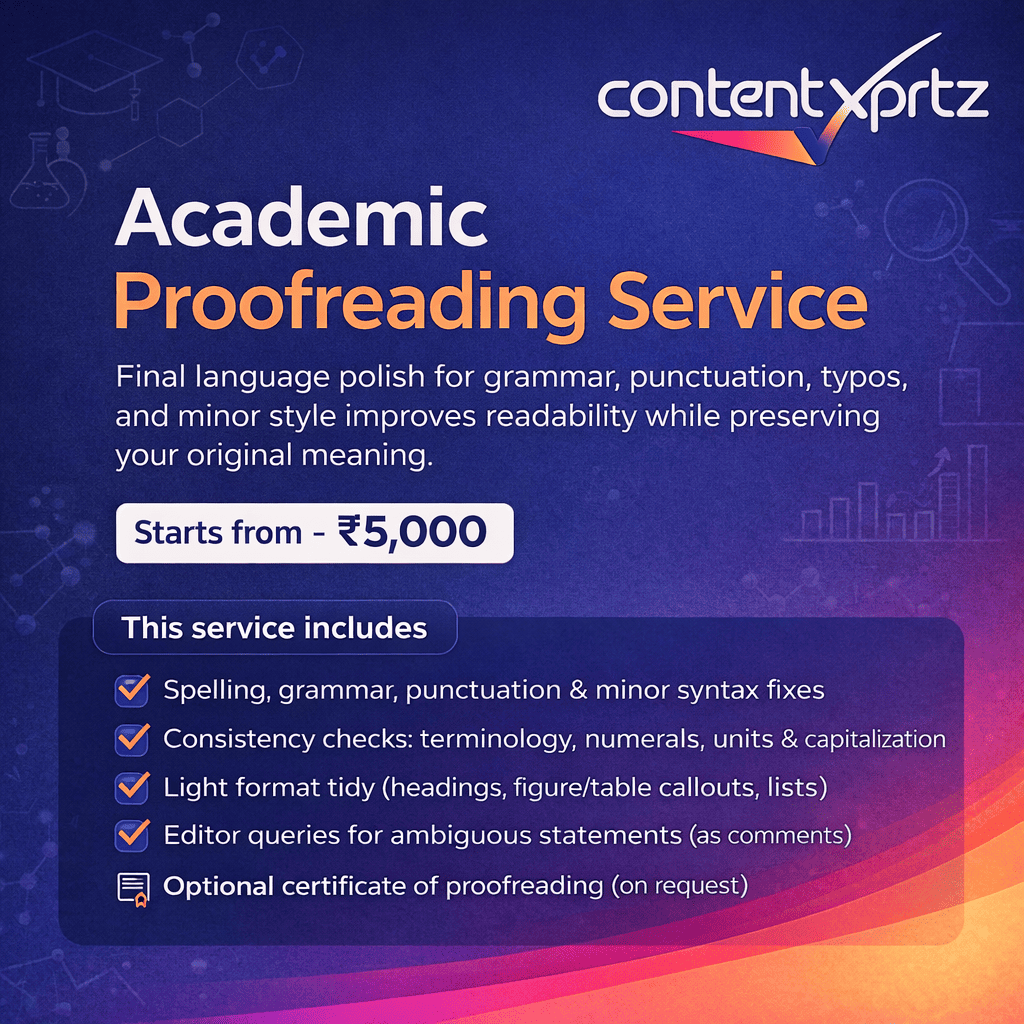
Your research deserves clarity, precision, and credibility. Our Academic Proofreading Service provides final language refinement—improving readability and flow while fully preserving your original meaning and scholarly voice.
What we help you with:
• Grammar, spelling, punctuation & minor syntax corrections
• Consistency checks for terminology, numerals, units & capitalization
• Light formatting tidy (headings, figure/table callouts, lists)
• Editor queries for unclear or ambiguous statements (as comments)
• Optional certificate of proofreading (on request)
✨ Starts from ₹5,000
We follow strict ethical standards—no content rewriting, no idea alteration, and full author ownership guaranteed. Your work remains 100% yours; we simply help it read at its best.
📲 Message us on WhatsApp to get started today
WhatsApp: https://wa.me/917065013200
🌐 Website: https://contentxprtz.com
#AcademicProofreading #PhDSupport #ResearchWriting #AcademicEditing #JournalSubmission #ResearchScholars #PhDScholars #PostdocLife #HigherEducation #ManuscriptPreparation #ThesisEditing #DissertationSupport #AcademicPublishing #ResearchEthics #ScholarlyWriting #UniversityStudents #PeerReviewReady #PublishWithConfidence #AcademicServices #ResearchCommunity #ContentXprtz #EditingServices #AcademicExcellence #StudentSupport
Academic Proofreading Service as a Strategic Tool for Scholarly Excellence and Publication Success
Introduction: Why Academic Proofreading Matters More Than Ever
For today’s PhD scholars, postgraduate students, and academic researchers, producing high-quality scholarly writing is no longer just an academic requirement. It is a professional necessity. In an increasingly competitive global research environment, the clarity, accuracy, and coherence of your writing directly influence how your work is evaluated, cited, and accepted by journals. Within this context, an academic proofreading service has emerged not as a luxury, but as a strategic academic support mechanism.
From doctoral candidates working under tight submission deadlines to early-career researchers navigating high-impact journal expectations, academic writing challenges are universal. Scholars are expected to produce original, methodologically rigorous, and theoretically grounded research while also meeting strict language, formatting, and ethical standards. For non-native English speakers, these demands are even more pronounced. Subtle grammatical errors, unclear argumentation, or inconsistent academic tone can significantly undermine otherwise strong research.
Global data reflects this reality. According to journal publisher statistics, rejection rates at leading international journals frequently exceed 70 percent, with language clarity and manuscript presentation cited as major contributing factors. Research-intensive publishers such as Elsevier and Springer Nature consistently highlight that many desk rejections occur before peer review, often due to issues unrelated to research quality but linked to poor structure, unclear writing, or failure to meet submission guidelines.
At the same time, PhD scholars face mounting pressures. Doctoral timelines are shrinking, funding structures are tightening, and publication requirements for graduation or career progression are becoming more demanding. Rising tuition costs, publication fees, and open-access charges further compound stress. As a result, researchers increasingly seek professional academic support to protect the value of their intellectual work.
An academic proofreading service operates at the intersection of quality assurance and scholarly integrity. It does not rewrite or fabricate research. Instead, it refines language, strengthens coherence, and ensures that the researcher’s original voice and contribution are communicated with precision. When delivered ethically and professionally, proofreading becomes a safeguard for academic credibility rather than a shortcut.
This article provides a comprehensive, evidence-based exploration of academic proofreading services for PhD scholars and researchers. It explains what academic proofreading entails, how it differs from editing and writing services, why it is critical for publication success, and how to choose a service aligned with ethical academic standards. Throughout, the discussion reflects global best practices in scholarly publishing while maintaining a student-centered, empathetic tone aligned with the mission of ContentXprtz.
Understanding Academic Proofreading in the Scholarly Context
Academic proofreading is a specialized form of quality review focused on correcting surface-level language issues while preserving the author’s intellectual ownership. Unlike general proofreading used in commercial writing, academic proofreading operates within the conventions of scholarly communication.
At its core, an academic proofreading service focuses on accuracy, clarity, and consistency. Proofreaders examine grammar, punctuation, spelling, syntax, and formatting. They also check citation consistency, reference list alignment, and adherence to journal or institutional style guides such as APA, Harvard, or Chicago. Importantly, they do not alter research content, methodology, or interpretation.
This distinction is critical. Leading publishers and ethics bodies such as the American Psychological Association emphasize that language support is acceptable when it does not compromise authorship integrity. Ethical proofreading respects the boundary between improving expression and influencing ideas.
In practice, academic proofreading supports scholars by ensuring that their arguments are presented clearly and professionally. A well-proofread manuscript allows reviewers and examiners to focus on the contribution of the research rather than being distracted by avoidable language issues.
Academic Proofreading Versus Academic Editing: Clarifying the Difference
Many scholars use the terms proofreading and editing interchangeably, yet in academic publishing, they serve distinct functions. Understanding this difference helps researchers choose the right level of support.
Proofreading is the final stage of manuscript preparation. It occurs after the content, structure, and argumentation are complete. The focus is on surface accuracy. Editing, by contrast, may involve deeper engagement with clarity, flow, and sometimes structural coherence.
An academic proofreading service typically addresses:
-
Grammar, spelling, and punctuation errors
-
Sentence-level clarity and readability
-
Formatting consistency
-
Citation and reference accuracy
-
Compliance with journal submission guidelines
Academic editing services, on the other hand, may also include improving transitions, refining academic tone, and resolving ambiguity in argumentation. At ContentXprtz, these services are clearly differentiated to maintain transparency and ethical compliance. Scholars can explore tailored support through the academic editing services designed to match different stages of the research lifecycle.
Why PhD Scholars and Researchers Increasingly Rely on Academic Proofreading
Publication Pressure and Competitive Journals
Academic publishing has become more competitive over the past two decades. High-impact journals receive thousands of submissions annually, and editorial screening processes are increasingly strict. According to publisher guidance from Taylor & Francis, clarity of language is a key factor during initial manuscript evaluation.
Even strong research can face rejection if reviewers struggle to understand the argument. An academic proofreading service helps mitigate this risk by ensuring that language quality does not become a barrier to scholarly evaluation.
Multilingual Research Environments
English dominates global academic publishing, yet a significant proportion of researchers are non-native English speakers. This linguistic imbalance creates systemic challenges. Proofreading services provide linguistic equity by allowing scholars to compete on intellectual merit rather than language fluency.
Time Constraints and Cognitive Load
PhD candidates often balance research with teaching, administrative duties, and personal responsibilities. Proofreading requires focused attention and time, both of which are scarce. Outsourcing this final quality check allows researchers to allocate their cognitive resources more strategically.
Institutional Expectations and Assessment Standards
Universities increasingly emphasize timely completion and publication output. Examiners expect polished, professional writing. An academic proofreading service supports compliance with institutional quality benchmarks, especially for thesis and dissertation submissions.
For structured doctoral support, scholars may also consider dedicated PhD thesis help aligned with institutional expectations.
The Role of Academic Proofreading in Research Integrity
Academic integrity extends beyond avoiding plagiarism. It includes responsible authorship, transparency, and clarity. Poorly written manuscripts risk misinterpretation, which can inadvertently distort research findings.
Professional proofreading enhances integrity by ensuring that claims, limitations, and evidence are communicated accurately. It reduces the likelihood of misrepresentation caused by ambiguous language. Publishers such as Emerald Insight explicitly recommend language polishing to improve research transparency.
At ContentXprtz, proofreading is positioned as an integrity-preserving practice. Editors do not alter data, arguments, or conclusions. They ensure that the researcher’s intent is communicated faithfully and clearly.
Key Features of a High-Quality Academic Proofreading Service
Not all proofreading services meet academic standards. A credible academic proofreading service should demonstrate several defining features.
Subject-Aware Proofreaders
Academic writing varies across disciplines. A humanities dissertation differs significantly from a biomedical research article. High-quality services assign proofreaders with subject familiarity to ensure appropriate terminology and tone.
Compliance with Academic Style Guides
Scholarly writing follows strict style conventions. Proofreaders must be proficient in APA, MLA, Harvard, Chicago, and journal-specific guidelines. Inconsistent referencing is a common cause of revision requests.
Ethical Boundaries
Professional proofreading respects authorship. It does not involve ghostwriting, content creation, or data manipulation. Ethical compliance is essential for trust and academic credibility.
Transparent Processes
Reputable services clearly explain what proofreading includes and excludes. They provide track-changes edits and allow authors to review all suggested corrections.
ContentXprtz integrates these principles across its writing and publishing services, ensuring clarity and accountability at every stage.
Academic Proofreading Across the Research Lifecycle
Academic proofreading is not limited to final-year PhD submissions. It plays a role throughout the research lifecycle.
-
Research proposals: Ensuring clarity of objectives and methodology
-
Conference papers: Improving readability for international audiences
-
Journal submissions: Aligning manuscripts with reviewer expectations
-
Theses and dissertations: Meeting institutional quality standards
-
Grant applications: Enhancing persuasiveness and precision
Students at earlier stages can also benefit from targeted student writing services that integrate proofreading with academic skill development.
Frequently Asked Questions About Academic Proofreading Service
Is using an academic proofreading service considered ethical in PhD research?
Yes, using an academic proofreading service is widely considered ethical when it is limited to language correction and formatting support. Leading academic publishers and ethics committees recognize that proofreading improves clarity without altering intellectual contribution. Organizations such as Elsevier and Springer Nature explicitly allow language editing and proofreading, provided the author retains ownership of ideas and data.
Ethical proofreading does not involve rewriting arguments, changing interpretations, or adding content. Instead, it ensures that grammar, syntax, and structure do not obscure meaning. For PhD scholars, this distinction is crucial. Doctoral research is assessed on originality and rigor. Proofreading supports fair evaluation by removing avoidable language barriers.
Universities often recommend proofreading for non-native English speakers. However, transparency is essential. Scholars should ensure that the service provider follows ethical guidelines and provides track-changes documentation. At ContentXprtz, proofreading operates within clearly defined ethical boundaries, aligning with global academic standards and institutional expectations.
How does academic proofreading improve journal acceptance rates?
Academic proofreading improves acceptance rates indirectly by enhancing readability and compliance with submission guidelines. Reviewers and editors assess manuscripts under time constraints. Clear language allows them to focus on research contribution rather than struggling with expression.
Many desk rejections occur before peer review due to formatting errors, inconsistent referencing, or unclear writing. Proofreading addresses these issues proactively. While no service can guarantee acceptance, proofreading reduces preventable rejections linked to presentation quality.
High-impact journals expect polished manuscripts. Proofreading signals professionalism and respect for the review process. It also reduces revision cycles, saving time and publication costs for researchers.
When should a PhD scholar use an academic proofreading service?
The optimal time to use an academic proofreading service is after completing the final draft of a manuscript or thesis. Proofreading is most effective when content decisions are finalized. Using it too early may result in repeated corrections as content evolves.
However, scholars may also use proofreading at key milestones, such as before supervisor submission, conference deadlines, or journal resubmissions. Strategic use ensures quality at critical evaluation points.
For doctoral candidates facing tight deadlines, professional proofreading provides reassurance that language quality will not undermine assessment outcomes.
Can academic proofreading help non-native English researchers compete globally?
Yes, academic proofreading plays a significant role in leveling the playing field for non-native English researchers. English-language dominance in academic publishing creates systemic disadvantages. Proofreading mitigates linguistic bias by ensuring that language quality reflects research rigor.
This support enables reviewers to assess work based on intellectual contribution rather than language proficiency. Proofreading does not erase cultural or disciplinary diversity. Instead, it enhances accessibility and comprehension.
Global research equity depends on fair evaluation. Ethical proofreading contributes to this goal by supporting clarity without compromising authenticity.
What is the difference between academic proofreading and plagiarism?
Academic proofreading and plagiarism are fundamentally different. Proofreading corrects language errors in the author’s original text. Plagiarism involves presenting someone else’s ideas or words as one’s own.
Professional proofreading services do not add content or copy external sources. They respect authorship and originality. In fact, proofreading can help reduce accidental plagiarism by improving citation accuracy and reference consistency.
Reputable services adhere to strict ethical policies. Scholars should avoid providers that offer content rewriting under the guise of proofreading, as this may raise ethical concerns.
How do journals view manuscripts that have been professionally proofread?
Most journals view professionally proofread manuscripts positively. Clear language facilitates peer review and reduces editorial workload. Some journals even recommend language editing for authors who are not confident in English.
However, journals expect transparency. Proofreading should not influence authorship or research claims. When used responsibly, proofreading aligns with journal expectations and enhances communication quality.
Is academic proofreading useful for theses and dissertations?
Academic proofreading is highly valuable for theses and dissertations. These documents are often lengthy and complex, increasing the likelihood of minor errors. Examiners expect polished writing that reflects doctoral-level scholarship.
Proofreading helps ensure consistency across chapters, accurate referencing, and professional presentation. It also reduces stress during submission, allowing candidates to focus on defense preparation and future research plans.
How does ContentXprtz ensure ethical academic proofreading?
ContentXprtz follows a strict ethical framework. Proofreading is limited to language, formatting, and consistency. Editors do not modify research content or contribute ideas. All changes are transparent and delivered with track changes.
The service aligns with guidelines from major publishers and academic institutions. This approach protects scholars from ethical risks while enhancing manuscript quality.
Can academic proofreading support interdisciplinary research?
Interdisciplinary research often faces additional communication challenges due to diverse terminologies and audiences. Proofreading helps harmonize language and improve coherence across disciplinary boundaries.
Subject-aware proofreaders ensure that terminology remains accurate while maintaining accessibility. This balance is essential for interdisciplinary publication success.
How should scholars choose a reliable academic proofreading service?
Scholars should evaluate services based on expertise, transparency, and ethical compliance. Key indicators include subject-specialist proofreaders, clear service descriptions, and alignment with academic standards.
Avoid services that promise guaranteed publication or offer content rewriting disguised as proofreading. Trustworthy providers focus on quality assurance rather than unrealistic outcomes.
Academic Proofreading as Part of a Holistic Research Support Strategy
While academic proofreading is powerful, it is most effective when integrated into a broader support framework. Researchers may require assistance with editing, formatting, submission preparation, or publication strategy.
ContentXprtz offers a comprehensive ecosystem, including research paper writing support, book authors writing services, and corporate writing services. This integrated approach allows scholars to access support tailored to their academic journey.
Conclusion: Elevating Research Through Ethical Academic Proofreading
An academic proofreading service is not merely about correcting errors. It is about protecting the integrity, clarity, and impact of scholarly work. In a global academic environment marked by high competition and rigorous standards, proofreading serves as a quality assurance mechanism that empowers researchers to present their ideas with confidence.
For PhD scholars, postgraduate students, and academic researchers, professional proofreading reduces avoidable risks, enhances communication, and supports fair evaluation. When delivered ethically and transparently, it aligns with the highest standards of academic practice.
ContentXprtz brings over a decade of global experience to academic proofreading and publication support. With regional teams and subject specialists, it offers tailored services that respect scholarly integrity while enhancing research quality.
Explore our PhD Assistance Services to strengthen your academic journey.
At ContentXprtz, we don’t just edit — we help your ideas reach their fullest potential.
