
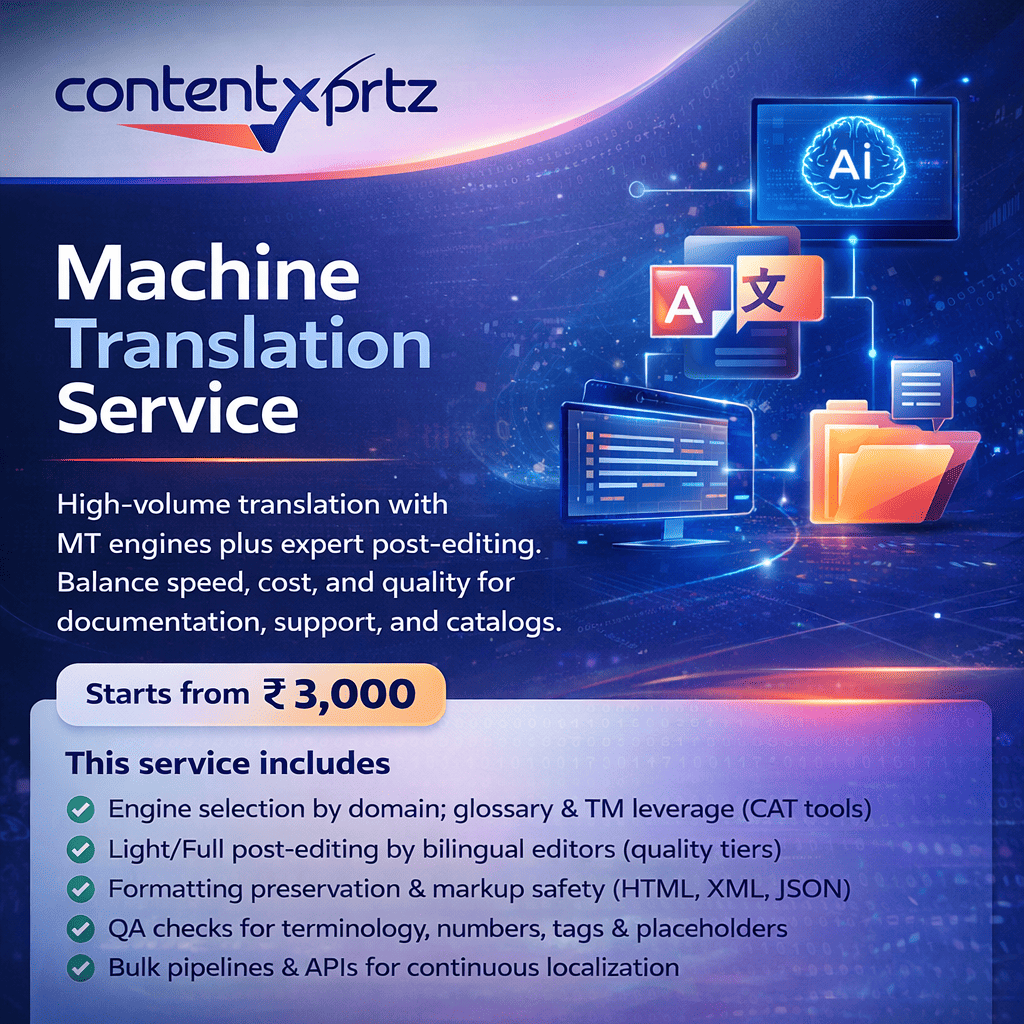
Machine Translation for Research & Academia 📘
Fast. Accurate. Publication-ready.
Managing multilingual academic content doesn’t have to be complex. ContentXprtz’s Machine Translation Service combines advanced MT engines with expert human post-editing to deliver reliable, high-quality translations—without compromising academic rigor.
Designed for researchers, PhD scholars, and institutions that need speed, scalability, and precision for documentation, support materials, and academic catalogs.
What you get with our service:
📄 Domain-specific MT engine selection with glossary & TM (CAT tools) support
🧠 Light or full post-editing by qualified bilingual editors
📘 Formatting & markup safety for HTML, XML, and JSON files
📊 Thorough QA checks for terminology, numbers, tags & placeholders
🎓 Secure workflows, confidentiality controls & bulk/API-based localization
We follow strict ethical standards—your work remains original, confidential, and fully owned by you. We support clarity and accessibility without altering authorship or academic intent.
Ready to scale your translations with confidence?
Message us on WhatsApp to get started today.
WhatsApp: https://wa.me/917065013200
Website: https://contentxprtz.com
#ContentXprtz #AcademicTranslation #MachineTranslation #PhDSupport #ResearchServices #AcademicWriting #JournalPublication #ScholarlyCommunication #ResearchScholars #PhDLife #PostEditing #LocalizationServices #HigherEducation #ResearchEthics #AcademicIntegrity #PublishingSupport #AcademicEditing #ResearchProfessionals #UniversityResearch #GlobalResearch #CATTools #MultilingualResearch #AcademicServices #StudentResearchers
Reimagining Academic Writing in a Global Research Era: The Role of Machine Translation Service
Introduction
The modern academic ecosystem is deeply global. Research collaborations cross borders, journals publish international submissions daily, and doctoral scholars increasingly engage with multilingual datasets, sources, and audiences. In this environment, a Machine Translation Service has emerged as a powerful, though often misunderstood, support mechanism for students, PhD scholars, and academic researchers.
For doctoral candidates, the pressure is relentless. Publishing expectations are rising, journal rejection rates remain high, and the cost of professional academic support continues to increase. According to Elsevier’s global research insights, less than 30 percent of submitted manuscripts are accepted by reputable indexed journals, with language clarity cited as one of the most frequent non-scientific reasons for rejection. At the same time, UNESCO reports that more than 70 percent of researchers worldwide operate in a second or third language when publishing internationally.
These realities create a structural imbalance. Scholars may produce rigorous research, yet struggle to communicate their ideas with linguistic precision. This challenge becomes even more complex when research materials, ethics approvals, participant data, or prior literature exist in multiple languages. Here, a Machine Translation Service can offer speed and accessibility. However, without academic oversight, such tools can also introduce risks, including loss of nuance, ethical violations, and misrepresentation of scholarly intent.
This article provides a comprehensive, evidence-based exploration of Machine Translation Service use in academic contexts. It explains how machine translation fits within ethical academic workflows, how it should and should not be used, and why professional academic editing remains essential for publication success. Drawing on global publishing standards from Elsevier, Springer, Emerald Insight, Taylor and Francis, and APA, the discussion aims to empower scholars with clarity rather than hype.
Aligned with the academic ethos of ContentXprtz, this guide is designed to support informed decision-making. It speaks directly to students and researchers navigating time constraints, publication pressure, and language barriers while striving to maintain academic integrity. Throughout, practical examples, expert insights, and best practices are integrated to ensure the content remains educational, trustworthy, and actionable.
Understanding Machine Translation Service in Academic Contexts
A Machine Translation Service refers to automated systems that convert text from one language to another using algorithms, statistical models, or neural networks. Popular examples include neural machine translation engines that rely on large multilingual datasets. In academic settings, these services are increasingly used to support preliminary comprehension, multilingual literature reviews, and early-stage drafting.
However, academic writing differs fundamentally from general communication. It relies on precision, discipline-specific terminology, methodological clarity, and ethical accountability. A literal translation may convey surface meaning, yet fail to preserve epistemic intent. This distinction is critical for PhD scholars whose work must withstand peer review scrutiny.
Machine translation can be valuable when used as an assistive layer rather than a final solution. For instance, a doctoral student reviewing non-English literature may use machine translation to grasp core arguments quickly. Similarly, researchers collaborating across regions may use it to align initial drafts. In these scenarios, the Machine Translation Service accelerates access without replacing scholarly judgment.
According to Springer Nature’s author guidelines, authors remain fully responsible for the accuracy and originality of translated content, regardless of whether automated tools are used. This reinforces the principle that machine translation must always be followed by expert academic review.
Why Language Quality Matters in Research Publication
Academic journals do not merely assess research novelty. They evaluate clarity, coherence, and argumentation. Language errors can obscure contributions and undermine reviewer confidence. Elsevier explicitly states that unclear language can lead to rejection before peer review.
For PhD candidates, this creates a paradox. While research training focuses on methodology and theory, limited institutional support exists for advanced academic writing, especially for non-native English speakers. A Machine Translation Service appears attractive due to its low cost and speed. Yet, without academic editing, the output often fails to meet publication standards.
Professional academic editing services bridge this gap. They contextualize machine-translated drafts, refine disciplinary language, and ensure alignment with journal style guides. At ContentXprtz, machine-assisted workflows are combined with human expertise to preserve author voice while enhancing clarity.
Ethical Use of Machine Translation in Academia
Ethics in academic writing extend beyond plagiarism. They encompass transparency, authorship responsibility, and data protection. When using a Machine Translation Service, scholars must consider several ethical dimensions.
First, confidentiality is paramount. Many machine translation platforms store user input for model training. This poses risks when handling unpublished research, sensitive data, or proprietary findings. Journals affiliated with Taylor and Francis emphasize data confidentiality and author accountability, warning against uploading sensitive material to unsecured platforms.
Second, authorship integrity must be preserved. Machine translation does not confer authorship, yet overreliance can dilute scholarly agency. APA guidelines clarify that tools may assist writing but cannot replace intellectual contribution.
Third, citation accuracy is critical. Automated translation may misinterpret cited sources, leading to incorrect attribution. Therefore, all translated content must be cross-verified against original texts.
An ethical academic workflow treats machine translation as a preliminary tool, followed by expert review, citation verification, and originality checks.
Machine Translation Service vs Academic Editing Services
A common misconception is that machine translation and academic editing serve the same purpose. In reality, they address different needs.
A Machine Translation Service focuses on linguistic conversion. It answers the question: what does this text say in another language? Academic editing, however, addresses how effectively the text communicates within a scholarly community.
Professional editors evaluate argument flow, methodological coherence, terminology accuracy, and journal alignment. They ensure that translated content reflects disciplinary conventions. For example, methodological descriptions in social sciences require different rhetorical framing than those in engineering or medicine.
At ContentXprtz, machine translation is used selectively to support multilingual comprehension. Final manuscripts undergo rigorous academic editing, ensuring they meet international publication standards.
Learn more about integrated academic editing workflows through PhD thesis help and academic editing services.
Practical Applications of Machine Translation Service for PhD Scholars
When used responsibly, machine translation can support several stages of the research lifecycle.
During literature review, scholars can quickly assess non-English studies, expanding theoretical perspectives. In early drafting, it can help non-native speakers express complex ideas before refinement. For collaborative projects, it facilitates cross-cultural communication.
However, machine translation should never be used for final submission drafts. Journals indexed in Scopus and Web of Science expect linguistic precision that automated tools alone cannot provide.
For researchers seeking structured support, research paper writing support and publication assistance offers ethically grounded solutions that integrate technology with expert oversight.
FAQs: Machine Translation Service in Academic Writing
Is using a Machine Translation Service acceptable for PhD research?
Yes, using a Machine Translation Service is acceptable when applied ethically and transparently. Academic publishers do not prohibit machine-assisted translation. However, responsibility for accuracy remains with the author. Machine translation should be used for comprehension, drafting, or internal communication rather than final submissions. Scholars must ensure that translated content is reviewed, edited, and aligned with disciplinary standards. Many journals emphasize that language tools do not replace scholarly accountability.
Can machine translation replace professional academic editing?
No, machine translation cannot replace professional academic editing. While it converts language, it does not evaluate argument quality, methodological clarity, or journal fit. Academic editors provide discipline-specific expertise, refine structure, and ensure compliance with publisher guidelines. Combining machine translation with expert editing ensures efficiency without compromising quality.
Does machine translation affect journal acceptance rates?
Indirectly, yes. Poorly reviewed machine-translated manuscripts often contain unnatural phrasing and conceptual inaccuracies. These issues can lead to desk rejection. Conversely, when machine translation is followed by professional editing, it can support clearer communication and improve acceptance potential. Elsevier and Springer consistently highlight language clarity as a critical evaluation factor.
Is it safe to upload unpublished research to online translation tools?
Caution is essential. Many free Machine Translation Service platforms retain data for training purposes. Uploading unpublished or sensitive research may violate confidentiality requirements. Researchers should use secure, compliant solutions or rely on professional academic service providers that ensure data protection and ethical handling.
How should citations be handled in machine-translated text?
Citations must always be verified against original sources. Machine translation can misinterpret titles, author names, or publication details. Researchers should cross-check references manually and follow journal-specific citation styles. APA emphasizes accuracy and traceability in all references.
Can machine translation help with multilingual data analysis?
Yes, machine translation can assist in preliminary analysis of multilingual qualitative data. However, interpretive accuracy requires human validation. Nuances, cultural context, and idiomatic expressions often require expert interpretation, especially in social science research.
Do journals require disclosure of machine translation use?
Most journals do not require explicit disclosure unless tools significantly influence content generation. However, transparency is encouraged. Authors should ensure that translated text reflects their original intent and meets ethical standards.
What role does machine translation play in systematic reviews?
Machine translation can expand access to non-English studies during screening. However, final data extraction and synthesis should involve expert language review to avoid misinterpretation. This approach aligns with best practices recommended by Cochrane and other evidence-based research bodies.
How does ContentXprtz integrate machine translation ethically?
ContentXprtz uses machine translation as a supplementary tool under strict editorial oversight. All outputs undergo expert academic editing, plagiarism checks, and journal alignment reviews. This ensures ethical compliance, data security, and publication readiness. Explore academic editing services for students and researchers to learn more.
Is machine translation suitable for book manuscripts?
For academic books, machine translation can support early-stage drafting or multilingual source review. However, final manuscripts require professional editing to maintain narrative coherence and scholarly tone. ContentXprtz provides dedicated book authors writing services tailored to academic publishing standards.
Choosing the Right Academic Support Beyond Machine Translation
Selecting the right support system is crucial for long-term academic success. While a Machine Translation Service offers speed, it must be embedded within a broader quality assurance framework. Scholars should prioritize services that emphasize ethics, subject expertise, and transparency.
ContentXprtz operates globally with regional academic teams, ensuring contextual understanding and localized support. From PhD theses to corporate research outputs, integrated services are designed to align with institutional and publisher expectations. Learn more through corporate and academic writing services.
Conclusion: Technology with Academic Integrity
Machine translation is not the enemy of academic writing. When used responsibly, it enhances accessibility and efficiency. However, it is not a substitute for scholarly rigor. Academic success depends on clarity, integrity, and expert refinement.
For PhD scholars and researchers navigating global publication demands, the optimal approach combines technological tools with professional academic support. ContentXprtz embodies this balance, offering ethical, reliable, and tailored solutions for scholars worldwide.
Explore PhD Assistance Services today and elevate your research journey.
At ContentXprtz, we don’t just edit — we help your ideas reach their fullest potential.
