
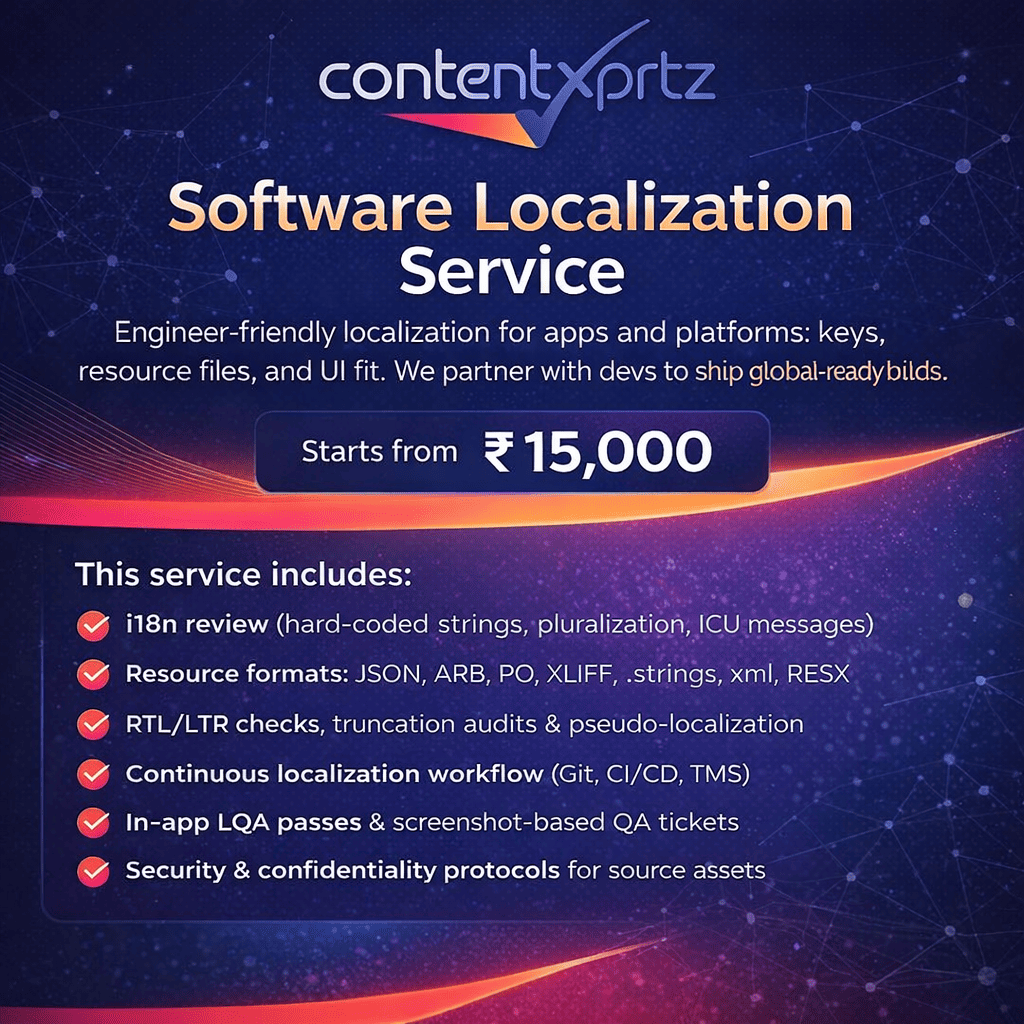
🌍 Software Localization for Global-Ready Research & Platforms
Build once. Publish everywhere—with confidence.
ContentXprtz offers engineer-friendly software localization designed for academic platforms, research tools, and digital applications that need precision, consistency, and global usability. We work alongside developers and researchers to ensure your software is publication- and deployment-ready across languages and regions.
🔹 i18n review for hard-coded strings, pluralization & ICU messages
🔹 Support for JSON, ARB, PO, XLIFF, .strings, XML & RESX files
🔹 RTL/LTR checks, truncation audits & pseudo-localization
🔹 Continuous localization workflows (Git, CI/CD, TMS)
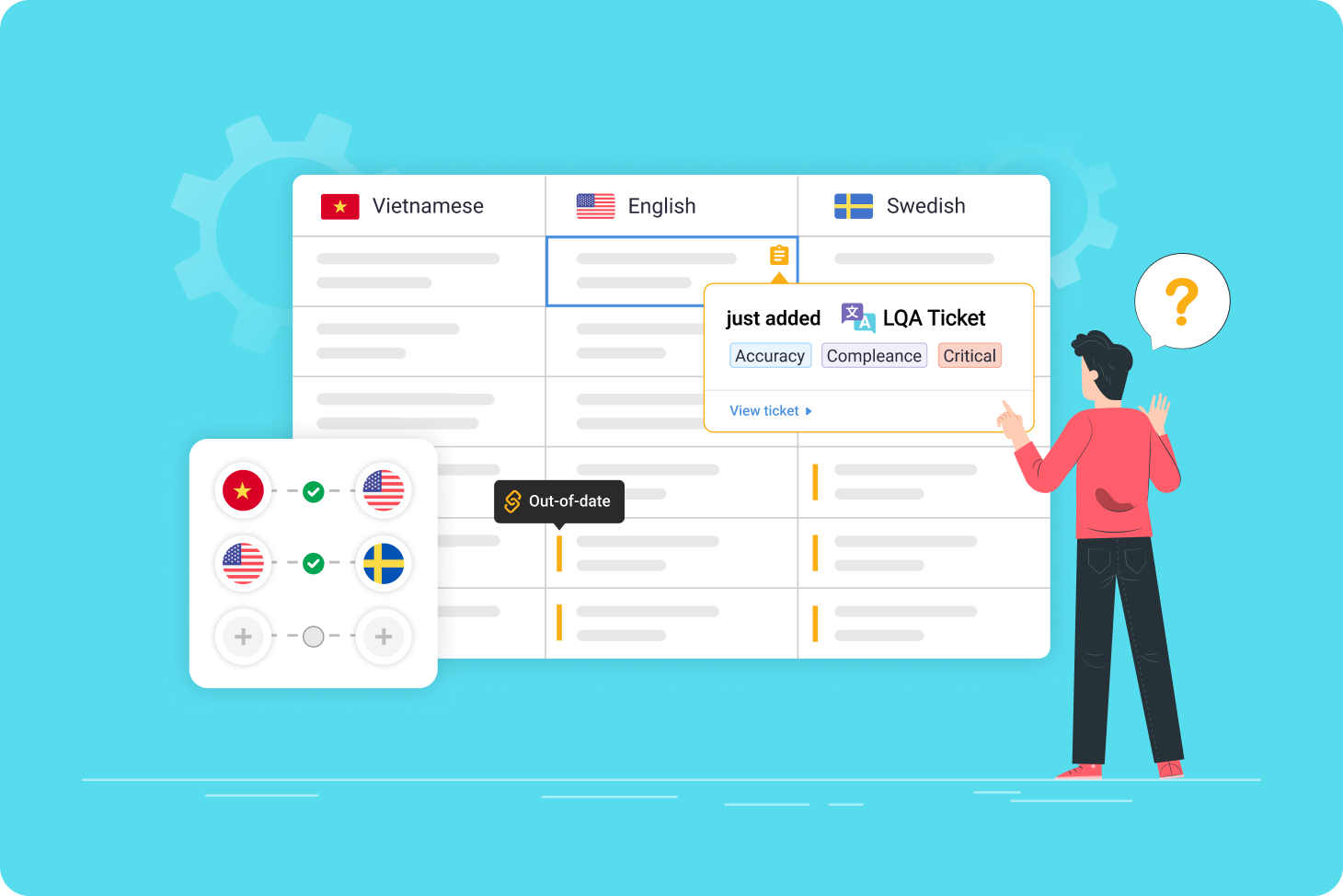
🔹 In-app LQA with screenshot-based QA tickets
We follow strict ethical standards—your code, content, and intellectual ownership remain fully yours. All projects are handled with security, confidentiality, and academic integrity at the core.
📘 Starts from ₹15,000
📲 Message us on WhatsApp to get started today
WhatsApp: https://wa.me/917065013200
🌐 Website: https://contentxprtz.com
#ContentXprtz #SoftwareLocalization #AcademicServices #ResearchSupport #PhDScholars #AcademicPublishing #ResearchTools #ScholarlyCommunication #GlobalResearch #PhDLife #PostdocLife #HigherEducation #ResearchIntegrity #EthicalResearch #JournalReady #AcademicWritingSupport #ResearchPlatforms #InternationalPublishing #STEMResearch #DigitalResearch #GraduateStudents #DoctoralStudies #UniversityResearch #PublicationSupport
Beyond Borders: How a Professional Software Localization Service Accelerates Global Academic and Research Impact
Introduction: Why Software Localization Matters More Than Ever in Academic and Research Ecosystems
In today’s hyperconnected academic and research environment, ideas rarely stay confined to a single country or language. Research software, data collection platforms, learning management systems, digital labs, and academic tools are now used by scholars, students, and institutions across continents. Yet, despite the global reach of these technologies, many researchers still struggle with a critical barrier: language and cultural accessibility. This is where a Software Localization Service becomes not just useful, but essential.
For PhD scholars, postgraduate students, and academic researchers, time is one of the scarcest resources. Balancing coursework, research design, data analysis, teaching responsibilities, funding pressures, and publication deadlines leaves little room to address technical language adaptation. At the same time, the pressure to publish in high-impact international journals continues to rise. According to global publishing data from major academic publishers, acceptance rates for top-tier journals often fall below 10 percent. This reality places enormous emphasis on clarity, usability, and accessibility, not only in manuscripts but also in the digital tools that support research workflows.
Moreover, the rising costs of research, software subscriptions, and international collaboration further intensify these challenges. Many research teams now collaborate across borders using shared platforms for surveys, simulations, analytics, or educational delivery. If these platforms are not linguistically accurate or culturally aligned, misunderstandings can emerge, data quality can suffer, and user adoption can decline. Poor localization can lead to misinterpretation of instructions, flawed responses in surveys, or even ethical and compliance risks.
A professional Software Localization Service addresses these issues holistically. It goes beyond literal translation to adapt software interfaces, documentation, help files, user journeys, and embedded academic content to the linguistic, cultural, and disciplinary expectations of target users. For researchers, this means higher participation rates, improved data reliability, smoother collaboration, and stronger global credibility.
At ContentXprtz, we understand these pressures deeply. Since 2010, we have worked with researchers in more than 110 countries, supporting not only manuscripts and dissertations, but also the broader research ecosystem that surrounds scholarly work. Our approach to software localization is grounded in academic precision, ethical integrity, and cultural intelligence. We do not treat localization as a technical afterthought. Instead, we see it as a strategic enabler of global research impact.
This article explores how a Software Localization Service supports academic success, how it differs from simple translation, and why researchers and institutions increasingly rely on specialized providers like ContentXprtz. Whether you are developing a research tool, deploying an educational platform, or scaling an academic product internationally, this guide will help you make informed decisions with confidence.
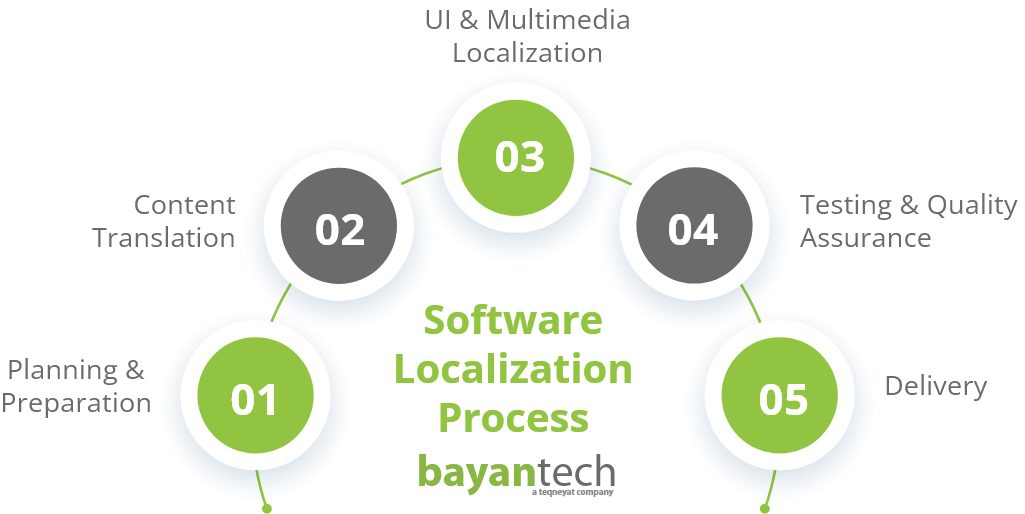


Understanding Software Localization in an Academic Context
What Is Software Localization Service?
A Software Localization Service is a structured process that adapts software applications to meet the linguistic, cultural, functional, and regulatory requirements of a specific target region. In academic and research settings, this includes localizing user interfaces, instructional text, error messages, data labels, dashboards, reports, consent forms, and supporting documentation.
Unlike basic translation, localization considers how language interacts with discipline-specific terminology, cultural norms, academic conventions, and user expectations. For example, a data analytics platform used by researchers in Europe, East Asia, and the Middle East must reflect different academic writing norms, numerical formats, date conventions, and ethical disclosures.
Why Localization Is Critical for Researchers and Institutions
Academic software often supports sensitive activities such as data collection, experimentation, assessment, and learning delivery. Any ambiguity in language can compromise data validity or participant understanding. Localization ensures that every user interacts with the software as intended, regardless of their native language or academic background.
From an institutional perspective, localized software improves adoption rates, reduces support costs, and strengthens international partnerships. For individual researchers, it enhances usability, credibility, and the likelihood that their tools will be accepted and trusted by global collaborators.
Software Localization vs Translation: A Crucial Distinction
Translation Alone Is Not Enough
Translation focuses on converting text from one language to another. While this is a component of localization, it does not address context, culture, or function. In academic environments, this limitation can be particularly problematic. Research software often includes complex instructions, methodological explanations, and discipline-specific terminology that cannot be translated accurately without subject expertise.
Localization as a Multidimensional Process
A comprehensive Software Localization Service integrates:
-
Linguistic accuracy aligned with academic standards
-
Cultural adaptation of tone, examples, and interaction styles
-
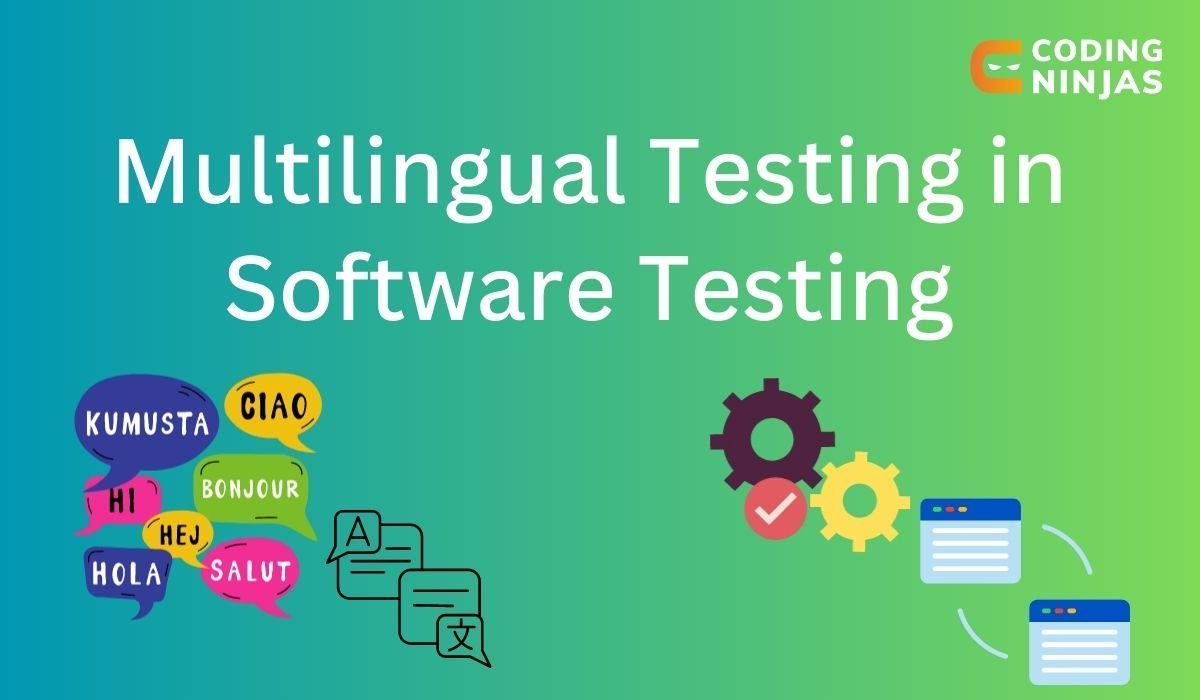
Functional testing to ensure software behavior matches localized content
-
Consistency with academic and ethical guidelines across regions
This multidimensional approach is what distinguishes professional localization from generic language services.
The Growing Demand for Software Localization in Research and Education
Globalization of Research Collaboration
International collaboration is now the norm rather than the exception. Multinational research teams rely on shared digital platforms for communication, experimentation, and dissemination. Localization enables seamless collaboration by removing language friction and ensuring mutual understanding.
Expansion of Digital Learning and Research Tools
The rise of online education, virtual labs, and AI-driven research platforms has accelerated demand for localized software. Universities and research centers increasingly deploy tools across campuses and partner institutions worldwide.
Compliance and Ethical Considerations
Different regions impose distinct regulatory and ethical requirements for research software, particularly in areas such as data privacy, informed consent, and accessibility. Localization ensures compliance while maintaining academic integrity.
How ContentXprtz Delivers Academic-Grade Software Localization Services
Subject-Matter Expertise at the Core
At ContentXprtz, localization projects are handled by teams that combine linguistic proficiency with subject-matter expertise. This is critical in academic contexts, where terminology must align with disciplinary conventions and scholarly expectations.
Integration with Academic Editing and Publishing Services
Our Software Localization Service is closely aligned with our broader academic editing services and research paper assistance offerings. This integrated approach ensures consistency across software interfaces, documentation, and related manuscripts.
Ethical and Quality Assurance Frameworks
We follow rigorous quality control processes, including peer review, back-translation checks, and usability testing. These practices mirror the standards used by leading academic publishers such as Elsevier, Springer, Emerald Insight, and Taylor and Francis.

Practical Applications of Software Localization for PhD Scholars and Researchers
Localizing Research Data Collection Tools
Surveys, questionnaires, and experimental interfaces must be localized carefully to avoid bias and misinterpretation. Professional localization improves response accuracy and participant engagement.
Adapting Educational Platforms for International Learners
Learning management systems and educational software benefit from localization that reflects pedagogical norms and academic expectations in different regions.
Scaling Academic Products and Innovations
Researchers developing software-based innovations can reach broader audiences and attract international funding by offering localized versions of their tools.
Best Practices for Choosing a Software Localization Service
-
Select providers with proven academic and research experience
-
Ensure access to subject-specific editors and reviewers
-
Verify quality assurance and testing protocols
-
Look for integration with academic editing and PhD support services
ContentXprtz meets these criteria through its global network of experts and its long-standing commitment to academic excellence.
Integrated FAQs: Addressing Common Questions from Researchers and Scholars
FAQ 1: How does a Software Localization Service support PhD research projects?
A Software Localization Service supports PhD research projects by ensuring that research tools, data collection platforms, and supporting software are accessible and accurate for diverse participant groups. Many doctoral studies involve cross-cultural samples or international collaborations. Localization helps maintain methodological rigor by reducing language-induced bias and misunderstanding. It also enhances ethical compliance, particularly in informed consent and participant instructions. For PhD scholars, this translates into more reliable data, smoother collaboration, and stronger acceptance during peer review and thesis evaluation.
FAQ 2: Is software localization relevant if my research is conducted in English?
Even when English is the primary research language, localization remains relevant. Many users interpret English differently based on cultural and educational background. Localization adapts tone, examples, and interface elements to align with local academic norms. This improves usability and reduces cognitive load for non-native speakers. In global research contexts, localized English content often performs better than generic versions.
FAQ 3: How does localization improve publication outcomes?
Localized software contributes indirectly to publication success by improving data quality, participant understanding, and methodological transparency. Journals published by organizations such as Elsevier and Springer emphasize ethical rigor and clarity. When research tools are localized professionally, reviewers are less likely to raise concerns about participant comprehension or procedural ambiguity.
FAQ 4: Can software localization align with academic editing services?
Yes. At ContentXprtz, software localization is closely aligned with academic editing services. This ensures consistency between software interfaces, user documentation, and related manuscripts. Such alignment strengthens the overall credibility of the research project and supports smoother peer review.
FAQ 5: What disciplines benefit most from software localization?
All disciplines benefit, but the impact is particularly strong in social sciences, health sciences, education, engineering, and interdisciplinary research. These fields often rely on digital tools for data collection, analysis, and learning delivery, making localization essential for accuracy and adoption.
FAQ 6: How does localization address ethical and regulatory requirements?
Localization adapts content to reflect local ethical standards, consent requirements, and regulatory language. This is critical for compliance with institutional review boards and international research ethics guidelines. Professional localization reduces the risk of ethical violations caused by linguistic ambiguity.
FAQ 7: Is localization cost-effective for individual researchers?
While localization requires investment, it often reduces long-term costs by minimizing errors, rework, and participant dropout. For grant-funded or collaborative projects, the return on investment is significant due to improved outcomes and credibility.
FAQ 8: How long does academic software localization take?
Timelines depend on software complexity, number of languages, and testing requirements. ContentXprtz follows structured project management processes to deliver timely results without compromising quality.
FAQ 9: Can localization support accessibility and inclusion?
Yes. Localization enhances accessibility by adapting content for linguistic diversity and cultural inclusivity. This aligns with global academic values of equity and inclusion.
FAQ 10: Why choose ContentXprtz for Software Localization Service?
ContentXprtz combines academic expertise, global experience, and ethical rigor. Established in 2010, we support researchers worldwide through integrated services that include software localization, PhD thesis help, and research paper writing support.
Trusted Academic Resources Supporting Localization Best Practices
For further reading and authoritative guidance, consult the following resources:
-
Elsevier Research Resources: https://www.elsevier.com
-
Springer Nature Author Services: https://www.springernature.com
-
Emerald Insight Publishing: https://www.emerald.com/insight
-
Taylor and Francis Author Services: https://www.taylorandfrancis.com
-
APA Style and Research Guidelines: https://apastyle.apa.org
How Software Localization Fits Within ContentXprtz’s Service Ecosystem
Software localization complements our broader offerings, including:
-
PhD thesis help and academic editing services through our Writing and Publishing Services: https://contentxprtz.com/writing-publishing-services
-
Comprehensive PhD and Academic Services: https://contentxprtz.com/phd-academic-services
-
Student-focused research and career support: https://contentxprtz.com/student-career-academic-writing-services
-
Support for book authors and editors: https://contentxprtz.com/book-authors-writing-services
-
Professional corporate and technical writing: https://contentxprtz.com/corporate-writing-services
This integrated ecosystem ensures that every aspect of your academic work, from software to manuscripts, meets the highest standards.
Conclusion: Empowering Global Research Through Strategic Software Localization
A professional Software Localization Service is no longer optional in a global academic environment. It is a strategic investment that enhances usability, credibility, and impact. For PhD scholars, students, and researchers, localization supports methodological rigor, ethical compliance, and international collaboration.
ContentXprtz brings more than a decade of global academic experience to every localization project. Our teams understand the pressures researchers face and deliver solutions that are precise, ethical, and culturally informed. By integrating localization with academic editing and publication support, we help scholars navigate complexity with confidence.
If you are ready to extend the reach of your research tools and strengthen your global academic presence, explore our PhD Assistance Services today.
At ContentXprtz, we don’t just edit — we help your ideas reach their fullest potential.
