
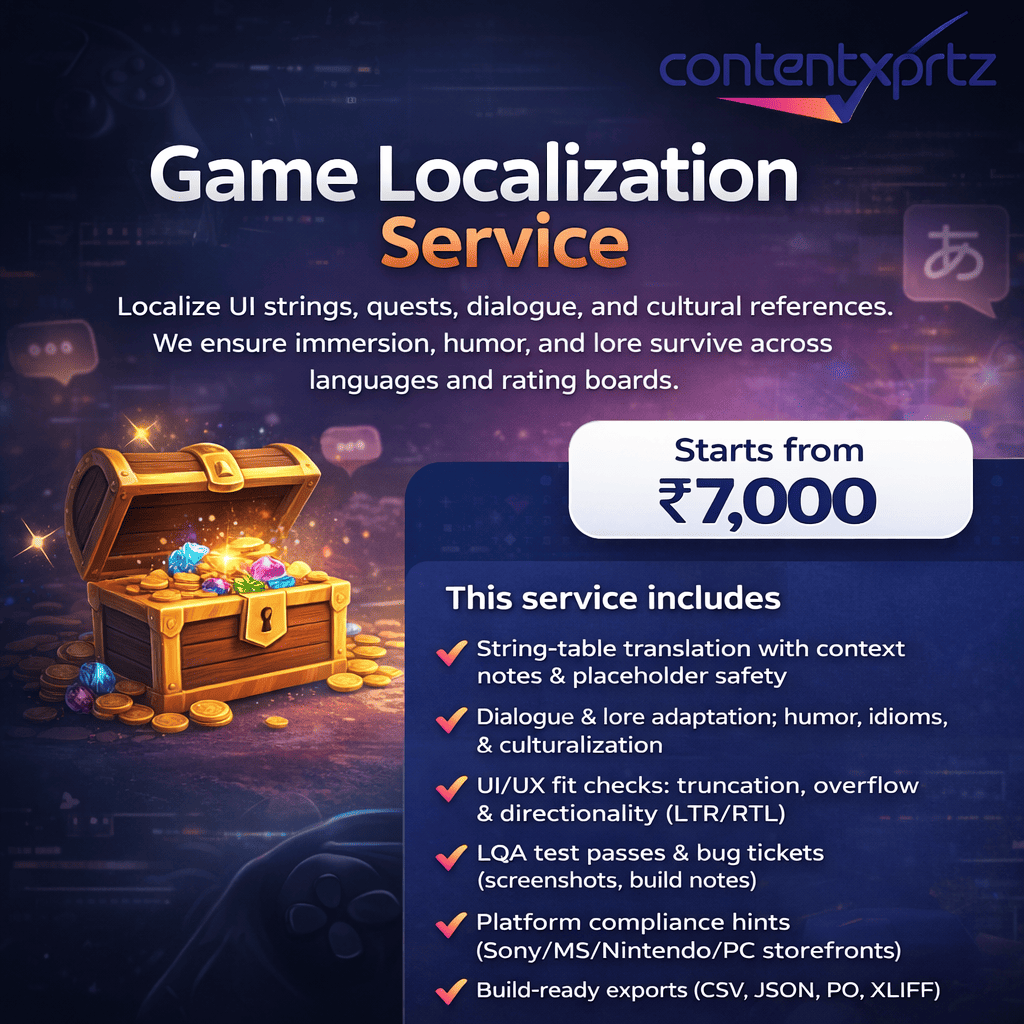
🎮 Game Localization That Preserves Meaning, Culture, and Immersion
Make your research-driven games speak every language—accurately and ethically.
At ContentXprtz, our Game Localization Service goes beyond translation. We adapt UI strings, dialogue, quests, and cultural references so your game remains clear, immersive, and globally compliant—without losing its original intent or creative integrity.
🔍 What you get with our Game Localization Service:
📄 Context-aware string-table translation with placeholder safety
🧠 Dialogue, lore, humor & cultural adaptation for global audiences
📘 UI/UX fit checks (truncation, overflow, LTR/RTL support)
🎮 Linguistic QA testing with actionable bug tickets
📊 Build-ready exports (CSV, JSON, PO, XLIFF) with platform compliance hints
💡 Ethical, Transparent, Author-First Approach
Your content remains yours. We ensure originality, cultural accuracy, and full author ownership—no shortcuts, no automated guesswork.
📲 Message us on WhatsApp to get started today
WhatsApp: https://wa.me/917065013200
🌐 Website: https://contentxprtz.com
🎓 Designed for students, researchers, and academic professionals building globally relevant digital products.
#AcademicServices #PhDSupport #ResearchPublishing #GameLocalization #AcademicWriting #PhDScholars #ResearchSupport #HigherEducation #PublicationSupport #EthicalResearch #StudentSupport #AcademicIntegrity #ScholarlyWork #ResearchLife #PhDJourney #PublishingResearch #AcademicCareers #DoctoralStudies #PostdocLife #ResearchTools #DigitalScholarship #GlobalResearch #ContentXprtz
Game Localization Service as a Strategic Academic Publishing Advantage for Global Researchers
Introduction: Why Game Localization Service Matters for Global Academic Impact
The global academic ecosystem is no longer confined by national borders, single languages, or regional readerships. Today, PhD scholars, postgraduate students, and academic researchers operate in a highly interconnected research environment where visibility, accessibility, and cultural relevance directly influence scholarly impact. In this context, Game Localization Service has emerged as a critical yet often misunderstood support mechanism for researchers aiming to disseminate interdisciplinary, gamified, simulation-based, and digital research outputs across global audiences.
At its core, a Game Localization Service goes far beyond translation. It is a structured academic adaptation process that ensures research-driven games, simulations, educational platforms, and interactive scholarly outputs remain conceptually accurate, culturally sensitive, linguistically precise, and publication compliant across regions. For researchers working in digital humanities, educational technology, behavioral sciences, management simulations, AI-driven learning platforms, and serious games, localization has become inseparable from research credibility.
PhD scholars today face unprecedented challenges. According to Elsevier’s global research insights, the average PhD candidate spends over 55 hours per week balancing research, teaching, publishing, and administrative responsibilities. Meanwhile, journal acceptance rates for top-tier publishers such as Springer Nature and Taylor and Francis often fall below 10 percent, intensifying publication stress. Adding to this pressure is the rapid rise of interdisciplinary outputs, including game-based research artifacts, which demand both technical accuracy and cultural alignment.
Moreover, global research dissemination is no longer optional. UNESCO data indicates that over 65 percent of academic collaborations now involve cross-border research teams. This shift requires scholars to present their work in formats that resonate across linguistic and cultural contexts. A poorly localized research game or simulation can distort findings, reduce user engagement, and weaken peer review outcomes.
This is where a professionally executed Game Localization Service becomes indispensable. When aligned with academic editing standards, research ethics, and publishing expectations, localization enables scholars to preserve theoretical rigor while expanding global reach. It also ensures compliance with institutional review boards, funding agency guidelines, and international academic norms.
At ContentXprtz, established in 2010 and trusted by researchers in more than 110 countries, game localization is approached not as a technical task but as an academic responsibility. By integrating subject expertise, linguistic precision, and publishing intelligence, ContentXprtz supports scholars in transforming complex research-driven games into globally credible academic outputs.
Understanding Game Localization Service in Academic and Research Contexts
A Game Localization Service in academic settings refers to the systematic adaptation of research-based games, simulations, and interactive learning tools for different linguistic, cultural, and scholarly environments. Unlike commercial game localization, academic localization prioritizes theoretical accuracy, methodological integrity, and ethical compliance.
Key Components of Academic Game Localization
Academic game localization involves multiple layers of scholarly validation:
-
Linguistic adaptation aligned with academic registers
-
Cultural contextualization without altering research constructs
-
Terminology standardization based on discipline-specific glossaries
-
User interface localization for diverse learner demographics
-
Compliance with academic and ethical review standards
For example, a behavioral economics simulation developed for an English-speaking cohort may require localization not only into Mandarin or German but also into culturally relevant decision-making frameworks. Failure to do so can compromise the validity of experimental outcomes.
Why PhD Scholars and Researchers Need Professional Game Localization Service
Preserving Research Validity Across Cultures
Cross-cultural research demands equivalence. When game-based research tools are poorly localized, constructs such as motivation, risk perception, or engagement may lose meaning. A professional Game Localization Service ensures conceptual equivalence rather than literal translation.
Enhancing Journal Acceptance and Peer Review Outcomes
Top publishers such as Elsevier and Emerald Insight increasingly assess methodological transparency and reproducibility. Localized games that demonstrate cultural and linguistic rigor strengthen peer reviewer confidence and improve acceptance probabilities.
Supporting Funded and International Research Projects
Funding bodies often require dissemination in multiple languages. Proper localization supports compliance with grant deliverables and enhances project impact reporting.
Academic Editing and Game Localization: A Converging Discipline
Academic editing and game localization intersect at the point of scholarly integrity. Editing ensures clarity, while localization ensures relevance. Together, they transform research artifacts into globally intelligible outputs.
At ContentXprtz, localization workflows integrate with academic editing services to ensure:
-
Alignment with APA, MLA, and Chicago style conventions
-
Consistency across manuscripts and interactive tools
-
Ethical compliance in participant-facing content
Researchers seeking PhD thesis help increasingly rely on integrated localization and editing support to strengthen appendices, supplementary materials, and digital artifacts linked to dissertations.
Learn more about our comprehensive academic editing approach at
https://contentxprtz.com/phd-academic-services
Game Localization Service and Research Ethics
Ethical research dissemination extends beyond consent forms and anonymization. Language itself is an ethical instrument. Poor localization may unintentionally bias participants or misrepresent findings.
Ethical Considerations in Localization
-
Avoiding cultural stereotyping
-
Maintaining neutrality in instructional content
-
Ensuring accessibility for diverse learner groups
-
Preserving informed consent clarity
According to the American Psychological Association, culturally responsive research communication enhances both participant protection and data reliability. This principle applies equally to interactive research tools.
Practical Use Cases of Game Localization Service in Academia
Educational Technology Research
Researchers developing AI-driven learning games must ensure pedagogical alignment across regions.
Management and Leadership Simulations
Case-based simulations used in management research require contextual localization to reflect regional organizational norms.
Healthcare and Behavioral Science Games
Clinical training games must adhere to local regulatory language and ethical standards.
Each of these domains benefits from research paper assistance combined with specialized localization expertise.
Integrated Academic Support for Game Localization
ContentXprtz offers localization as part of a broader ecosystem of academic services, including:
-
Writing and Publishing Services
https://contentxprtz.com/writing-publishing-services -
Student Writing Services
https://contentxprtz.com/student-career-academic-writing-services -
Book Authors Writing Services
https://contentxprtz.com/book-authors-writing-services -
Corporate Writing Services
https://contentxprtz.com/corporate-writing-services
This integrated approach ensures consistency across research outputs.
Frequently Asked Questions: Game Localization Service for Academic Researchers
FAQ 1: How does Game Localization Service differ from standard academic translation?
A Game Localization Service differs fundamentally from standard academic translation in scope, methodology, and scholarly responsibility. Translation focuses on linguistic conversion, while localization addresses meaning, context, usability, and research integrity. For academic researchers, especially PhD scholars, this distinction is critical. Research-driven games often embed theoretical constructs, experimental variables, and instructional cues that cannot be translated verbatim without risking distortion.
Localization ensures that cognitive load, decision-making structures, and behavioral triggers function equivalently across cultures. For example, a leadership simulation grounded in Western organizational norms may require conceptual adaptation for Asian or Middle Eastern contexts. Standard translation cannot address these nuances. Localization, therefore, operates at the intersection of linguistics, cultural studies, and research methodology.
From a publication standpoint, journals increasingly scrutinize methodological transparency. Reviewers expect researchers to demonstrate how tools were adapted for multilingual deployment. A professional Game Localization Service documents these adaptations systematically, strengthening methodological sections and appendices. This level of rigor directly supports acceptance in publishers such as Springer Nature and Elsevier.
FAQ 2: Is Game Localization Service relevant for non-gaming academic research?
Yes, Game Localization Service is highly relevant beyond traditional gaming research. In academia, the term “game” often includes simulations, serious games, interactive learning platforms, and decision-making experiments. Fields such as education, management, psychology, economics, and healthcare increasingly use game-based methodologies to capture real-world behaviors.
For PhD scholars, these tools often form a core part of data collection. Localization ensures that participants across regions interpret scenarios consistently. Without localization, cross-cultural validity becomes questionable, weakening research findings. Therefore, even if the research is not about games per se, localization remains essential when interactive tools are involved.
FAQ 3: Can localized research games improve journal acceptance rates?
While no service can guarantee journal acceptance, professionally localized research tools significantly strengthen a manuscript’s methodological credibility. Peer reviewers often assess whether instruments are appropriate for the sampled population. Localization demonstrates due diligence, cultural awareness, and ethical responsibility.
Publishers such as Emerald Insight emphasize methodological rigor and transparency. When localization is documented clearly, reviewers are more likely to trust data integrity. This trust contributes positively to editorial decisions, particularly in interdisciplinary and international journals.
FAQ 4: How does localization support PhD thesis evaluation and viva voce?
PhD theses increasingly include digital appendices, simulations, or interactive components. During evaluation and viva voce examinations, examiners may assess not only theoretical contributions but also methodological robustness. Localized tools signal academic maturity and global awareness.
Moreover, external examiners from different countries may interact with localized materials. Clear, culturally adapted content facilitates understanding and reduces misinterpretation during defense discussions. As part of PhD thesis help, localization strengthens both written and interactive components.
FAQ 5: What disciplines benefit most from Game Localization Service?
Disciplines that benefit significantly include educational technology, behavioral sciences, management studies, human-computer interaction, AI and machine learning, and healthcare training. However, any field employing simulations or interactive research instruments can benefit.
For example, economics experiments using gamified decision tasks must ensure equivalent incentives and comprehension across cultures. Localization addresses these concerns systematically, supporting cross-national research validity.
FAQ 6: How does ContentXprtz ensure academic integrity in localization?
ContentXprtz employs subject-matter experts, academic editors, and localization specialists who collaborate closely. This multidisciplinary approach ensures that localization does not alter theoretical constructs or research hypotheses.
All localization processes adhere to ethical guidelines, publisher standards, and institutional expectations. Documentation is provided to support transparency in manuscripts and dissertations.
FAQ 7: Is localization required for publishing in English-language journals?
Even when publishing in English-language journals, localization remains relevant if data collection involved multilingual participants. Journals expect researchers to explain how instruments were adapted linguistically and culturally.
Localization documentation strengthens methodology sections and enhances compliance with editorial policies. Therefore, localization is not language-dependent but research-dependent.
FAQ 8: Can localization support grant-funded research dissemination?
Funding agencies increasingly mandate open access and multilingual dissemination. Localized research games facilitate broader impact, stakeholder engagement, and policy relevance.
Localization also supports reporting requirements by demonstrating inclusive dissemination strategies. This aligns with global funding priorities emphasizing equity and accessibility.
FAQ 9: How long does academic game localization take?
Timelines vary based on complexity, languages involved, and research scope. However, professional services prioritize accuracy over speed. ContentXprtz follows structured workflows to balance efficiency with scholarly rigor.
Researchers are advised to plan localization early to avoid delays in submission and dissemination.
FAQ 10: How do I integrate Game Localization Service into my research workflow?
Integration begins at the design stage. Researchers should consult localization experts while developing instruments. Early integration reduces revisions and strengthens methodological coherence.
ContentXprtz offers consultative support to align localization with research objectives, ethics approvals, and publication timelines.
Conclusion: Advancing Global Research Through Game Localization Service
In an era where academic impact transcends borders, Game Localization Service has evolved into a strategic necessity rather than an optional enhancement. For PhD scholars, students, and researchers employing interactive tools, localization safeguards research validity, ethical integrity, and global relevance.
By integrating localization with academic editing, publication support, and ethical best practices, researchers can confidently disseminate their work across cultures and platforms. ContentXprtz brings over a decade of global academic experience to this complex process, ensuring that scholarly ideas remain accurate, accessible, and impactful.
Explore our PhD and Academic Services to strengthen your research journey and global reach.
At ContentXprtz, we don’t just edit — we help your ideas reach their fullest potential.
