
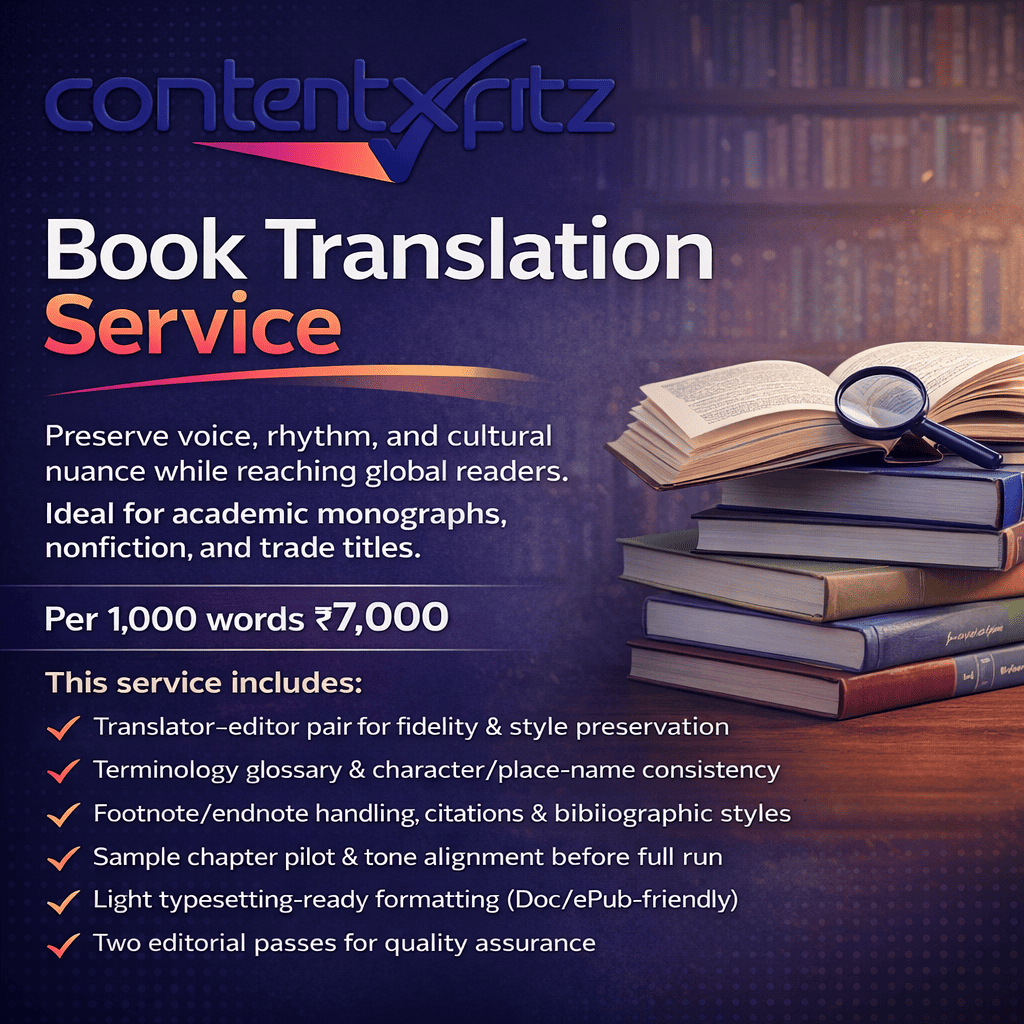
📘 Translate Your Book Without Losing Its Scholarly Voice
Reach global readers while preserving meaning, nuance, and academic integrity.
At ContentXprtz, our Book Translation Service is designed for academic monographs, nonfiction, and trade titles—ensuring clarity, consistency, and publication-ready quality across languages.
🔍 Why researchers trust our translation support:
• Translator–editor pairing for accuracy and style preservation
• Discipline-specific terminology glossaries for consistency
• Careful handling of footnotes, citations, and references
• Sample chapter pilot to align tone before full translation
• Doc/ePub-friendly formatting for smooth publishing
• Two editorial passes for rigorous quality assurance
🧠 Ethical & Author-Centric
Your ideas remain yours. We focus on faithful translation, originality, and complete author ownership—no shortcuts, no automation-only outputs.
📄 Pricing: ₹7,000 per 1,000 words
📩 Ready to take your work global?
Message us on WhatsApp to get started today.
WhatsApp: https://wa.me/917065013200
Website: https://contentxprtz.com
#AcademicTranslation #BookTranslation #PhDSupport #ResearchPublishing #AcademicWritingServices #ScholarlyBooks #ResearchSupport #PhDLife #PostdocLife #AcademicIntegrity #PublicationSupport #HigherEducation #ResearchScholars #Monograph #NonFictionBooks #GlobalResearch #JournalReady #EthicalEditing #ContentXprtz #AcademicAuthors #ResearchCommunity #ThesisSupport #ScholarlyCommunication #UniversityResearch
Beyond Language Barriers: How a Professional Book Translation Service Shapes Global Academic Impact
Introduction: Translating Knowledge for a Global Academic Community
For PhD scholars, academic researchers, and scholarly authors, research does not end with discovery. Its real value emerges when ideas travel across borders, disciplines, and cultures. In today’s interconnected academic ecosystem, English remains the dominant language of scholarly publishing, while influential research is increasingly produced in Chinese, Japanese, Korean, German, French, Spanish, and many other languages. This linguistic diversity creates both opportunity and pressure. Scholars are expected to disseminate their work globally, yet language barriers often stand between high-quality research and international recognition.
This is where a Book Translation Service becomes a critical academic investment rather than a technical afterthought. Within the first stages of publication planning, researchers must decide how to preserve conceptual rigor, disciplinary nuance, and methodological accuracy while adapting their work for a new linguistic and cultural audience. For PhD candidates especially, this challenge intersects with tight submission deadlines, limited funding, and the emotional strain of high-stakes publishing requirements.
Globally, the pressure is intensifying. According to major publishing houses, acceptance rates for top-tier academic books and monographs often remain below 10 percent, even before language quality is considered. Journals and academic presses increasingly reject manuscripts not for weak research design, but for unclear argumentation, inconsistent terminology, or culturally inappropriate framing. These issues become more pronounced when a book is translated without subject-matter expertise.
At the same time, doctoral candidates and early-career researchers face rising costs associated with research dissemination. Conference travel, open-access fees, and professional editing already stretch academic budgets. Adding translation to this list can feel overwhelming. However, poor translation frequently leads to desk rejection, reputational risk, or misinterpretation of findings, which costs far more in the long run.
A professional Book Translation Service, when delivered ethically and academically, bridges this gap. It allows scholars to maintain authorship integrity while meeting the linguistic and stylistic expectations of global publishers. At ContentXprtz, this philosophy guides every translation project. Since 2010, we have supported researchers in more than 110 countries by transforming complex academic books into publication-ready manuscripts that speak fluently to international audiences.
This article offers a comprehensive, evidence-based guide for students, PhD scholars, and researchers seeking professional translation and publication support. It explains how academic book translation works, why it differs from general translation, and how scholars can evaluate services ethically and strategically. Throughout, the focus remains on one principle: translation is not about replacing the author’s voice, but amplifying it across languages and cultures.
Understanding Academic Book Translation in the Research Ecosystem
Academic book translation is fundamentally different from commercial or literary translation. While novels prioritize narrative flow and emotional resonance, scholarly books demand conceptual precision, terminological consistency, and methodological transparency. A single mistranslated term in economics, medicine, law, or philosophy can alter the meaning of an entire argument.
A professional Book Translation Service therefore operates at the intersection of linguistics and scholarship. Translators must understand disciplinary conventions, citation norms, and the epistemological assumptions of the target academic community. For example, argument structure in German philosophy differs significantly from Anglo-American analytical traditions. Similarly, methodological descriptions in Chinese social science texts often require restructuring to align with Western journal expectations.
In reputable academic publishing, translation is viewed as an extension of scholarly communication rather than a mechanical process. Major publishers such as Elsevier and Springer Nature emphasize language clarity, ethical authorship, and transparency in translated submissions. Translators are expected to preserve citations, respect intellectual property, and avoid interpretive overreach.
At ContentXprtz, academic book translation is integrated into a broader publishing workflow. Translation, editing, and formatting work together to ensure the final manuscript meets disciplinary and publisher-specific standards.
Why PhD Scholars and Researchers Need Specialized Book Translation Support
Preserving Research Integrity Across Languages
The primary concern for any scholar is the integrity of their research. Automated or non-specialist translation tools often fail to capture theoretical nuance or methodological detail. This risk increases for interdisciplinary work, where terminology may differ across fields.
A specialized Book Translation Service employs subject experts who understand both the source language and the academic context. This dual expertise ensures that hypotheses, models, and interpretations remain intact.
Meeting International Publishing Standards
Academic presses expect translated manuscripts to read as if originally written in the target language. This includes stylistic norms, citation formats, and logical flow. According to editorial guidelines from Taylor & Francis, language quality directly affects peer review outcomes.
Professional translation combined with academic editing significantly improves acceptance probability. Many scholars integrate translation with academic editing services and research paper writing support to streamline submission.
Reducing Time-to-Publication Stress
PhD candidates often balance coursework, teaching, data analysis, and personal responsibilities. Managing translation independently adds cognitive and emotional strain. Outsourcing to a reliable service allows scholars to focus on intellectual contribution rather than linguistic mechanics.
Ethical Dimensions of Book Translation in Academia
Ethics in academic translation extend beyond plagiarism concerns. Transparency, authorship ownership, and acknowledgment practices matter deeply in scholarly communities. Translation must never distort data, introduce unsupported interpretations, or remove limitations acknowledged by the original author.
Professional services adhere to guidelines from bodies such as the American Psychological Association, which emphasize clarity, attribution, and methodological honesty. Ethical translation also involves respecting cultural context while aligning with international academic discourse.
ContentXprtz follows a strict ethical framework. Authors retain full intellectual ownership. Translators act as facilitators, not co-authors, unless explicitly agreed. This approach aligns with best practices across global academic publishing.
How ContentXprtz Approaches Professional Book Translation
At ContentXprtz, translation is never isolated from publication goals. Each project begins with a needs assessment that considers discipline, target publisher, audience, and timeline. This structured approach differentiates professional academic translation from generic language services.
Our process integrates translation with services such as PhD thesis help, academic editing services, and research paper assistance, ensuring coherence across an author’s academic portfolio. Scholars publishing monographs often benefit from parallel support through our
Writing & Publishing Services and
PhD & Academic Services.
Practical Considerations When Choosing a Book Translation Service
Selecting a translation provider requires critical evaluation. Scholars should assess subject expertise, revision processes, confidentiality policies, and familiarity with target publishers. Cost alone should never determine choice, as low-quality translation often results in rejection or reputational damage.
Authors writing for broader audiences may also explore
Book Authors Writing Services, while professionals translating institutional reports often rely on
Corporate Writing Services.
Frequently Asked Questions: Book Translation and Academic Publishing
FAQ 1: How is academic book translation different from regular translation services?
Academic book translation differs fundamentally from general translation because it operates within a scholarly knowledge system. Regular translation focuses on surface meaning, fluency, and readability for general audiences. In contrast, a professional Book Translation Service for academia prioritizes conceptual accuracy, disciplinary terminology, and methodological clarity. Academic translators must understand the theoretical frameworks, citation practices, and argumentation styles of specific fields. For example, translating a sociology monograph requires familiarity with qualitative methodologies, while translating a biomedical book demands knowledge of clinical terminology and reporting standards. Without this expertise, translations risk distorting meaning, misrepresenting findings, or weakening scholarly credibility. Academic translation also integrates with peer-review expectations, making it a strategic part of the publication process rather than a standalone task.
FAQ 2: Can a translated academic book be accepted by international publishers?
Yes, translated academic books are widely accepted by international publishers, provided they meet quality and ethical standards. Major publishers such as Elsevier, Springer Nature, and Emerald Insight routinely publish translated monographs. However, acceptance depends on how well the translation reads as an original academic text in the target language. Publishers evaluate clarity, coherence, and disciplinary alignment during peer review. A professional Book Translation Service increases acceptance probability by ensuring linguistic accuracy, stylistic conformity, and consistency with publisher guidelines. Authors who combine translation with academic editing and formatting further strengthen their submission.
FAQ 3: Does using a book translation service affect authorship or academic integrity?
Using a professional translation service does not compromise authorship or academic integrity when conducted ethically. The author retains full intellectual ownership, while translators act as language facilitators. Reputable services maintain confidentiality, avoid interpretive additions, and preserve original arguments. Ethical guidelines from organizations such as the APA emphasize transparency and accuracy rather than prohibiting translation. Problems arise only when services rewrite content without author consent or misrepresent contributions. ContentXprtz follows strict ethical protocols to ensure authorial control remains intact.
FAQ 4: When should PhD scholars consider translating their dissertation into a book?
PhD scholars often consider translation after completing revisions based on examiner feedback and identifying a target publisher. Translating too early may result in duplicated effort if structural changes occur later. Ideally, authors should first adapt the dissertation into a monograph, then engage a Book Translation Service aligned with the publisher’s language requirements. This sequence ensures conceptual maturity and reduces revision cycles. Many scholars integrate translation with PhD thesis help and academic editing services to streamline the transition from dissertation to book.
FAQ 5: How long does professional academic book translation take?
Timelines vary based on word count, subject complexity, and language pair. A 80,000-word academic book may require several months when translation, revision, and quality checks are included. Rushed translation increases error risk and compromises quality. Professional services provide realistic timelines that balance efficiency with scholarly rigor. ContentXprtz emphasizes phased delivery, allowing authors to review sections progressively while maintaining momentum toward publication.
FAQ 6: What languages are most commonly requested for academic book translation?
English remains the most common target language due to its dominance in global publishing. However, demand for translations into Chinese, Japanese, Korean, German, French, and Spanish continues to grow as regional scholarship gains international attention. A professional Book Translation Service should demonstrate expertise in both source and target academic cultures. ContentXprtz supports multilingual translation through subject-aligned linguists rather than generic language providers.
FAQ 7: Can book translation support interdisciplinary research?
Interdisciplinary research poses unique translation challenges because terminology and conventions vary across fields. A term may carry different implications in psychology versus economics. Professional academic translators navigate these complexities by consulting discipline-specific sources and maintaining internal consistency. This approach ensures interdisciplinary arguments remain coherent and persuasive in the target language.
FAQ 8: Is book translation combined with editing and proofreading?
High-quality academic translation almost always includes editing and proofreading. Translation produces a linguistically accurate draft, while editing refines structure, clarity, and argument flow. Proofreading ensures consistency and eliminates residual errors. ContentXprtz integrates these stages to deliver publication-ready manuscripts aligned with international standards.
FAQ 9: How does book translation influence citation impact and visibility?
Accurate translation significantly enhances citation potential by making research accessible to broader audiences. Studies indicate that English-language publications receive higher citation counts, particularly in STEM and social sciences. A professional Book Translation Service therefore contributes directly to academic visibility, collaboration opportunities, and career advancement.
FAQ 10: What role does ContentXprtz play beyond translation?
ContentXprtz offers end-to-end academic support. Beyond translation, we assist with editing, formatting, submission strategy, and reviewer response preparation. Scholars often combine translation with our
Student Writing Services or broader research paper writing support to manage the entire publication lifecycle effectively.
Conclusion: Translating Scholarship Into Global Influence
Academic research deserves to travel without distortion. In a competitive publishing environment, language quality can determine whether years of scholarly effort achieve global recognition or remain confined by linguistic boundaries. A professional Book Translation Service is therefore not a luxury, but a strategic investment in academic impact.
ContentXprtz brings more than translation expertise. We offer disciplinary insight, ethical rigor, and publication-focused support built on over a decade of global experience. By aligning language precision with scholarly intent, we help researchers communicate their ideas clearly and confidently to international audiences.
If you are seeking reliable PhD assistance, academic editing, or professional book translation aligned with global publishing standards, explore our comprehensive support services today.
At ContentXprtz, we don’t just edit — we help your ideas reach their fullest potential.
