
English Editing That Respects Your Research Voice 🎓📄
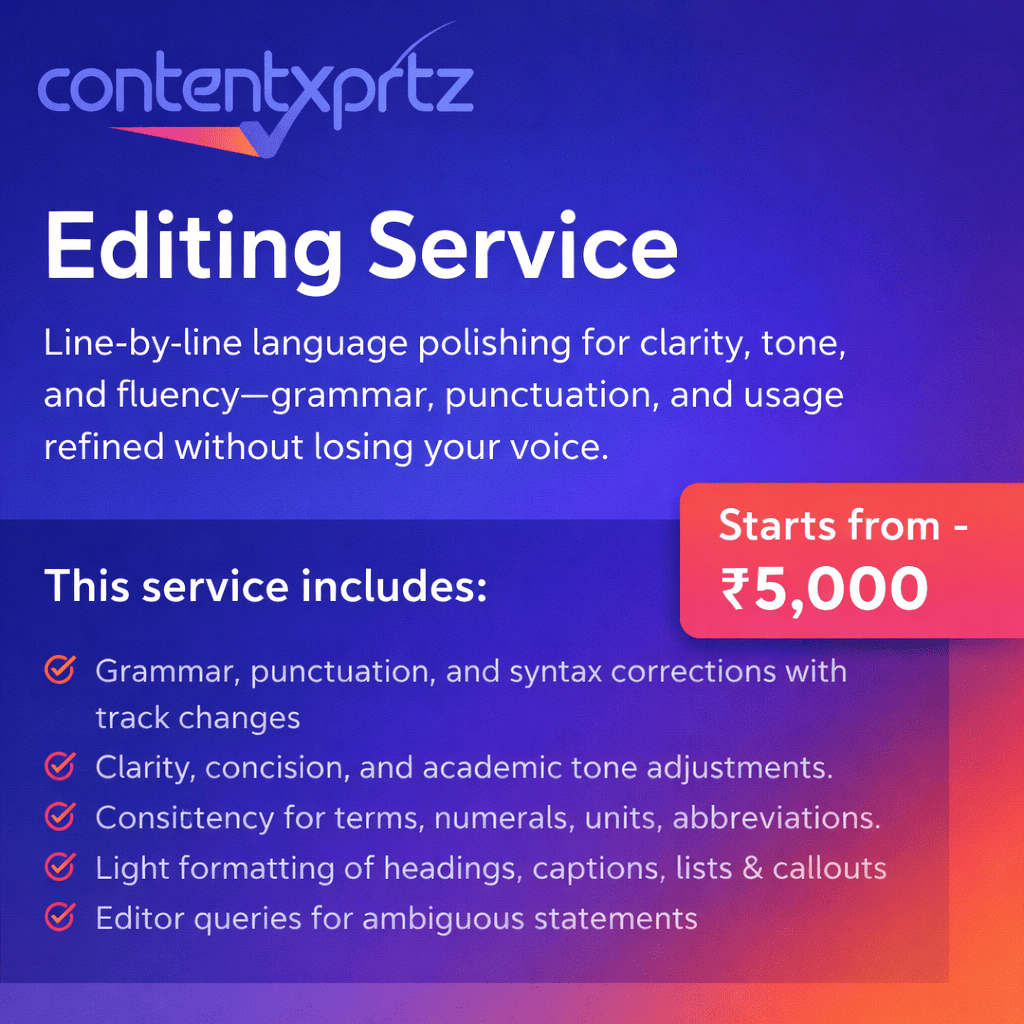
Polish your manuscript line by line—without losing your academic identity.
ContentXprtz’s English Editing Service is designed for scholars who want clarity, precision, and publication-ready language while retaining full author ownership.
We focus on improving readability, academic tone, and consistency—so your ideas speak clearly to reviewers, editors, and readers.
What you get:
• Grammar, punctuation, and syntax corrections with track changes
• Improved clarity, concision, and academic tone
• Consistency across terminology, numerals, units, and abbreviations
• Light formatting for headings, captions, lists, and callouts
• Editor queries to flag unclear or ambiguous statements
Ethical. Transparent. Author-first.
We do not rewrite your research or alter meaning. Your work remains 100% original—refined, not replaced.
Starts from ₹5,000
📘 Message us on WhatsApp to get started today
WhatsApp: https://wa.me/917065013200
🌐 Website: https://contentxprtz.com
#AcademicEditing #EnglishEditing #PhDSupport #ResearchWriting #ManuscriptEditing #JournalSubmission #PublishYourResearch #AcademicIntegrity #ResearchScholars #DoctoralStudies #PostdocLife #ThesisEditing #DissertationSupport #HigherEducation #ResearchPublication #ScholarlyWriting #PeerReviewReady #AcademicServices #StudentsOfResearch #PhDLife #EthicalEditing #AuthorOwnership #ResearchExcellence #ContentXprtz
Mastering Scholarly Communication Through a Professional English Editing Service
Introduction: Why English Editing Is No Longer Optional in Global Academia
For PhD scholars, postdoctoral researchers, and academic professionals, writing is not merely a skill. It is the primary currency of scholarly legitimacy. In today’s hypercompetitive research environment, even groundbreaking ideas struggle to gain recognition if they are not communicated with clarity, precision, and linguistic confidence. This is where a professional English Editing Service becomes indispensable rather than optional.
Across disciplines, English has emerged as the dominant language of scholarly communication. Leading academic publishers, international journals, and indexing bodies overwhelmingly prefer or require submissions in polished academic English. However, for many researchers, especially those working in multilingual or non-English academic systems, producing linguistically flawless manuscripts while maintaining conceptual rigor is a persistent challenge.
The pressures facing doctoral researchers today are unprecedented. According to global higher-education data, PhD completion timelines have lengthened in many countries, while publication expectations have intensified. Early-career scholars are often required to publish multiple Scopus or Web of Science indexed papers even before thesis submission. At the same time, journal acceptance rates continue to decline. Several high-impact journals now report acceptance rates below 10 percent, particularly in fields such as management, medicine, engineering, and social sciences.
These realities create a difficult paradox. Scholars are expected to produce original, methodologically sound, and theoretically significant research, while also meeting strict linguistic and stylistic standards imposed by international journals. Most doctoral programs, however, provide limited formal training in advanced academic English writing. Supervisors may offer conceptual guidance, yet they rarely have the time or editorial bandwidth to refine language at the sentence or discourse level.
This gap has fueled the growing demand for ethical, expert-led English editing services that support scholars without compromising academic integrity. When used responsibly, professional editing does not alter authorship or intellectual ownership. Instead, it strengthens argumentation, enhances coherence, and ensures that the research is evaluated on its intellectual merit rather than linguistic limitations.
At ContentXprtz, we have observed this shift firsthand. Since 2010, we have supported researchers from over 110 countries, helping them navigate the linguistic and editorial expectations of top-tier journals while preserving their authentic scholarly voice. Our experience confirms a critical truth: strong research deserves strong presentation.
This article provides an in-depth, educational exploration of English editing services for PhD scholars and academic researchers. It explains what professional editing truly involves, how it differs from proofreading or rewriting, and why it plays a decisive role in publication success. More importantly, it equips scholars with the knowledge needed to choose ethical, credible, and academically sound editing support.
Understanding the Role of an English Editing Service in Academic Publishing
An English editing service in the academic context goes far beyond correcting grammar or fixing punctuation. Its primary purpose is to enhance the clarity, coherence, and scholarly readability of a manuscript while fully preserving the author’s intellectual contribution.
Professional academic editing operates at multiple levels. At the sentence level, it addresses grammar, syntax, word choice, and academic tone. At the paragraph level, it improves logical flow, transitions, and cohesion. At the document level, it ensures consistency in terminology, tense usage, and alignment with journal-specific style guidelines.
Importantly, ethical English editing does not involve content creation, data manipulation, or idea insertion. Reputable service providers adhere strictly to international publication ethics defined by leading publishers such as Elsevier, Springer Nature, Taylor & Francis, and Emerald Insight.
For PhD scholars, this distinction is crucial. Journals and universities increasingly scrutinize manuscripts for ethical compliance. Professional editing is explicitly permitted by most publishers, provided it focuses on language and presentation rather than intellectual contribution. Clear acknowledgment policies and transparency further protect authors from ethical concerns.
Why PhD Scholars and Researchers Struggle With Academic English
Academic English is a specialized register. It demands precision, discipline-specific vocabulary, logical argumentation, and stylistic restraint. Even native English speakers frequently struggle with these demands, particularly in highly technical or theoretical fields.
For non-native English scholars, the challenges multiply. Differences in rhetorical structure, argument sequencing, and academic conventions often lead to manuscripts that reviewers perceive as unclear, even when the research itself is strong. Reviewer comments frequently highlight issues such as lack of coherence, unclear methodology descriptions, weak argument framing, or inconsistent terminology.
Time constraints further exacerbate the problem. Doctoral candidates juggle coursework, teaching responsibilities, data collection, analysis, conferences, and administrative duties. Revising language at a granular level becomes an exhausting and inefficient use of limited time. As a result, many promising manuscripts face rejection for reasons unrelated to research quality.
A professional English editing service addresses these challenges systematically. It allows scholars to focus on intellectual contribution while ensuring their work meets global linguistic standards.
Types of English Editing Services Available to Researchers
Not all editing services are the same, and understanding the differences helps scholars choose appropriate support.
Language Editing
Language editing focuses on grammar, sentence structure, word choice, and academic tone. It improves readability without altering meaning.
Substantive or Developmental Editing
This level addresses clarity, flow, and logical progression. It may involve reorganizing paragraphs, improving transitions, and strengthening argument coherence while preserving original content.
Technical Editing
Technical editing ensures consistency in terminology, symbols, abbreviations, tables, and figures, especially in STEM disciplines.
Journal-Specific Editing
Many journals have unique formatting and stylistic requirements. Journal-specific editing aligns manuscripts with these guidelines, reducing desk rejection risk.
At ContentXprtz, our academic editing services are tailored to the scholar’s discipline, target journal, and stage of research, ensuring precision without ethical compromise.
How Professional English Editing Improves Publication Outcomes
Evidence from academic publishing consistently demonstrates that language quality influences peer review outcomes. Reviewers are human readers. When language obscures meaning, it increases cognitive load and reduces reviewer patience.
High-quality English editing improves manuscripts in several measurable ways:
-
Clearer articulation of research questions and contributions
-
Improved coherence in literature reviews and theoretical frameworks
-
More precise methodology descriptions
-
Stronger discussion and conclusion sections
-
Reduced revision cycles after peer review
Editors at leading journals routinely advise authors to seek professional language editing before resubmission. Doing so often shortens review timelines and improves acceptance probability.
Ethical Considerations in Using an English Editing Service
Ethics are central to academic credibility. Responsible English editing adheres to strict boundaries. It does not introduce new ideas, manipulate results, or alter interpretations. Instead, it refines expression.
Most publishers explicitly permit language editing. The American Psychological Association, for example, recognizes language editing as acceptable support when properly disclosed if required.
At ContentXprtz, ethical compliance is non-negotiable. Our editors are trained to enhance clarity without crossing authorship boundaries. This commitment protects both the researcher and the integrity of the scholarly record.
Choosing the Right English Editing Service: What Scholars Should Evaluate
Selecting an English editing service requires discernment. Scholars should evaluate providers based on academic expertise, transparency, and ethical standards.
Key criteria include editor qualifications, subject-matter familiarity, clear service scope, confidentiality policies, and alignment with journal standards. Overly cheap services or those promising guaranteed publication often compromise quality or ethics.
Trusted providers emphasize collaboration, revision transparency, and respect for the author’s voice. They position editing as academic support rather than content creation.
For comprehensive support, many scholars combine editing with broader research paper writing support and PhD thesis help, particularly when navigating complex publication pathways.
Integrated FAQs: English Editing Service for PhD Scholars and Researchers
FAQ 1: Is using an English editing service allowed by journals and universities?
Using an English editing service is widely accepted by journals and academic institutions when it is used ethically and transparently. Most leading publishers explicitly permit language editing because it does not interfere with the intellectual ownership of the work. Organizations such as Elsevier and Springer Nature recognize that many scholars operate in multilingual environments and require professional support to meet linguistic standards. What is critical is that the service focuses solely on improving language clarity, coherence, and presentation. It must not add content, alter interpretations, or manipulate data. Universities similarly view language editing as academic support rather than misconduct. When in doubt, scholars can review publisher guidelines or disclose editing assistance if required. Ethical providers like ContentXprtz clearly define service boundaries, ensuring compliance with institutional and journal policies.
FAQ 2: How is English editing different from proofreading?
English editing and proofreading serve different purposes, although they are often confused. Proofreading is the final quality check performed after a manuscript is fully developed. It focuses on surface-level errors such as typos, punctuation mistakes, and formatting inconsistencies. English editing, in contrast, is a deeper process. It improves sentence structure, academic tone, clarity, and flow. Editing ensures that arguments are presented logically and that the manuscript reads smoothly for an international academic audience. For PhD scholars submitting to high-impact journals, editing is far more valuable than proofreading alone, especially when reviewers expect clarity and precision in argumentation.
FAQ 3: Will editing change my academic voice or ideas?
A professional English editing service should never change your academic voice or intellectual contribution. Ethical editors work to preserve the author’s intent while improving clarity. They refine language without rewriting ideas or introducing new interpretations. At ContentXprtz, editors follow strict guidelines to ensure that the scholar’s voice remains intact. Changes are made transparently, allowing authors to review and approve edits. The goal is not to sound different, but to sound clearer, more confident, and more aligned with academic conventions.
FAQ 4: When should a PhD scholar use an English editing service?
The ideal time to use an English editing service is after the core research content is finalized but before journal submission. Editing is most effective when arguments, data, and structure are already established. Many scholars also use editing services after receiving reviewer comments, particularly when revisions require clearer explanations or stronger responses. For doctoral theses, editing is often conducted after supervisor approval of content but before final submission. Early use of editing during drafting can also be helpful for non-native English writers, although final editing should always occur at the end.
FAQ 5: Can English editing improve my chances of journal acceptance?
While no ethical service can guarantee acceptance, high-quality English editing significantly improves the likelihood that a manuscript will be evaluated fairly. Reviewers are more receptive to manuscripts that are clear, coherent, and professionally presented. Poor language often distracts reviewers and leads to rejection even when research quality is strong. By reducing linguistic barriers, editing allows reviewers to focus on the research contribution. Many scholars report fewer language-related reviewer comments and faster revision cycles after professional editing.
FAQ 6: How do I know if an editing service is ethical?
Ethical editing services are transparent about what they do and do not offer. They do not promise guaranteed publication, fabricate content, or conceal their processes. Reputable providers employ qualified editors, often with doctoral or subject-matter expertise. They provide clear confidentiality policies and respect intellectual ownership. Ethical services position themselves as academic partners rather than ghostwriters. ContentXprtz, for example, emphasizes integrity, compliance, and author control at every stage of editing.
FAQ 7: Is English editing useful for native English speakers?
Yes, English editing benefits native English speakers as well. Academic writing requires a level of precision and discipline that differs from everyday language. Editors help refine tone, eliminate ambiguity, and align manuscripts with journal conventions. Many native speakers struggle with verbosity, unclear argument progression, or inconsistent terminology. Professional editing enhances clarity and strengthens scholarly impact regardless of the author’s linguistic background.
FAQ 8: What disciplines benefit most from English editing services?
All disciplines benefit from English editing, but it is particularly valuable in fields with high publication competition and strict reviewer expectations. These include management, economics, medicine, engineering, psychology, education, and social sciences. Interdisciplinary research also benefits because it must communicate effectively across diverse academic audiences. Editing ensures that complex ideas are accessible without oversimplification.
FAQ 9: How does English editing support PhD thesis submission?
A PhD thesis represents years of research and is evaluated rigorously. Language issues can undermine its perceived quality. English editing ensures consistency, coherence, and academic tone across chapters. It improves transitions, clarifies methodology descriptions, and strengthens conclusions. Editing also helps align the thesis with institutional formatting and style guidelines. For many scholars, professional editing provides confidence during final submission and viva preparation.
FAQ 10: How does ContentXprtz approach English editing differently?
ContentXprtz combines academic expertise with ethical precision. Our editors understand disciplinary conventions and publication standards. We tailor editing to the scholar’s goals, whether journal submission, thesis defense, or grant application. We emphasize collaboration, transparency, and respect for author voice. Beyond editing, we provide integrated support through PhD thesis help, academic editing services, and broader research paper assistance, ensuring scholars receive comprehensive guidance without compromising integrity.
Strategic Internal Support for Academic Success
Scholars often require more than editing alone. ContentXprtz offers integrated academic solutions, including
-
PhD thesis help through our PhD & Academic Services
-
End-to-end support via Writing & Publishing Services
-
Early-career assistance through Student Writing Services
-
Scholarly book development through Book Authors Writing Services
-
Professional documentation via Corporate Writing Services
These services complement English editing by addressing the broader academic communication lifecycle.
Conclusion: Elevating Research Through Ethical English Editing
In an era where academic success depends as much on communication as on discovery, a professional English editing service is a strategic investment rather than a luxury. It empowers scholars to present their research clearly, confidently, and ethically to a global audience.
For PhD scholars and researchers, editing bridges the gap between intellectual contribution and international recognition. It reduces publication barriers, enhances reviewer engagement, and protects academic integrity.
At ContentXprtz, we don’t just edit — we help your ideas reach their fullest potential.
Explore our PhD Assistance Services today and take the next confident step toward publication excellence.
