
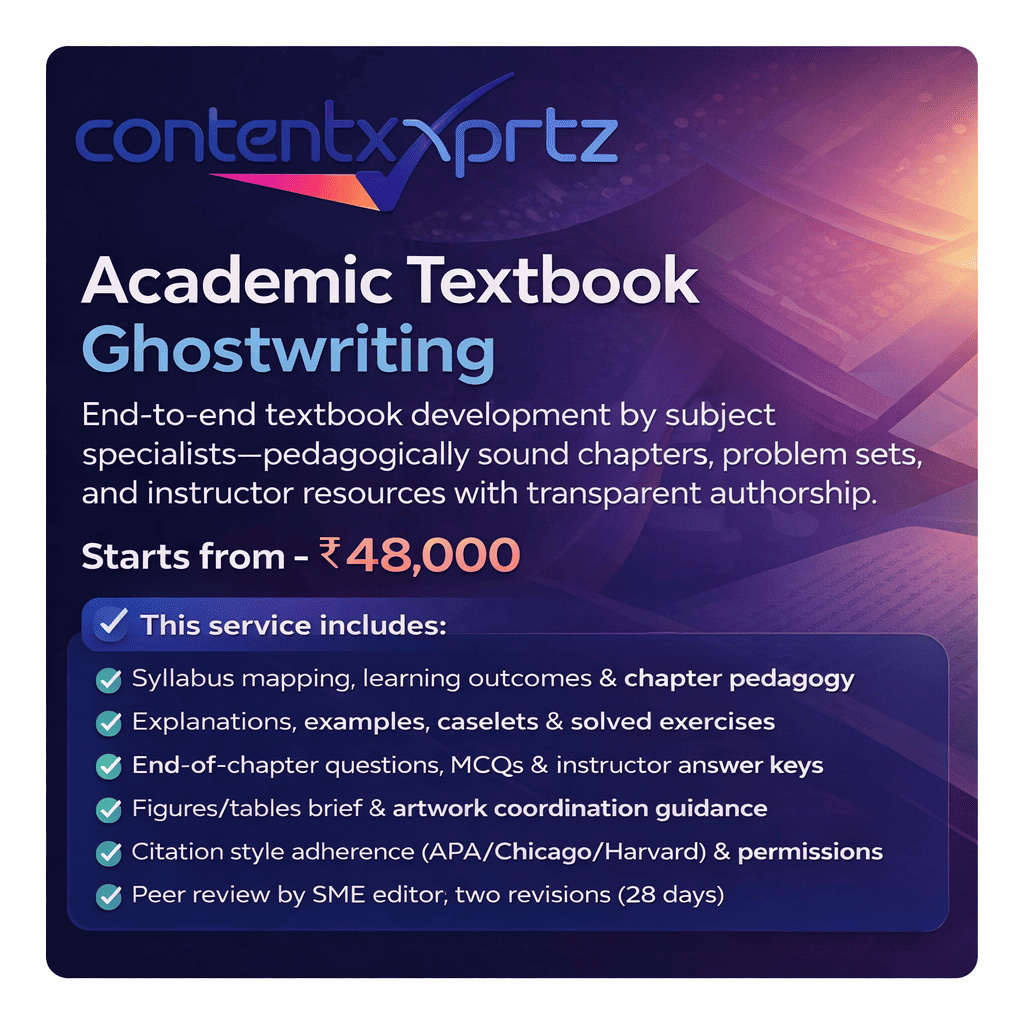
📘 Academic Textbook Ghostwriting—Done Right
Built for rigor. Designed for learning. Delivered with integrity.
At ContentXprtz, we support educators, researchers, and subject experts with end-to-end academic textbook development—crafted by subject specialists and aligned with pedagogical best practices. From syllabus mapping to instructor resources, we help you turn expertise into a structured, publication-ready textbook.
What you gain:
📄 Pedagogically sound chapters aligned to learning outcomes
🧠 Clear explanations, real-world examples, caselets & solved exercises
🎓 End-of-chapter questions, MCQs & instructor answer keys
📘 Citation-style compliance (APA / Chicago / Harvard) & permissions support
🔍 Peer review by an SME editor with two structured revision rounds
Ethical. Transparent. Author-first.
Your authorship remains yours. We ensure originality, proper citations, and complete academic integrity—no shortcuts, no exaggeration.
Starts from ₹48,000
📲 Message us on WhatsApp to get started today
WhatsApp: https://wa.me/917065013200
🌐 Website: https://contentxprtz.com
#AcademicTextbook #GhostwritingServices #PhDSupport #AcademicWriting #HigherEducation #ResearchSupport #ScholarlyPublishing #UniversityFaculty #PhDScholars #PostdocLife #ResearcherLife #AcademicIntegrity #EthicalWriting #TextbookAuthors #EducationPublishing #AcademicServices #ResearchMentorship #DoctoralStudies #PublishAcademically #AcademicCareers #ThesisToBook #FacultySupport #ScholarlyWork #ContentXprtz
Academic Textbook Ghostwriting as a Strategic Solution for Scholars Navigating Modern Academic Pressures
Introduction: Why Academic Textbook Ghostwriting Has Become a Critical Scholarly Support Mechanism
For today’s PhD scholars, postdoctoral researchers, and academic professionals, the demand to publish authoritative academic textbooks has never been higher. Universities increasingly value book authorship for tenure, promotion, and international recognition. At the same time, global academia faces unprecedented structural pressures. These include intensifying publication competition, shrinking research funding, rising teaching workloads, and mounting expectations to contribute high-impact scholarly outputs across journals, books, and interdisciplinary platforms.
Within this environment, academic textbook ghostwriting has emerged as a legitimate and strategic academic support solution rather than a shortcut or compromise. When practiced ethically and transparently, academic textbook ghostwriting enables scholars to transform years of research, lecture notes, and fragmented manuscripts into coherent, publication-ready textbooks that meet the rigorous standards of leading academic publishers.
According to Elsevier’s global research insights, the number of active researchers worldwide has more than doubled over the last two decades, while acceptance rates for academic book proposals and monographs have declined steadily due to quality thresholds and market saturation. Springer Nature similarly reports that editorial boards now reject a significant proportion of textbook proposals at the initial review stage due to structural weaknesses, unclear pedagogical framing, or insufficient academic positioning rather than lack of subject knowledge. These trends underscore a critical reality: scholarly expertise alone no longer guarantees successful textbook publication.
PhD candidates and early-career academics, in particular, face a paradox. They possess deep subject mastery yet struggle with time constraints, narrative coherence, and publisher-specific formatting requirements. Many balance full-time teaching, administrative responsibilities, grant writing, and personal obligations while attempting to author comprehensive textbooks. As a result, promising academic contributions often remain unpublished or are delayed for years.
Within this context, academic textbook ghostwriting serves as a structured collaboration between the scholar and experienced academic writers, editors, and publication consultants. The goal is not to replace intellectual ownership but to professionally articulate it. By aligning content with publisher expectations, pedagogical standards, and disciplinary conventions, ghostwriting support allows scholars to disseminate knowledge effectively while retaining full authorship and academic credit.
At ContentXprtz, established in 2010 and trusted by researchers in over 110 countries, academic textbook ghostwriting is positioned as an ethical extension of academic authorship. The process emphasizes transparency, author control, and compliance with academic integrity standards. Rather than writing in isolation, scholars engage in a guided, collaborative framework that elevates their work to global publishing standards.
This article offers a comprehensive, evidence-based exploration of academic textbook ghostwriting. It addresses ethical considerations, practical workflows, publisher expectations, and decision-making criteria for scholars considering professional support. For researchers seeking clarity amid publication pressures, this guide provides both reassurance and actionable insight grounded in contemporary academic practice.
Understanding Academic Textbook Ghostwriting in the Contemporary Academic Ecosystem
What Academic Textbook Ghostwriting Truly Means
Academic textbook ghostwriting refers to a structured scholarly collaboration in which professional academic writers assist subject-matter experts in developing, refining, and organizing textbook manuscripts for publication. Unlike popular misconceptions, this practice does not involve fabricating research or misrepresenting authorship. Instead, it focuses on transforming an author’s original intellectual contributions into a polished academic text that meets publisher, pedagogical, and disciplinary standards.
In most cases, scholars provide core materials such as lecture notes, prior publications, datasets, outlines, or draft chapters. The ghostwriting team then supports content structuring, academic language refinement, logical progression, referencing alignment, and pedagogical clarity. Final approval and intellectual ownership remain entirely with the scholar.
Reputable academic publishers such as Taylor and Francis and Emerald Insight emphasize originality, author accountability, and methodological rigor. Ethical academic textbook ghostwriting adheres strictly to these principles while enhancing clarity and coherence.
Why Textbook Writing Is Uniquely Challenging for Scholars
Textbook authorship differs fundamentally from journal article writing. While research papers prioritize novelty and methodological contribution, textbooks require synthesis, instructional clarity, and conceptual scaffolding. Authors must anticipate diverse learner backgrounds, align chapters with curriculum frameworks, and integrate examples, summaries, and learning objectives.
For many PhD scholars, this shift proves challenging. Years of specialized research do not automatically translate into accessible textbook narratives. Additionally, publishers often require market analysis, competitor mapping, and pedagogical justification, tasks that fall outside traditional doctoral training.
Academic textbook ghostwriting addresses these gaps by combining disciplinary expertise with instructional design and publishing strategy. This integrated approach significantly increases the likelihood of proposal acceptance and long-term textbook adoption.
Ethical Foundations of Academic Textbook Ghostwriting
Academic Integrity and Author Ownership
Ethical academic textbook ghostwriting is grounded in transparency, originality, and author control. Scholars remain the sole intellectual owners of their work. Professional writers function as facilitators rather than creators of ideas.
The American Psychological Association explicitly distinguishes between unethical authorship misrepresentation and legitimate editorial or writing assistance. When properly disclosed and managed, ghostwriting support aligns with ethical academic practice, particularly when the scholar retains accountability for content accuracy and interpretation.
Institutional and Publisher Acceptance
Contrary to outdated assumptions, many universities and publishers implicitly recognize professional writing support. What matters is originality, accuracy, and scholarly contribution. As long as the work reflects the author’s research and insights, textbook ghostwriting does not violate academic standards.
ContentXprtz operates within this ethical framework, ensuring that all textbook projects comply with institutional policies and publisher guidelines.
How Academic Textbook Ghostwriting Works in Practice
Step-by-Step Collaborative Workflow
The academic textbook ghostwriting process typically follows a structured sequence:
-
Initial consultation to define scope, audience, and publisher targets
-
Content audit of existing materials and research assets
-
Chapter-level outlining aligned with curriculum frameworks
-
Iterative drafting with author feedback at each stage
-
Academic editing, citation verification, and style alignment
-
Final manuscript preparation for publisher submission
This phased approach ensures clarity, author involvement, and academic rigor throughout the project lifecycle.
Customization Across Disciplines
Textbook expectations vary significantly across disciplines. Engineering textbooks emphasize problem-solving frameworks and worked examples. Social science textbooks prioritize theoretical integration and case studies. Medical and life sciences texts demand strict adherence to evidence hierarchies and ethical guidelines.
Effective academic textbook ghostwriting adapts to these disciplinary nuances rather than applying generic templates.
Strategic Benefits of Academic Textbook Ghostwriting for Scholars
Accelerated Publication Timelines
One of the most tangible benefits is time efficiency. Professional support enables scholars to progress systematically rather than struggling with fragmented writing schedules. This acceleration can be critical for tenure timelines or grant-linked publication requirements.
Enhanced Publisher Acceptance Rates
Publishers such as Elsevier and Springer report that structurally coherent, market-aligned manuscripts progress more smoothly through peer review. Ghostwriting support improves proposal clarity, reducing desk rejections.
Global Reach and Pedagogical Impact
Well-structured textbooks are more likely to be adopted internationally. Professional support enhances readability, cultural neutrality, and instructional design, increasing global classroom adoption.
Integrating Academic Textbook Ghostwriting with Broader PhD Support Services
Academic textbook ghostwriting rarely exists in isolation. Many scholars require complementary services such as academic editing, research paper assistance, or proposal development. ContentXprtz integrates textbook projects within a broader ecosystem of PhD thesis help, academic editing services, and research paper writing support.
Scholars can explore comprehensive options through the following internal resources:
-
PhD-focused academic support via https://contentxprtz.com/phd-academic-services
-
End-to-end academic editing and publication guidance at https://contentxprtz.com/writing-publishing-services
-
Student-oriented academic writing support through https://contentxprtz.com/student-career-academic-writing-services
-
Book development solutions at https://contentxprtz.com/book-authors-writing-services
-
Specialized professional documentation via https://contentxprtz.com/corporate-writing-services
Frequently Asked Questions on Academic Textbook Ghostwriting
Is academic textbook ghostwriting ethical for PhD scholars?
Academic textbook ghostwriting is ethical when conducted transparently and responsibly. Scholars retain intellectual ownership, approve all content, and remain accountable for academic accuracy. Professional writers assist with structure, language, and coherence rather than generating original ideas. Major academic bodies acknowledge legitimate writing support as distinct from misconduct. Ethical providers follow publisher guidelines, avoid data fabrication, and ensure originality. For PhD scholars, this support often enables timely dissemination of research without compromising integrity.
Will academic publishers accept textbooks developed with ghostwriting support?
Academic publishers prioritize quality, originality, and pedagogical value rather than the writing process itself. As long as the scholar is the intellectual author and the content meets academic standards, publishers typically focus on manuscript merit. Many successful textbooks involve professional editorial collaboration. What matters is transparent authorship, rigorous referencing, and scholarly contribution aligned with publisher expectations.
How does academic textbook ghostwriting differ from editing services?
Editing services refine existing text for clarity and correctness, while academic textbook ghostwriting involves deeper structural collaboration. Ghostwriting may include outlining chapters, reorganizing content, and drafting sections based on the author’s research materials. Both services complement each other, but ghostwriting offers more comprehensive manuscript development support.
Can early-career researchers benefit from academic textbook ghostwriting?
Early-career researchers often benefit significantly. Textbook authorship enhances academic profiles, supports tenure applications, and establishes subject authority. Ghostwriting support helps navigate unfamiliar publishing processes, align content with curricula, and present expertise effectively without excessive time burden.
How is confidentiality maintained during textbook ghostwriting?
Reputable providers implement strict confidentiality agreements, secure data handling protocols, and controlled access to materials. Authors retain full rights, and no content is reused or disclosed. ContentXprtz applies enterprise-grade confidentiality standards to protect scholarly work.
Does academic textbook ghostwriting involve plagiarism risks?
Ethical academic textbook ghostwriting eliminates plagiarism risks by working exclusively from the author’s original materials and properly cited sources. Professional teams use plagiarism detection tools and rigorous citation checks to ensure originality and compliance with publisher standards.
How long does academic textbook ghostwriting typically take?
Timelines vary based on scope, discipline, and manuscript length. A standard textbook may require several months of collaborative work. However, structured workflows significantly reduce delays compared to solo writing under academic workload constraints.
What disciplines commonly use academic textbook ghostwriting?
Academic textbook ghostwriting is used across disciplines, including engineering, management, medicine, social sciences, education, and applied sciences. Any field requiring pedagogical clarity and structured knowledge dissemination can benefit from professional support.
How much control does the author retain during the process?
Authors retain complete control. They review outlines, drafts, and revisions at every stage. No content progresses without explicit approval. Ghostwriting functions as a support mechanism rather than an autonomous authorship process.
How do I choose a trustworthy academic textbook ghostwriting provider?
Scholars should evaluate providers based on academic credentials, transparency, ethical policies, publisher familiarity, and client testimonials. Providers with long-standing academic focus, global experience, and clear integrity frameworks offer the most reliable support.
Conclusion: Positioning Academic Textbook Ghostwriting as an Ethical Scholarly Investment
Academic textbook ghostwriting has evolved into a strategic, ethical support system within modern academia. For scholars navigating intense publication pressures, it offers a pathway to transform expertise into impactful, globally accessible textbooks without compromising integrity or authorship.
By combining disciplinary knowledge with professional academic writing and publishing expertise, scholars can achieve timely, high-quality textbook publications aligned with institutional and publisher expectations.
At ContentXprtz, our global academic support model reflects over a decade of experience working with PhD scholars, researchers, and institutions worldwide. We prioritize ethics, author ownership, and scholarly excellence across every textbook project.
If you are exploring professional support for textbook development, we invite you to engage with our PhD & Academic Services and discover how structured academic collaboration can elevate your scholarly contributions.
At ContentXprtz, we don’t just edit — we help your ideas reach their fullest potential.
