
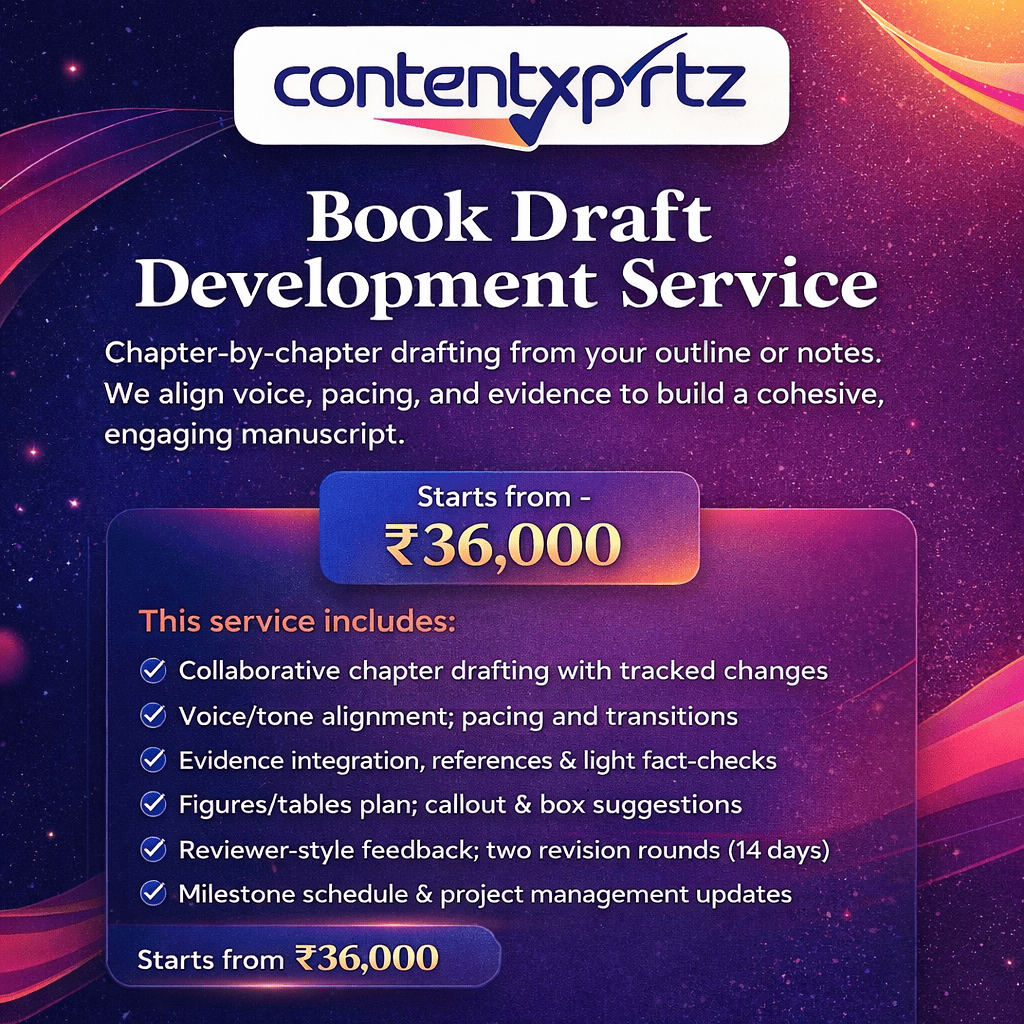
Turn Your Research Into a Publish-Ready Book Draft
Structured. Scholarly. Ethically Written. 📘
Our Book Draft Development Service helps you transform outlines, notes, or early ideas into a cohesive, chapter-by-chapter manuscript—while preserving your academic voice and intellectual ownership.
Designed for PhD scholars, researchers, and academic professionals who value clarity, rigor, and ethical writing support.
What you get with ContentXprtz:
📄 Chapter-by-chapter collaborative drafting (with tracked changes)
🧠 Clear voice, tone, pacing, and logical transitions
📘 Evidence integration, references, and light fact-checks
📊 Figures & tables planning with academic callouts
🎓 Reviewer-style feedback with two structured revision rounds
Ethics first.
We do not sell authorship or fabricate research. Every draft is original, transparent, and developed in collaboration with you—ensuring full author ownership and academic integrity.
Starts from ₹36,000
Message us on WhatsApp to get started today
WhatsApp: https://wa.me/917065013200
Website: https://contentxprtz.com
#ContentXprtz #PhDSupport #AcademicWriting #BookManuscript #ResearchWriting #PhDScholars #DoctoralResearch #AcademicPublishing #ResearchSupport #ScholarlyWriting #PhDLife #PostdocLife #HigherEducation #ResearchEthics #OriginalResearch #ThesisToBook #AcademicAuthors #JournalPreparation #UniversityResearch #ResearchProfessionals #PublicationSupport #AcademicCareers #GraduateStudies
Book Draft Development Service: From Research Idea to Publication-Ready Academic Book
Introduction: Why Book Draft Development Has Become a Critical Academic Need
For PhD scholars, postdoctoral researchers, and academic professionals, writing a scholarly book represents both a career milestone and an intellectual responsibility. However, transforming years of research into a coherent, publication-ready manuscript is rarely straightforward. This is precisely where a Book Draft Development Service becomes not only helpful but essential.
Across disciplines, scholars face mounting pressure to publish monographs, edited volumes, and research-based books to strengthen academic profiles, secure tenure, and contribute meaningfully to global knowledge production. Yet, despite deep subject expertise, many researchers struggle with structuring long-form arguments, maintaining narrative coherence, meeting publisher expectations, and balancing writing demands alongside teaching, supervision, and administrative responsibilities.
According to data from UNESCO, the global number of active researchers exceeded 9 million, with publication output increasing year over year. At the same time, major academic publishers such as Elsevier and Springer report acceptance rates for academic book proposals below 10–15%, reflecting intense competition and rising quality thresholds. These statistics highlight a stark reality: strong research alone is no longer sufficient. Publishers increasingly evaluate clarity, originality, methodological transparency, and market positioning at the manuscript stage.
PhD candidates encounter additional challenges. Many transition directly from thesis writing to book drafting, assuming that a dissertation can be converted into a book with minor edits. In practice, publishers expect a fundamental reworking of structure, tone, and argumentation. Doctoral theses prioritize examination criteria, while academic books demand broader engagement, refined narratives, and disciplinary positioning. Without expert guidance, this transition often leads to repeated rejections and prolonged publication delays.
Time constraints further intensify the problem. A global survey by Nature Research indicates that early-career researchers spend less than 30% of their time on actual writing, with the remainder consumed by teaching, grant applications, peer reviews, and institutional obligations. As academic workloads rise and funding pressures increase, scholars require structured, ethical, and professionally guided support to bring book projects to completion.
A Book Draft Development Service, when delivered ethically and transparently, addresses these challenges holistically. It does not replace the author’s intellectual ownership. Instead, it supports idea organization, chapter structuring, academic tone refinement, methodological clarity, and publisher alignment. This collaborative approach allows scholars to retain authorship while benefiting from professional academic expertise.
At ContentXprtz, established in 2010 and trusted by researchers across more than 110 countries, book draft development is treated as an academic partnership rather than a transactional service. Our approach integrates scholarly integrity, publication standards, and discipline-specific expertise to help researchers move confidently from concept to completed manuscript.
Understanding the Scope of a Professional Book Draft Development Service
A Book Draft Development Service is not limited to proofreading or language correction. Instead, it encompasses the intellectual, structural, and stylistic dimensions of long-form academic writing. For scholars unfamiliar with professional academic development workflows, understanding this scope is critical.
At its core, book draft development focuses on shaping a manuscript that aligns with publisher expectations, disciplinary conventions, and reader engagement standards. This involves early-stage conceptual guidance as well as late-stage refinement.
Key components typically include:
-
Conceptual alignment with the intended academic audience
-
Logical chapter sequencing and thematic coherence
-
Argument development across chapters
-
Integration of literature without redundancy
-
Refinement of methodology and theoretical framing
-
Academic tone calibration for book readership
-
Compliance with publisher submission guidelines
Unlike journal articles, academic books demand sustained argumentation over extended lengths. Weak transitions, inconsistent voice, or repetitive framing can significantly undermine credibility. Therefore, expert developmental input is essential.
At ContentXprtz, book draft development often intersects with our broader Writing & Publishing Services, allowing authors to receive integrated support across manuscripts, proposals, and supplementary materials.
Why PhD Scholars Struggle with Book Draft Development
The Dissertation-to-Book Misconception
One of the most common misconceptions among doctoral scholars is that a PhD thesis can simply be edited into a book. While dissertations demonstrate scholarly rigor, they are written for examiners, not readers. Publishers expect books to engage wider academic communities, present refined arguments, and contribute clearly articulated theoretical or empirical value.
Dissertations often include:
-
Extended literature reviews not suitable for book formats
-
Methodological detail beyond reader needs
-
Redundant explanations for examination clarity
Book draft development requires rethinking, not recycling.
Cognitive Fatigue and Academic Burnout
After completing a PhD, many scholars experience cognitive exhaustion. According to studies published in Higher Education Research & Development, doctoral burnout rates have increased significantly over the past decade. Attempting to develop a book manuscript without structured support during this phase often results in stalled projects.
Lack of Training in Long-Form Scholarly Writing
While doctoral programs emphasize journal publications, few formally train scholars in book writing. As a result, early-career academics often learn through trial and error, leading to inefficiencies and avoidable rejections.
A professional Book Draft Development Service fills this training gap by offering process clarity, academic mentoring, and structural guidance.
The Ethical Framework Behind Book Draft Development
Ethical considerations remain central to any academic writing service. Reputable providers distinguish clearly between legitimate academic support and unethical practices.
At ContentXprtz, book draft development adheres to internationally accepted academic ethics, including:
-
Full author ownership of intellectual content
-
Transparent collaboration models
-
No plagiarism or content reuse
-
Compliance with publisher and institutional guidelines
Organizations such as the Committee on Publication Ethics (COPE) emphasize that editorial and developmental support is acceptable when authors retain responsibility for ideas and interpretations. Our processes align with these standards while empowering scholars to strengthen their work responsibly.
How Book Draft Development Supports Publication Success
Publisher Alignment and Market Positioning
Academic publishers such as Elsevier, Springer, Emerald Insight, and Taylor & Francis evaluate manuscripts not only on scholarly merit but also on relevance, audience, and contribution clarity. A book draft development process ensures:
-
Clear articulation of research contribution
-
Alignment with publisher series objectives
-
Improved proposal acceptance rates
For example, Springer’s author guidelines emphasize narrative clarity and reader engagement, while Emerald prioritizes practical relevance and conceptual rigor. Tailoring manuscripts to these expectations significantly improves outcomes.
Structural Coherence Across Chapters
Books are evaluated as cohesive wholes. A weak chapter can undermine the entire manuscript. Developmental experts ensure that:
-
Each chapter advances the core argument
-
Transitions maintain logical flow
-
Redundancies are eliminated
This coherence strengthens reviewer confidence and reader trust.
Language Precision Without Voice Loss
Language refinement focuses on clarity rather than stylistic homogenization. Experienced academic editors preserve author voice while ensuring accessibility, particularly for non-native English scholars.
This approach aligns with best practices recommended by the American Psychological Association, which emphasizes clarity, concision, and reader orientation in scholarly communication.
The ContentXprtz Approach to Book Draft Development
Discipline-Specific Expertise
ContentXprtz works with subject-matter experts across social sciences, management, engineering, medicine, humanities, and interdisciplinary fields. This ensures that book drafts reflect disciplinary conventions rather than generic academic templates.
Structured Development Phases
Our process typically includes:
-
Conceptual mapping and outline validation
-
Chapter-by-chapter development support
-
Argument refinement and coherence checks
-
Academic editing and stylistic polishing
-
Final readiness assessment for submission
This structured workflow minimizes revisions and accelerates progress.
Integrated Academic Support Ecosystem
Book draft development often overlaps with doctoral and postdoctoral needs. Authors benefit from our broader PhD & Academic Services, which include thesis support, journal submission guidance, and reviewer response assistance.
Frequently Asked Questions on Book Draft Development Service
How is a Book Draft Development Service different from academic editing?
Many scholars assume that book draft development is simply an advanced form of academic editing. In reality, the two services differ significantly in scope, intent, and academic depth. Academic editing focuses primarily on improving language quality, grammar, clarity, and adherence to style guides. It ensures that an already written manuscript meets linguistic and formatting standards.
A Book Draft Development Service, by contrast, operates at a deeper intellectual level. It addresses how ideas are organized, how arguments unfold across chapters, and how the manuscript aligns with publisher expectations. Developmental support often begins before a complete draft exists. It may involve refining chapter outlines, restructuring arguments, or reworking sections to improve coherence.
For PhD scholars transitioning from dissertations to books, this distinction is critical. A thesis edited for language will still fail if its structure does not meet book publishing norms. Developmental services bridge this gap ethically, ensuring that scholarly ownership remains intact while professional expertise strengthens the manuscript.
Is using a Book Draft Development Service considered ethical in academia?
Ethical concerns are valid and widely discussed in academic communities. The key distinction lies in transparency and authorship. Reputable Book Draft Development Services do not generate original research ideas or claim authorship. Instead, they support scholars in expressing their own work clearly and coherently.
Organizations such as COPE and major publishers recognize the legitimacy of editorial and developmental assistance, provided that authors retain responsibility for content and interpretation. At ContentXprtz, ethical compliance is central to all services. Authors remain the sole owners of their intellectual contributions, and all development occurs collaboratively.
This approach aligns with global academic norms and protects scholars from ethical risks while enhancing publication readiness.
Can a Book Draft Development Service help with converting a PhD thesis into a book?
Yes, and this is one of the most common use cases. However, successful conversion requires more than editing. Dissertation-to-book transformation involves rethinking structure, tone, and audience. Examination-focused sections often need condensation, while broader theoretical discussions may require expansion.
A Book Draft Development Service guides scholars through this transformation systematically. It identifies which sections to revise, remove, or reframe. It also helps scholars articulate a clear book narrative rather than a segmented thesis argument.
This structured approach significantly improves publisher reception and reduces revision cycles.
How long does professional book draft development usually take?
Timelines vary based on manuscript length, discipline, and author readiness. On average, developmental support may span several weeks to months. Early-stage conceptual development often proceeds faster, while full manuscript refinement requires sustained collaboration.
Importantly, professional support often saves time in the long run. Without guidance, scholars may spend years revising unsuccessfully. A structured Book Draft Development Service streamlines progress and reduces rejection delays.
Do publishers accept manuscripts developed with professional assistance?
Yes. Major academic publishers focus on content quality, originality, and relevance rather than the use of professional services. As long as authors maintain intellectual ownership and ethical standards, developmental support does not affect acceptance negatively.
In fact, manuscripts developed with expert guidance often demonstrate stronger coherence and clarity, increasing acceptance likelihood.
How does ContentXprtz ensure discipline-specific accuracy?
ContentXprtz assigns subject specialists with expertise aligned to the manuscript’s discipline. This ensures familiarity with theoretical frameworks, methodological norms, and citation practices. Discipline-specific accuracy is reviewed at each development stage, reducing the risk of conceptual errors.
Is Book Draft Development suitable for early-career researchers?
Absolutely. Early-career scholars often benefit the most from structured support, as they are still developing long-form writing confidence. Developmental services also function as mentorship, helping scholars internalize best practices for future projects.
What role does the author play during development?
Authors remain actively involved throughout the process. Developmental feedback is collaborative rather than prescriptive. Authors review, revise, and approve all changes, ensuring full control over the manuscript.
Can Book Draft Development support interdisciplinary research books?
Yes. Interdisciplinary manuscripts often face additional challenges due to mixed methodologies and audiences. Developmental experts help balance disciplinary expectations while maintaining coherence, making such projects more accessible to publishers.
How does Book Draft Development improve proposal acceptance?
Publishers often reject proposals due to unclear contributions or weak structure. Developmental services help articulate the book’s value, audience, and positioning clearly, improving proposal success rates.
Is Book Draft Development different from ghostwriting?
Yes, fundamentally. Ghostwriting involves creating content on behalf of an author, which raises ethical concerns in academia. Book Draft Development supports the author’s own writing without replacing authorship, ensuring ethical compliance.
Why ContentXprtz Is a Trusted Partner for Book Draft Development
Since 2010, ContentXprtz has supported scholars across continents, disciplines, and career stages. Our global presence enables localized academic understanding while maintaining international publication standards.
Authors seeking integrated academic support often benefit from related services such as Student Writing Services, Book Authors Writing Services, and Corporate Writing Services, allowing continuity across academic and professional writing needs.
Our credibility is reinforced by alignment with established academic publishers including Elsevier, Springer, Emerald Insight, and Taylor & Francis, whose guidelines inform our development standards.
Conclusion: Turning Scholarly Work Into Lasting Academic Contributions
Developing an academic book is one of the most demanding yet rewarding scholarly endeavors. Without structured support, even the most rigorous research can remain unpublished or underrecognized. A professional Book Draft Development Service offers scholars the clarity, structure, and confidence needed to transform ideas into impactful books.
At ContentXprtz, we combine academic precision, ethical integrity, and global expertise to support scholars at every stage of their writing journey. Whether converting a dissertation, developing an original monograph, or refining an interdisciplinary manuscript, our approach ensures that authors remain empowered and in control.
If you are seeking trusted, ethical, and publication-focused support, explore our PhD Assistance and Book Development Services today.
At ContentXprtz, we don’t just edit — we help your ideas reach their fullest potential.
