
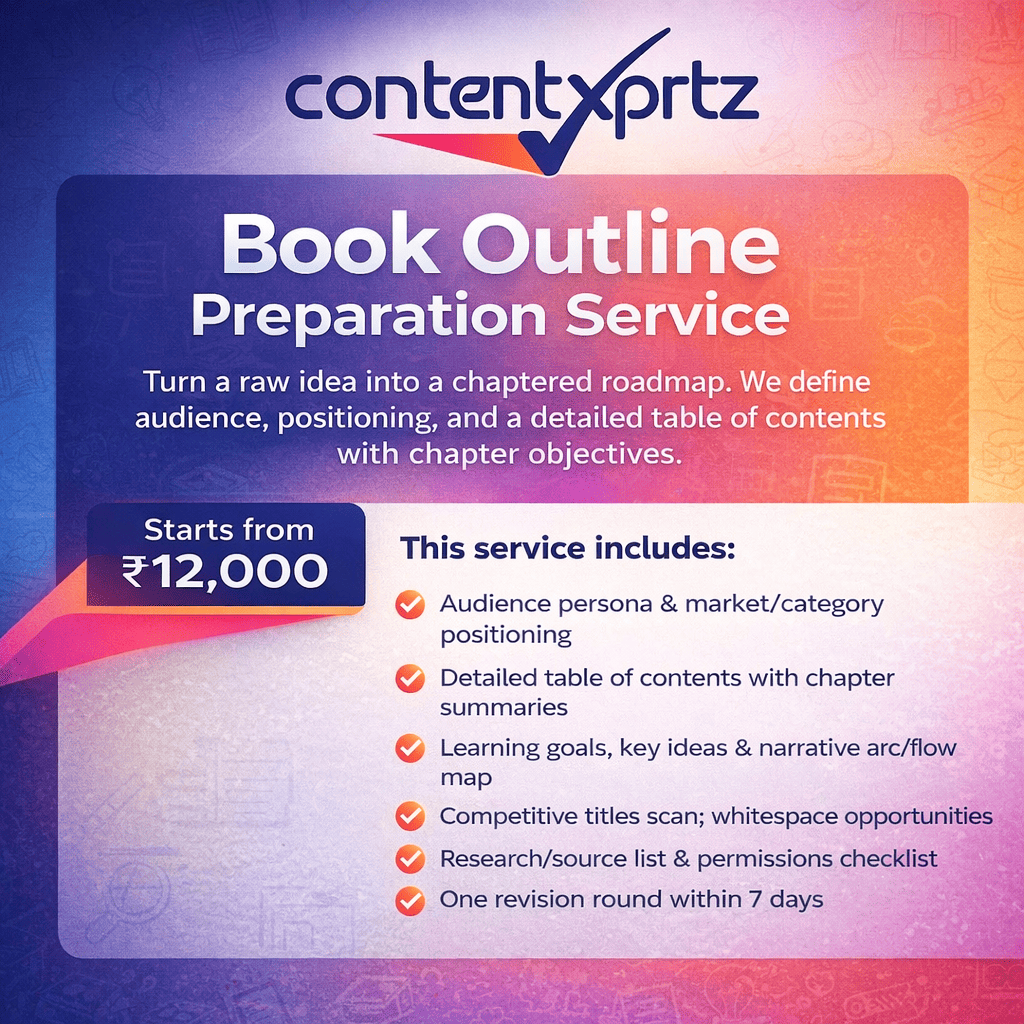
📘 From Idea to Impact—Build Your Book the Right Way
A strong book starts with a clear, publication-ready outline.
Turn your raw concept into a structured, chapter-by-chapter roadmap with our Book Outline Preparation Service—designed for students, PhD scholars, and academic authors who value clarity, rigor, and ethical authorship.
Why this service matters:
A well-crafted outline strengthens your argument, aligns your content with the right audience, and sets a solid foundation for writing, peer review, and publication.
What you get with ContentXprtz:
📄 Clear audience persona & market/category positioning
📄 Detailed table of contents with chapter summaries
📄 Learning goals, key ideas & narrative flow mapping
📄 Competitive title scan and whitespace analysis
📄 Curated research/source list with permissions checklist
🔍 Ethical. Original. Author-owned.
We do not generate content without your approval. Your ideas remain yours—enhanced with professional structure, transparency, and academic integrity.
💰 Starts from ₹12,000
🕒 One revision round within 7 days
📲 Message us on WhatsApp to get started today
WhatsApp: https://wa.me/917065013200
🌐 Website: https://contentxprtz.com
#ContentXprtz #PhDSupport #AcademicWriting #BookOutline #ResearchSupport #PhDScholars #AcademicAuthors #HigherEducation #ResearchWriting #PublicationSupport #EthicalAcademicServices #ScholarlyWriting #PhDLife #DoctoralJourney #AcademicEditing #ResearchPublishing #ThesisToBook #AcademicConsulting #UniversityLife #ResearchIntegrity #PostdocLife #StudentResearchers #Academia #ScholarlyPublishing
Designing Scholarly Books with Precision: A Complete Guide to Book Outline Preparation Service for Academic Authors
Introduction: Why Academic Books Begin With Structure, Not Writing
For PhD scholars, postdoctoral researchers, and academic authors, writing a scholarly book is often regarded as the pinnacle of intellectual contribution. Unlike journal articles that address narrowly defined research questions, academic books demand conceptual depth, theoretical coherence, and long-range narrative planning. Yet, despite their importance, many manuscripts fail not because of weak ideas, but because of poor structural planning. This is precisely where a Book Outline Preparation Service becomes a critical academic asset rather than an optional convenience.
In the first stages of academic book development, scholars frequently encounter uncertainty. They may possess years of research, multiple datasets, and a strong theoretical lens, yet struggle to organize these elements into a coherent book framework. This challenge intensifies under the pressures faced by today’s researchers. According to UNESCO, the global research workforce exceeded 8.8 million researchers in recent years, creating unprecedented competition for visibility, citations, and publishing contracts. Meanwhile, acceptance rates for academic book proposals at leading publishers often remain below 10 percent, especially in the social sciences and interdisciplinary domains.
At the doctoral level, scholars juggle teaching loads, grant writing, administrative responsibilities, and personal obligations. As a result, strategic planning is often sacrificed for reactive writing. However, publishers such as Elsevier and Springer Nature consistently emphasize that a clearly articulated outline is one of the most decisive factors in editorial approval. A book outline demonstrates not only what the author wants to say, but how the argument will evolve across chapters, how the literature will be positioned, and how the book contributes to existing scholarship.
A professionally designed Book Outline Preparation Service helps scholars translate intellectual ambition into a structured, reviewer-ready blueprint. Rather than imposing generic templates, such services adapt to disciplinary norms, publisher expectations, and the author’s academic voice. For PhD scholars transforming dissertations into monographs, early-career researchers preparing tenure-relevant books, or senior academics planning edited volumes, the outline serves as both a navigational map and a quality assurance mechanism.
At ContentXprtz, academic outlining is treated as an intellectual collaboration. Since 2010, the organization has supported researchers across more than 110 countries by combining disciplinary expertise with publication ethics. The goal is not merely to organize chapters, but to align scholarly intent with global publishing standards, reduce revision cycles, and enhance acceptance probability. In the sections that follow, this article provides an in-depth exploration of how a Book Outline Preparation Service functions, why it matters in academic publishing, and how scholars can use it strategically to elevate their research impact.
Understanding the Purpose of a Book Outline in Academic Publishing
A book outline is far more than a table of contents. In academic publishing, it operates as a conceptual contract between the author, reviewers, and publishers. Editors rely on outlines to evaluate scope, originality, market relevance, and scholarly coherence before committing resources to peer review and production.
How Publishers Evaluate Book Outlines
Academic publishers assess outlines through several lenses:
-
Theoretical contribution: Does the book extend, critique, or consolidate existing theories?
-
Structural logic: Do chapters progress logically rather than repeat content?
-
Audience clarity: Is the target readership clearly defined?
-
Methodological rigor: Are methods integrated meaningfully across chapters?
-
Market positioning: Does the book fill a clear gap in existing literature?
Publishers associated with platforms such as Emerald Insight and Taylor & Francis explicitly request detailed chapter summaries, learning outcomes, and comparative titles as part of proposal submissions. A weak outline often leads to desk rejection, regardless of the author’s credentials.
Outline as a Writing and Quality Control Tool
From the author’s perspective, a structured outline:
-
Prevents conceptual drift during long writing timelines
-
Reduces redundancy between chapters
-
Clarifies how arguments accumulate
-
Aligns empirical evidence with theoretical claims
-
Simplifies collaboration in co-authored or edited volumes
Therefore, engaging a Book Outline Preparation Service is not an admission of weakness. Instead, it reflects strategic academic professionalism, similar to consulting statisticians or methodological experts.
What a Professional Book Outline Preparation Service Includes
A high-quality Book Outline Preparation Service extends well beyond listing chapter titles. It is a multi-stage academic process designed to ensure intellectual coherence and publication readiness.
Core Components of a Scholarly Book Outline
A professionally prepared outline typically includes:
-
A refined book title and subtitle aligned with publisher conventions
-
A conceptual overview defining the book’s central thesis
-
Chapter-by-chapter summaries detailing arguments, methods, and outcomes
-
Logical sequencing of chapters
-
Integration points for literature, theory, and empirical data
-
Identification of potential overlaps or gaps
-
Alignment with ethical and citation standards guided by organizations such as American Psychological Association
Customization by Discipline and Publisher
Book outlines in engineering differ significantly from those in humanities or management sciences. A professional service accounts for:
-
Disciplinary writing norms
-
Preferred chapter length
-
Balance between theory and application
-
Publisher-specific proposal requirements
For authors seeking end-to-end support, ContentXprtz integrates outlining with its broader Writing and Publishing Services, ensuring consistency across drafting, editing, and submission phases.
Why PhD Scholars and Researchers Benefit Most from Structured Outlining
Reducing Cognitive and Time Burden
PhD scholars often work in fragmented schedules. A detailed outline reduces decision fatigue by eliminating constant structural choices during writing. Instead, scholars can focus on argumentation and evidence.
Enhancing Supervisor and Reviewer Feedback
Supervisors and peer reviewers respond more effectively to outlines than to partial drafts. A clear structure allows them to comment on logic, scope, and contribution early, preventing costly rewrites later.
Supporting Dissertation-to-Book Transitions
Transforming a dissertation into a monograph requires significant restructuring. Chapters that function as standalone thesis sections often need integration and synthesis. A Book Outline Preparation Service helps reframe the work into a cohesive narrative suitable for a broader academic audience.
Scholars navigating this transition frequently combine outlining with PhD and Academic Services to maintain scholarly integrity while meeting publisher expectations.
Ethical Dimensions of Professional Academic Support
One of the most common concerns among scholars is whether using professional services compromises academic ethics. When used correctly, outlining services support ethical authorship rather than undermine it.
What Ethical Book Outline Support Does and Does Not Do
Ethical services:
-
Preserve author ownership of ideas
-
Clarify structure without generating unauthorized content
-
Enhance clarity and organization
-
Follow institutional and publisher guidelines
They do not:
-
Fabricate data
-
Misrepresent authorship
-
Replace the author’s intellectual contribution
ContentXprtz operates under strict ethical frameworks, ensuring that every Book Outline Preparation Service aligns with academic integrity standards.
Frequently Asked Questions: Book Outline Preparation Service
How does a Book Outline Preparation Service differ from ghostwriting?
A Book Outline Preparation Service focuses on structure, logic, and planning, not content creation. Unlike ghostwriting, where text may be produced on behalf of the author, outlining preserves the scholar’s intellectual authorship. The service assists in organizing ideas, sequencing chapters, and aligning arguments with publishing standards. This distinction is critical in academic environments where authorship transparency is essential. Many universities and publishers explicitly permit structural and editorial assistance, particularly during proposal development. By engaging a professional outlining service, scholars retain full control over writing while benefiting from expert guidance on organization. This approach supports ethical scholarship and reduces the risk of rejection due to structural weaknesses.
Is a professional outline necessary if I already have a draft manuscript?
Even completed drafts often benefit from professional outlining. Many manuscripts suffer from redundancy, unclear progression, or uneven emphasis. A Book Outline Preparation Service can reverse-engineer an existing draft to identify structural issues and propose reorganization. This process frequently results in clearer arguments and stronger coherence. For authors preparing for peer review or publisher submission, restructuring based on a refined outline can significantly improve reception. In this sense, outlining functions as a strategic revision tool rather than a preliminary step only.
Can a Book Outline Preparation Service help with edited volumes?
Yes. Edited volumes present unique challenges, including thematic consistency and contributor coordination. A professional outline establishes a unifying framework, clarifies chapter roles, and minimizes overlap. Editors can use the outline to guide contributors, set expectations, and streamline review processes. This structured approach enhances the credibility of the proposal and reassures publishers that the volume will maintain coherence despite multiple authors.
How does outlining improve publisher acceptance rates?
Publishers assess outlines to determine feasibility and scholarly value. A well-prepared outline demonstrates clarity of purpose, logical progression, and awareness of market positioning. While acceptance depends on multiple factors, strong outlines significantly reduce desk rejection risk. They signal professionalism and preparedness, which editors value highly.
What information should authors provide before starting the outlining process?
Authors typically provide research objectives, target audience, preferred publishers, disciplinary context, and existing materials such as proposals or drafts. The more context provided, the more tailored the outline becomes. Professional services also conduct preliminary literature and market assessments to align structure with expectations.
Is outlining useful for early-career researchers?
Early-career researchers benefit substantially from outlining. Limited publishing experience often leads to structural inefficiencies. A Book Outline Preparation Service provides mentorship-like guidance, helping scholars internalize publishing conventions and develop transferable writing skills.
How long does professional outline preparation take?
Timelines vary based on project complexity. Standard academic outlines may require two to four weeks, including consultations and revisions. Complex or interdisciplinary projects may take longer. However, this upfront investment often saves months during writing and revision.
Can outlining align my book with specific publishers?
Yes. Professional services analyze publisher guidelines and comparable titles to tailor outlines accordingly. This alignment enhances proposal relevance and reduces revision requests from editors.
How does outlining integrate with academic editing services?
Outlining and editing complement each other. While outlining addresses macro-level structure, editing refines language and clarity. Many scholars combine outlining with academic editing services to ensure both conceptual and linguistic excellence.
Is a Book Outline Preparation Service suitable for non-traditional or interdisciplinary books?
Interdisciplinary projects often face the greatest structural challenges. Professional outlining helps bridge disciplinary perspectives, clarify terminology, and ensure coherence. For such projects, outlining is not optional but essential.
Strategic Integration With Broader Academic Support
A Book Outline Preparation Service delivers maximum value when integrated into a broader academic support ecosystem. ContentXprtz offers seamless progression from outlining to drafting, editing, and submission through services such as Book Authors Writing Services and Corporate Writing Services for policy-oriented or applied research outputs.
Conclusion: Structuring Ideas for Lasting Academic Impact
Academic books shape disciplines, influence policy, and define scholarly legacies. However, their success depends not only on intellectual merit but on structural clarity. A professional Book Outline Preparation Service empowers scholars to plan strategically, write confidently, and publish effectively in a competitive global environment.
By combining disciplinary expertise, ethical standards, and publisher awareness, ContentXprtz supports scholars at every stage of the academic journey. Whether you are preparing your first monograph or coordinating an edited volume, structured outlining transforms complex research into compelling scholarly narratives.
Explore ContentXprtz’s PhD assistance services today and position your work for global academic impact.
At ContentXprtz, we don’t just edit — we help your ideas reach their fullest potential.
