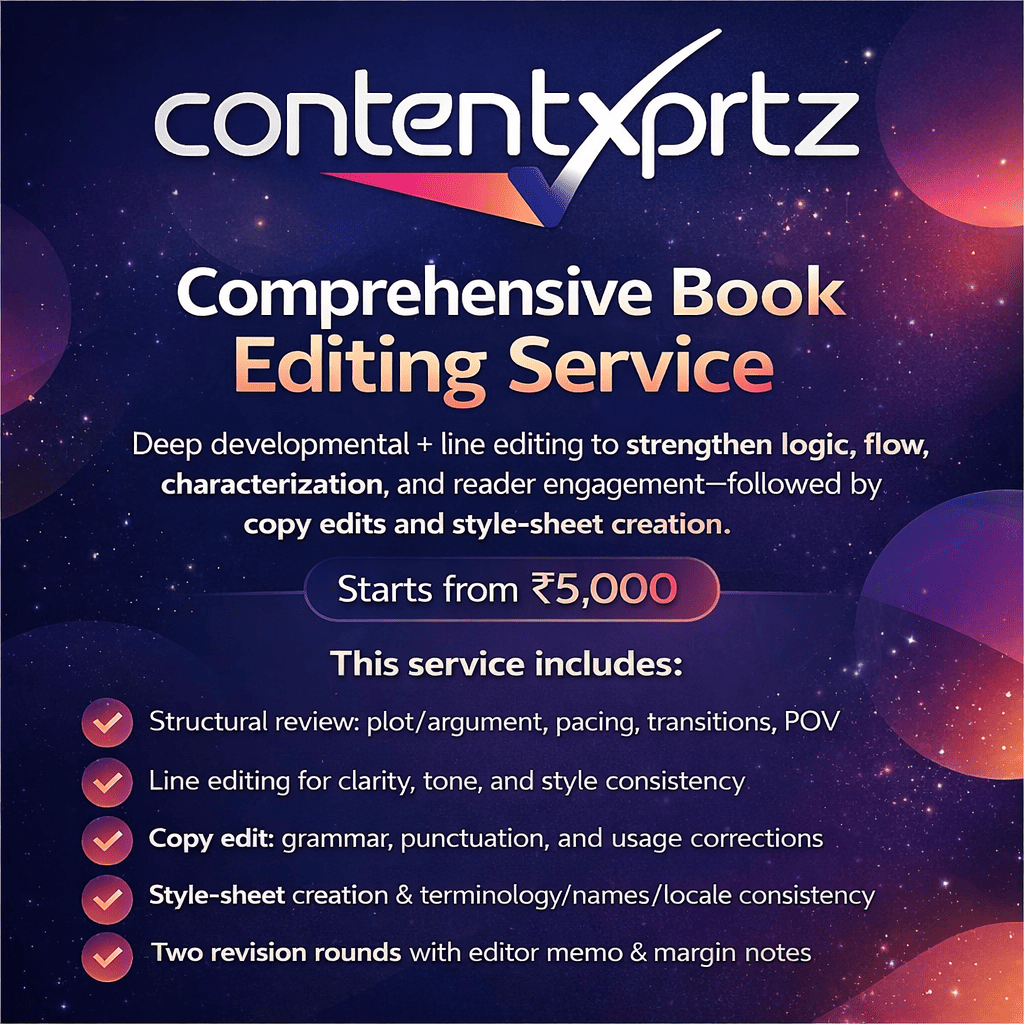
From Manuscript to Masterpiece: Why a Comprehensive Book Editing Service Is Essential for Academic Authors
Introduction: Why Academic Authors Can No Longer Afford to Ignore Professional Book Editing
For PhD scholars, postdoctoral researchers, and academic authors, writing a book is not merely an intellectual milestone. It is a defining moment in an academic career. A scholarly book represents years of conceptual development, empirical rigor, and theoretical contribution. Yet, despite the depth of research, many manuscripts struggle to gain acceptance or recognition due to avoidable issues in structure, language, coherence, and compliance with publisher standards. This is where a Comprehensive Book Editing Service becomes indispensable.
Across disciplines, the pressure on academic authors has intensified. According to global higher education data, more than 3.5 million doctoral degrees are awarded worldwide each year, while academic publishing standards continue to tighten. Major publishers report acceptance rates for scholarly books and monographs that often fall below 10–15 percent, particularly with university presses and international academic publishers. The challenge is not a lack of ideas, but a lack of editorial refinement aligned with global publishing expectations.
PhD scholars today face overlapping constraints. Time scarcity is acute, especially for early-career researchers balancing teaching, grant applications, and publication targets. Financial pressure adds another layer, as publishing costs, indexing requirements, and open-access mandates continue to rise. At the same time, editorial expectations have shifted. Publishers now demand not only methodological rigor but also narrative clarity, structural precision, and international readability.
Language further complicates the process. For scholars writing in English as an additional language, even a well-argued manuscript can be undermined by stylistic inconsistencies, unclear transitions, or discipline-inappropriate tone. Studies in academic communication consistently show that linguistic clarity directly influences reviewer perception, citation potential, and long-term academic impact.
A Comprehensive Book Editing Service addresses these challenges holistically. It does not focus solely on grammar or proofreading. Instead, it integrates developmental editing, structural refinement, language polishing, citation accuracy, and publisher alignment into a single, ethically grounded process. For academic authors seeking credibility, visibility, and publication success, comprehensive editing is no longer optional. It is strategic.
At ContentXprtz, established in 2010, we have supported scholars across more than 110 countries in transforming complex manuscripts into publication-ready academic books. Our experience confirms a simple truth. Strong research deserves equally strong presentation. Editing is not cosmetic. It is foundational to scholarly communication.
Understanding What a Comprehensive Book Editing Service Truly Includes
A frequent misconception among academic authors is that book editing is synonymous with proofreading. In reality, a comprehensive approach addresses multiple layers of scholarly writing, each critical to publication success.
Developmental and Structural Editing
At the highest level, developmental editing evaluates the intellectual architecture of the book. Editors assess argument flow, chapter logic, theoretical consistency, and alignment with disciplinary norms. This stage ensures that the manuscript communicates its contribution clearly and persuasively to its intended academic audience.
Content and Substantive Editing
Substantive editing refines clarity without altering authorial voice. Redundancies are removed, arguments sharpened, and transitions strengthened. This phase is particularly important for interdisciplinary books, where conceptual coherence determines reviewer reception.
Language and Style Editing
Academic language must be precise, formal, and accessible. Language editing focuses on sentence structure, terminology consistency, discipline-specific tone, and international readability. For global publishers, clarity across linguistic backgrounds is essential.
Technical and Citation Editing
Incorrect citations or inconsistent referencing styles remain a leading cause of revision requests. Comprehensive book editing ensures alignment with APA, Chicago, Harvard, or publisher-specific guidelines, referencing authoritative standards from organizations such as the American Psychological Association.
Final Proofreading and Quality Assurance
The final stage removes residual errors and ensures typographical accuracy. More importantly, it verifies internal consistency across tables, figures, references, and cross-references, creating a polished, submission-ready manuscript.
Why PhD Scholars and Researchers Benefit Most from Comprehensive Editing
For doctoral candidates and early-career academics, a book often serves as a credentialing tool. University presses and academic publishers increasingly view books as indicators of scholarly maturity. Comprehensive editing enhances this perception in several ways.
First, it improves reviewer engagement. Research from academic publishing platforms shows that manuscripts with clear structure and refined language receive faster and more constructive reviews. Second, it increases global accessibility. Edited manuscripts reach wider audiences, improving citation potential and academic influence. Third, it reduces revision cycles, saving time and financial resources.
Publishers affiliated with organizations such as Elsevier and Springer Nature emphasize editorial quality as a core evaluation criterion. Comprehensive editing aligns manuscripts with these expectations before submission, not after rejection.
Ethical Book Editing: Preserving Scholarly Integrity
A critical concern among academic authors is ethical compliance. Comprehensive editing must never compromise intellectual ownership. At ContentXprtz, editing adheres strictly to international publication ethics. Editors refine expression, not ideas. Arguments remain the author’s. Data interpretation remains unchanged.
This ethical boundary distinguishes legitimate academic editing from ghostwriting. Reputable publishers, including Taylor & Francis and Emerald Insight, explicitly recognize ethical editing as an accepted academic practice.
How Comprehensive Book Editing Supports Long-Term Academic Impact
Editing does more than facilitate acceptance. It shapes how a book performs after publication. Clear structure enhances teaching adoption. Consistent terminology improves citation accuracy. Professional language increases the likelihood of translations, second editions, and policy influence.
Books edited comprehensively also integrate more smoothly into digital platforms, indexing systems, and academic databases. In an era of algorithmic discoverability, clarity is a strategic advantage.
Integrated FAQs: Addressing Critical Questions on Book Editing and Academic Publishing
FAQ 1: Is comprehensive book editing necessary if my research is already strong?
Strong research is essential, but it is not sufficient for publication success. Academic publishing operates on communication as much as contribution. Reviewers and editors evaluate how effectively ideas are presented, not only what ideas are presented. A comprehensive book editing service ensures that strong research is communicated with clarity, coherence, and disciplinary precision.
Even groundbreaking work can face rejection due to structural ambiguity, unclear argumentation, or inconsistent language. Comprehensive editing identifies these issues early and resolves them systematically. It enhances readability without diluting intellectual rigor. For PhD scholars, this process also functions as advanced academic training, improving future writing efficiency and confidence.
Moreover, publishers often assess marketability alongside scholarly merit. A well-edited manuscript demonstrates professionalism, respect for readers, and alignment with publishing standards. These factors significantly influence editorial decisions.
FAQ 2: How does comprehensive editing differ from standard proofreading?
Proofreading addresses surface-level errors such as spelling, punctuation, and typographical mistakes. Comprehensive editing operates at multiple levels. It includes developmental analysis, structural refinement, substantive clarity, language optimization, and technical accuracy.
For academic books, this distinction is crucial. Proofreading alone cannot resolve conceptual redundancy, weak transitions, or inconsistent theoretical framing. Comprehensive editing addresses the manuscript holistically, ensuring that every chapter contributes effectively to the book’s central argument.
FAQ 3: Can comprehensive book editing help with publisher-specific requirements?
Yes. One of the core benefits of comprehensive book editing is alignment with publisher expectations. Different academic publishers follow distinct editorial guidelines, citation styles, and structural norms.
Editors familiar with major publishers adapt manuscripts accordingly, reducing revision cycles and improving acceptance probability. This includes formatting chapters, refining abstracts or proposals, and ensuring consistency with submission guidelines.
FAQ 4: Is comprehensive editing suitable for first-time academic authors?
First-time authors benefit significantly from comprehensive editing. Writing a book requires a different skill set than writing journal articles or dissertations. Editors provide structural guidance, clarify narrative flow, and ensure consistency across long manuscripts.
This support reduces anxiety, improves learning outcomes, and accelerates publication readiness. Many early-career scholars report that comprehensive editing transforms their understanding of academic writing.
FAQ 5: How does editing improve citation impact and visibility?
Clear language improves reader comprehension. Logical structure enhances teaching adoption. Consistent terminology ensures accurate citations. These factors collectively increase a book’s visibility and academic impact.
Edited books are more likely to be cited correctly, reviewed positively, and recommended within academic networks. Over time, this visibility strengthens scholarly reputation.
FAQ 6: Does comprehensive editing work for interdisciplinary books?
Interdisciplinary books benefit greatly from comprehensive editing. Editors ensure conceptual clarity across disciplinary boundaries, harmonize terminology, and maintain narrative coherence.
Without editing, interdisciplinary manuscripts often suffer from fragmentation. Comprehensive editing unifies diverse perspectives into a cohesive scholarly contribution.
FAQ 7: How long does comprehensive book editing usually take?
Timelines vary based on manuscript length, complexity, and editing depth. On average, comprehensive editing may take several weeks. However, structured workflows ensure efficiency without compromising quality.
Early planning allows authors to align editing timelines with submission or funding deadlines.
FAQ 8: Is comprehensive editing acceptable to academic institutions?
Yes. Academic institutions and publishers widely accept ethical editing. Editing enhances clarity without altering intellectual content. Many universities actively encourage language and structural editing for non-native English scholars.
FAQ 9: Can editing help transform a PhD thesis into a book?
Transforming a thesis into a book is one of the most common uses of comprehensive editing. Theses are written for examiners. Books are written for readers. Editing reshapes tone, structure, and emphasis accordingly.
FAQ 10: How do I choose a reliable comprehensive book editing service?
Choose providers with academic expertise, ethical standards, transparent processes, and global experience. Review credentials, client profiles, and publisher familiarity.
ContentXprtz offers specialized academic editing services, PhD thesis help, and research paper writing support through its integrated platforms:
Conclusion: Elevating Scholarship Through Editorial Excellence
A Comprehensive Book Editing Service is not an optional refinement. It is a strategic investment in scholarly credibility, visibility, and long-term impact. For PhD scholars and academic researchers navigating competitive publishing landscapes, comprehensive editing bridges the gap between intellectual contribution and global recognition.
ContentXprtz combines academic rigor, ethical editing, and global publishing expertise to support scholars at every stage of their writing journey. Our editors understand research, respect authorship, and deliver publication-ready manuscripts aligned with international standards.
Explore our PhD Assistance Services and discover how professional editing can elevate your work from manuscript to masterpiece.
At ContentXprtz, we don’t just edit — we help your ideas reach their fullest potential.