
Dietitian Dietitian: Roles, Qualifications, and Research Explained
Dietitian dietitian is an unusual repeated search phrase, but the underlying questions are familiar: What does a dietitian actually do? Is a dietitian the same as a nutritionist? Which qualifications matter, and how can students and researchers write accurately about dietetics? A dietitian is a trained nutrition professional who uses food and nutrition science to support health, manage nutrition-related conditions, educate communities, and evaluate outcomes. The precise professional title, route to practice, and legal scope depend on the country. That distinction matters whether you are selecting a practitioner, considering a dietetics career, or preparing an academic paper on nutrition care.
For a nutrition student, the immediate concern may be choosing a recognised course, interpreting a case study, or understanding supervised practice. For a postgraduate scholar, it may be developing a research question about dietary behaviour, food insecurity, clinical nutrition, or patient adherence. A practising dietitian may instead be preparing an audit, reviewing a nutrition intervention, or turning service observations into a carefully reported manuscript. These tasks use some of the same scientific vocabulary, yet they require different kinds of evidence, permissions, and expertise.
Confusion grows because the words dietitian, registered dietitian, registered dietitian nutritionist, and nutritionist are not interchangeable across jurisdictions. Many countries specify recognised education and professional registration; others use different titles and regulatory structures. A marketing profile, social-media following, or nutrition certificate alone does not establish authority to provide medical nutrition therapy. Meanwhile, a strong nutrition manuscript needs more than fluent prose: it needs clearly defined populations, valid dietary measures, transparent methods, balanced interpretation, accurate citations, and protection of sensitive information.
This guide separates professional practice from academic research. It explains how dietitians work, how to verify credentials, how dietitian-led research can be designed and communicated, and when independent tools or peer feedback are enough. Where a manuscript already contains the author's research and needs clearer English, organisation, or journal formatting, ethical academic editing services may support readability without inventing results or assuming clinical responsibility. Contentxprtz can assist with research communication, while clinical advice and professional registration remain matters for qualified practitioners and the relevant authorities.
Quick Answer: What Is a Dietitian?
A dietitian is a professional trained to apply nutrition science in clinical, community, public-health, research, and food-service settings. Depending on national law and their scope of practice, qualified dietitians may assess nutrition needs, create individualised care plans, support people living with disease, deliver nutrition education, and work alongside other healthcare professionals.
Dietitian versus nutritionist is not a universal legal distinction. In the United Kingdom, dietitian is a protected title requiring registration with the Health and Care Professions Council (HCPC). In the United States, the Registered Dietitian Nutritionist (RDN) credential has defined education, supervised practice, examination, and continuing-education requirements. Other countries have their own pathways. Always check the local regulator and the practitioner's registration status.
For students and researchers, the best next step is to distinguish clinical scope from academic inquiry. Choose accredited training or qualified clinical care when needed; for a dietetics thesis or paper, define a specific research question, assess evidence quality, report methods transparently, and keep responsibility for every claim and citation.
Key Takeaways
- A dietitian applies food and nutrition science to individuals, groups, healthcare teams, and populations.
- Credentials and protected titles vary by country; verify the applicable national or state registration rules.
- A dietitian is not automatically equivalent to every person who uses the title nutritionist.
- Evidence-based dietetic practice combines relevant research, professional judgement, and the person's circumstances and preferences.
- Dietetic research should report dietary measures, sample characteristics, interventions, outcomes, and limitations clearly.
- Students can use free library resources and institutional writing support; specialist editing is useful for complex manuscripts when permitted.
- Authors remain accountable for clinical accuracy, participant protections, analyses, citations, and final submission.
What This Page Covers
- What a dietitian does in clinical, community, research, and food-service roles
- How dietitian and nutritionist titles differ across countries
- Education, supervised training, credentials, and verification questions
- Steps for reading, designing, and reporting nutrition research
- Research-writing errors that can weaken dietetics assignments and papers
- Three practical cases, a submission checklist, and ethical editing options
Table of Contents
Methodology and Academic Sources
This article draws on professional standards and research-reporting guidance rather than treating a job title or a website description as proof of competence. The International Confederation of Dietetic Associations (ICDA) standards describe the global foundation of dietetic education, ethics, and evidence-based practice. They explicitly recognise that national standards take precedence where local requirements differ.
To illustrate credential differences, the article also references official United States registration eligibility information and the UK National Health Service's explanation of the dietitian title. Research communication guidance comes from the EQUATOR Network's nutrition and dietetics reporting resources and the ICMJE manuscript preparation recommendations.
These sources inform a general educational framework, not a universal licensing checklist or patient-specific diet prescription. Requirements, publisher instructions, course curricula, and clinical guidelines change; always confirm the currently applicable authority and the requirements for the specific research project.
What Does “Dietitian” Mean in Professional and Academic Contexts?
A dietitian translates nutrition science into decisions and communications that people can use safely. The ICDA describes a dietitian-nutritionist as someone who applies food and nutrition science to health promotion, disease prevention, and disease management for individuals and populations. That definition connects two often separated parts of the profession: care for individual people and the generation or interpretation of evidence that can improve care.
Clinical nutrition and medical nutrition therapy
Dietitians working in healthcare may assess diet history, relevant laboratory and clinical information, food access, symptoms, preferences, medications, and treatment goals. They use this context to help develop, monitor, and adapt nutrition interventions within their legal and professional scope. For example, someone living with kidney disease may need advice that differs substantially from generic healthy-eating guidance. Such decisions belong to the qualified care team, not an academic writing service or an automatically generated diet plan.
Public health, education, and food systems
Community dietitians may help design and evaluate programmes supporting maternal and child nutrition, food literacy, school meals, or equitable access to nutritious food. Others work in menu planning, institutional food services, industry, sports settings, research units, or teaching. These activities call for different combinations of counselling, quality improvement, communication, and programme evaluation.
The academic dimension of dietetics
In universities and research organisations, dietetics connects nutritional biochemistry, epidemiology, behavioural science, sociology, clinical science, and statistics. Students may analyse a dietary survey; doctoral researchers may study intervention adherence; practitioners may evaluate a new clinic pathway. The academic aim is not simply to recommend a diet. It is to ask a measurable question, examine the evidence, make justified inferences, and state clearly what remains uncertain.
Why Do Students, PhD Scholars, and Researchers Study Dietitians?
People study the dietitian profession because nutrition decisions affect care, health services, public programmes, and everyday behaviour. The research questions differ by the reader's responsibilities.
For undergraduate and postgraduate students
Common tasks include case analyses, food-composition assignments, literature reviews, reflective placement reports, and assessments of nutrition education. Students need to separate textbook facts from current clinical recommendations and learn that dietary assessment methods have limitations. A food-frequency questionnaire, for example, does not measure intake in the same way as a weighed food record.
For PhD scholars and early-career researchers
Doctoral work may examine relationships between dietary patterns and outcomes, culturally appropriate counselling, nutrition services in underserved settings, or interventions to improve adherence. These projects require a defensible protocol, ethical approvals where applicable, reliable instruments, reproducible analysis, and cautious interpretation. The degree of uncertainty should be visible in the writing.
For practising professionals and healthcare teams
Dietitians regularly communicate with patients, physicians, nurses, researchers, policymakers, and administrators. Service audits and quality-improvement reports can explain whether a programme was implemented as intended, who was reached, and what outcomes changed. When such work becomes formal research or a publication, governance, consent, reporting standards, and distinctions between improvement and research must be considered.
For first-time academic authors
New authors often know the practical problem but struggle to explain the study design, evidence gap, outcomes, and limitations. Clear writing matters because the same result can be interpreted quite differently depending on whether the study was observational, randomised, qualitative, or a small uncontrolled service evaluation. An editor can improve wording and flow, but cannot rescue a design that does not support the claimed conclusion.
Dietitian vs Nutritionist vs Researcher: What Is the Difference?
The key difference lies in training, credentialing, legal scope, and actual responsibilities—not in which title sounds more authoritative. The table offers a way to check terminology without assuming identical laws worldwide.
| Role or term | Typical focus | What to verify | Important limitation |
|---|---|---|---|
| Dietitian / registered dietitian | Applied nutrition care, education, and sometimes clinical nutrition therapy | Country-specific accredited education, supervised practice, registration or licence | Scope differs by jurisdiction, employment setting, and individual competence |
| Registered Dietitian Nutritionist (RDN), US | Credentialed food and nutrition practice | CDR requirements, registration, relevant state law, specialist competence | US credential requirements do not automatically apply abroad |
| Nutritionist | Nutrition education, science, or other nutrition-related work | Exact qualification, professional body, local title protection, permitted activities | Title regulation is inconsistent across countries |
| Nutrition or dietetics researcher | Study design, evidence collection, analysis, reporting | Methodological and subject expertise; institutional and ethics approval where needed | Research qualifications alone do not confer clinical practice rights |
| Academic editor | Language, structure, consistency, and formatting | Editing scope, confidentiality, experience, and permitted assistance rules | Editing does not replace a registered dietitian, statistician, or research author |
In the UK, dietitian is a legally protected title linked to HCPC registration. In the US, new eligibility for the dietitian registration examination has required a graduate degree since 1 January 2024, alongside accredited coursework and supervised practice; existing registered professionals were not required to earn a new degree merely because that requirement changed. Elsewhere, check a current official register or a recognised national dietetic association before drawing conclusions about qualifications or scope.
What credentials should a reader check?
Ask which professional authority recognises the qualification, whether the person has current registration, whether their training covers the relevant clinical concern, and what referral arrangements exist for matters beyond their scope. For students planning a career, verify programme recognition before paying fees or committing to a placement. For researchers describing a clinical team, use the accurate locally recognised role rather than substituting titles casually.
Free, Low-Cost, and Professional Sources of Nutrition Guidance
Many questions can be answered through university libraries, professional standards, peer-reviewed research, and publicly available health guidance. Paid help is not a substitute for evidence quality, and the right professional depends on the task.
| Need | Useful first step | When to seek specialist help |
|---|---|---|
| Understand a basic nutrition concept | Course materials, academic library, reputable public-health information | When technical concepts or contradictory findings remain unclear |
| Make a personal clinical diet change | Qualified healthcare team and verified dietitian | When a condition, medication, nutritional risk, or complex restriction is involved |
| Plan dietetics research | Supervisor, librarian, institutional methods resources | When measures, ethics, sampling, or statistical choices need expert review |
| Improve a complete manuscript | Self-editing, peer feedback, journal instructions | When language, structure, terminology, and references need specialist editing |
Match the support to the risk. Clinical decisions require qualified clinicians. Study design and analysis require appropriate methodological oversight. A language editor can help make a defensible result easier to understand but should not select clinical treatments or create study results.
When Is Self-Service Enough—and When Is Expert Review Appropriate?
Self-service work is often enough for reading an introductory paper, checking terminology against a recognised glossary, drafting an assignment outline, or comparing a handful of sources. Before asking for paid services, use available library tutorials, a writing centre, reference-management tools, and supervisor feedback.
Expert review becomes more valuable when a thesis uses specialised nutrition terminology, a manuscript has several co-authors, or a journal requires detailed reporting of dietary exposure, intervention components, missing data, and limitations. If the concern is whether an intervention was clinically appropriate, consult a dietitian or another qualified healthcare professional with suitable expertise. If the concern is whether the analysis is sound, consult a statistician or methods supervisor. If the problem is clarity, grammar, figure legends, and consistency, professional editing may be an appropriate choice.
Institutions and publishers differ in what assistance must be acknowledged or disclosed. Make the scope explicit in advance, retain tracked changes, and ensure the named researchers review the final text. The cheapest intervention is often a careful early discussion about what kind of help is actually needed.
How to Become Informed About Dietetics and Prepare Nutrition Research: Step by Step
A useful dietetics workflow has two linked tracks: verifying professional pathways and building a credible evidence-based academic project. Use the parts that apply to your situation rather than treating the entire sequence as a licensing procedure.
1. Identify the country, role, and specific objective
Start with the question: Are you seeking clinical care, choosing education, or writing research? Record the country and intended role. This prevents a qualification that is valid in one system from being misrepresented as automatic permission to practise elsewhere.
2. Check recognised education and registration requirements
Look for official programme accreditation, supervised practice expectations, examinations, title protection, and continuing education. If training abroad, ask the destination regulator about qualification recognition rather than relying solely on university marketing materials.
3. Translate a broad nutrition interest into a research question
“Does diet matter for health?” is too broad for a useful study. “Among adults attending a community clinic, how is self-reported fruit intake associated with a selected clinical outcome?” is more workable. Define the population, exposure or intervention, comparator where relevant, outcome, and timeframe.
4. Find and record credible studies
Search discipline-appropriate bibliographic databases with synonyms for dietary exposure, study population, and outcome. Record which databases were searched, when, and with which terms. Follow relevant clinical guidelines, but do not treat a guideline's summary as a substitute for understanding the supporting research.
5. Choose appropriate dietary and outcome measures
Explain whether intake is assessed through recall, food-frequency questionnaires, weighed records, biomarkers, or another instrument. Describe validation, recall bias, portion-size estimation, missingness, and the suitability of the tool for the study population. Define outcomes before presenting results.
6. Address ethics, consent, privacy, and governance
Work with your supervisor or institution to identify whether the project requires ethics committee approval, consent procedures, clinical governance review, or data-protection controls. Remove identifying information from case examples unless the appropriate permission and consent requirements are fulfilled.
7. Analyse without overstating causality
Observational associations do not, by themselves, show that an eating pattern caused an outcome. Consider confounders, selection bias, measurement error, and statistical uncertainty. In interventions, explain allocation, adherence, fidelity, attrition, and deviations from the plan.
8. Report methods and results so others can evaluate them
Describe recruitment, inclusion criteria, sample size, exposure or intervention, analytic method, actual findings, adverse events where relevant, and study limitations. Use a reporting guideline suited to the design. If the study uses nutritional epidemiology methods, check whether STROBE-nut is appropriate.
9. Edit terminology, references, and visual explanations
Check units, dietary terminology, table denominators, figure captions, abbreviations, citations, and whether the abstract reflects the full results. Avoid turning a tentative interpretation into a certainty during language polishing.
10. Obtain author sign-off and follow submission rules
Every author should be able to explain their contributions and stand behind the version submitted. Recheck target journal instructions, institutional disclosure rules, relevant reporting checklists, and any permitted editing acknowledgements. Submission readiness is a quality-control stage, not a promise of acceptance.
How Can Dietetics Students Search for Reliable Nutrition Evidence?
Start with concepts rather than brand names, dietary trends, or an entire assignment sentence. A question about nutrition counselling and hypertension, for example, may need terms for counselling, dietary intervention, blood pressure, primary care, and the relevant patient population.
Use population, exposure, outcome, and design terms
Build alternative terms for each concept. Consider spelling differences and established names for dietary instruments. A literature review needs sufficient coverage to test a claim, not only a few articles that agree with the initial hypothesis.
Separate primary evidence from commentary
A systematic review may be helpful for orientation but has its own eligibility criteria and limits. An individual trial can provide intervention information; an observational cohort can show associations over time; qualitative research can explain experiences and barriers. Ask what each design can and cannot establish.
Document the search and selection decisions
Keep an evidence matrix with bibliographic details, country, sample, diet measure, comparator, outcomes, design, limitations, and relevance to your question. Record the date and source of each search. If the work is a formal review, follow the reporting and protocol expectations set by the discipline.
What Should You Extract from a Dietetics Research Paper?
Read beyond the abstract. The details that determine whether a nutrition claim is convincing often appear in the methods, supplemental files, and limitations.
Dietary assessment and exposure
Identify who reported intake, how often measurements were taken, which dietary database or classification was used, and whether the tool was suitable for the population. Self-reported consumption may be affected by memory, social desirability, cultural food patterns, and changing portion sizes.
Intervention design and fidelity
For counselling studies, report who delivered the intervention, the number and duration of sessions, the content, materials, control condition, and how adherence was evaluated. The label “nutrition counselling” alone does not describe a reproducible intervention.
Outcomes and interpretation
Distinguish pre-specified outcomes from exploratory analyses. Report effect sizes and uncertainty when available, not only whether a result crossed a conventional significance threshold. Consider whether changes were clinically meaningful and whether the population resembles the readers or patients to whom conclusions might be applied.
What a literature matrix should contain
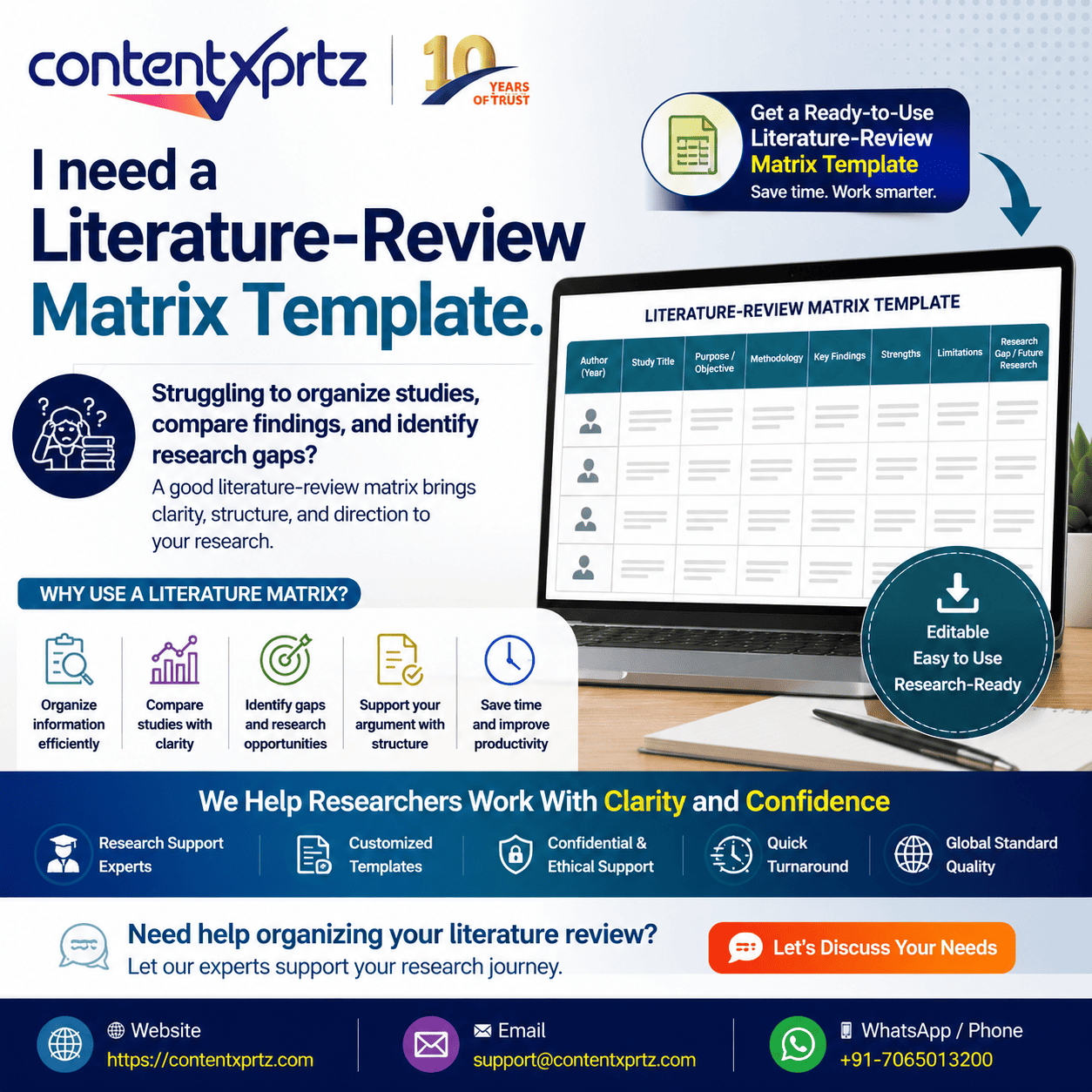
Useful columns include author and year, study location, design, eligibility criteria, sample size, dietary measurement, intervention details, outcome measure, main result, limitations, risk-of-bias concerns, and relevance. This simple structure reduces the temptation to write a literature review as a succession of disconnected article summaries.
How Should a Dietitian or Researcher Evaluate Nutrition Claims?
The best nutrition claim is one whose strength matches the quality and applicability of the evidence. Neither a large headline nor a statistically significant association is enough on its own.
| Quality check | Questions to ask | Writing implication |
|---|---|---|
| Population | Who participated, and who was excluded? | Avoid generalising beyond the studied group |
| Diet measurement | Was intake self-reported, measured, or estimated? Was the tool validated? | State measurement limits and potential bias |
| Study design | Randomised trial, cohort, cross-sectional study, qualitative work, or audit? | Use causal language only when justified |
| Confounding | Could age, income, illness, activity, or other factors explain an association? | Discuss residual confounding and alternative explanations |
| Intervention reporting | Was the content, dose, provider, and adherence described? | Explain exactly what another team could reproduce |
| Ethics and transparency | Are approvals, consent, funding, and conflicts reported where relevant? | Include required statements and avoid unsupported assurances |
An observation that participants who reported eating more vegetables had a different outcome does not establish that the vegetables alone caused the difference. Equally, one small trial does not settle a question for every population. Good dietetic communication explains the intervention or exposure, considers plausible alternatives, and makes uncertainty visible rather than hiding it in technical language.
Ethical Dietetics Writing, Patient Privacy, and Author Responsibility
Ethical dietetics research protects participants and communicates findings without crossing the boundary into unearned clinical authority. Case material, clinical records, and interviews can contain sensitive details even after names are removed. Researchers must follow their institution's governance and consent requirements, and authors should not paste identifiable patient information into general editing or AI systems.
Academic editing is a language and communication service. It can improve grammar, technical consistency, tables, transitions, and formatting, but it must not fabricate participants, adjust data to create significance, insert invented references, or rewrite uncertain findings as definitive treatment claims. The authors should verify each citation against the underlying source, check that every table agrees with the text, and report relevant funding and conflicts of interest where required.
AI-assisted drafting can accelerate outlining or style checks, yet numerical values, clinical terminology, quotations, and references require independent checking. If your course, institution, journal, or publisher asks for disclosure of AI or editorial assistance, comply with that policy. Authorship involves responsibility for the scientific content, not merely approval of a polished paragraph.
When editing a collaborative dietetics manuscript, keep a change log or tracked changes, ask a subject expert to approve technical modifications, and confirm that the final version accurately represents the original analysis. This is especially important when English editing affects words such as associated, effective, prevented, and caused, which can materially change the strength of a scientific claim.
Common Dietitian and Nutrition Research Mistakes to Avoid
Most preventable problems arise when the professional role, measurement method, study design, and manuscript claim are not aligned. Use these checks before finalising an assignment or submission.
- Assuming all nutrition titles are equivalent. Verify the local regulator, actual credential, and practice permissions.
- Choosing a programme on its name alone. Confirm accreditation, placements, and eligibility for the intended professional pathway.
- Confusing advice with personalised treatment. A general educational article cannot replace clinical assessment for a person with complex health needs.
- Reporting “diet” without a measurement method. Describe the instrument, recall period, units, and limitations.
- Using causal verbs for observational findings. Match the language to study design and evidence strength.
- Hiding non-significant or inconvenient results. Report outcomes transparently, including uncertainty and deviations from plans.
- Comparing studies without noting population differences. Age, geography, healthcare access, and cultural patterns influence applicability.
- Citing secondary summaries without checking originals. Verify claims, bibliographic details, and whether sources have been corrected or retracted.
- Submitting identifiable patient details to an editor. Use approved data-handling and confidentiality processes.
- Assuming language editing guarantees publication. Editors improve communication; reviewers and journal editors assess suitability and scientific merit.
Practical Examples: Dietitian Training, Research, and Manuscript Decisions
These illustrative scenarios show how a modest change in approach can prevent larger problems. They are examples for learning, not reports of specific Contentxprtz clients or clinical treatment recommendations.
Example 1: A dietetics student selecting a career pathway
Situation: A student finds several programmes advertising nutrition careers and assumes every course qualifies graduates to practise as registered dietitians. Common mistake: Comparing only tuition, course titles, and university rankings. Better approach: The student first identifies the country in which they intend to work, checks official professional recognition, reviews required supervised practice, and asks the programme about graduate eligibility. Where guidance helps: A university adviser or professional regulator resolves qualification questions; a writing mentor can then help the student present a well-supported professional development plan.
Example 2: A PhD scholar analysing a dietary survey
Situation: A doctoral researcher studies dietary patterns and metabolic markers using a cross-sectional questionnaire. Common mistake: Drafting a conclusion that a particular eating pattern “prevents” a condition despite the absence of a longitudinal or experimental design. Better approach: The researcher describes measurement validity, population characteristics, confounders, effect estimates, and remaining uncertainties. They revise the conclusion to report an association without asserting a proven cause. Where guidance helps: A methods adviser reviews the analysis, while an academic editor improves the logic and language without changing results.
Example 3: A hospital dietitian writing a quality-improvement report
Situation: A dietitian evaluates uptake of a counselling pathway introduced in an outpatient department. Common mistake: Calling every change a treatment effect while omitting recruitment, follow-up, and missing-data information. Better approach: The report identifies its improvement objective, eligible population, implementation dates, measures, and limitations, and follows institutional governance rules. Where guidance helps: Clinical supervisors check scope and data handling; structured manuscript editing helps the practitioner explain the process clearly to a professional audience.
Example 4: A first-time author preparing a nutrition intervention paper
Situation: A multidisciplinary team has completed a pilot intervention, but the manuscript uses inconsistent names for study groups and different denominators across figures. Common mistake: Polishing the abstract before reconciling tables and methods. Better approach: Authors create a single terminology and results checklist, confirm every number against verified analyses, and only then request language and formatting support. Where guidance helps: A subject-aware editor can flag ambiguity for author review, but must not silently choose a value or rewrite the study's conclusions.
Dietitian Research and Academic Writing Checklist
Use this checklist before submitting coursework, a thesis chapter, an abstract, or a nutrition manuscript. Not every item applies to every document; select the checks appropriate to your design and institution.
Professional and topic accuracy
- Professional titles, credentials, and scope statements match the relevant jurisdiction.
- The clinical or public-health problem and population are defined clearly.
- Key nutrition terms are used consistently and explained at first mention.
- Statements about clinical care are supported by appropriately qualified sources.
Methods and evidence
- The research question, design, setting, inclusion criteria, and sampling process are described.
- Dietary assessment tools, measurement periods, and units are identified.
- Intervention content and adherence measures are reported where relevant.
- Potential biases, confounders, missing data, and uncertainty are considered.
- Any necessary ethics approval, consent, and governance statements are present.
Writing and submission
- Results, figures, tables, abstract, and conclusion tell the same factual story.
- Causal language does not exceed what the study can support.
- References are authentic, traceable, current enough for the topic, and accurately formatted.
- The correct reporting checklist and target journal instructions have been consulted.
- Author contributions, conflicts, and editorial assistance are disclosed if required.
- All contributors approve the final version and have checked sensitive information.
How Contentxprtz Can Help Dietetics Researchers and Academic Authors
Contentxprtz can support the communication stage of a dietetics project when the underlying science, ethics, and analysis remain under the researchers' control. This may include improving the flow of a nutrition literature review, making a methodology section easier to follow, ensuring terminology and abbreviations remain consistent, and checking references, tables, and journal formatting. For authors writing in a second language, careful editing can make nuanced findings clearer without erasing their original voice.
For completed articles and research drafts, the most direct option is research paper editing support. Researchers preparing longer academic work may also consider relevant ethical academic editing. These services do not provide clinical diet prescriptions, professional registration, research participant recruitment, or guarantees of publication.
Before requesting help, prepare the target journal or university style guide, a complete version of your text, agreed terminology, any reporting checklist, and clear instructions about passages that must not change technically. Retain author review of every proposed revision, particularly for dietetic recommendations and statistical interpretations.
Summary: Dietitian Dietitian Roles and Nutrition Research
A dietitian is a professionally trained nutrition specialist, but title and registration requirements vary across the world. A sensible reader checks local credentials and clinical scope rather than assuming that dietitian and nutritionist mean the same thing everywhere. For students, the next step is to verify an educational pathway; for people seeking care, it is to confirm a practitioner's registration and suitability for the clinical need.
For researchers, the crucial distinction is between generating evidence and communicating it. Design choices, dietary measures, participant protections, analyses, and interpretation determine whether conclusions are defensible. Clear, ethical editing can improve the delivery of those conclusions, but it cannot substitute for professional judgement or author accountability.
Frequently Asked Questions
What is a dietitian, and what does a dietitian do?
A dietitian applies nutrition science to health promotion, disease prevention, nutrition care, education, and evaluation. Depending on the country, registration, employment setting, and personal competence, their work may include nutrition assessment, individualised care plans, food-service planning, community education, research, and quality improvement. A hospital dietitian and a public-health dietitian may use overlapping knowledge but work with different populations and outcomes. To understand a particular practitioner’s role, ask about their current credentials, clinical specialism, and the service they provide. A general title cannot tell you whether someone has expertise in kidney disease, paediatrics, sports performance, or another specialised area. For students, describing the setting and scope precisely makes coursework more accurate; for people seeking care, credential verification should come before relying on individualised treatment advice.
Why do people search for “dietitian dietitian,” and is the term different from “dietitian”?
The repeated words “dietitian dietitian” do not name a separate qualification or a second type of clinician. Usually the meaningful search intent is to understand what a dietitian is, compare dietitian credentials, find a qualified professional, or study the profession. There is no universal professional designation created by repeating the word. The useful next step is to specify the country and purpose of your question: for example, “registered dietitian qualifications in the United States,” “dietitian versus nutritionist in the United Kingdom,” or “dietetics research methods.” That extra context matters because credentials, protected titles, clinical privileges, and educational pathways can change by jurisdiction. If the goal is academic writing, clarify whether you need a definition, career information, or research guidance so that the evidence you cite matches the question you are answering.
Is a dietitian the same as a nutritionist?
Not necessarily. The titles overlap in some places, but their legal meaning and educational requirements vary worldwide. In the United Kingdom, dietitian is a protected professional title associated with HCPC registration, whereas nutritionist is not a statutorily protected title. In the United States, Registered Dietitian Nutritionist is a specific credential with defined education, supervised practice, examination, and continuing-professional-development expectations. Other countries may recognise nutritionist as a formal professional title or use different credentialing systems. Therefore, do not generalise a UK or US rule to every country. Check the relevant regulator, current registration, scope of practice, and expertise. A nutrition degree alone is not proof of permission to provide clinical dietetic services. Researchers should state which titles their studies use and define them in the methods when professional roles affect interpretation.
How do I become a registered dietitian?
The route depends on where you want to practise. First, identify the national or regional professional authority and a recognised education programme; then check whether supervised practice, an examination, registration, licensing, and ongoing professional development are required. In the United States, eligibility for the dietitian registration examination for new candidates generally requires a graduate degree, appropriate ACEND-accredited education and supervised practice, and successful completion of the registration exam, with applicable state requirements for practice. In the United Kingdom, the dietitian title is regulated through the HCPC and recognised professional training. The rules are not interchangeable, and qualifications earned abroad may require formal assessment. Before enrolling, ask the programme and regulator to confirm the pathway in writing. Students should also consider placement availability, accessibility, cost, specialisms, and the practical learning needed for their intended career.
Can a dietitian help with a medical condition or a specialised diet?
A qualified dietitian may be able to provide nutrition support for a medical condition within their competence and legal scope, often in coordination with the person’s wider healthcare team. The appropriate intervention depends on the diagnosis, medications, clinical history, nutritional status, goals, and local practice rules. This is different from following a generic diet trend or relying on a social-media plan. Before an appointment, gather relevant medical information and ask whether the practitioner has experience with your concern. Complex or urgent medical needs should be assessed through appropriate healthcare services rather than addressed solely through a general article. For academic readers, describe dietetic interventions as individualised processes; do not present a study average or a single protocol as a universally suitable prescription. Authors should also avoid including personal patient details in public teaching materials without the necessary permissions.
What are good dietetics research topics for students and PhD scholars?
A useful topic joins a specific population, a measurable exposure or intervention, and a meaningful outcome. Examples include the feasibility of culturally tailored nutrition education, dietary assessment accuracy in a particular age group, food access barriers among university students, patient experiences of nutrition counselling, or adherence to a defined nutrition-service pathway. Suitability depends on available data, equipment, recruitment access, ethical approval, time, and supervisory expertise. Avoid starting with a conclusion such as “this food cures disease” and designing the question to prove it. Instead, assess what the literature already shows, identify an answerable gap, select an appropriate study design, and choose a valid outcome measure. An evidence matrix can help compare the strengths and limitations of previous studies. Your supervisor or an academic librarian can help narrow the scope before you commit to data collection.
How should dietary intake be measured and reported in a research paper?
Report the dietary assessment method, who completed it, the reference period, frequency of measurements, units, food-composition resources, scoring system, and any validation information. Common approaches include 24-hour recalls, food-frequency questionnaires, food records, and selected biomarkers, but none is perfect for every purpose. Self-report methods can introduce recall and reporting errors, while measurement frequency and cultural food patterns may affect validity. Explain missing records, implausible values, how dietary categories were formed, and whether the instrument suits the population. When comparing studies, distinguish their measurement methods before pooling or narratively combining outcomes. A clear methods section allows other researchers to judge whether the findings are reproducible and clinically applicable. Language editing may clarify the description but must not invent details about an instrument or retrospectively change what was measured.
Which reporting guidelines matter for nutrition and dietetics research?
Choose reporting guidance according to the actual study design and journal requirements. Observational nutrition research may benefit from the STROBE guidance and its nutrition-focused extension, STROBE-nut. Randomised trials often refer to CONSORT, while systematic reviews commonly use PRISMA. The EQUATOR Network groups reporting resources by design and by nutrition and dietetics topic. A reporting checklist is not a substitute for good study design or ethics approval; it helps authors disclose information needed to assess what they did. Consult the current journal instructions and the relevant guideline version before submission. Make sure recruitment, dietary measurements, intervention details, outcomes, adverse events where appropriate, limitations, and transparency statements are consistent across the manuscript. If a checklist reveals that information is missing, authors must correct the reporting or explain the limitation rather than asking an editor to create the missing methods.
What mistakes should dietetics authors avoid when interpreting results?
Avoid asserting causation from a cross-sectional association, treating statistical significance as proof of clinical importance, ignoring measurement error, and generalising beyond the study population. Another common error is presenting a broad nutrition intervention without enough detail for another team to reproduce it. Compare study groups, denominators, exposure units, and analysis labels across the abstract, tables, figures, and results text. Report uncertainty and null findings accurately. Dietary research is particularly vulnerable to confounding because food choices are related to income, health status, lifestyle, and many other factors. Explain these limits in language that matches the design rather than making the research seem stronger than it is. Expert methodological review is appropriate for analytic concerns; ethical academic editing is appropriate when the conclusions are scientifically sound but their wording is confusing or inconsistent.
When can Contentxprtz help with a dietetics thesis or journal manuscript?
Contentxprtz can help when an author already has a dietetics assignment, thesis chapter, literature review, or research manuscript that needs clearer English, more consistent terminology, better organisation, reference checks, or journal-specific formatting. For a complete research paper, editorial review can flag unclear methods descriptions, inconsistent abbreviation use, or a conclusion that appears stronger than the stated evidence, leaving decisions and corrections to the researcher. It cannot act as a licensed dietitian, obtain clinical permissions, collect participant data, invent citations, or guarantee acceptance. Before requesting support, identify the target publication or university style, clarify which sections can be edited, remove sensitive information appropriately, and check the rules for editorial acknowledgements. Authors should approve all revisions and remain responsible for the design, findings, patient safety implications, citations, and final submission.
Conclusion: Combine Verified Dietitian Expertise with Clear Research Communication
If a search for dietitian qualifications or nutrition guidance brought you here, begin by confirming the country, relevant credential, and intended task. A qualified dietitian may be the right partner for nutrition care; a university adviser or librarian may be the right first resource for coursework and research planning. For a simple assignment, careful self-editing and supervisor comments may be sufficient. For a specialised dietetics thesis or research manuscript, subject-aware academic editing can be a sensible final quality check when permitted.
Contentxprtz helps academic authors communicate their own research more clearly through accurate language, consistent structure, and responsible manuscript preparation. If your dietetics article is ready for editorial review, explore research paper editing services with the understanding that the original authors remain responsible for the data, clinical accuracy, citations, ethics, and submission decisions.
At Contentxprtz, we don’t just edit; we help ideas reach their fullest potential.
