
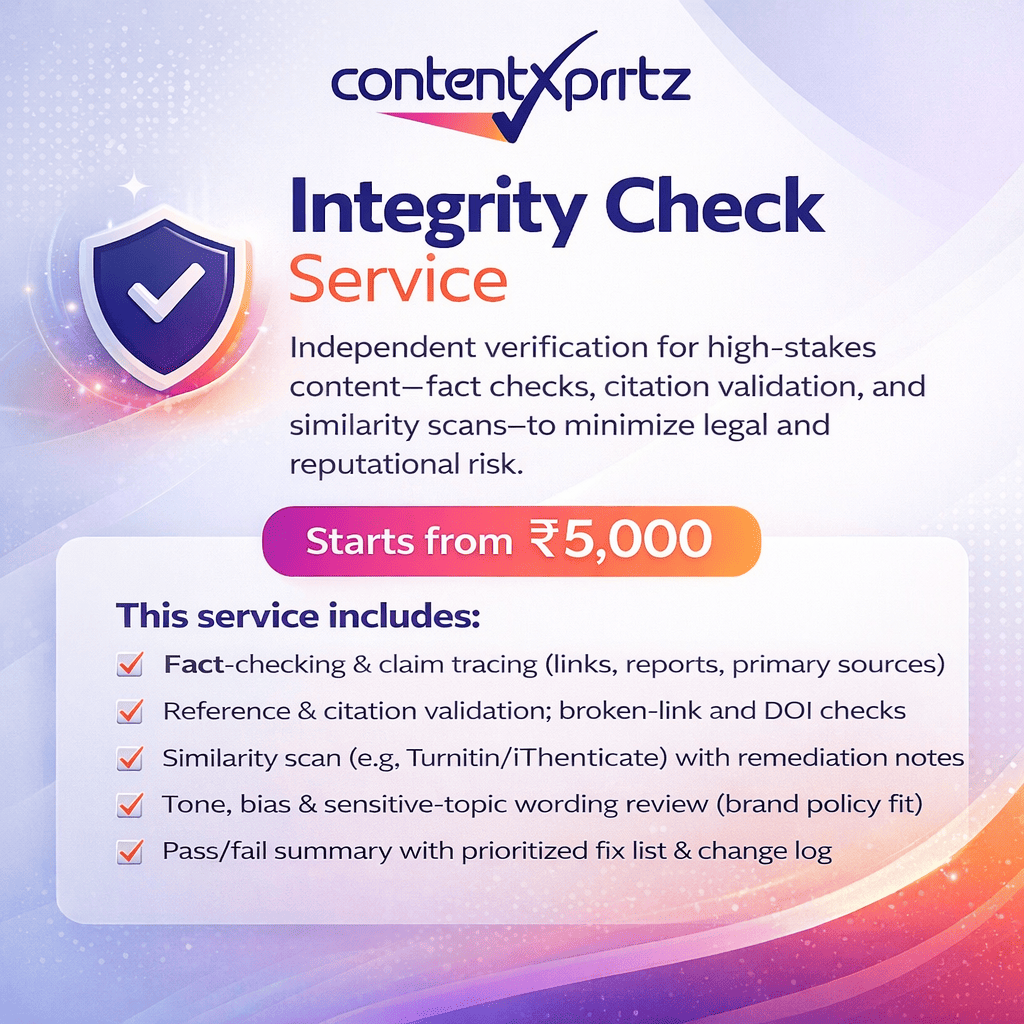
Integrity Check Service by ContentXprtz
Protect your research. Strengthen your credibility.
High-stakes academic and professional content demands accuracy, transparency, and trust. Our Integrity Check Service provides independent verification to help you submit with confidence and minimize legal or reputational risk.
What we help you achieve:
📘 Reliable, publication-ready content
📄 Verified references and citations
🧠 Reduced risk of factual, ethical, or similarity issues
This service includes:
• Fact-checking & claim tracing using primary sources
• Reference and citation validation (DOI & broken-link checks)
• Similarity scan (Turnitin/iThenticate) with remediation notes
• Tone, bias & sensitive-topic wording review
• Clear pass/fail summary with prioritized fix list
At ContentXprtz, your work remains yours—100% ethical, original, and author-owned. We support clarity and compliance, not shortcuts.
Starts from ₹5,000
Message us on WhatsApp to get started today
WhatsApp: https://wa.me/917065013200
Website: https://contentxprtz.com
#ContentXprtz #AcademicIntegrity #PhDSupport #ResearchEthics #ScholarlyWriting #PublicationSupport #ResearchScholars #PhDLife #DoctoralResearch #AcademicServices #JournalSubmission #ResearchVerification #HigherEducation #PostdocLife #ThesisSupport #DissertationHelp #EthicalResearch #CitationCheck #PlagiarismCheck #Turnitin #iThenticate #AcademicPublishing #ResearchQuality #StudentsSupport #Academia
Integrity Check Service as the Ethical Backbone of Modern Academic Publishing
Introduction
For many PhD scholars, postgraduate students, and academic researchers, the journey from an initial research idea to a published manuscript is both intellectually rewarding and emotionally exhausting. In the first year of doctoral study, enthusiasm often dominates. However, as deadlines accumulate, reviewer expectations grow sharper, and publication pressure intensifies, even experienced researchers begin to question whether their work meets the increasingly strict standards of academic integrity. It is within this complex landscape that an Integrity Check Service becomes not just helpful, but essential.
An Integrity Check Service is far more than a plagiarism scan. It is a structured, expert-led evaluation of originality, ethical compliance, citation accuracy, authorship transparency, and alignment with international publishing standards. In the current academic environment, integrity is not optional. Journals, funding bodies, and universities worldwide now operate under zero-tolerance policies for ethical lapses, whether intentional or accidental.
Globally, the pressure on researchers has increased sharply. According to data reported by major academic publishers, journal acceptance rates in high-impact outlets often fall below 10 percent. At the same time, the number of manuscript submissions continues to rise each year, driven by doctoral graduation requirements, performance-based funding systems, and institutional ranking metrics. For early-career researchers and PhD scholars, this creates a paradox. They must publish more, faster, and better, while adhering to increasingly complex ethical frameworks.
Time constraints further compound the problem. Many doctoral candidates balance teaching responsibilities, grant applications, conference commitments, and personal obligations. As a result, citation errors, unintentional paraphrasing overlaps, and inconsistent referencing can occur even in otherwise rigorous research. These issues rarely reflect dishonesty. Instead, they reflect the reality of academic overload.
Rising costs also play a role. Journal submission fees, proofreading charges, statistical consultation, and software subscriptions can strain already limited research budgets. In this environment, students often attempt to self-manage quality checks, relying on automated tools that lack contextual judgment. Unfortunately, automated checks alone cannot identify nuanced integrity risks such as self-plagiarism, citation manipulation, patchwriting, or mismatched author contributions.
An Integrity Check Service addresses these challenges holistically. It combines human expertise with ethical frameworks recognized by leading publishers. At ContentXprtz, this service is designed specifically for scholars who value originality, transparency, and long-term academic credibility. Rather than correcting problems after rejection, an integrity-first approach strengthens manuscripts before submission, improving both ethical confidence and publication outcomes.
This article explains what an Integrity Check Service truly involves, why it matters for modern academic publishing, and how students and researchers can use it strategically. Throughout, the discussion reflects best practices endorsed by globally recognized academic institutions and publishers, while remaining grounded in the real experiences of doctoral researchers.
Understanding the Integrity Check Service in Academic Writing
An Integrity Check Service is a comprehensive academic quality assurance process. Its primary goal is to ensure that a manuscript complies fully with ethical writing, publication, and authorship standards before submission to a journal, university, or funding body.
Unlike basic plagiarism detection, which relies solely on similarity percentages, an Integrity Check Service evaluates the nature, context, and intent of textual overlaps. For example, it distinguishes between legitimate methodological descriptions and problematic paraphrasing. It also assesses whether citations accurately reflect original sources and whether references align with disciplinary norms.
In academic publishing, integrity encompasses several dimensions:
-
Originality of ideas and expression
-
Proper acknowledgment of prior research
-
Transparent authorship and contribution disclosure
-
Ethical data reporting and interpretation
-
Compliance with journal and institutional guidelines
An Integrity Check Service addresses each of these dimensions systematically. This approach aligns with the ethical frameworks promoted by organizations such as Elsevier, Springer Nature, and Taylor & Francis, all of which emphasize pre-submission ethical compliance as a shared responsibility between authors and publishers.
At ContentXprtz, integrity checks are conducted by subject specialists and academic editors with direct experience in journal review processes. This ensures that feedback reflects real editorial expectations rather than generic software outputs.
Why Integrity Has Become Central to PhD and Research Publishing
Over the past decade, academic publishing has undergone a profound transformation. Digital submission systems, cross-publisher similarity databases, and AI-assisted screening tools have significantly increased scrutiny at the editorial desk stage. As a result, manuscripts are now evaluated for ethical compliance even before peer review begins.
Editorial rejection due to integrity concerns is increasingly common. Journals routinely screen for:
-
Excessive textual similarity
-
Inconsistent citation practices
-
Undisclosed reuse of prior publications
-
Questionable authorship patterns
These checks are not limited to plagiarism. Self-plagiarism, sometimes called redundant publication, is a frequent cause of rejection, particularly for PhD scholars converting thesis chapters into journal articles. Without expert guidance, researchers may unintentionally violate journal policies.
Furthermore, academic integrity is closely tied to reputation. A single ethical flag can have long-term consequences, including retractions, institutional investigations, and funding restrictions. Therefore, proactive integrity management is no longer optional for serious scholars.
An Integrity Check Service provides reassurance at this critical stage. It allows researchers to submit work with confidence, knowing that ethical risks have been identified and resolved systematically.
Core Components of a Professional Integrity Check Service
Originality Assessment Beyond Similarity Scores
Similarity percentages alone are misleading. A professional Integrity Check Service evaluates whether overlaps are justified, properly cited, and consistent with disciplinary norms. This approach reflects guidance published by Emerald Insight, which emphasizes qualitative assessment over numerical thresholds.
Citation and Reference Accuracy
Incorrect citations undermine both credibility and integrity. Editors often reject manuscripts when references do not support claims accurately. Integrity checks verify source alignment, citation completeness, and formatting consistency.
Paraphrasing and Academic Voice Review
Patchwriting remains a common issue among non-native English speakers. An Integrity Check Service identifies areas where paraphrasing may appear too close to the source and recommends revisions that preserve meaning while ensuring originality.
Self-Plagiarism and Redundancy Detection
Doctoral researchers often publish multiple outputs from a single dataset. Integrity checks help ensure that each output meets originality requirements and that prior publications are disclosed appropriately.
Ethical Compliance Review
This includes checks for informed consent statements, ethical approval disclosures, and data transparency, particularly in social sciences, medical research, and psychology, where ethical oversight is mandatory.
Integrity Check Service and the Role of Academic Editing
Integrity and academic editing are deeply interconnected. While academic editing focuses on clarity, structure, and language precision, integrity checks ensure that improvements do not compromise originality or ethical standards.
For example, during language refinement, editors must avoid inadvertently increasing similarity by overusing common phrases from source material. At ContentXprtz, integrity checks are integrated into the academic editing workflow, ensuring that stylistic improvements enhance, rather than undermine, ethical compliance.
Researchers seeking comprehensive support often combine integrity checks with professional editing through services such as academic editing services. This integrated approach reduces revision cycles and improves editorial outcomes.
How an Integrity Check Service Supports Publication Success
From an editorial perspective, integrity compliance is a prerequisite for peer review. Manuscripts flagged for ethical issues rarely reach reviewers, regardless of research quality. Therefore, an Integrity Check Service directly influences publication timelines and success rates.
By addressing potential issues early, researchers can:
-
Reduce desk rejection risk
-
Respond confidently to reviewer queries
-
Demonstrate professionalism and transparency
-
Build long-term academic credibility
For PhD scholars, this support is particularly valuable during thesis submission and journal conversion stages. ContentXprtz offers integrity-focused support as part of its broader PhD thesis help, ensuring alignment with university and journal standards.
Frequently Asked Questions Integrated Within the Article
What exactly does an Integrity Check Service include for PhD scholars?
An Integrity Check Service for PhD scholars is a multi-layered evaluation designed to protect both academic credibility and long-term career prospects. It begins with an originality assessment that goes beyond similarity percentages. Instead of focusing solely on numerical thresholds, experts analyze whether overlaps are contextually acceptable, properly cited, and consistent with disciplinary conventions. This distinction is critical, as many PhD theses contain standardized methodological language that similarity tools may flag incorrectly.
Beyond originality, the service includes a detailed review of citation accuracy. Each reference is examined to ensure it genuinely supports the associated claim. Incorrect or misaligned citations are a common reason for examiner and reviewer criticism. An integrity check also evaluates paraphrasing quality. Patchwriting often occurs unintentionally, especially when synthesizing complex literature. Experts help reframe such sections to reflect an authentic academic voice.
Self-plagiarism detection is another core component. PhD scholars frequently publish conference papers or articles during their doctoral studies. An Integrity Check Service ensures that any reuse of prior work is disclosed transparently and revised appropriately to meet journal originality requirements. Finally, ethical compliance is reviewed, including consent statements, data transparency, and institutional approval disclosures where applicable. Together, these elements provide PhD scholars with a comprehensive safeguard against ethical risks.
How is an Integrity Check Service different from plagiarism software?
Plagiarism software is a useful starting point, but it is not a substitute for a professional Integrity Check Service. Automated tools rely on algorithmic matching, which cannot interpret context, intent, or disciplinary norms. For example, a similarity tool may flag a literature review section heavily, even when citations are present and paraphrasing is acceptable within the field.
An Integrity Check Service adds expert judgment to the process. Academic editors interpret similarity reports critically, distinguishing between acceptable overlap and problematic reuse. They also identify issues that software cannot detect, such as citation manipulation, misleading paraphrasing, or inconsistent authorship claims. Moreover, software tools do not provide guidance on how to revise problematic sections ethically. Integrity checks include actionable recommendations tailored to journal expectations.
In essence, plagiarism software answers the question of where text overlaps occur. An Integrity Check Service answers whether those overlaps are ethically acceptable and how to address them effectively. This human-led evaluation is particularly important for doctoral and postdoctoral researchers targeting high-impact journals.
When should researchers use an Integrity Check Service in the writing process?
Timing is critical when using an Integrity Check Service. Ideally, researchers should engage the service after completing a full draft but before final submission. At this stage, the manuscript structure is stable, allowing experts to assess integrity comprehensively without disrupting the research narrative.
For PhD scholars, integrity checks are particularly valuable at two points. The first is before thesis submission, when institutional examiners scrutinize originality and citation rigor closely. The second is during thesis-to-journal conversion, when chapters must be revised significantly to meet journal originality standards.
Using an Integrity Check Service too early may result in redundant revisions, while using it too late can delay submission timelines. At ContentXprtz, integrity checks are often integrated with academic editing services to streamline the process. This approach ensures that language refinement and ethical compliance progress simultaneously, reducing revision fatigue and improving submission readiness.
Can an Integrity Check Service improve journal acceptance rates?
While no ethical service can guarantee acceptance, an Integrity Check Service significantly improves the conditions under which a manuscript is evaluated. Journals reject a large proportion of submissions at the desk stage due to ethical concerns. By eliminating these issues in advance, researchers increase the likelihood that their work proceeds to peer review.
Integrity checks also enhance reviewer perception. Reviewers are more receptive to manuscripts that demonstrate transparency, accurate citation, and ethical rigor. When reviewers focus on research contribution rather than ethical corrections, the review process becomes more constructive.
Moreover, integrity compliance reduces the risk of major revisions related to originality or citation issues. This can shorten revision cycles and improve overall publication efficiency. For researchers seeking long-term academic careers, consistently submitting ethically robust work builds a positive editorial reputation, which indirectly supports future acceptance prospects.
Is an Integrity Check Service suitable for non-native English researchers?
Non-native English researchers often benefit significantly from an Integrity Check Service. Language challenges can increase the risk of patchwriting, unintentional similarity, and citation misalignment. These issues do not reflect a lack of integrity, but rather the complexity of academic English.
An Integrity Check Service addresses these challenges empathetically. Experts identify areas where paraphrasing may appear too close to source material and recommend revisions that preserve meaning while enhancing originality. This process supports language development rather than penalizing linguistic differences.
Additionally, integrity checks ensure that language editing does not inadvertently increase similarity. Automated rewriting tools, in particular, can introduce ethical risks if used improperly. By combining integrity checks with professional academic editing, non-native English researchers can submit work that meets both linguistic and ethical standards confidently.
How does an Integrity Check Service handle self-plagiarism?
Self-plagiarism is one of the most misunderstood aspects of academic integrity. Many researchers assume that reusing their own work is automatically acceptable. However, most journals require substantial originality in each submission and explicit disclosure of prior publications.
An Integrity Check Service evaluates self-reuse carefully. Experts identify overlapping sections with prior work and assess whether reuse is justified, properly cited, and compliant with journal policies. Where necessary, recommendations are provided to reframe content, update analyses, or clarify disclosures.
For PhD scholars, this is particularly important when publishing multiple articles from a single dataset or adapting thesis chapters into journal articles. Integrity checks help navigate these scenarios ethically, reducing the risk of rejection or post-publication corrections.
Does an Integrity Check Service replace academic supervision?
An Integrity Check Service complements, rather than replaces, academic supervision. Supervisors provide intellectual guidance, theoretical direction, and methodological oversight. Integrity checks focus specifically on ethical compliance and publication readiness.
In many cases, supervisors appreciate professionally checked manuscripts, as it allows them to focus on conceptual development rather than technical corrections. Integrity checks can also help resolve disagreements about originality thresholds by referencing established publisher guidelines.
For researchers working independently or across institutions, an Integrity Check Service provides an additional layer of support that aligns manuscripts with global publishing standards.
How do integrity checks align with publisher guidelines?
Professional Integrity Check Services align closely with publisher ethics policies. Leading publishers such as Elsevier, Springer Nature, and Taylor and Francis publish detailed guidelines on originality, citation, and ethical disclosure. Integrity checks interpret these guidelines in practical terms, applying them to individual manuscripts.
This alignment ensures that recommendations are not arbitrary. Instead, they reflect real editorial expectations. For example, integrity checks consider journal-specific similarity thresholds, disclosure requirements, and reference styles. This targeted approach increases relevance and effectiveness.
Are Integrity Check Services ethical?
Yes, when conducted transparently and responsibly, Integrity Check Services are ethical and widely accepted. They do not fabricate content, manipulate data, or misrepresent authorship. Instead, they help researchers identify and correct issues in their own work.
Ethical integrity support is consistent with the principles promoted by organizations such as the American Psychological Association, which emphasizes education and prevention in academic ethics. Integrity checks empower researchers to uphold these principles proactively.
How does ContentXprtz approach Integrity Check Services differently?
ContentXprtz approaches integrity checks as part of a broader academic partnership. Established in 2010, the organization combines subject expertise, editorial experience, and ethical commitment. Integrity checks are not treated as standalone reports, but as actionable, educational processes.
Experts provide detailed explanations alongside recommendations, helping researchers understand not just what to change, but why it matters. This approach supports long-term skill development and ethical awareness. Integrity checks can also be integrated with services such as research paper writing support, student writing services, and book author support, depending on project needs.
What should researchers prepare before requesting an Integrity Check Service?
Before requesting an Integrity Check Service, researchers should prepare a complete draft of their manuscript, including references and supplementary materials where applicable. Providing information about target journals, prior publications, and institutional requirements also enhances the relevance of the review.
Researchers should approach integrity checks with openness. The goal is not to defend the draft, but to improve it ethically. When researchers engage actively with feedback, the process becomes a valuable learning experience rather than a corrective exercise.
Conclusion: Integrity as a Strategic Academic Investment
In modern academia, integrity is inseparable from excellence. An Integrity Check Service provides researchers with the assurance that their work meets the highest ethical standards before it enters the competitive publication arena. For PhD scholars, students, and academic researchers, this service is not merely a safeguard, but a strategic investment in credibility, confidence, and career sustainability.
ContentXprtz brings over a decade of global experience to integrity-focused academic support. Through expert-led evaluations, ethical guidance, and integrated editing services, the organization helps scholars navigate complex publishing landscapes with clarity and confidence.
If you are preparing a thesis, journal article, or research manuscript, explore professional integrity support through ContentXprtz and ensure your work reflects both intellectual rigor and ethical excellence.
At ContentXprtz, we don’t just edit. We help your ideas reach their fullest potential.
