
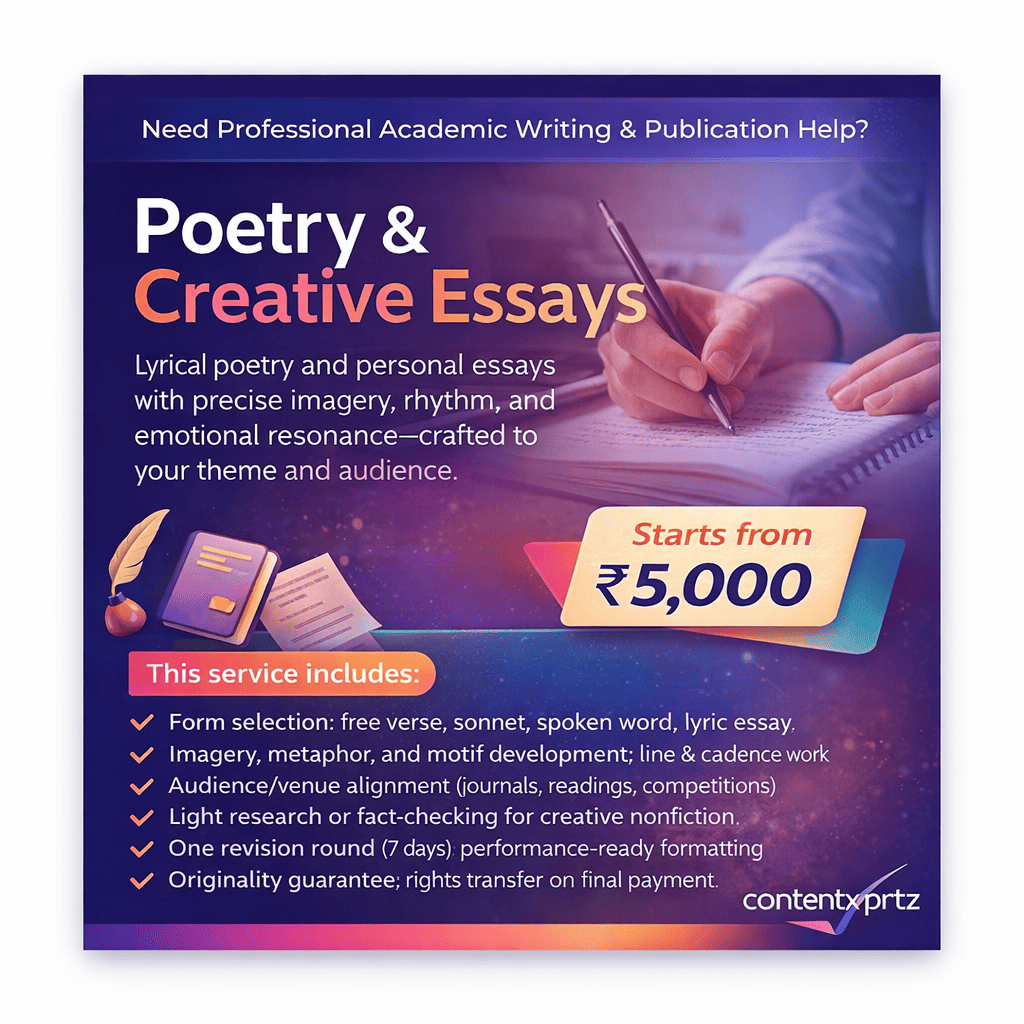
Poetry & Creative Essays — Crafted with Purpose ✨
Where academic sensitivity meets creative excellence.
At ContentXprtz, we help students, PhD scholars, and researchers transform ideas into lyrical poetry and compelling creative essays—crafted with clarity, structure, and emotional depth, while remaining publication- and performance-ready.
What you receive with this service:
📘 Choice of form: free verse, sonnet, spoken word, or lyric essay
🧠 Strong imagery, metaphor, motif, and rhythm development
📄 Alignment with journals, readings, or creative competitions
🎓 Light research or fact-checking for creative nonfiction
📄 One structured revision round with performance-ready formatting
We are committed to ethical academic support:
• 100% original writing
• No reuse or resale of content
• Full author ownership with rights transferred upon final payment
Starts from ₹5,000
Transparent pricing. Ethical process. Professional outcomes.
📩 Message us on WhatsApp to get started today
WhatsApp: https://wa.me/917065013200
Website: https://contentxprtz.com
#ContentXprtz #AcademicWriting #CreativeEssays #PoetryWriting #PhDSupport #ResearchWriting #AcademicServices #PublicationSupport #PhDScholars #ResearchStudents #HigherEducation #ScholarlyWriting #CreativeNonfiction #JournalSubmission #EthicalWriting #StudentSupport #AcademicEditing #ResearchCommunity #PostdocLife #GraduateStudies #AcademicExcellence #WritingSupport #UniversityLife
Poetry & Creative Essays in Academic Writing: Transforming Scholarly Thought into Publishable Expression
Introduction: Why Poetry & Creative Essays Matter in Academic Scholarship
For many PhD scholars and academic researchers, writing is both a necessity and a burden. While quantitative rigor and methodological precision dominate doctoral training, an often-overlooked dimension of scholarly communication is Poetry & Creative Essays. These forms of writing allow researchers to express complex intellectual, cultural, and emotional insights that traditional academic formats may restrict.
In recent years, universities, interdisciplinary journals, and global conferences have increasingly recognized the academic value of creative scholarly expression. Poetry, reflective essays, and narrative-based academic writing now appear in peer-reviewed outlets, doctoral portfolios, and research impact narratives. Within the first stages of doctoral study, scholars often discover that communicating ideas effectively matters as much as generating them. This is where Poetry & Creative Essays become not only relevant but powerful.
However, mastering these forms is not straightforward. PhD scholars across disciplines face intense challenges: limited time, pressure to publish, rising tuition and research costs, language barriers, and increasingly competitive journal acceptance rates. According to data published by Elsevier, global research output has grown by over 4 percent annually, while acceptance rates in high-impact journals continue to decline. Springer Nature reports that fewer than 25 percent of submissions are accepted in many humanities and interdisciplinary journals.
At the same time, doctoral candidates are expected to demonstrate originality, reflexivity, and social relevance. Creative academic writing offers a solution, yet few scholars receive formal training in it. As a result, many promising manuscripts remain unpublished, misunderstood, or rejected due to structural weaknesses, unclear narratives, or misalignment with editorial expectations.
This article addresses these challenges directly. It provides a comprehensive, evidence-based guide to Poetry & Creative Essays within academic contexts, supported by global publishing standards and ethical writing practices. Drawing on ContentXprtz’s experience since 2010, the discussion integrates academic editing expertise, publication insights, and practical strategies tailored for students, PhD scholars, and researchers worldwide.
Throughout this guide, readers will gain clarity on how creative academic writing fits into doctoral research, how it differs from conventional formats, and how professional academic support can elevate scholarly expression without compromising originality or ethics.
Understanding Poetry & Creative Essays in Academic Contexts
What Defines Poetry & Creative Essays in Research Writing
In academic settings, poetry and creative essays are not acts of literary indulgence. Instead, they are structured forms of scholarly communication grounded in theory, reflexivity, and evidence. Creative essays often appear in fields such as education, sociology, anthropology, cultural studies, psychology, and health sciences. Poetry is increasingly used in qualitative research dissemination, autoethnography, and critical inquiry.
According to Taylor and Francis, creative academic writing enhances reader engagement and knowledge translation, especially when research addresses lived experience, identity, or social transformation. These formats demand the same intellectual rigor as traditional articles, while requiring additional narrative discipline.
Why Universities and Journals Are Embracing Creative Scholarship
Several global academic trends explain this shift:
-
Growth of interdisciplinary research
-
Emphasis on research impact and public engagement
-
Recognition of diverse epistemologies
-
Expansion of qualitative and narrative methodologies
Emerald Insight highlights that reflective and creative scholarship improves citation longevity and interdisciplinary reach. However, editorial standards remain strict. Manuscripts must balance creativity with scholarly clarity, methodological grounding, and ethical transparency.
This balance is where many scholars struggle.
Common Challenges Faced by PhD Scholars Writing Creative Academic Work
Time Constraints and Cognitive Load
Doctoral researchers juggle coursework, teaching, data collection, and administrative responsibilities. Creative writing requires reflective depth and revision cycles that many scholars cannot sustain without structured support.
Language and Expression Barriers
For non-native English speakers, expressing nuanced ideas creatively in academic English is particularly challenging. While grammar tools assist surface-level issues, they do not address narrative coherence or scholarly tone.
Publication Anxiety and Rejection Cycles
Repeated desk rejections erode confidence. Elsevier’s publishing insights note that unclear positioning and narrative misalignment account for a significant proportion of humanities rejections.
Ethical Concerns
Many scholars fear that seeking writing help compromises academic integrity. This misconception often prevents them from accessing legitimate academic editing services that operate within ethical boundaries.
The Role of Professional Academic Support in Poetry & Creative Essays
Ethical Editing Versus Ghostwriting
Professional academic support does not mean authorship replacement. According to APA ethical guidelines, editing that improves clarity, structure, and compliance is permissible when intellectual ownership remains with the author.
At ContentXprtz, editorial interventions are transparent, ethical, and aligned with institutional standards. Scholars retain full authorship while benefiting from expert refinement.
How Academic Editing Enhances Creative Scholarship
Professional editors support scholars by:
-
Strengthening narrative flow
-
Aligning creative expression with journal scope
-
Enhancing theoretical clarity
-
Ensuring citation integrity
-
Improving readability without altering meaning
For scholars exploring Poetry & Creative Essays, this guidance is often decisive for successful publication.
You can explore structured academic editing support through ContentXprtz’s academic editing services available under
https://contentxprtz.com/phd-academic-services
Where Poetry & Creative Essays Fit in Academic Publishing
Doctoral Theses and Dissertations
Many universities now accept creative components within doctoral theses, particularly in education, arts, and social sciences. These sections must still meet examination criteria.
Peer-Reviewed Journals
Journals published by Springer and Taylor and Francis increasingly include creative sections or methodological reflections.
Books and Edited Volumes
Scholarly books often provide space for extended creative essays, making professional manuscript preparation essential. Support for this is available through
https://contentxprtz.com/book-authors-writing-services
Best Practices for Writing High-Quality Poetry & Creative Essays
Anchor Creativity in Theory
Creative expression must emerge from scholarly frameworks. Grounding narratives in theory enhances credibility.
Maintain Structural Discipline
Clear introductions, thematic coherence, and purposeful conclusions remain essential.
Respect Ethical Boundaries
Autoethnographic and reflective writing must address consent, representation, and confidentiality.
Revise with External Perspective
Peer and professional feedback improves clarity and reduces bias.
Scholars seeking end-to-end assistance can explore
https://contentxprtz.com/writing-publishing-services
Integrated FAQs on Poetry & Creative Essays in Academic Writing
FAQ 1: Are Poetry & Creative Essays accepted in PhD research?
Yes, many universities and journals accept them when aligned with disciplinary norms. Acceptance depends on methodological justification, clarity, and scholarly relevance. Institutions increasingly recognize narrative and creative inquiry as valid epistemological approaches.
FAQ 2: Do creative academic writings reduce publication credibility?
No. When properly structured and peer-reviewed, creative academic work enhances impact. Springer and Emerald have published extensive creative scholarship across disciplines.
FAQ 3: Can I seek editing help for creative academic work ethically?
Yes. Ethical editing focuses on clarity and structure, not idea generation. APA confirms this distinction.
FAQ 4: How do I choose journals for creative academic submissions?
Review journal aims, recent issues, and author guidelines. Interdisciplinary journals often welcome creative formats.
FAQ 5: Is creative writing suitable for STEM researchers?
While less common, reflective and narrative essays appear in medical humanities, ethics, and science communication.
FAQ 6: What are common reasons creative submissions are rejected?
Lack of theoretical grounding, unclear methodology, excessive subjectivity, and poor structure are leading causes.
FAQ 7: How long should an academic creative essay be?
Length varies by journal, typically ranging from 3000 to 8000 words. Always consult submission guidelines.
FAQ 8: Can poetry be peer-reviewed?
Yes. Peer reviewers assess coherence, theoretical alignment, originality, and contribution to knowledge.
FAQ 9: How does ContentXprtz support creative academic writers?
Through ethical editing, journal alignment, language refinement, and compliance support, without compromising originality.
FAQ 10: Is creative academic writing suitable for early-stage PhD scholars?
Yes, when guided appropriately. Early exploration often strengthens later dissertation chapters.
For student-focused support, explore
https://contentxprtz.com/student-career-academic-writing-services
Why ContentXprtz Is a Trusted Partner for Creative Academic Writing
Since 2010, ContentXprtz has supported scholars across 110+ countries with ethical, publication-ready academic assistance. Its editorial teams include subject specialists, language experts, and publishing consultants trained in global academic standards.
Corporate and professional researchers can also access tailored services via
https://contentxprtz.com/corporate-writing-services
Conclusion: Turning Scholarly Creativity into Lasting Academic Impact
Poetry & Creative Essays are no longer peripheral to academic research. They are powerful tools for intellectual expression, social impact, and interdisciplinary engagement. Yet, without expert guidance, many scholars struggle to translate creative insight into publishable scholarship.
By combining academic rigor with narrative clarity, ethical editing, and publication expertise, scholars can elevate their creative academic work without compromising integrity.
If you are a PhD scholar, researcher, or academic professional seeking reliable, ethical, and globally recognized writing support, explore ContentXprtz’s PhD assistance services today.
At ContentXprtz, we don’t just edit — we help your ideas reach their fullest potential.
