
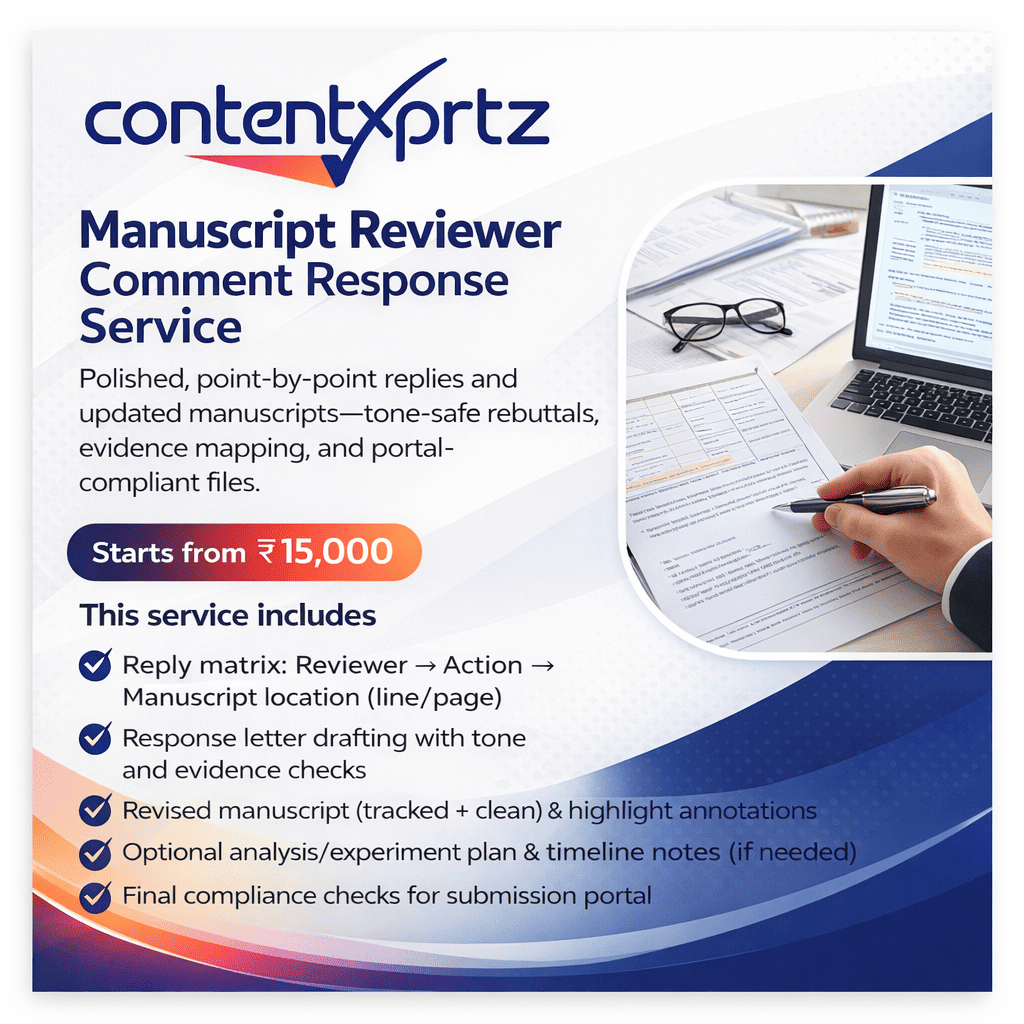
Manuscript Review Comments? Turn Them into Acceptance 📄🎓
Structured. Respectful. Journal-ready.
Facing reviewer comments or a major revision decision? ContentXprtz helps you respond with clarity, confidence, and academic precision—so your research moves forward, not backwards.
What you get with our Manuscript Reviewer Comment Response Service:
📄 Point-by-point reply matrix (Reviewer → Action → Line/Page)
🧠 Professionally drafted response letters with tone & evidence checks
📘 Revised manuscript (tracked + clean) with clear highlight annotations
📄 Optional analysis / experiment plan & timeline notes (if required)
🎓 Final compliance checks for journal submission portals
We work ethically and transparently—your ideas, data, and authorship always remain yours. No shortcuts, no fabricated content, no exaggerated claims—only responsible academic support aligned with journal expectations.
Starts from ₹15,000
Message us on WhatsApp to get started today
📲 WhatsApp: https://wa.me/917065013200
🌐 Website: https://contentxprtz.com
#ContentXprtz #AcademicWriting #ReviewerComments #ManuscriptRevision #PhDSupport #ResearchPublication #JournalSubmission #PublishOrPerish #PhDLife #ResearchScholars #AcademicEditing #PostdocLife #ScholarlyPublishing #PeerReview #ResearchSupport #UniversityResearch #HigherEducation #ThesisWriting #DissertationHelp #AcademicIntegrity #JournalEditing #ResearchWork #DoctoralStudies #ScholarsOfInstagram
From Reviewer Critique to Journal Acceptance: A Strategic Guide to Manuscript Reviewer Comment Response Service
Introduction: Why Reviewer Comments Decide the Fate of Your Research
For most PhD scholars and academic researchers, the first journal decision rarely arrives as an outright acceptance. Instead, it comes as a familiar combination of “major revisions,” “minor revisions,” or “revise and resubmit.” While this outcome signals scholarly potential, it also introduces one of the most demanding phases of the publication journey: responding effectively to reviewer comments.
A Manuscript Reviewer Comment Response Service exists precisely to address this challenge. Within the first revision cycle, authors must interpret complex critiques, revise manuscripts with precision, and defend scholarly decisions in a clear, professional tone. This task often unfolds under strict deadlines, teaching responsibilities, funding pressure, and personal constraints.
Globally, the pressure is intensifying. According to data from Scopus and journal publishers, annual research output has more than doubled over the last two decades, while top-tier journal acceptance rates often remain below 10 percent. Even mid-tier indexed journals routinely reject manuscripts that demonstrate strong ideas but weak revision strategies. Reviewers expect authors to engage critically, transparently, and respectfully with feedback. Failure to do so often results in rejection, even after promising first-round reviews.
PhD candidates face additional challenges. Many are navigating their first major submission, often without structured mentorship on reviewer engagement. Others work in non-native English environments, where nuanced academic tone becomes difficult to sustain. Moreover, journals increasingly demand methodological rigor, ethical clarity, and alignment with disciplinary debates. Responding to reviewer comments now requires not only subject expertise but also editorial strategy and publication literacy.
At this stage, professional academic support becomes a strategic investment rather than a convenience. A structured manuscript reviewer comment response service helps authors transform critique into clarity, confusion into coherence, and revision into acceptance readiness. It ensures that responses are not defensive or superficial, but scholarly, evidence-based, and aligned with journal expectations.
At ContentXprtz, we have supported researchers across more than 110 countries since 2010. Our experience confirms one insight consistently: manuscripts are rarely rejected because of poor ideas. They are rejected because reviewer concerns are misunderstood, under-addressed, or poorly communicated. This article explains how a professional manuscript reviewer comment response service works, why it matters, and how it supports PhD scholars and researchers in achieving publication success.
Understanding the Purpose of a Manuscript Reviewer Comment Response Service
A manuscript reviewer comment response service is a specialized academic support offering focused on revision-stage publishing. Unlike general editing or proofreading, it addresses the intellectual dialogue between authors and peer reviewers.
What This Service Actually Covers
This service typically includes:
-
Systematic analysis of reviewer and editor comments
-
Categorization of comments into major, minor, and editorial concerns
-
Line-by-line manuscript revision aligned with reviewer expectations
-
Development of a detailed response-to-reviewers document
-
Academic tone refinement and justification of methodological decisions
-
Ethical and citation compliance checks
-
Journal guideline alignment for revised submissions
The goal is not to simply correct language, but to demonstrate scholarly engagement, accountability, and rigor.
Why Journals Emphasize Reviewer Responses
Editors often assess revised manuscripts by reading the response letter before re-evaluating the paper itself. A weak or unclear response signals poor academic maturity. Conversely, a structured and respectful response can significantly improve editorial confidence.
Major publishers such as Elsevier and Springer explicitly advise authors to address every reviewer comment transparently, even when they disagree. Ignoring or dismissing feedback almost always leads to rejection.
Why PhD Scholars Struggle with Reviewer Comments
Emotional and Cognitive Overload
Reviewer feedback can feel personal, especially after months or years of research. Scholars often struggle to separate critique of the manuscript from critique of the researcher. This emotional response can lead to defensive replies or rushed revisions.
Lack of Training in Reviewer Communication
Doctoral training emphasizes research execution, not publication negotiation. Writing a response letter requires a different skill set, combining diplomacy, evidence-based argumentation, and editorial awareness.
Language and Structural Barriers
For non-native English speakers, even strong revisions can fail due to tone, clarity, or structural coherence. Reviewers expect polished academic communication, not approximate responses.
Time and Career Pressure
Most journals allow between two and six weeks for revision. During this period, researchers juggle teaching loads, grant deadlines, and institutional obligations. Professional research paper writing support becomes essential for maintaining quality under pressure.
How a Professional Manuscript Reviewer Comment Response Service Works
Step 1: Reviewer Comment Mapping
Each reviewer comment is extracted and mapped against the manuscript sections it affects. This prevents oversight and ensures full coverage.
Step 2: Revision Strategy Design
Experts determine whether comments require textual edits, methodological clarification, additional citations, or theoretical reframing.
Step 3: Manuscript Revision
Edits are implemented carefully to preserve the author’s voice while addressing reviewer expectations. This often includes academic editing, structural refinement, and argument strengthening.
Step 4: Response Letter Development
A formal response document is prepared, explaining how each comment was addressed. When disagreement is justified, it is supported with citations and academic rationale.
Step 5: Final Compliance Review
The revised manuscript and response letter are checked against journal submission guidelines, ethical standards, and formatting requirements.
Ethical Dimensions of Reviewer Comment Response Support
A legitimate manuscript reviewer comment response service operates within strict ethical boundaries. The author retains full intellectual ownership. The service supports clarity, structure, and communication without fabricating data or altering scholarly intent.
Organizations such as APA emphasize transparency and author accountability in publication ethics. ContentXprtz adheres to these principles across all academic editing services.
When Should Researchers Seek Reviewer Comment Response Help
Professional support is particularly valuable when:
-
Reviewer comments are extensive or contradictory
-
The editor requests major revisions
-
The manuscript involves complex methods or interdisciplinary theory
-
English is not the author’s first language
-
Previous revision attempts resulted in rejection
In these cases, structured PhD thesis help and publication-focused guidance significantly improve outcomes.
Frequently Asked Questions on Manuscript Reviewer Comment Response Service
How is a manuscript reviewer comment response service different from academic editing?
Academic editing focuses on language, clarity, and structure. A manuscript reviewer comment response service goes further by engaging directly with reviewer critiques. It involves interpreting feedback, revising arguments, and crafting formal response letters. While editing improves readability, reviewer response services improve acceptance probability. For complex revisions, both services often work together.
Can I disagree with reviewer comments in my response?
Yes, disagreement is acceptable when justified academically. However, it must be respectful, evidence-based, and clearly explained. Professional services help frame such responses diplomatically, citing relevant literature from publishers like Emerald Insight or Taylor & Francis to support the author’s position.
Does using reviewer response support affect authorship integrity?
No. Ethical services do not add ideas or data. They help authors articulate existing scholarship more clearly. Authorship remains unchanged, and intellectual ownership stays with the researcher.
How long does the reviewer response process take?
Timelines vary based on revision depth. Minor revisions may take one to two weeks, while major revisions can require three to six weeks. Early engagement improves quality and reduces last-minute errors.
Is this service suitable for first-time PhD authors?
Yes. First-time authors often benefit most, as they lack experience in reviewer communication. Structured guidance accelerates learning and improves confidence.
What disciplines benefit from reviewer comment response services?
All disciplines, including STEM, social sciences, humanities, business, and medicine. Each field has unique reviewer expectations that professional teams understand.
Can the service help after a second-round revision request?
Absolutely. Second-round revisions often demand precision. Reviewers expect previous issues to be fully resolved. Professional academic editing services ensure consistency across revision cycles.
How does this service improve acceptance rates?
By ensuring that every reviewer concern is addressed clearly, professionally, and completely. Editors gain confidence that the author can engage in scholarly dialogue.
Is this service compatible with journal resubmission?
Yes. Many rejected manuscripts are resubmitted to new journals. Reviewer feedback remains valuable. Professional services help adapt revisions for new editorial contexts.
How does ContentXprtz differ from generic editing providers?
ContentXprtz combines subject-matter expertise, publication strategy, and ethical academic editing. Since 2010, we have supported global researchers with tailored PhD support and journal-aligned revision services.
Integrating Reviewer Response Support with Broader Academic Services
A manuscript reviewer comment response service works best when combined with comprehensive academic support. At ContentXprtz, researchers often integrate this service with:
This integrated approach ensures consistency across manuscripts, theses, and long-term research outputs.
Conclusion: Turning Reviewer Feedback into Scholarly Advantage
Reviewer comments are not obstacles. They are invitations to strengthen research, refine arguments, and engage in academic dialogue. However, navigating this process requires more than subject expertise. It requires editorial literacy, emotional discipline, and strategic communication.
A professional manuscript reviewer comment response service empowers researchers to meet these demands with confidence. It transforms revision from a source of stress into a structured pathway toward publication.
If you are facing reviewer comments and want to improve your chances of acceptance, explore our PhD Assistance Services today.
At ContentXprtz, we don’t just edit; we help your ideas reach their fullest potential.
