
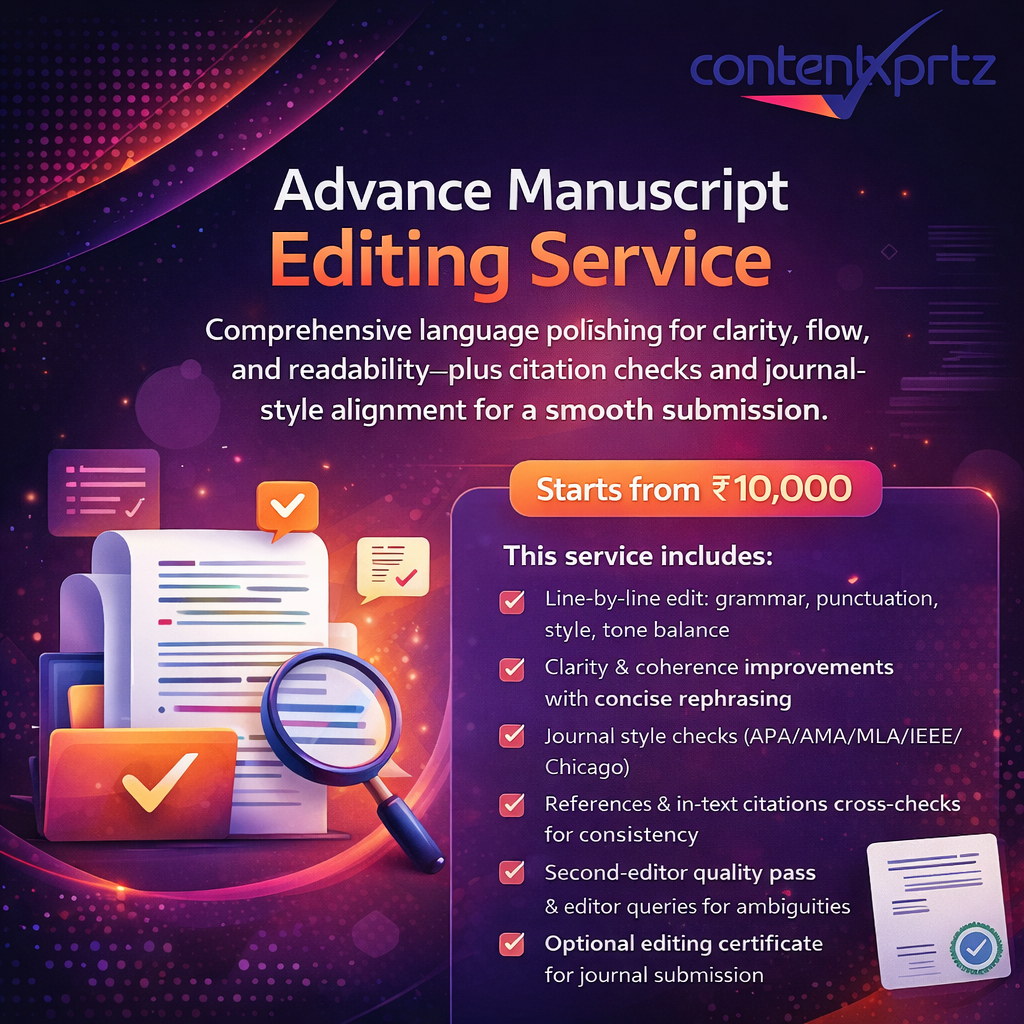
Advance Your Manuscript. Strengthen Your Submission. 📘
Clear language, coherent arguments, and journal-ready presentation can make the difference between revision and acceptance. ContentXprtz’s Advance Manuscript Editing Service is designed to help you submit with confidence—without compromising ethics or authorship.
We focus on improving clarity, flow, and readability while ensuring your manuscript aligns with journal expectations and citation standards.
What this service delivers:
📄 Line-by-line language editing for grammar, tone, and academic style
🧠 Improved clarity and coherence through concise rephrasing
📘 Journal style alignment (APA / AMA / MLA / IEEE / Chicago)
📑 Reference list and in-text citation consistency checks
🎓 Second-editor quality review with transparent editor queries
Ethics always come first.
Your ideas remain yours—we do not fabricate content, alter results, or engage in ghostwriting. Every edit respects originality, author ownership, and academic integrity.
Ready to submit with confidence?
Message us on WhatsApp to get started today.
📲 WhatsApp: https://wa.me/917065013200
🌐 Website: https://contentxprtz.com
#ContentXprtz #AcademicEditing #ManuscriptEditing #PhDLife #PhDScholars #ResearchPaper #JournalSubmission #AcademicWriting #PublishResearch #ResearchSupport #HigherEducation #ScholarlyPublishing #DoctoralStudies #PostdocLife #ThesisEditing #EthicalEditing #STEMResearch #SocialSciences #HumanitiesResearch #ResearchStudents #UniversityLife #ScopusJournals #WebOfScience #ResearchIntegrity
Why an Advance Manuscript Editing Service Is No Longer Optional for Serious Academic Publishing
Introduction: The Invisible Struggle Behind Every Published Paper
For most PhD scholars and academic researchers, writing is not the hardest part of research. The real challenge begins after the first draft is complete. This is the stage where many promising manuscripts quietly fail. Despite strong data, sound methodology, and original insights, papers often face rejection due to language clarity, structural inconsistencies, weak academic tone, or non-compliance with journal guidelines.
This is precisely where an Advance Manuscript Editing Service becomes essential rather than optional.
In the global academic ecosystem, competition for journal space has intensified dramatically. According to Elsevier’s global research report, more than 3 million scholarly articles are submitted annually, yet top-tier journals maintain acceptance rates between 5% and 20%. Springer Nature reports that over 60% of desk rejections occur due to issues unrelated to research quality, including poor academic presentation, unclear argument flow, and language problems.
For PhD scholars, these rejections come at a high cost. Time delays affect graduation timelines. Publication pressure impacts funding, postdoctoral opportunities, and academic promotions. Moreover, rising tuition costs and shrinking research grants leave little room for repeated submission cycles.
Across regions, the challenges are strikingly similar:
-
Non-native English researchers struggle with academic tone and fluency
-
Scholars face inconsistent reviewer feedback
-
Journal formatting requirements change frequently
-
Ethical standards for authorship and originality grow stricter
-
AI detection tools increase scrutiny on writing authenticity
An Advance Manuscript Editing Service bridges the gap between research excellence and publishable quality. It ensures that your work communicates ideas clearly, ethically, and persuasively while meeting the exacting standards of international journals.
At ContentXprtz, established in 2010 and supporting scholars across 110+ countries, we understand that editing is not cosmetic. It is strategic academic refinement. This article explains what advanced manuscript editing truly involves, why it matters, and how it supports researchers throughout the publication lifecycle.
Understanding the Scope of an Advance Manuscript Editing Service
What Makes Advanced Editing Different from Basic Proofreading
Many scholars confuse proofreading with advanced editing. Proofreading corrects surface-level errors. Advanced manuscript editing, however, is intellectually engaged and structurally transformative.
An Advance Manuscript Editing Service includes:
-
Logical flow optimization across sections
-
Strengthening argument coherence
-
Discipline-specific academic tone refinement
-
Methodology clarity and reproducibility checks
-
Journal alignment for scope, structure, and citation style
-
Ethical compliance screening
Unlike generic editing platforms, advanced editing requires domain expertise, familiarity with peer-review expectations, and an understanding of academic discourse conventions.
At ContentXprtz, our editors are subject specialists who understand how reviewers read manuscripts, not just how grammar works.
Why PhD Scholars Need Advanced Manuscript Editing More Than Ever
Increasing Journal Scrutiny and Desk Rejection Rates
Major publishers such as Taylor and Francis emphasize clarity, originality, and ethical transparency as key acceptance criteria. Journals now deploy AI-assisted screening tools to detect language anomalies, citation manipulation, and structural weaknesses.
Without professional editing:
-
Strong research risks being misinterpreted
-
Reviewers focus on presentation flaws
-
Revision cycles multiply unnecessarily
Advanced editing reduces this risk by ensuring that language never obscures insight.
Language Is No Longer a Neutral Factor
According to Emerald Insight, over 55% of global research submissions come from non-native English-speaking scholars. Even minor language issues influence reviewer perception.
An Advance Manuscript Editing Service ensures that:
-
Language supports credibility
-
Tone reflects disciplinary expectations
-
Argument strength remains central
Core Components of a High-Quality Advance Manuscript Editing Service
Structural and Conceptual Editing
Advanced editors assess whether:
-
The research question is clearly framed
-
The literature review supports the gap
-
Methods are replicable
-
Results align with objectives
-
Discussion contextualizes findings
This level of editing strengthens the manuscript’s intellectual integrity.
Journal-Specific Compliance Editing
Each journal has unique submission rules. Elsevier and Springer journals, for example, differ significantly in abstract structure, reference formatting, and reporting standards.
ContentXprtz aligns manuscripts with:
-
Target journal scope
-
Author guidelines
-
Reporting frameworks such as APA or discipline-specific standards
This minimizes technical rejections.
Ethical and Originality Safeguards
Ethical editing ensures:
-
No content rewriting that alters author voice
-
No data fabrication or enhancement
-
No plagiarism or AI-generated phrasing risks
ContentXprtz follows COPE and publisher-aligned ethical editing practices.
How an Advance Manuscript Editing Service Supports the Entire Research Lifecycle
Advanced editing is not limited to final drafts. It supports scholars at multiple stages:
-
Pre-submission readiness checks
-
Reviewer comment response refinement
-
Resubmission optimization
-
Post-acceptance language polishing
Researchers using structured editing support report shorter publication timelines and higher reviewer satisfaction, as noted by Springer Nature author surveys.
Why ContentXprtz Sets the Benchmark for Advanced Manuscript Editing
With over a decade of academic publishing support, ContentXprtz integrates:
-
Subject-matched editors
-
Multi-layer quality checks
-
Ethical compliance assurance
-
Journal-aligned delivery
Our academic editing services work seamlessly with our broader
PhD & Academic Services to support scholars holistically.
We also offer complementary support through:
Frequently Asked Questions: Advance Manuscript Editing Service
1. How is advanced manuscript editing different from journal language editing?
Advanced manuscript editing goes far beyond surface-level language correction. While journal language editing focuses mainly on grammar, punctuation, and sentence clarity, an Advance Manuscript Editing Service addresses the manuscript as a scholarly argument. Editors evaluate logical progression, clarity of research questions, alignment between objectives and results, and coherence across sections. This service improves readability without altering the author’s academic voice or intellectual ownership. It also ensures that the manuscript aligns with disciplinary conventions and journal expectations. For PhD scholars, this distinction is critical because reviewers assess manuscripts holistically. A grammatically correct paper can still be rejected if arguments lack clarity or structure. Advanced editing mitigates this risk by strengthening both content presentation and scholarly rigor.
2. Is using an advance manuscript editing service ethically acceptable?
Yes, when conducted responsibly. Major publishers such as Elsevier and Springer explicitly allow professional editing support, provided it does not involve ghostwriting or data manipulation. Ethical editing preserves author originality while improving clarity and presentation. At ContentXprtz, editing adheres strictly to academic integrity principles. Editors do not introduce ideas, fabricate content, or alter research outcomes. Instead, they refine expression, structure, and compliance. Ethical editing enhances transparency rather than compromising it. This approach aligns with COPE guidelines and global academic norms, ensuring scholars receive legitimate support without risking ethical violations.
3. Can advanced manuscript editing improve journal acceptance rates?
While no service can guarantee acceptance, advanced editing significantly improves submission readiness. Studies cited by Springer Nature indicate that manuscripts with professional editing experience fewer desk rejections and require fewer revision rounds. This happens because reviewers can focus on research quality rather than presentation issues. By eliminating language ambiguity and structural confusion, advanced editing ensures that scholarly contributions are evaluated fairly. Many ContentXprtz clients report smoother peer-review processes and faster editorial decisions following professional manuscript refinement.
4. When should a PhD scholar seek advanced manuscript editing?
The ideal time is after completing a full draft but before journal submission. However, advanced editing is also valuable after receiving reviewer comments. Editors can help interpret feedback, restructure arguments, and refine responses. Early-stage editing can also support scholars facing recurring rejections. Advanced manuscript editing is most effective when integrated strategically into the publication workflow rather than treated as a last-minute correction.
5. Does advanced editing help non-native English researchers more?
Non-native English scholars benefit significantly, but advanced editing is equally valuable for native speakers. Academic writing follows conventions that differ from everyday English. Advanced editing ensures disciplinary tone, clarity, and formal coherence. For non-native scholars, it also reduces linguistic bias during peer review. Research published by Emerald Insight highlights that language clarity directly influences reviewer confidence. Advanced editing helps ensure language supports rather than undermines scholarly authority.
6. How does ContentXprtz ensure subject relevance during editing?
ContentXprtz assigns manuscripts to editors with subject-specific expertise. This ensures familiarity with terminology, methodological standards, and citation practices. Editors understand how arguments function within specific disciplines, from social sciences to engineering and medical research. Subject alignment allows editors to refine manuscripts without misinterpreting technical content. This approach distinguishes advanced editing from generic language services.
7. Can advanced editing help with reviewer comment responses?
Yes. Responding to reviewers requires precision, diplomacy, and clarity. Advanced editing helps scholars restructure rebuttals, clarify revisions, and ensure responses address reviewer concerns comprehensively. Editors help articulate changes clearly while maintaining academic professionalism. This increases the likelihood of favorable second-round decisions.
8. Will advanced editing change my academic voice?
No. Ethical advanced editing preserves the author’s voice and intellectual ownership. Editors focus on clarity and coherence, not rewriting content in their own style. The goal is to amplify the author’s intent, not replace it. ContentXprtz follows strict author-centric editing protocols to ensure authenticity remains intact.
9. How long does advanced manuscript editing take?
Turnaround time depends on manuscript length, complexity, and service scope. Typically, advanced editing ranges from a few days to a few weeks. ContentXprtz offers flexible timelines aligned with submission deadlines. Importantly, quality is never compromised for speed. Each manuscript undergoes multi-level review to ensure accuracy and consistency.
10. Is advanced manuscript editing suitable for interdisciplinary research?
Interdisciplinary manuscripts face higher rejection risks due to complexity. Advanced editing is particularly valuable in such cases. Editors help clarify conceptual bridges, ensure terminology consistency, and align arguments for broader audiences. This improves accessibility without diluting scholarly depth. For interdisciplinary PhD research, advanced editing often determines whether reviewers fully grasp the contribution.
Conclusion: Turning Research into Publishable Impact
In today’s competitive academic environment, strong research alone is not enough. Clarity, structure, ethical presentation, and journal alignment determine publication success. An Advance Manuscript Editing Service ensures that your research speaks with authority, precision, and confidence.
At ContentXprtz, we combine academic expertise, ethical rigor, and global publishing insight to support scholars at every stage. Whether you need PhD thesis help, academic editing services, or research paper writing support, our team is equipped to guide your work toward publication readiness.
Explore our PhD Assistance Services and experience editing that respects your scholarship and amplifies your impact.
At ContentXprtz, we don’t just edit, we help your ideas reach their fullest potential.
