
Plagiarism Issues Holding Back Your Submission? 📄
Rewrite Responsibly. Submit Confidently.
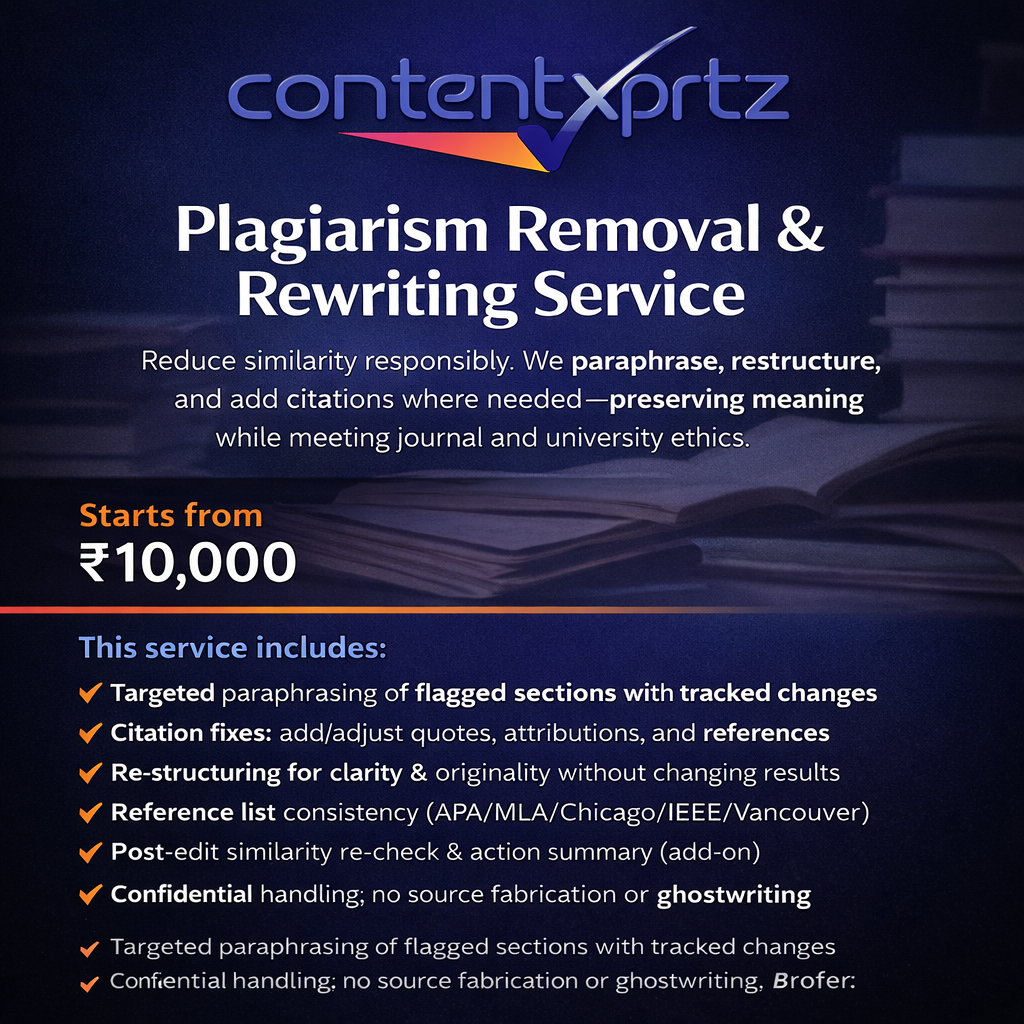
At ContentXprtz, our Plagiarism Removal & Rewriting Service helps you reduce similarity the right way—without compromising your research integrity, results, or author ownership. We focus on clarity, originality, and full compliance with journal and university ethics.
What we do for your manuscript:
📘 Targeted paraphrasing of flagged sections with tracked changes
📘 Citation fixes and proper attribution where required
📘 Structural reworking for clarity and originality (no data or results altered)
📘 Reference list consistency across major styles (APA, MLA, Chicago, IEEE, Vancouver)
📘 Confidential handling—no ghostwriting, no source fabrication
Our approach is ethical, transparent, and author-centric. You remain the sole owner of your work—refined to meet academic standards and ready for submission.
Starting from ₹10,000
Message us on WhatsApp to get started today.
WhatsApp: https://wa.me/917065013200
Website: https://contentxprtz.com
#ContentXprtz #AcademicIntegrity #PlagiarismRemoval #ResearchSupport #PhDSupport #JournalSubmission #ManuscriptEditing #AcademicWriting #ResearchEthics #PhDLife #DoctoralStudies #PostdocLife #PublishOrPerish #ScholarlyWriting #ThesisEditing #DissertationSupport #ResearchScholars #HigherEducation #UniversityResearch #JournalReady #AcademicServices #STEMResearch #SocialScienceResearch #HumanitiesResearch #StudentResearchers
Plagiarism Removal and Rewriting Service for PhD Scholars and Academic Researchers
Introduction: Why Originality Is the Real Currency of Academic Success
For PhD scholars and academic researchers, originality is not optional. It is the foundation of credibility, career progression, and publication success. Yet, maintaining absolute originality has become increasingly complex in today’s hyper-competitive, data-saturated research environment. As global research output continues to rise, so does scrutiny around academic integrity, similarity detection, and ethical writing standards. This is where a Plagiarism Removal and Rewriting Service becomes not just helpful, but essential.
According to UNESCO’s Science Report, global research output has more than doubled over the past two decades, with emerging economies contributing significantly to publication volume. At the same time, leading publishers such as Elsevier and Springer Nature report rejection rates exceeding 70 percent for many indexed journals. One of the most common reasons for desk rejection is not poor research quality, but high similarity scores, improper paraphrasing, and unintentional plagiarism.
PhD scholars often work under extreme pressure. They balance coursework, teaching responsibilities, funding constraints, publication requirements, and strict submission deadlines. Many researchers also write in English as a second or third language, which increases the risk of textual similarity even when ideas are original. Moreover, the growing use of sophisticated plagiarism detection tools like iThenticate and Turnitin has raised expectations around paraphrasing depth, citation accuracy, and textual originality.
In this environment, rewriting is no longer about changing words. It is about restructuring arguments, preserving academic voice, maintaining conceptual integrity, and aligning manuscripts with publisher-specific ethical guidelines. A professional plagiarism removal and rewriting service addresses these challenges systematically and ethically.
At ContentXprtz, we understand that plagiarism anxiety is not a sign of dishonesty. It is a reflection of the high standards imposed by modern academia. Since 2010, we have supported researchers across more than 110 countries, helping them refine manuscripts, dissertations, and research papers into publication-ready documents that meet the strictest originality benchmarks.
This article offers an in-depth, evidence-based exploration of plagiarism removal and rewriting services for PhD scholars and academic researchers. It explains how these services work, why they matter, how they differ from unethical practices, and how to choose a partner you can trust. Most importantly, it demonstrates how ethical rewriting protects your academic reputation while accelerating your path to publication.
Understanding Plagiarism in Academic Writing
What Plagiarism Really Means in Research Contexts
Plagiarism in academia extends far beyond copy-paste misconduct. According to the American Psychological Association, plagiarism includes presenting another author’s language, ideas, or structure as one’s own without appropriate acknowledgment. However, publishers increasingly recognize nuanced forms of plagiarism that many researchers overlook.
These include:
-
Patchwork plagiarism, where phrases from multiple sources are blended.
-
Self-plagiarism, where authors reuse their previously published text without disclosure.
-
Structural plagiarism, where argument flow or organization closely mirrors a source.
-
Inadequate paraphrasing, where wording is altered but sentence structure remains similar.
Elsevier’s publishing ethics guidelines explicitly state that manuscripts may be rejected even when citations are present if paraphrasing is insufficient. This highlights why advanced rewriting, not surface-level editing, is necessary.
Why Similarity Scores Matter More Than Ever
Most high-impact journals use similarity detection tools before peer review. A similarity score above acceptable thresholds often results in immediate rejection. While acceptable limits vary, many journals expect similarity below 10 to 15 percent, excluding references.
However, similarity reports do not evaluate intent. They measure textual overlap. This means honest scholars can be penalized for language limitations, methodological descriptions, or discipline-specific terminology.
A professional plagiarism removal and rewriting service focuses on reducing similarity while preserving academic rigor. It ensures that rewritten text reflects the author’s intellectual contribution, not just altered phrasing.
What Is a Plagiarism Removal and Rewriting Service
Beyond Editing: A Scholarly Reengineering Process
A genuine plagiarism removal and rewriting service is not a cosmetic exercise. It is a multi-layered academic process that involves:
-
Deep semantic rewriting rather than synonym replacement
-
Structural reorganization of arguments
-
Preservation of citations and scholarly attribution
-
Alignment with journal style guides and ethical frameworks
-
Verification using industry-standard plagiarism tools
At ContentXprtz, rewriting is performed by subject-matter experts who understand disciplinary conventions. This ensures that rewritten content remains academically valid, logically sound, and publication-appropriate.
Ethical Rewriting vs Unethical Content Manipulation
Ethical rewriting maintains the author’s ideas while improving expression and originality. Unethical practices, such as ghostwriting or content spinning, replace intellectual contribution and violate academic norms.
Reputable publishers like Taylor and Francis clearly distinguish between language editing support and unethical authorship substitution. ContentXprtz operates strictly within ethical boundaries, supporting authors without compromising academic ownership.
Why PhD Scholars Need Professional Plagiarism Removal Support
The High Stakes of Doctoral Research
A PhD is not just a degree. It is a scholarly identity. Any allegation of plagiarism can have lasting consequences, including degree revocation, funding loss, or reputational damage.
Professional rewriting safeguards against these risks by ensuring:
-
Clean similarity reports
-
Transparent citation practices
-
Compliance with institutional ethics committees
-
Confidence during supervisor and reviewer evaluations
Language Barriers and Global Academia
Springer Nature reports that over 60 percent of its submissions come from non-native English speakers. These scholars often struggle with paraphrasing complex theoretical frameworks without mirroring source language.
A plagiarism removal and rewriting service bridges this gap by transforming content into fluent, original academic English while retaining technical accuracy.
How ContentXprtz Approaches Plagiarism Removal and Rewriting
A Structured, Transparent Methodology
Our approach is systematic and evidence-driven:
-
Initial similarity analysis using industry-standard tools.
-
Identification of high-risk sections.
-
Subject-specific rewriting by expert editors.
-
Structural refinement to enhance originality.
-
Citation and reference integrity checks.
-
Final similarity verification and reporting.
This process ensures measurable improvement rather than subjective claims.
Integration with Academic Editing and Publication Support
Plagiarism removal is rarely an isolated requirement. It often intersects with broader academic editing needs, such as clarity, coherence, and journal formatting. Our services integrate seamlessly with:
-
PhD thesis help through our PhD & Academic Services
-
Academic editing services available under Writing & Publishing Services
-
Research paper writing support for students via Student Writing Services
This holistic approach enhances both originality and overall manuscript quality.
Practical Benefits of a Professional Rewriting Service
Improved Journal Acceptance Probability
Emerald Insight emphasizes that originality and clarity significantly influence editorial decisions. Clean similarity reports remove one of the biggest barriers to peer review.
Time Efficiency for Researchers
Rewriting complex chapters can take weeks. Professional support accelerates turnaround without compromising quality, allowing scholars to focus on research rather than linguistic reengineering.
Ethical Assurance and Peace of Mind
Knowing that your manuscript aligns with publisher ethics policies reduces stress and builds confidence during submission.
Frequently Asked Questions on Plagiarism Removal and Rewriting
Is using a plagiarism removal and rewriting service ethical for PhD scholars?
Yes, when performed correctly, it is entirely ethical. Reputable publishers including Elsevier and APA recognize language editing and rewriting as legitimate academic support services. The key distinction lies in ownership of ideas. Ethical rewriting preserves the author’s intellectual contribution while improving expression and originality. It does not introduce new arguments or fabricate content. At ContentXprtz, rewriting is transparent, citation-preserving, and compliant with academic integrity policies.
Can plagiarism removal guarantee journal acceptance?
No ethical service can guarantee acceptance. Journal decisions depend on research quality, novelty, methodology, and reviewer evaluation. However, plagiarism removal significantly reduces desk rejection risk by ensuring similarity compliance. According to Springer Nature, manuscripts that clear ethical and technical checks proceed faster to peer review. Professional rewriting improves your manuscript’s readiness but does not replace scholarly merit.
How is rewriting different from paraphrasing?
Paraphrasing involves restating sentences in different words. Rewriting is deeper. It restructures arguments, improves flow, and changes sentence construction while preserving meaning. This depth is essential for reducing similarity scores. Simple paraphrasing often fails similarity detection because structural overlap remains.
Will rewriting change my academic voice?
Professional rewriting enhances clarity without erasing voice. Editors trained in academic discourse adapt tone to discipline norms. Your argument structure, theoretical stance, and findings remain intact. The goal is refinement, not replacement.
How do you ensure citations remain accurate?
Every rewritten section is cross-checked against original references. Citation placement is preserved or improved to ensure attribution accuracy. This aligns with APA and publisher guidelines on ethical scholarship.
Can rewriting help with self-plagiarism?
Yes. Many scholars reuse methodological descriptions or literature reviews from prior publications. Rewriting helps reframe this content while maintaining transparency. Publishers such as Taylor and Francis allow text reuse when properly disclosed and rewritten.
How long does plagiarism removal usually take?
Turnaround time depends on document length and complexity. Typical timelines range from three to ten working days. Urgent requests can be accommodated without compromising quality.
Is plagiarism removal suitable for dissertations as well as journal papers?
Absolutely. Dissertations undergo institutional similarity checks that are often stricter than journals. Professional rewriting ensures compliance with university ethics committees and examination standards.
What similarity percentage is considered safe?
There is no universal threshold. Many journals prefer below 10 to 15 percent excluding references. However, context matters. Our service focuses on reducing problematic overlap rather than chasing arbitrary numbers.
How does ContentXprtz differ from generic editing platforms?
ContentXprtz combines subject expertise, ethical rigor, and publication insight. Since 2010, we have supported researchers globally with discipline-specific editors and transparent processes. Our services extend beyond rewriting to full-spectrum academic support, including Book Authors Writing Services and Corporate Writing Services.
Choosing the Right Plagiarism Removal Partner
What to Look for in a Service Provider
When selecting a plagiarism removal and rewriting service, consider:
-
Subject-matter expertise
-
Transparency of process
-
Ethical compliance statements
-
Experience with indexed journals
-
Post-revision similarity reporting
Avoid providers that promise guaranteed acceptance or use automated rewriting tools.
Why ContentXprtz Is Trusted Globally
With over a decade of experience and a presence across major academic hubs, ContentXprtz operates as a scholarly partner, not a transactional vendor. Our editors understand both disciplinary nuance and publisher expectations.
Conclusion: Protect Your Research, Strengthen Your Academic Future
In a publishing environment defined by scrutiny and competition, originality is your strongest asset. A professional plagiarism removal and rewriting service protects that asset while enhancing clarity, credibility, and compliance. For PhD scholars and academic researchers, this support is not a shortcut. It is a strategic investment in academic integrity and long-term success.
By combining ethical rewriting, subject expertise, and publication insight, ContentXprtz helps scholars navigate complexity with confidence. Whether you are refining a dissertation, preparing a journal submission, or responding to reviewer feedback, professional support can make the difference between rejection and recognition.
Explore our PhD Assistance Services today and take the next step toward confident, ethical publication.
At ContentXprtz, we don’t just edit, we help your ideas reach their fullest potential.
