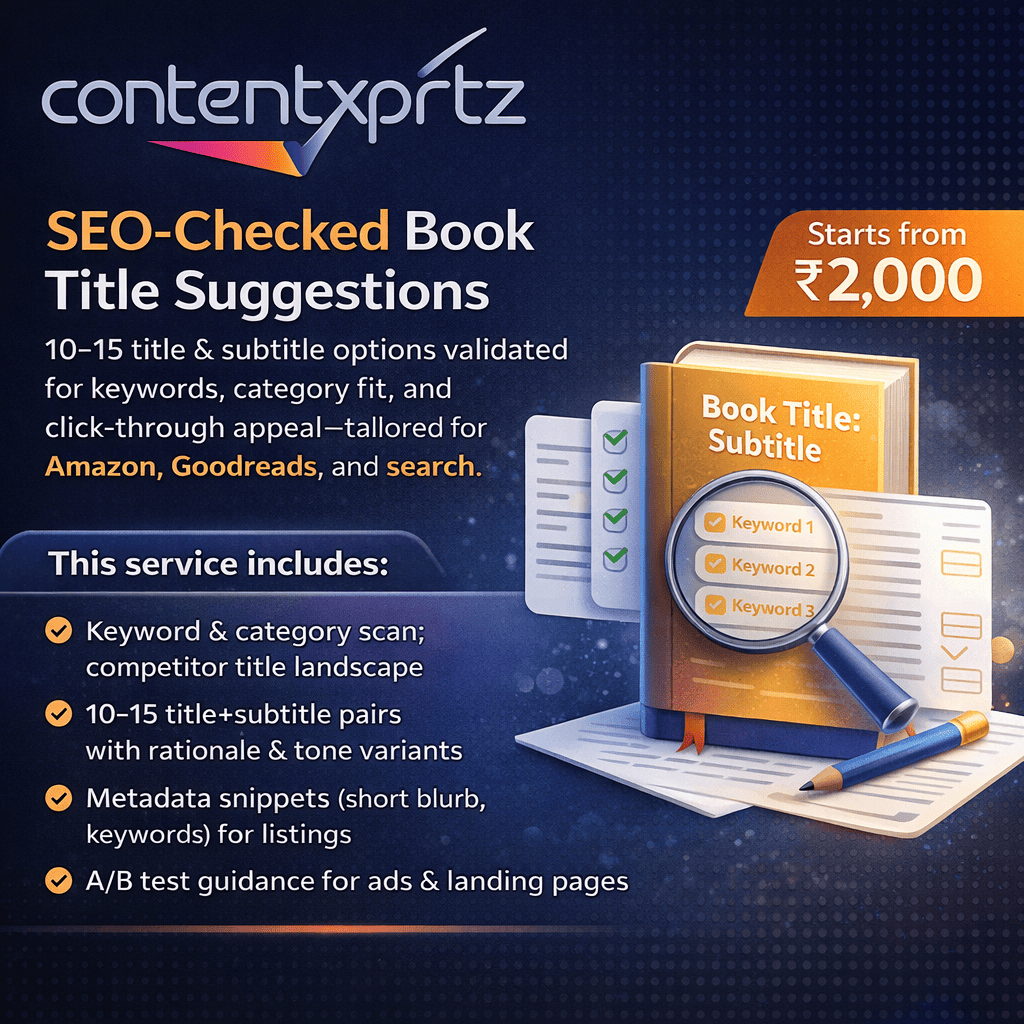
SEO-Checked Book Title Suggestions Service: Turning Scholarly Ideas into Discoverable Academic Books
Introduction: Why a Book Title Can Make or Break Your Academic Impact
For many PhD scholars, early-career researchers, and seasoned academics, writing a scholarly book is not merely a milestone; it is a defining moment in their intellectual journey. Years of data collection, theoretical refinement, and rigorous peer engagement culminate in a manuscript that represents deep scholarly contribution. Yet, one of the most underestimated and high-stakes decisions in this journey is choosing the right book title.
This is where a SEO-Checked Book Title Suggestions Service becomes critically important. In today’s digital-first academic ecosystem, discoverability matters as much as intellectual merit. A book title is no longer just a label; it is a gateway. It determines whether your work appears in library catalogues, Google Scholar results, publisher databases, online bookstores, and institutional repositories.
Within the first few seconds, a title signals relevance, credibility, and scope to editors, reviewers, librarians, and readers. A poorly optimized title, even for a high-quality manuscript, risks remaining invisible. For PhD scholars already juggling time constraints, publication pressure, rising academic costs, and the emotional toll of revision cycles, this invisibility can be deeply discouraging.
Global data reinforces this concern. According to Elsevier’s research insights, more than 2.5 million academic books and monographs are indexed digitally, with thousands added annually. Meanwhile, acceptance rates for academic book proposals at top publishers often fall below 10–15 percent, particularly in competitive disciplines. In this environment, titles that align with search behavior, disciplinary keywords, and publisher expectations gain a measurable advantage.
PhD candidates face additional challenges. Many are publishing their first book derived from a dissertation. They must translate a technically dense thesis into a market-ready academic narrative while meeting publisher guidelines, SEO discoverability norms, and interdisciplinary relevance. This is not simply a writing challenge; it is a strategic publishing challenge.
At ContentXprtz, we understand that scholars do not fail because of weak ideas. They struggle because academic ecosystems increasingly demand visibility, clarity, and positioning alongside rigor. Our SEO-Checked Book Title Suggestions Service was developed to address this exact gap. It combines academic subject expertise, publishing intelligence, and ethical SEO practices to help your book reach the audience it deserves.
This article explores why SEO-checked academic book titles matter, how they influence discoverability and publishing outcomes, and how ContentXprtz supports researchers globally in making informed, ethical, and impactful title decisions. Whether you are revising a PhD thesis into a book, preparing a monograph proposal, or planning an edited volume, this guide is designed to support you with clarity and confidence.
Understanding the Role of SEO in Academic Book Publishing
Why SEO Is No Longer Optional in Scholarly Communication
Search Engine Optimization, often associated with commercial marketing, has become a fundamental component of academic knowledge dissemination. Academic books today live in a hybrid space: they are evaluated by peer reviewers but discovered by algorithms. Library systems, publisher platforms, indexing databases, and search engines all rely on metadata, keywords, and semantic relevance.
A book title plays a central role in this metadata ecosystem. It influences how your work is indexed in databases such as Scopus, Web of Science, Google Books, and institutional repositories. It also shapes how often your book appears in keyword-based searches conducted by researchers, students, and policymakers.
Springer Nature highlights that discoverability directly impacts citation potential, library acquisition decisions, and long-term academic influence. Titles that clearly reflect subject focus, methodology, and disciplinary relevance perform better across digital platforms.
SEO vs Academic Integrity: Addressing a Common Misconception
A frequent concern among scholars is whether SEO compromises academic seriousness. Ethical academic SEO does not dilute scholarly rigor. Instead, it enhances clarity and accessibility. An SEO-checked academic title respects disciplinary language while aligning with how readers search for knowledge.
For example, replacing vague metaphors with precise conceptual framing does not reduce intellectual depth. It improves communication. ContentXprtz follows strict editorial ethics to ensure that SEO supports scholarship rather than distorting it.
What Is an SEO-Checked Book Title Suggestions Service?
Definition and Scope
An SEO-Checked Book Title Suggestions Service is a specialized academic support offering that helps scholars develop, evaluate, and refine book titles using a combination of:
Unlike generic title brainstorming, this service is grounded in evidence-based publishing strategy. It considers how titles function across proposal reviews, digital platforms, and academic readerships.
Who Needs This Service?
This service is particularly valuable for:
-
PhD scholars converting dissertations into books
-
Early-career researchers preparing first monographs
-
Academics submitting proposals to Springer, Elsevier, Routledge, or Emerald
-
Edited volume editors coordinating multi-author contributions
-
Non-native English scholars seeking linguistic and semantic precision
Why Book Titles Matter More Than Ever in the Digital Academic Era
Titles as Discovery Tools
According to Taylor and Francis publishing guidance, book titles are among the most frequently scanned elements during proposal evaluations. Editors assess titles for clarity, scope, originality, and market alignment before engaging deeply with content.
From a reader’s perspective, titles influence decisions to click, download, request, or cite a book. In digital searches, titles compete with journal articles, conference papers, and policy reports. SEO-aligned titles increase visibility in this crowded landscape.
Titles and Citation Impact
Emerald Insight research indicates that discoverable academic works receive higher engagement metrics, including downloads and citations. While content quality remains central, discoverability acts as a multiplier.
How ContentXprtz Designs SEO-Checked Academic Book Titles
Step 1: Academic Context and Discipline Mapping
Every project begins with a deep understanding of your discipline, theoretical framework, and research contribution. Our editors assess:
This ensures titles remain academically authentic.
Step 2: Publisher and Market Alignment
Different publishers have different expectations. A Routledge humanities title differs stylistically from an Elsevier STEM monograph. ContentXprtz aligns title suggestions with publisher-specific norms to strengthen proposal acceptance.
Step 3: Ethical SEO Validation
We analyze how scholars search for topics using verified academic keyword tools and publishing insights. Titles are refined for clarity, relevance, and discoverability without resorting to promotional language.
Step 4: Linguistic Precision and Readability
Titles are reviewed for linguistic flow, grammatical accuracy, and international readability. This is particularly valuable for non-native English authors.
Real Examples: Before and After SEO-Checked Title Refinement
Before:
“Perspectives on Change in Modern Systems”
After:
“Organizational Change in Modern Systems: A Comparative Study of Adaptive Governance Models”
The revised title improves clarity, specificity, and search relevance while maintaining academic tone.
Integration with Broader Academic Editing and PhD Support
An SEO-checked title is most effective when aligned with the manuscript itself. At ContentXprtz, this service integrates seamlessly with our broader offerings, including:
FAQs: Addressing Common Questions on Academic Book Titles and SEO
FAQ 1: Why is SEO important for academic book titles when publishers already promote books?
Publishers play a vital role in academic dissemination, but discoverability increasingly begins before formal promotion. Researchers, librarians, and students often encounter books through keyword searches in Google Scholar, publisher platforms, and library databases. SEO ensures that your title aligns with these search behaviors.
Moreover, publishers manage thousands of titles. An SEO-optimized title improves visibility within catalogues and recommendation systems. This does not replace publisher marketing; it complements it. Ethical SEO strengthens the connection between scholarly intent and reader discovery without compromising academic standards.
FAQ 2: Will an SEO-checked title look less scholarly or too commercial?
No. A professionally developed SEO-checked title remains academically rigorous. The goal is clarity, not commercialization. Academic SEO focuses on precision, relevance, and accessibility.
At ContentXprtz, editors are trained in disciplinary conventions. Titles retain formal tone, theoretical framing, and scholarly language. SEO refinement typically involves improving specificity and removing ambiguity rather than adding promotional phrasing.
FAQ 3: Is this service useful for humanities and social sciences books?
Yes. Humanities and social sciences benefit significantly from SEO-checked titles. These fields often use abstract or metaphorical titles, which can reduce discoverability.
SEO does not eliminate nuance. It ensures that key concepts, periods, methods, or regions are visible. For example, a subtitle can balance interpretive depth with searchable clarity.
FAQ 4: Can SEO-checked titles increase citation potential?
While citations depend on content quality and relevance, discoverability influences access. A title that appears in relevant searches increases the likelihood of being read and cited.
Research dissemination studies suggest that visibility is a necessary condition for impact. SEO-checked titles support this visibility ethically.
FAQ 5: How does ContentXprtz ensure ethical compliance?
ContentXprtz follows academic editing ethics aligned with APA and publisher guidelines. Titles are developed collaboratively with authors. No misrepresentation, exaggeration, or misleading keywords are used.
Our approach respects scholarly ownership and intellectual honesty.
FAQ 6: Is this service suitable for non-native English authors?
Absolutely. Non-native English scholars often struggle with nuance and phrasing in titles. Our editors ensure linguistic precision, cultural neutrality, and international readability.
FAQ 7: How many title options are usually provided?
Typically, we provide multiple title options with explanatory notes. This empowers authors to make informed decisions and adapt titles based on publisher feedback.
FAQ 8: Can this service help with rejected book proposals?
Yes. Title revision is often a critical step after proposal rejection. Editors frequently cite lack of clarity or market alignment. SEO-checked title refinement can address these issues strategically.
FAQ 9: Does this service replace peer feedback?
No. It complements peer and supervisor feedback. Our role is to add publishing and discoverability expertise to existing academic guidance.
FAQ 10: When should scholars use an SEO-Checked Book Title Suggestions Service?
Ideally, during proposal preparation or dissertation-to-book conversion. However, it is equally useful during revision stages or before resubmission to publishers.
Conclusion: Positioning Your Book for Academic Visibility and Impact
In an era where scholarly excellence must coexist with digital discoverability, book titles have become strategic assets. An academically sound manuscript deserves a title that reflects its depth, relevance, and contribution while ensuring it can be found, read, and cited.
The SEO-Checked Book Title Suggestions Service offered by ContentXprtz is designed to support scholars ethically and effectively. It bridges academic rigor with modern publishing realities, ensuring that your work is positioned for success without compromising integrity.
If you are preparing a book proposal, revising a PhD thesis, or seeking to strengthen your academic presence, explore our PhD and academic assistance services today. Let experienced editors and research consultants guide you through informed, strategic title development.
At ContentXprtz, we don’t just edit — we help your ideas reach their fullest potential.