
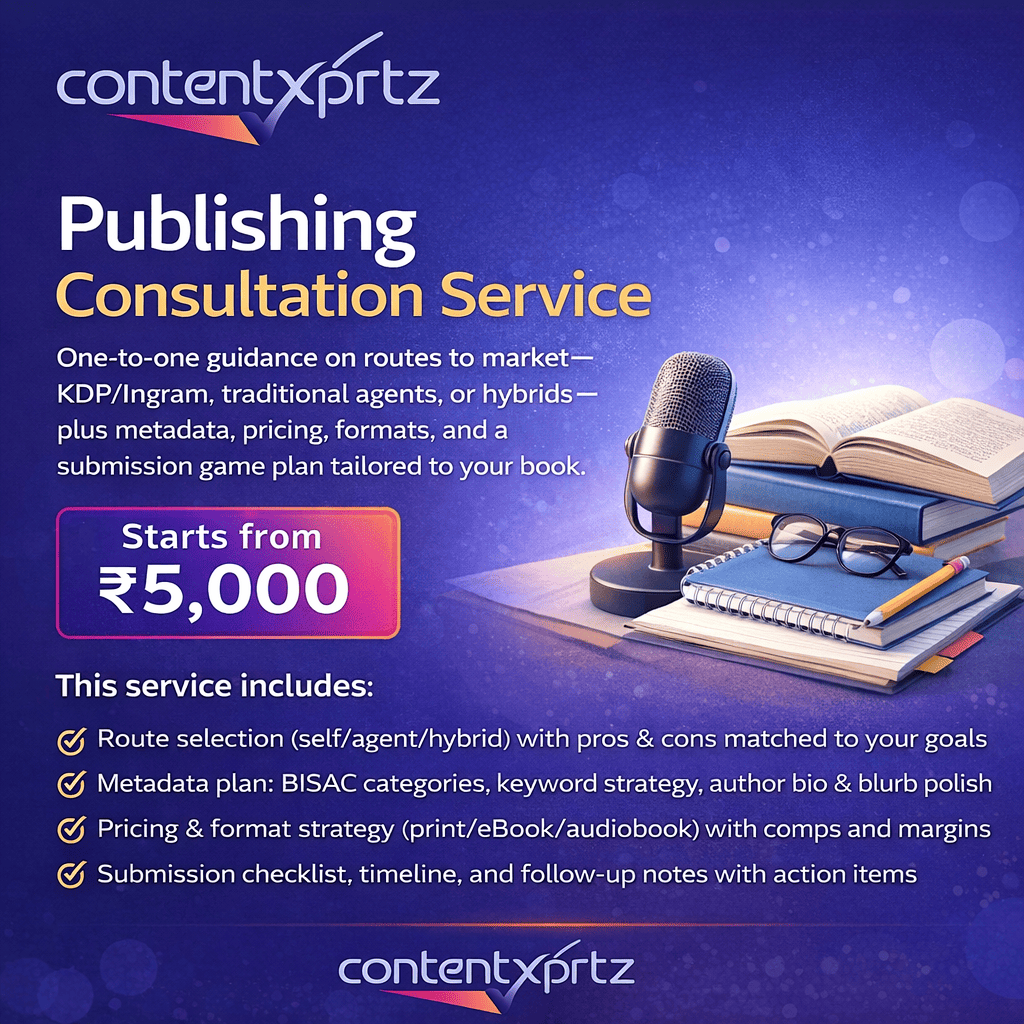
📘 Confused about the right publishing path for your book?
🎓 Get expert guidance—clear, ethical, and tailored to your goals.
Publishing a book doesn’t have to be overwhelming. ContentXprtz’s Publishing Consultation Service offers one-to-one guidance to help you choose the right route to market and prepare a clear, actionable submission plan—so you move forward with confidence and clarity.
✨ What you get with our consultation:
📄 Personalized route selection (KDP/Ingram, traditional agents, or hybrid models)
📘 Metadata strategy: BISAC categories, keywords, author bio & blurb refinement
🧠 Pricing & format guidance (print, eBook, audiobook) with realistic market comparisons
📄 Submission checklist, timeline, and structured follow-up action plan
💡 Our commitment:
We work ethically and transparently. Your ideas remain 100% yours—we guide, refine, and support without altering authorship, originality, or academic integrity.
💰 Starts from ₹5,000
📲 Message us on WhatsApp to get started today
WhatsApp: https://wa.me/917065013200
🌐 Website: https://contentxprtz.com
#ContentXprtz #PublishingConsultation #AcademicPublishing #PhDScholars #ResearchPublishing #BookPublishingSupport #SelfPublishingIndia #AcademicAuthors #ResearcherLife #PhDLife #PostdocLife #ScholarlyPublishing #ThesisToBook #KDPPublishing #IngramSpark #AuthorSupport #AcademicWritingHelp #EthicalPublishing #HigherEducation #ResearchSupport #PublishYourBook #AcademicCareers #StudentResearchers
Publishing Consultation Service: A Strategic Guide for PhD Scholars and Academic Researchers Navigating Global Publication Standards
Introduction: Why a Publishing Consultation Service Has Become Essential for Today’s Researchers
For PhD scholars, postdoctoral researchers, and academic professionals, publishing is no longer a single milestone. Instead, it has become a continuous, high-stakes process that determines career progression, funding opportunities, institutional reputation, and long-term academic credibility. In this environment, a Publishing Consultation Service is not a luxury. It is a strategic necessity.
Across disciplines, scholars face increasing pressure to publish in high-impact journals while maintaining methodological rigor, ethical integrity, and originality. However, the realities of academic life often create structural barriers. Time constraints, language limitations, unfamiliarity with journal expectations, repeated desk rejections, and escalating publication costs have made scholarly publishing more complex than ever before.
According to data from Elsevier’s global research insights, journal acceptance rates in many Scopus-indexed and SSCI journals have fallen below 15 percent, with top-tier journals reporting rates closer to 5 percent. Springer Nature similarly reports that editors now reject more than half of all submissions at the desk review stage, often due to issues unrelated to the research contribution itself, such as structural weaknesses, poor alignment with journal scope, or inadequate academic presentation.
At the same time, global research output continues to grow rapidly. UNESCO estimates that the number of active researchers worldwide has surpassed 9 million, intensifying competition for limited journal space. PhD scholars, particularly those writing in English as an additional language, are disproportionately affected by this competition. Even high-quality research can struggle to pass editorial screening if it does not meet international publishing standards.
This is where a professional Publishing Consultation Service plays a decisive role. Rather than focusing narrowly on proofreading or formatting, publishing consultation addresses the entire publication lifecycle. It helps scholars clarify journal fit, strengthen argumentation, align manuscripts with editorial expectations, and navigate reviewer feedback strategically. Most importantly, it does so ethically, without compromising authorship or academic integrity.
At ContentXprtz, we have supported researchers across more than 110 countries since 2010. Our experience working with PhD candidates, faculty members, and institutional research teams has shown us a clear pattern. Successful publication outcomes depend not only on strong data, but on informed publishing decisions made at the right time. A well-structured consultation process can save months, sometimes years, of revision cycles and repeated rejection.
This article offers a comprehensive, evidence-based guide to understanding what a Publishing Consultation Service entails, how it differs from standard academic editing, and why it has become central to doctoral and research success. Drawing on global publishing standards, best practices from leading academic publishers, and real-world insights from a decade of academic support, this guide is designed to help you publish with confidence, clarity, and control.
Understanding the Scope of a Publishing Consultation Service
A Publishing Consultation Service is a structured, expert-led engagement that supports researchers through the strategic and technical dimensions of academic publishing. Unlike transactional services that focus on surface-level language correction, publishing consultation addresses decision-making, positioning, and long-term publication strategy.
What Publishing Consultation Really Covers
A comprehensive consultation typically includes:
-
Journal selection analysis based on scope, impact, and acceptance patterns
-
Manuscript readiness evaluation beyond grammar and formatting
-
Structural and argument-level feedback aligned with journal expectations
-
Ethical compliance checks based on COPE and publisher guidelines
-
Reviewer comment interpretation and response strategy
-
Submission planning to avoid desk rejection
These elements are critical because most rejections occur before peer review. Editors at publishers such as Elsevier and Taylor and Francis consistently emphasize that manuscripts fail early due to misalignment with journal aims, unclear contribution, or poor structural coherence.
Publishing consultation is therefore proactive rather than reactive. It helps scholars submit strategically rather than simply submit quickly.
Why PhD Scholars Are Turning to Publishing Consultation Services
The Unique Pressures of Doctoral Publishing
PhD scholars operate under constraints that differ significantly from senior academics. They often face:
-
Mandatory publication requirements for degree completion
-
Limited supervisory time and inconsistent feedback
-
High emotional stress associated with repeated rejection
-
Funding-linked deadlines tied to publications
-
Language and academic style barriers
A study published by Emerald Insight highlights that doctoral candidates experience significantly higher publication-related anxiety than established researchers, largely due to uncertainty about expectations and evaluation criteria.
A Publishing Consultation Service addresses these pressures by providing clarity and structure. Instead of navigating the process alone, scholars gain access to expert guidance grounded in editorial realities.
Reducing the Cost of Rejection
Repeated submissions to unsuitable journals lead to wasted time and financial strain. Many journals charge submission or open-access fees that can exceed several thousand dollars. A strategic consultation minimizes these risks by aligning manuscripts with appropriate journals from the outset.
Publishing Consultation vs Academic Editing: A Critical Distinction
While academic editing improves language quality, it does not address whether a manuscript is publishable in a specific journal. Publishing consultation goes further.
Academic Editing Focuses On
-
Grammar and syntax
-
Style consistency
-
Formatting corrections
-
Language clarity
Publishing Consultation Focuses On
-
Contribution positioning
-
Journal fit and scope alignment
-
Structural logic and coherence
-
Reviewer expectation mapping
-
Ethical compliance
-
Submission strategy
For scholars seeking long-term publication success, these higher-order concerns are often more decisive than surface-level language issues.
How Publishing Consultation Aligns with Global Publisher Standards
Leading academic publishers provide extensive guidelines outlining what they expect from submissions. Publishing consultation services interpret and operationalize these standards for individual researchers.
For example:
-
Elsevier emphasizes clear novelty statements and structured abstracts
https://www.elsevier.com/authors/journal-authors/submit-your-paper -
Springer Nature highlights ethical transparency and reporting standards
https://www.springernature.com/gp/authors/research-data-policy -
Taylor and Francis stress manuscript coherence and audience relevance
https://authorservices.taylorandfrancis.com
A professional Publishing Consultation Service ensures that manuscripts are aligned with these expectations before submission, reducing editorial friction.
Integrating Publishing Consultation with Academic Support Services
Publishing consultation works best when integrated with broader academic support. At ContentXprtz, consultation is embedded within our full-service academic ecosystem.
Researchers often combine consultation with:
-
PhD thesis help through our
https://contentxprtz.com/phd-academic-services -
Academic editing services available under
https://contentxprtz.com/writing-publishing-services -
Research paper writing support for coursework and journal submissions via
https://contentxprtz.com/student-career-academic-writing-services -
Book manuscript development for monographs and edited volumes through
https://contentxprtz.com/book-authors-writing-services
This integrated approach ensures consistency, ethical compliance, and publication readiness across all academic outputs.
Ethical Foundations of a High-Quality Publishing Consultation Service
Ethics are central to credible academic support. Reputable consultation services do not engage in ghostwriting, data fabrication, or authorship manipulation.
ContentXprtz adheres strictly to:
-
COPE guidelines on publication ethics
-
APA ethical standards for scholarly communication
https://www.apa.org/pubs/authors/ethical-issues
Our role is advisory and developmental. The scholar remains the author. We provide clarity, not substitution.
FAQs: Publishing Consultation Service for PhD Scholars and Researchers
FAQ 1: What exactly does a Publishing Consultation Service help me achieve as a PhD scholar?
A Publishing Consultation Service helps you move from a completed manuscript to a strategically positioned submission that aligns with journal expectations. For PhD scholars, the challenge is rarely about research quality alone. More often, it involves uncertainty about where to submit, how to present contributions, and how to avoid early rejection.
Through consultation, you receive expert feedback on whether your manuscript is ready for submission, which journals are realistically suitable, and what revisions are necessary to meet editorial standards. This includes guidance on abstract framing, contribution statements, structure, and ethical disclosures.
Unlike generic editing, consultation focuses on publishability. It helps you understand why journals reject papers and how editors evaluate submissions. Over time, this knowledge strengthens your independent publishing skills, making it an investment in both your current manuscript and your academic career.
FAQ 2: Is a Publishing Consultation Service ethical, and will it affect my authorship?
Yes, a legitimate Publishing Consultation Service is entirely ethical when it follows international academic standards. Ethical consultation does not involve writing your paper for you or altering your data. Instead, it provides advisory feedback, strategic guidance, and structural recommendations.
Reputable providers, including ContentXprtz, operate within the ethical frameworks outlined by COPE and major publishers. You remain the sole author. All intellectual contributions remain yours.
In fact, many universities and funding bodies encourage scholars to seek professional consultation, especially when publishing in international journals. Ethical consultation enhances transparency, clarity, and compliance without compromising academic integrity.
FAQ 3: When in the research process should I seek publishing consultation?
The ideal time to engage a Publishing Consultation Service is before submission, but after your manuscript has reached a stable draft stage. Early consultation helps prevent structural issues that are difficult to fix later.
However, consultation is also valuable after rejection. Reviewer feedback can be complex and emotionally challenging. A consultant helps interpret comments objectively and develop a targeted revision strategy.
Some scholars also use consultation at the proposal or early drafting stage to align their research design with publication goals. This proactive approach reduces downstream revisions and improves publication efficiency.
FAQ 4: How does publishing consultation reduce the risk of desk rejection?
Desk rejection often occurs due to misalignment with journal scope, unclear contribution, or poor presentation. A Publishing Consultation Service addresses these risks directly.
Consultants evaluate whether your manuscript matches the journal’s aims, audience, and methodological preferences. They assess whether your introduction clearly articulates novelty and relevance. They also check whether your structure follows disciplinary conventions.
By resolving these issues before submission, consultation significantly increases the likelihood of passing editorial screening and entering peer review.
FAQ 5: Can a Publishing Consultation Service help with reviewer comments?
Yes, responding to reviewer comments is a core component of effective publishing consultation. Reviewer feedback can be dense, contradictory, or unclear, especially for early-career researchers.
A consultation helps you interpret reviewer intent, prioritize revisions, and craft professional response letters. This process aligns with best practices recommended by publishers such as Elsevier and Springer.
Importantly, consultation ensures that responses are respectful, evidence-based, and strategically framed, which improves the chances of acceptance after revision.
FAQ 6: How is publishing consultation different from supervisor feedback?
Supervisors provide invaluable intellectual guidance, but they may not always have time to engage deeply with publication mechanics. A Publishing Consultation Service complements supervisory input by focusing specifically on editorial expectations and submission strategy.
Consultants bring cross-journal experience and up-to-date knowledge of publishing trends. They can offer an external perspective that identifies issues supervisors may overlook, particularly those related to journal fit and presentation.
This support does not replace supervision. Instead, it enhances the overall quality and readiness of your work.
FAQ 7: Does publishing consultation help with interdisciplinary research?
Interdisciplinary research often faces additional publication challenges due to unclear audience targeting. A Publishing Consultation Service is particularly valuable in these cases.
Consultants help identify journals that welcome interdisciplinary work and advise on framing your contribution in a way that resonates with diverse reviewers. They also help balance methodological explanations for readers from different disciplinary backgrounds.
This strategic framing increases acceptance likelihood and ensures your work reaches the right scholarly audience.
FAQ 8: Can publishing consultation help with open access and funding compliance?
Yes, many scholars struggle with open access policies and funder requirements. A Publishing Consultation Service helps you navigate these obligations.
Consultants advise on journal open access options, embargo periods, and compliance with funder mandates such as Plan S. They also help assess cost-benefit considerations related to article processing charges.
This guidance ensures that your publication strategy aligns with both institutional and funding requirements.
FAQ 9: Is publishing consultation useful for non-native English researchers?
Absolutely. Non-native English researchers face additional scrutiny in international publishing. A Publishing Consultation Service helps bridge this gap by addressing clarity, tone, and academic style expectations.
Consultation goes beyond language correction. It helps ensure that arguments are logically structured and culturally aligned with international academic norms. This holistic support significantly improves publication outcomes for global scholars.
FAQ 10: How do I choose a trustworthy Publishing Consultation Service?
A trustworthy Publishing Consultation Service demonstrates transparency, ethical standards, and proven experience. Look for providers with a long operational history, clear service boundaries, and alignment with major publisher guidelines.
ContentXprtz, established in 2010, operates globally with regional expertise and strict ethical policies. Our consultation services are designed to empower scholars, not replace them.
Always avoid providers that promise guaranteed publication or engage in unethical practices. Credible consultation supports quality, not shortcuts.
Conclusion: Publishing with Confidence Through Strategic Consultation
In today’s competitive academic landscape, publishing is as much about strategy as it is about scholarship. A Publishing Consultation Service provides the clarity, structure, and expert insight needed to navigate this complexity successfully.
For PhD scholars and researchers, consultation reduces uncertainty, saves time, and improves publication outcomes. It transforms publishing from a trial-and-error process into an informed, deliberate strategy aligned with global standards.
At ContentXprtz, we combine academic rigor, ethical commitment, and global experience to support researchers at every stage of their publishing journey. We invite you to explore our PhD Assistance and academic publishing services and take the next step toward confident, successful publication.
At ContentXprtz, we don’t just edit — we help your ideas reach their fullest potential.
