
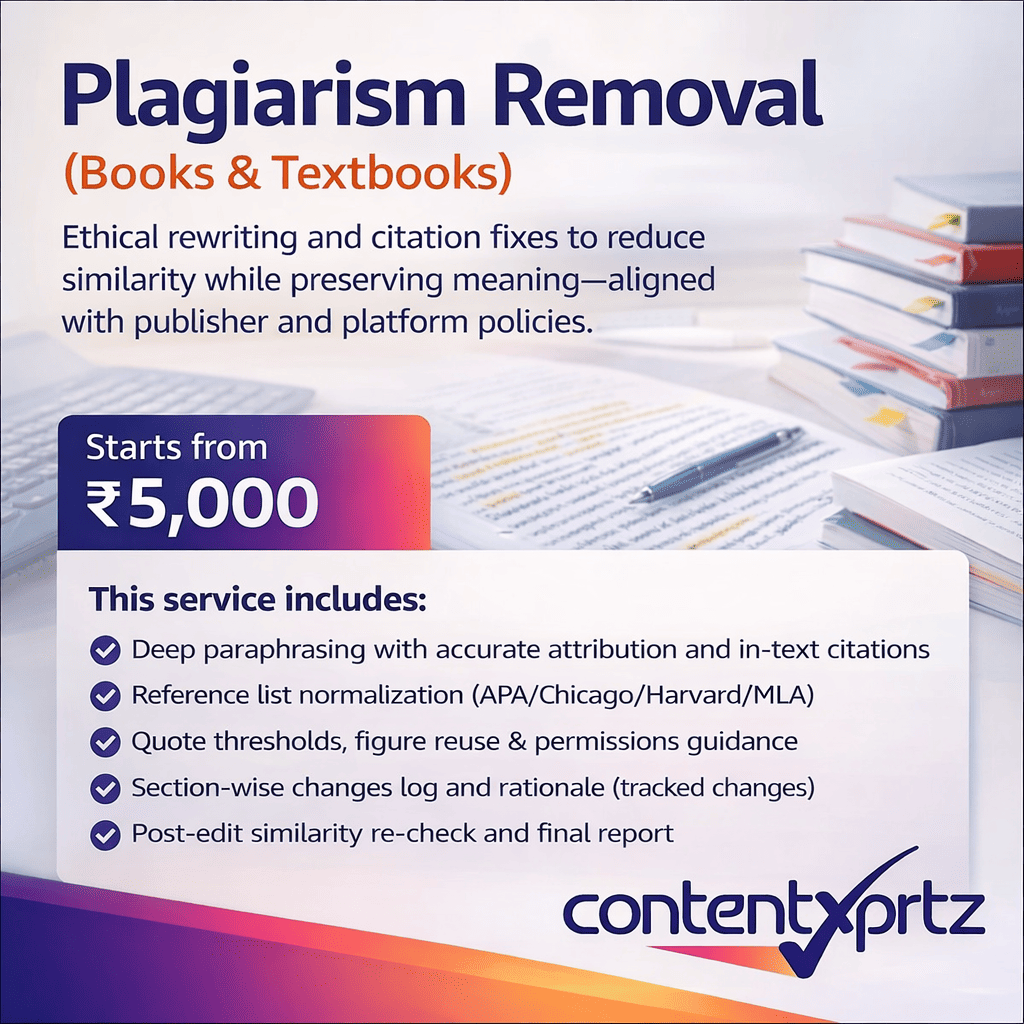
Plagiarism Removal (Books & Textbooks): Ethical, Academic, and Publication-Ready Solutions for Serious Scholars
Introduction
Plagiarism Removal (Books & Textbooks) has emerged as one of the most critical academic support needs for students, PhD scholars, and professional researchers worldwide. In an era where originality is non-negotiable and digital detection tools have become increasingly sophisticated, even unintentional similarity can jeopardize years of scholarly effort. For authors working on books, textbooks, monographs, or edited volumes, the stakes are even higher. A single flagged chapter can delay publication, damage academic credibility, or result in outright rejection from reputable publishers.
For PhD scholars in particular, academic pressure is no longer limited to research quality alone. Today’s doctoral journey is shaped by multiple constraints. Time limitations, publication mandates, rising tuition costs, and performance-linked funding create a constant state of stress. According to data published by Elsevier, global research output has more than doubled over the past two decades, intensifying competition for publication space. At the same time, acceptance rates for leading academic journals remain below 15 percent in many disciplines. Book publishers and textbook commissioning editors now apply the same originality standards used by top journals, often requiring similarity reports before manuscript review even begins.
Against this backdrop, plagiarism concerns rarely stem from academic dishonesty. Instead, they arise from structural challenges inherent to scholarly writing. Extensive literature reviews, discipline-specific terminology, methodological repetition, and legacy content reuse often trigger similarity alerts. Multilingual scholars face additional difficulties when translating ideas from prior publications or conference papers into English-language books. Furthermore, early-career researchers often struggle to paraphrase complex theoretical frameworks without distorting meaning or violating citation norms.
These challenges are compounded by the rapid evolution of plagiarism detection technologies. Tools such as iThenticate, Turnitin, and Crossref Similarity Check now detect not only direct copying but also close paraphrasing, self-plagiarism, and structural resemblance. As a result, authors increasingly realize that plagiarism removal is not a mechanical rewriting task. Instead, it is a nuanced academic process requiring subject expertise, ethical sensitivity, and deep familiarity with publishing standards.
This is precisely where professional plagiarism removal services for books and textbooks play a vital role. When executed ethically, plagiarism removal safeguards academic integrity while preserving authorial voice, conceptual clarity, and disciplinary accuracy. It enables scholars to meet publisher requirements without compromising intellectual ownership or scholarly intent.
At ContentXprtz, we understand that books and textbooks represent more than manuscripts. They reflect years of intellectual labor, professional identity, and academic legacy. Since 2010, we have supported researchers across more than 110 countries, helping them transform complex academic content into originality-compliant, publication-ready work. Our approach to Plagiarism Removal (Books & Textbooks) is rooted in academic ethics, evidence-based editing, and publisher-aligned best practices.
This article offers a comprehensive, research-informed guide to plagiarism removal for books and textbooks. It explains why similarity issues occur, how ethical remediation works, and what scholars should expect from professional academic editing services. More importantly, it empowers authors to make informed decisions that protect both their work and their reputation.
Understanding Plagiarism in Books and Textbooks
Plagiarism in books and textbooks differs fundamentally from plagiarism in short research papers. Long-form academic writing inherently engages with extensive prior scholarship, making similarity risks more complex and multidimensional.
Why Books and Textbooks Face Higher Similarity Risks
Books often synthesize decades of research, theory, and empirical evidence. As a result, similarity reports may reflect:
-
Recurrent use of discipline-specific terminology
-
Standard methodological descriptions
-
Extended literature synthesis across chapters
-
Reuse of previously published material by the same author
-
Quotations from foundational theories
According to Springer Nature’s publishing ethics guidelines, similarity alone does not constitute misconduct. Context, attribution, and intent are decisive factors. However, publishers still require authors to reduce similarity scores to acceptable thresholds, often below 10 to 15 percent, depending on the field.
Self-Plagiarism in Academic Books
Self-plagiarism is one of the most misunderstood challenges faced by experienced scholars. Authors frequently expand dissertations, journal articles, or conference proceedings into book chapters. While this practice is academically legitimate, it must be managed carefully.
The American Psychological Association emphasizes that authors must properly reference their earlier work and substantially reframe reused material. Failure to do so may result in ethical violations, even when the author owns the original content.
Publisher Expectations and Compliance
Major academic publishers such as Elsevier, Taylor and Francis, Emerald Insight, and Wiley apply rigorous originality screening to book manuscripts. Many require authors to submit similarity reports during proposal or final manuscript stages. High similarity scores often lead to revision requests, delayed contracts, or rejection.
What Ethical Plagiarism Removal Actually Means
Plagiarism removal is often misunderstood as superficial rewriting or automated paraphrasing. In academic publishing, such approaches are not only ineffective but also unethical.
Ethical vs Mechanical Plagiarism Removal
Ethical plagiarism removal focuses on:
-
Conceptual restructuring rather than word substitution
-
Preservation of scholarly meaning and intent
-
Accurate citation and attribution
-
Discipline-specific academic language
In contrast, mechanical rewriting tools frequently distort arguments, introduce inaccuracies, and raise red flags during peer review.
The Role of Academic Editing Expertise
Effective plagiarism removal requires editors with subject knowledge, research training, and familiarity with academic writing conventions. Editors must understand how to reframe arguments while maintaining theoretical coherence and methodological accuracy.
At ContentXprtz, our plagiarism removal process is integrated with advanced academic editing services, ensuring that originality improvements enhance clarity rather than compromise scholarship.
The Plagiarism Removal Process for Books and Textbooks
Professional plagiarism removal follows a structured, transparent workflow aligned with academic and publishing standards.
Initial Similarity Diagnosis
The process begins with a comprehensive similarity analysis using industry-recognized tools. Editors assess not only percentage scores but also the nature of matched content, distinguishing between acceptable overlaps and problematic similarity.
Contextual Evaluation
Each similarity instance is reviewed within its academic context. Citations, quotation usage, and disciplinary norms are evaluated to determine whether rewriting or restructuring is required.
Ethical Rewriting and Structural Refinement
Content requiring remediation is rewritten at the conceptual level. Editors restructure sentences, paragraphs, and arguments while preserving scholarly intent. Where necessary, citations are strengthened or clarified.
Final Validation and Quality Assurance
The revised manuscript undergoes a final similarity check to ensure compliance with publisher thresholds. Language quality, coherence, and academic tone are also reviewed.
Why Professional Plagiarism Removal Matters for PhD Scholars and Authors
Plagiarism issues can have far-reaching consequences beyond manuscript rejection.
Academic Reputation and Career Impact
For PhD scholars and early-career researchers, plagiarism allegations can damage reputations permanently. Academic integrity is foundational to tenure, funding, and collaborative opportunities.
Publisher Relationships and Contract Security
Publishers expect authors to submit originality-compliant manuscripts. Failure to do so may affect future contracts and professional credibility.
Legal and Ethical Considerations
Textbook plagiarism can raise copyright concerns, particularly when commercial publishing is involved. Ethical plagiarism removal protects authors from legal risks while ensuring compliance with publishing agreements.
How ContentXprtz Approaches Plagiarism Removal (Books & Textbooks)
ContentXprtz adopts a scholar-centric, ethics-first approach to plagiarism removal.
Academic Integrity at the Core
We do not engage in content manipulation or unethical rewriting. Every revision is grounded in academic best practices and transparent documentation.
Subject-Specific Expertise
Our editors are subject specialists with advanced degrees and publication experience. This ensures disciplinary accuracy and conceptual depth.
End-to-End Publication Alignment
Our plagiarism removal services integrate seamlessly with broader academic editing services, research paper writing support, and PhD thesis help, offering authors a complete publication readiness solution.
You can explore our comprehensive support offerings through our
Writing and Publishing Services
PhD and Academic Services
Student Writing Services
Book Authors Writing Services
Corporate Writing Services
Frequently Asked Questions Integrated Within the Article
How much similarity is acceptable in academic books and textbooks?
Acceptable similarity thresholds vary by publisher and discipline. Most academic publishers prefer similarity scores below 10 to 15 percent, excluding references and properly quoted material. However, editors also assess qualitative factors such as citation accuracy and content originality.
Is plagiarism removal legal and ethical?
Yes, when conducted ethically. Professional plagiarism removal focuses on improving originality, clarity, and citation practices without altering intellectual ownership. It aligns with APA and COPE guidelines and supports academic integrity.
Can plagiarism removal change my academic voice?
Ethical plagiarism removal preserves authorial voice. Skilled academic editors restructure content while maintaining tone, argumentation style, and disciplinary conventions.
Do publishers accept professionally edited manuscripts?
Reputable publishers welcome professionally edited manuscripts, provided the work adheres to ethical standards. Many publishers encourage authors to seek academic editing support before submission.
How long does plagiarism removal for books take?
Timelines depend on manuscript length, similarity complexity, and subject area. Comprehensive book-level plagiarism removal may take several weeks, especially when quality assurance is prioritized.
Can self-plagiarism be fixed without citation issues?
Yes. Self-plagiarism can be addressed through proper citation, content restructuring, and reframing prior work within a new scholarly context.
What tools are used for plagiarism checking?
Industry-standard tools such as iThenticate and Turnitin are commonly used. These tools align with publisher screening systems.
Will plagiarism removal affect my research accuracy?
Professional plagiarism removal enhances clarity without altering research findings. Editors ensure factual and methodological accuracy throughout the process.
Is plagiarism removal suitable for textbooks written for students?
Yes. Textbooks often face higher similarity due to standardized explanations. Ethical plagiarism removal ensures originality while maintaining pedagogical clarity.
How do I know if I need plagiarism removal services?
If your similarity report shows significant overlap, or if a publisher requests originality revision, professional plagiarism removal is strongly recommended.
Conclusion: Ethical Originality as the Foundation of Academic Publishing
Plagiarism Removal (Books & Textbooks) is not merely a technical requirement. It is an essential component of ethical scholarship and professional publishing. In a competitive academic landscape shaped by advanced detection tools and stringent publisher standards, originality is both a responsibility and a strategic advantage.
For PhD scholars, textbook authors, and academic researchers, professional plagiarism removal safeguards intellectual credibility while enhancing clarity, coherence, and publication readiness. When approached ethically, it strengthens rather than diminishes scholarly contribution.
At ContentXprtz, our commitment extends beyond editing words. We support scholars through every stage of their academic journey, offering expert academic editing services, research paper writing support, and comprehensive PhD thesis help tailored to global publishing standards.
If you are preparing a book or textbook for submission and want to ensure ethical originality, explore our PhD Assistance Services and academic support solutions today.
At ContentXprtz, we don’t just edit, we help your ideas reach their fullest potential.
