
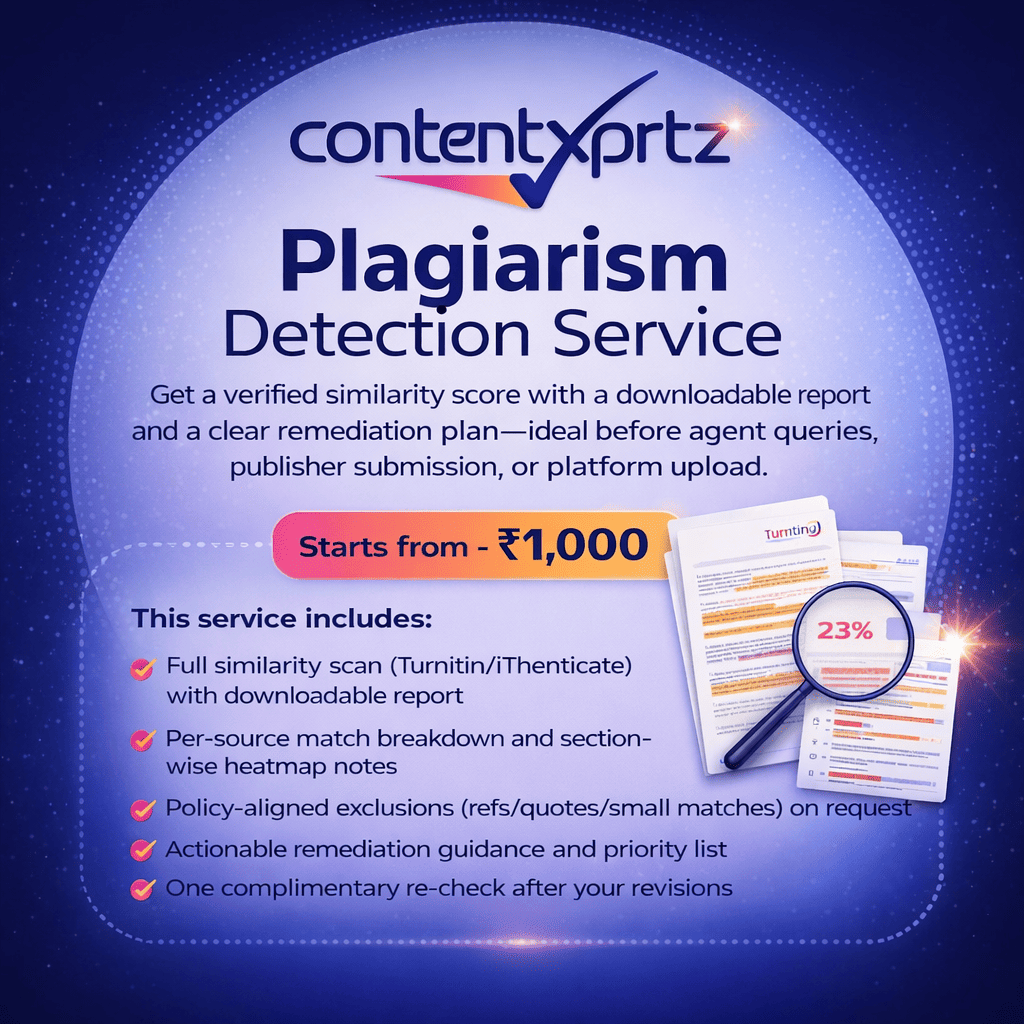
Ensure originality, Submit with Confidence.
Before you submit your manuscript, know exactly where it stands. ContentXprtz’s Plagiarism Detection Service helps you verify originality, understand similarity sources, and prepare your work for ethical, confident submission to journals, publishers, or academic platforms.
Designed for students, PhD scholars, and researchers who value transparency and academic integrity.
What you get with this service:
• Verified similarity check using Turnitin / iThenticate
• Downloadable similarity report with clear interpretation
• Per-source match breakdown and section-wise insights
• Policy-aligned exclusions (references, quotes, minor matches)
• Actionable remediation guidance + one complimentary re-check
Ethical by design.
Your ideas remain yours—no rewriting without consent, no content ownership transfer, and full respect for academic authorship and originality.
Starts from ₹1,000
📄 Prepare your manuscript the right way—before submission stress begins.
Message us on WhatsApp to get started today
WhatsApp: https://wa.me/917065013200
Website: https://contentxprtz.com
#ContentXprtz #PlagiarismCheck #AcademicIntegrity #PhDLife #ResearchSupport #JournalSubmission #ResearchEthics #AcademicWriting #PhDScholars #DoctoralResearch #TurnitinCheck #iThenticate #ManuscriptPreparation #PublishWithConfidence #HigherEducation #ScholarlyPublishing #ResearchStudents #ThesisSubmission #DissertationSupport #OriginalResearch #EthicalPublishing #AcademicServices #UniversityLife
Plagiarism Detection Service: Safeguarding Academic Integrity in High-Stakes Research Publishing
Introduction: Why Plagiarism Detection Has Become Non-Negotiable in Academic Publishing
For PhD scholars, postdoctoral researchers, and academic professionals, originality is no longer a virtue alone; it is a prerequisite for survival in the global research ecosystem. In this context, a Plagiarism Detection Service is not a corrective afterthought. Instead, it has become a foundational safeguard for academic credibility, ethical compliance, and publication success.
The pressure to publish has intensified worldwide. According to data reported by Elsevier, the global volume of research publications has more than doubled over the past two decades, with emerging economies contributing significantly to this growth. While this expansion reflects healthy scholarly participation, it also introduces systemic risks. These risks include unintentional textual overlap, improper citation practices, and self-plagiarism, particularly among early-stage researchers navigating complex academic conventions.
PhD scholars today face a convergence of challenges. They must balance rigorous research demands with teaching responsibilities, funding deadlines, conference expectations, and institutional performance metrics. Simultaneously, journal acceptance rates continue to decline. Top-tier journals published by Springer Nature, Elsevier, and Taylor and Francis routinely report acceptance rates below 10 percent. In such an environment, even minor ethical lapses can result in desk rejection, reputational damage, or institutional scrutiny.
Plagiarism rarely occurs as deliberate misconduct among serious researchers. Instead, it often emerges from structural constraints. These include limited access to mentoring, language barriers for non-native English scholars, inconsistent referencing styles across journals, and evolving definitions of acceptable similarity thresholds. Many researchers are surprised to learn that reusing their own previously published content without proper attribution qualifies as self-plagiarism under APA and COPE guidelines.
Furthermore, plagiarism detection has evolved beyond simple text matching. Journals now deploy advanced similarity algorithms capable of identifying paraphrased content, translated plagiarism, and citation manipulation. As a result, relying on basic or free plagiarism tools exposes researchers to unnecessary risk.
A professional plagiarism detection service addresses these realities with precision and ethical clarity. It does not merely generate a similarity score. Instead, it contextualizes overlaps, differentiates acceptable academic conventions from problematic reuse, and provides actionable guidance aligned with journal-specific expectations.
At ContentXprtz, plagiarism detection is embedded within a broader academic quality assurance framework. Since 2010, we have supported scholars across more than 110 countries by combining technical rigor with disciplinary sensitivity. Our approach recognizes that originality is not only about avoiding duplication but also about presenting ideas with scholarly responsibility, transparency, and confidence.
This article examines plagiarism detection through an academic lens. It explains how professional services function, why they matter across disciplines, and how researchers can use them strategically to strengthen their work before submission. For PhD scholars and academic professionals seeking publication-ready outcomes, understanding plagiarism detection is no longer optional. It is essential.
Understanding Plagiarism in Contemporary Academic Research
Plagiarism in academic research is often misunderstood as a singular act of copying text verbatim. In reality, it encompasses a spectrum of practices that vary across disciplines, journals, and ethical frameworks.
Defining Plagiarism According to Academic Authorities
The American Psychological Association defines plagiarism as presenting another author’s ideas, words, or data as one’s own without proper attribution. The Committee on Publication Ethics further expands this definition to include redundant publication, self-plagiarism, and mosaic plagiarism.
Leading publishers such as Elsevier and Springer Nature explicitly state that plagiarism can occur even when sources are cited, if the original structure or phrasing is retained excessively. Therefore, compliance requires more than citation. It requires intellectual transformation.
Common Forms of Plagiarism Encountered by PhD Scholars
Plagiarism manifests in multiple forms within theses and research manuscripts:
-
Direct plagiarism, involving verbatim copying without quotation or attribution
-
Mosaic plagiarism, where phrases are rearranged or partially modified
-
Self-plagiarism, including reuse of published conference papers or chapters
-
Inadequate paraphrasing, often caused by language constraints
-
Improper citation practices, such as missing page numbers or incorrect formats
These issues frequently arise during literature review drafting, methodology descriptions, and theoretical framework development. Ironically, sections requiring the highest academic rigor are often the most vulnerable.
Why Plagiarism Detection Thresholds Differ Across Journals
There is no universal similarity threshold accepted across all journals. While some journals tolerate similarity levels up to 15 percent, others enforce stricter limits below 5 percent, particularly for review articles and theoretical contributions.
Moreover, similarity scores alone are insufficient indicators. Editors evaluate where overlap occurs. Similarity in references or methodology descriptions may be acceptable. Overlap in discussion or conclusions is not.
A professional plagiarism detection service interprets similarity reports with these nuances in mind, reducing false alarms while flagging genuine concerns.
How a Professional Plagiarism Detection Service Works
A high-quality plagiarism detection service goes beyond automated scanning. It integrates technology, editorial judgment, and ethical interpretation.
Advanced Similarity Algorithms and Databases
Professional services rely on industry-recognized tools with access to expansive databases. These include millions of journal articles, conference proceedings, dissertations, and institutional repositories. Unlike free tools, these platforms detect both exact matches and sophisticated paraphrasing patterns.
Publishers such as Elsevier and Emerald Insight employ similar systems during editorial screening. Therefore, pre-submission checks using comparable standards significantly reduce rejection risk.
Human Interpretation and Academic Contextualization
Raw similarity reports are misleading without expert analysis. A 12 percent similarity score may be acceptable in one context and problematic in another. Human reviewers assess:
-
Location of overlaps within the manuscript
-
Nature of the matched sources
-
Presence of appropriate citations
-
Discipline-specific writing conventions
At ContentXprtz, editors with subject-matter expertise review each report. This ensures recommendations are academically grounded rather than mechanically driven.
Actionable Recommendations and Ethical Rewriting
A professional plagiarism detection service does not merely diagnose issues. It provides structured guidance on resolving them. This may include:
-
Rewriting suggestions aligned with academic tone
-
Citation corrections based on APA, MLA, or journal-specific styles
-
Structural reorganization to improve originality
-
Ethical disclosure recommendations for self-reuse
These interventions preserve the author’s voice while ensuring compliance.
Why Plagiarism Detection Is Critical for PhD Theses and Dissertations
Doctoral research represents a permanent academic record. Once submitted and archived, theses remain accessible indefinitely through institutional repositories. Any integrity issue can have long-term consequences.
Institutional Requirements and Examination Standards
Universities worldwide mandate plagiarism checks before thesis submission. In many regions, including Europe, Australia, and parts of Asia, similarity reports are reviewed by examination committees.
A high similarity score can delay graduation, require extensive revisions, or trigger academic misconduct investigations. Therefore, early detection is a strategic necessity.
Long-Term Academic Reputation and Career Impact
Plagiarism allegations, even when unintentional, can derail academic careers. Funding agencies, hiring committees, and editorial boards increasingly scrutinize publication ethics histories.
Using a plagiarism detection service proactively demonstrates professional responsibility and safeguards future opportunities.
Plagiarism Detection in Journal Publishing and Research Articles
Journal editors operate under intense pressure to maintain publication integrity. Automated screening occurs before peer review, making plagiarism detection a gatekeeping mechanism.
Desk Rejections and Ethical Screening
Most major publishers perform similarity checks immediately upon submission. Manuscripts exceeding acceptable thresholds are desk rejected without review.
This process is unforgiving. Editors rarely provide detailed feedback at this stage. Consequently, authors may not understand why their work was rejected.
Pre-submission plagiarism detection mitigates this risk by aligning manuscripts with editorial expectations.
Enhancing Peer Review Outcomes
Peer reviewers are increasingly sensitive to originality concerns. A clean similarity report allows reviewers to focus on contribution quality rather than ethical compliance.
This improves the probability of constructive feedback and favorable outcomes.
Choosing the Right Plagiarism Detection Service: What Scholars Should Look For
Not all plagiarism detection services are equal. Selecting the right partner requires careful evaluation.
Key Criteria for Evaluation
A credible service should offer:
-
Access to publisher-grade databases
-
Human expert interpretation
-
Discipline-specific guidance
-
Confidentiality and data security
-
Alignment with COPE and APA standards
Free tools lack these safeguards and may compromise manuscript confidentiality.
Why ContentXprtz Meets These Standards
ContentXprtz integrates plagiarism detection within a holistic academic support ecosystem. Our services extend beyond similarity checking to include academic editing services, research paper assistance, and publication strategy support.
Explore our comprehensive offerings through the following services:
-
PhD thesis help and academic editing services: https://contentxprtz.com/phd-academic-services
-
Research paper writing support and publishing guidance: https://contentxprtz.com/writing-publishing-services
-
Student-focused academic writing assistance: https://contentxprtz.com/student-career-academic-writing-services
-
Book manuscript and author services: https://contentxprtz.com/book-authors-writing-services
-
Professional and corporate writing solutions: https://contentxprtz.com/corporate-writing-services
Frequently Asked Questions on Plagiarism Detection Service
How does plagiarism detection differ from academic editing?
Plagiarism detection focuses on identifying similarity and originality issues, while academic editing addresses language, structure, and clarity. However, both are interdependent. Effective plagiarism resolution often requires advanced editing expertise to reframe content ethically without altering meaning. Professional services integrate both to ensure compliance and readability.
Is plagiarism detection mandatory before journal submission?
While not universally mandatory, most reputable journals conduct plagiarism screening during editorial review. Submitting without prior checks exposes authors to desk rejection risks. Proactive detection aligns manuscripts with journal standards and improves acceptance probability.
Can plagiarism detection identify paraphrased content?
Advanced plagiarism detection tools identify paraphrased and translated content using semantic analysis. Human reviewers further enhance detection by evaluating contextual similarities. This capability is critical as superficial paraphrasing no longer bypasses editorial scrutiny.
What similarity percentage is considered acceptable?
Acceptable similarity varies by journal and discipline. Typically, similarity below 10 percent is preferred, excluding references and methodology. However, context matters more than numbers. Professional interpretation ensures compliance with specific editorial guidelines.
Does plagiarism detection affect the originality of ideas?
Plagiarism detection does not alter ideas. It evaluates textual presentation. Ethical rewriting preserves intellectual contribution while enhancing originality expression. This process strengthens scholarly communication rather than diluting it.
Is self-plagiarism treated seriously by journals?
Yes. Reusing previously published content without disclosure constitutes self-plagiarism. Journals may reject manuscripts or request revisions. Disclosure and proper citation mitigate this risk. Professional services guide authors through ethical reuse practices.
How early should plagiarism detection be conducted during PhD research?
Early-stage checks during proposal and chapter drafting are advisable. This prevents cumulative issues and reduces revision workload near submission deadlines. Continuous monitoring ensures consistency and compliance.
Are plagiarism detection reports confidential?
Reputable services maintain strict confidentiality. ContentXprtz adheres to data protection standards and does not store or share manuscripts beyond service delivery.
Can plagiarism detection improve writing quality?
Indirectly, yes. Identifying overlapping content encourages clearer paraphrasing and synthesis. This improves narrative flow, argument strength, and scholarly voice.
How does plagiarism detection support long-term academic success?
Beyond immediate publication goals, plagiarism detection cultivates ethical research habits. It enhances academic credibility, supports funding applications, and builds trust with collaborators and institutions.
Conclusion: Plagiarism Detection as a Strategic Academic Investment
In the evolving landscape of global research publishing, plagiarism detection is no longer a defensive mechanism. It is a strategic investment in academic integrity, credibility, and long-term success.
For PhD scholars and researchers navigating competitive publication environments, professional plagiarism detection services offer clarity, confidence, and compliance. They transform similarity reports into actionable insights and safeguard scholarly contributions against ethical pitfalls.
ContentXprtz brings over a decade of experience in supporting academic excellence worldwide. Our plagiarism detection approach reflects deep disciplinary understanding, editorial rigor, and ethical commitment.
Explore our PhD Assistance Services to strengthen your research journey and publication outcomes.
At ContentXprtz, we don’t just edit — we help your ideas reach their fullest potential.
