
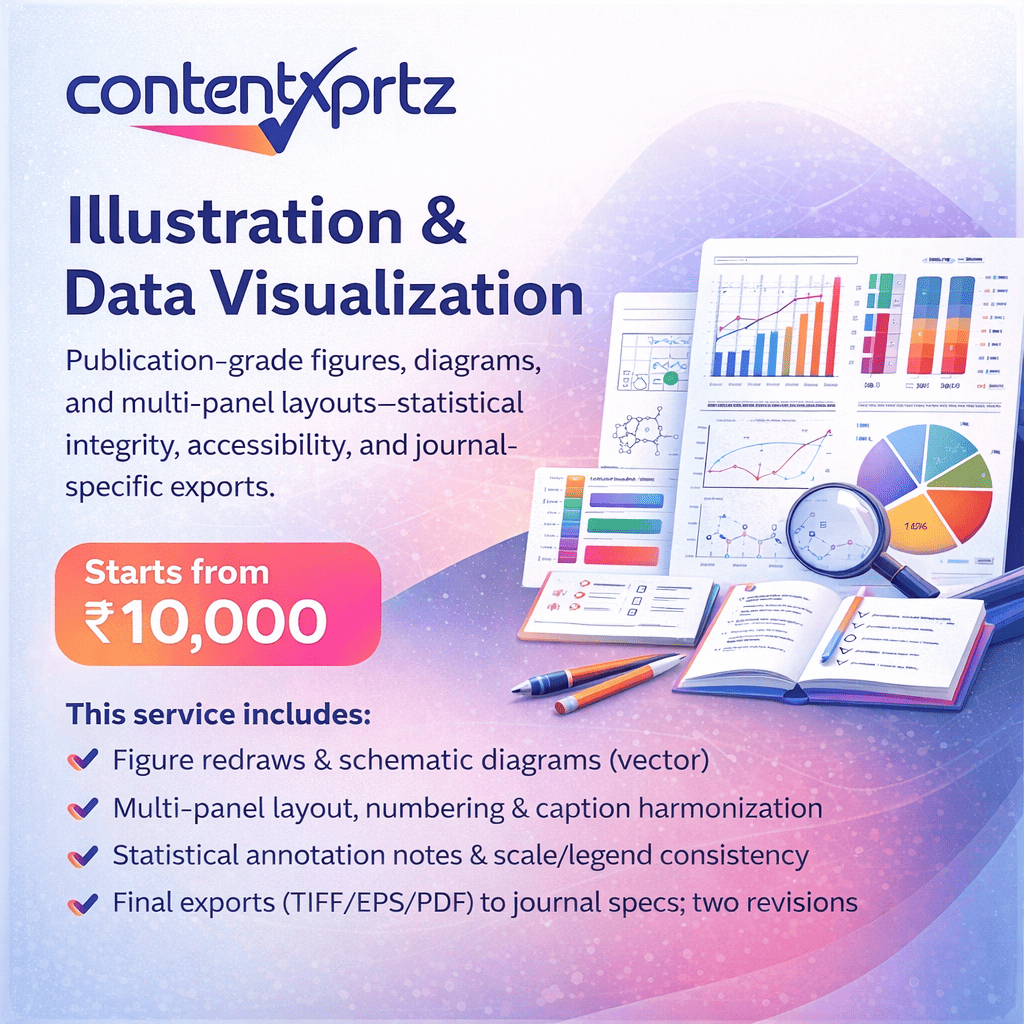
📊 Turn Your Research Figures Into Publication-Ready Visuals
Clarity, precision, and journal-compliant design—handled by experts.
Well-designed illustrations and data visualizations can significantly improve how your research is understood and reviewed. At ContentXprtz, we create publication-grade figures that meet journal standards while preserving the scientific integrity of your work.
What you get with our Illustration & Data Visualization service:
📘 Vector-based figure redraws & schematic diagrams
📄 Clean multi-panel layouts with consistent numbering and captions
🧠 Accurate statistical annotations with aligned scales and legends
🎓 Journal-specific exports (TIFF / EPS / PDF) with two revision rounds
📊 Visuals designed for clarity, accessibility, and reviewer confidence
We follow strict ethical standards—your data remains yours. No fabrication, no manipulation, no loss of author ownership. Only clear, accurate, and transparent visual communication of your research.
Message us on WhatsApp to get started today
WhatsApp: https://wa.me/917065013200
Website: https://contentxprtz.com
#AcademicPublishing #PhDLife #ResearchVisualization #JournalSubmission #PhDScholars #AcademicSupport #ResearchDesign #ScientificIllustration #PhDStudents #HigherEducation #ResearchIntegrity #ScholarlyPublishing #ThesisSupport #PublicationReady #AcademicWritingServices #ResearchCommunication #DoctoralResearch #PostdocLife #STEMResearch #SocialSciences #OpenAccessJournals #ManuscriptPreparation #DataVisualization #ContentXprtz
Illustration & Data Visualization in Academic Research: Turning Complex Ideas into Clear, Publishable Insights
Introduction: Why Illustration & Data Visualization Matter More Than Ever in Academic Research
For PhD scholars and academic researchers, the journey from an initial idea to a published manuscript is rarely linear. It is shaped by time pressure, publication anxiety, reviewer scrutiny, funding constraints, and the growing demand for clarity in research communication. In this demanding landscape, Illustration & Data Visualization have emerged as more than visual enhancements. They now function as essential scholarly tools that directly influence comprehension, credibility, and acceptance outcomes.
In the first paragraph of any high-impact journal article, reviewers often assess whether the research problem is clearly framed. However, as they move deeper into the methodology, results, and discussion sections, they increasingly rely on visual elements to interpret complex data efficiently. According to Elsevier’s author insights, editors and reviewers typically spend limited time on each submission during the first screening stage. Manuscripts that present results through well-structured figures, conceptual frameworks, and data visualizations often communicate value faster and more effectively than text-heavy papers.
Globally, PhD students face unprecedented challenges. UNESCO data indicates that doctoral enrollments have increased steadily over the last decade, while acceptance rates in top-tier journals have remained stagnant or declined. Springer Nature reports acceptance rates often below 15 percent in Q1 journals across disciplines such as management, engineering, medicine, and social sciences. This imbalance has intensified competition, forcing scholars to refine not only what they research but how they present it.
At the same time, research itself has become more data-intensive. Whether you are working with large-scale survey data, qualitative interviews, machine learning outputs, or archival datasets, the volume and complexity of information have grown. Traditional narrative explanations alone are no longer sufficient. Editors now expect authors to demonstrate analytical rigor through clear visual storytelling, where illustrations and data visualizations guide readers logically through hypotheses, methods, results, and implications.
For PhD scholars balancing coursework, teaching responsibilities, funding deadlines, and personal commitments, mastering illustration and visualization techniques can feel overwhelming. Many researchers possess deep subject knowledge but lack formal training in academic visual communication. As a result, strong studies sometimes face rejection due to unclear figures, poorly labeled tables, or inconsistent visual logic. These issues are not methodological flaws. Instead, they are presentation gaps that can be addressed with expert academic support.
This is where professional academic services play a critical role. At ContentXprtz, illustration and data visualization are treated as integral components of scholarly writing, not as afterthoughts. Since 2010, ContentXprtz has supported researchers in more than 110 countries, helping them translate complex data into publication-ready visuals that meet the standards of Elsevier, Springer, Emerald Insight, Taylor and Francis, Wiley, and APA-endorsed journals.
In this comprehensive guide, you will learn how Illustration & Data Visualization enhance academic clarity, improve journal acceptance prospects, and support ethical research communication. You will also gain practical insights, expert commentary, and answers to common PhD-level questions, enabling you to approach visual research communication with confidence and authority.
Understanding Illustration & Data Visualization in Academic Contexts
Illustration and data visualization serve different but complementary purposes in academic research. While illustrations often focus on conceptual clarity, data visualization emphasizes empirical interpretation. Together, they form the backbone of effective scholarly communication.
What Academic Illustrations Really Represent
Academic illustrations include conceptual models, theoretical frameworks, process diagrams, flowcharts, and schematic representations. These visuals help readers understand relationships between variables, stages in a process, or theoretical contributions. For example, a conceptual framework illustrating mediating and moderating variables can clarify complex hypothesis structures far more efficiently than dense paragraphs.
Publishers such as Emerald Insight emphasize that conceptual clarity significantly influences reviewer evaluations, especially in theory-driven disciplines. A well-designed illustration signals that the author understands the research structure at a deep level.
Defining Data Visualization in Research Writing
Data visualization refers to the graphical representation of empirical findings. This includes charts, graphs, heatmaps, regression plots, network diagrams, and statistical summaries. According to Springer Nature’s author guidelines, visualizations should not duplicate textual explanations but complement them by highlighting key patterns, trends, and relationships.
Effective data visualization allows readers to grasp results quickly. It also reduces cognitive load, enabling reviewers to focus on interpretation rather than decoding raw numbers.
Why Illustration & Data Visualization Influence Journal Acceptance
High-quality visuals are no longer optional in academic publishing. They influence decision-making at multiple stages of the publication process.
First-Round Editorial Screening
During desk review, editors assess clarity, originality, and relevance. Manuscripts with poorly structured figures often fail to communicate contribution efficiently. In contrast, clear illustrations immediately signal professionalism and rigor.
Peer Review Evaluation
Reviewers assess whether results support hypotheses and whether interpretations are justified. Data visualizations that clearly represent statistical outcomes reduce ambiguity and reviewer skepticism.
Reader Engagement Post-Publication
Even after publication, articles with strong visual elements receive higher downloads and citations. Elsevier analytics consistently show that visually clear articles enjoy longer reading times and broader dissemination.
Core Principles of Effective Academic Illustration & Data Visualization
To meet publication standards, visuals must adhere to specific scholarly principles.
Accuracy and Integrity
Visuals must reflect data honestly. Misleading scales, omitted variables, or exaggerated effects violate ethical research standards outlined by the APA and Committee on Publication Ethics.
Clarity and Simplicity
Complex data does not require complex visuals. Effective visualization simplifies without distorting meaning. Each figure should answer a specific research question.
Consistency Across the Manuscript
Fonts, colors, labeling conventions, and terminology should remain consistent. Inconsistency undermines perceived rigor.
Alignment with Journal Guidelines
Each publisher provides detailed figure specifications. Taylor and Francis, for instance, specify resolution, color modes, and file formats. Compliance reduces revision cycles.
Illustration & Data Visualization Across PhD Thesis and Research Paper Sections
Visual strategies vary across different parts of an academic document.
Introduction and Literature Review
Conceptual frameworks, theory maps, and citation networks help synthesize prior research. These illustrations demonstrate scholarly positioning and gap identification.
Methodology
Flowcharts, sampling diagrams, and research design schematics clarify procedures. They improve transparency and reproducibility.
Results
Statistical graphs, tables, and plots highlight key findings. Visualization should prioritize hypothesis testing outcomes.
Discussion and Implications
Integrated visuals linking results to theory enhance interpretive depth. Conceptual models may evolve based on findings.
The Role of Professional Academic Support in Visualization Excellence
Many PhD scholars recognize the importance of visuals but struggle with execution. Software limitations, design skills, and time constraints create barriers. Professional academic support bridges this gap.
At ContentXprtz, illustration and visualization support is integrated into academic editing services and research paper writing support. Experts collaborate with scholars to refine visuals without altering intellectual ownership. Ethical standards remain central to every engagement.
Researchers seeking end-to-end assistance often explore PhD thesis help through ContentXprtz’s
PhD & Academic Services, while those preparing journal submissions benefit from
Writing & Publishing Services.
Frequently Asked Questions on Illustration & Data Visualization
FAQ 1: Why do journals emphasize illustration and data visualization so strongly today?
Journals emphasize illustration and data visualization because academic publishing has become increasingly competitive and interdisciplinary. Editors and reviewers often evaluate hundreds of submissions annually. Visual clarity allows them to assess a study’s contribution more efficiently. Data visualization also supports transparency, reproducibility, and methodological rigor, which are core principles promoted by publishers such as Elsevier and Springer Nature. Additionally, modern research involves large datasets that are difficult to interpret through text alone. Visual representations reduce cognitive load, improve comprehension, and enable cross-disciplinary readership. For PhD scholars, this means that strong visuals are not decorative but functional elements that directly influence acceptance decisions and citation impact.
FAQ 2: Can poor data visualization lead to manuscript rejection even if the research is strong?
Yes, poor data visualization can significantly increase the likelihood of rejection. Reviewers often interpret unclear figures as signs of weak analytical skills or insufficient rigor. Even when the underlying data is sound, poorly labeled graphs, inconsistent scales, or confusing layouts can obscure results. According to Taylor and Francis reviewer guidelines, unclear visuals may prevent reviewers from validating findings, leading to negative recommendations. This is why many researchers seek academic editing services to refine visuals before submission.
FAQ 3: How does illustration differ from data visualization in a PhD thesis?
Illustration focuses on conceptual clarity, while data visualization focuses on empirical evidence. Illustrations include theoretical frameworks, process diagrams, and conceptual models that explain how variables relate. Data visualization, on the other hand, presents numerical or categorical data through charts and graphs. In a PhD thesis, both serve complementary roles. Illustrations guide readers through theoretical logic, while data visualizations demonstrate analytical outcomes. Together, they create a coherent scholarly narrative.
FAQ 4: What ethical issues should researchers consider in data visualization?
Ethical data visualization requires honesty, transparency, and accuracy. Researchers must avoid manipulating scales, omitting data points, or exaggerating effects. APA guidelines emphasize that visuals should faithfully represent findings without misleading readers. Ethical breaches in visualization can damage credibility and lead to retractions. Professional research paper assistance ensures compliance with ethical standards while improving clarity.
FAQ 5: Do different journals require different visualization standards?
Yes, each publisher provides specific guidelines for figures and illustrations. Elsevier, Springer, Emerald Insight, and Wiley differ in resolution requirements, color usage, and file formats. Failure to comply often results in revision requests. Understanding these requirements early saves time and reduces stress. ContentXprtz supports researchers by aligning visuals with target journal specifications.
FAQ 6: How can PhD scholars improve visualization skills without design training?
PhD scholars can improve visualization skills by studying published articles in top journals, following publisher guidelines, and using standardized visualization principles. However, time constraints often limit learning opportunities. Professional academic support provides an efficient alternative by offering expert guidance without requiring extensive design training.
FAQ 7: Are data visualization tools like Python or R sufficient for publication-quality figures?
Tools such as Python, R, and SPSS can generate publication-quality figures when used correctly. However, default outputs often require refinement to meet journal aesthetics. Labeling, color schemes, and layout adjustments are critical. Academic editing services help refine these outputs for submission readiness.
FAQ 8: How does data visualization affect interdisciplinary research impact?
Interdisciplinary research often reaches audiences unfamiliar with domain-specific jargon. Clear visuals bridge disciplinary gaps by presenting findings intuitively. This increases accessibility and citation potential. Publishers actively encourage visual clarity to support interdisciplinary dissemination.
FAQ 9: Can professional services assist without altering research ownership?
Ethical academic services focus on presentation and clarity, not content manipulation. At ContentXprtz, scholars retain full intellectual ownership. Experts refine visuals based on author-provided data and interpretations, ensuring ethical compliance.
FAQ 10: When should researchers seek professional illustration and visualization support?
Researchers should seek support during manuscript preparation rather than after rejection. Early intervention reduces revision cycles and improves first-round acceptance chances. Services such as
Student Writing Services and
Book Authors Writing Services provide tailored assistance across academic stages.
Strategic Benefits of Integrating Illustration & Data Visualization Early
Early integration of visualization strategies improves coherence across the research lifecycle. It aligns theory, methodology, and results into a unified narrative. Scholars who plan visuals during research design often experience smoother writing processes and clearer argumentation.
Conclusion: Elevating Research Impact Through Visual Clarity
In today’s competitive academic environment, Illustration & Data Visualization are essential scholarly competencies. They enhance clarity, support ethical communication, and influence journal acceptance outcomes. For PhD scholars navigating time pressure and publication stress, professional academic support provides strategic value.
By combining subject expertise, editorial rigor, and visualization excellence, ContentXprtz empowers researchers to present their work with confidence. Whether you need research paper writing support, academic editing services, or end-to-end publication guidance, ContentXprtz offers globally trusted solutions.
Explore professional support through
Writing & Publishing Services or
Corporate Writing Services to elevate your scholarly impact.
At ContentXprtz, we don’t just edit, we help your ideas reach their fullest potential.
