
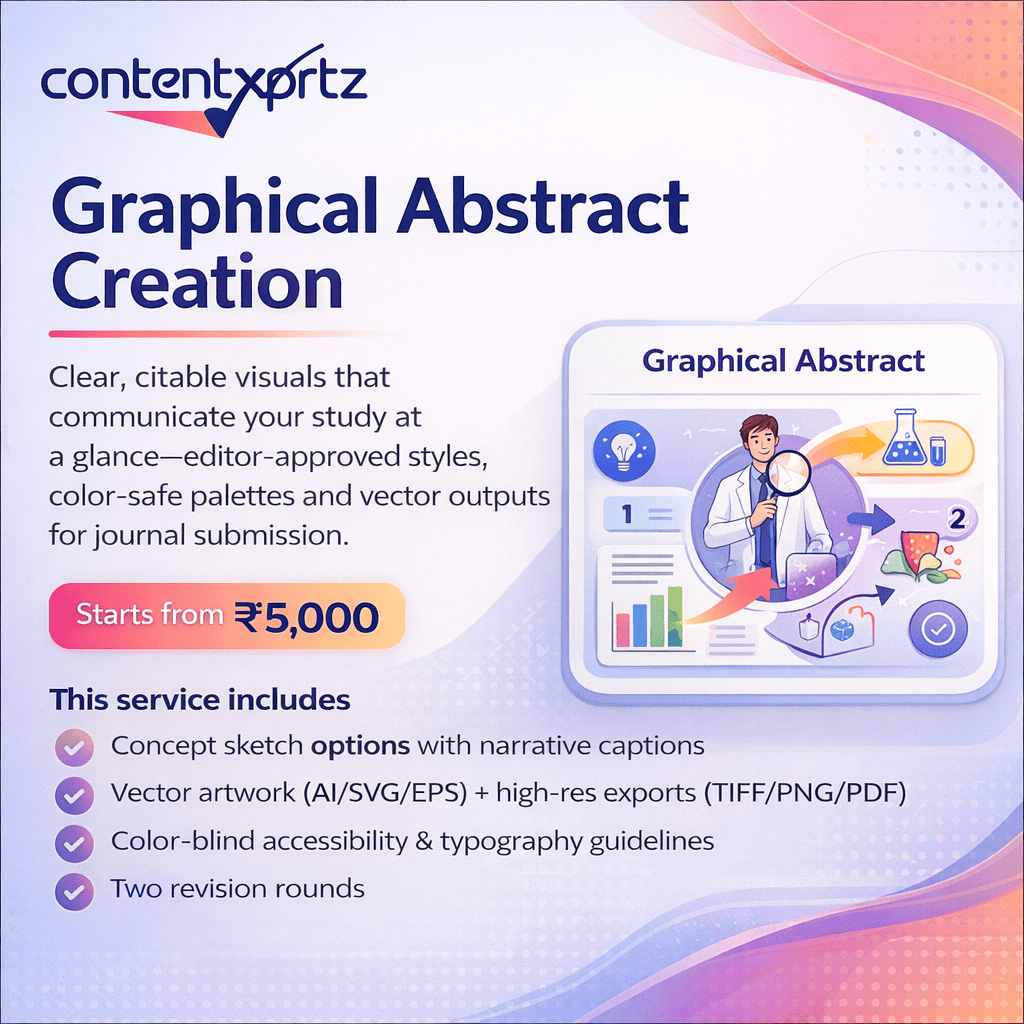
📊 Turn Your Research Into a Powerful Visual Story
Professional Graphical Abstract Creation by ContentXprtz
Make your research instantly clear, citable, and journal-ready with expertly designed graphical abstracts that communicate your study at a glance—without compromising academic rigor.
Our editors and designers translate complex findings into clean, publication-compliant visuals aligned with journal expectations and accessibility standards.
What you get with our Graphical Abstract Creation service:
• Concept sketch options with clear narrative captions
• Vector artwork (AI/SVG/EPS) with high-resolution exports (TIFF/PNG/PDF)
• Color-blind accessibility and academic typography guidelines
• Two structured revision rounds for precision and clarity
We follow strict ethical standards. Your research remains 100% original, fully author-owned, and aligned with journal submission requirements—no templates, no automation misuse.
Starts from ₹5,000
📩 Message us on WhatsApp to get started today
WhatsApp: https://wa.me/917065013200
Website: https://contentxprtz.com
#ContentXprtz #GraphicalAbstract #AcademicPublishing #ResearchDesign #PhDLife #JournalSubmission #ScholarlyCommunication #AcademicSupport #ResearchVisualization #PhDScholars #PostdocLife #ResearchWriting #ScientificPublishing #HigherEducation #ThesisSupport #AcademicIntegrity #PublishOrPerish #ResearchTools #STEMResearch #SocialSciences #DoctoralResearch #OpenScience #EarlyCareerResearchers
From Concept to Impact: Mastering Graphical Abstract Creation for High-Impact Research Publications
Introduction
For PhD scholars, early-career researchers, and seasoned academics alike, publishing in reputable journals has become more competitive than ever. Beyond methodological rigor and theoretical contribution, journals increasingly expect authors to communicate their findings with clarity, precision, and visual impact. Within this evolving scholarly landscape, Graphical Abstract Creation has emerged as a decisive factor in how research is perceived, discovered, and cited.
A graphical abstract is no longer an optional add-on. Today, it is a strategic academic communication tool. Leading publishers such as Elsevier, Springer Nature, Taylor & Francis, and Emerald Insight increasingly recommend or mandate graphical abstracts to enhance article discoverability across digital platforms. Studies in scholarly communication consistently show that articles with strong visual summaries achieve higher engagement, better comprehension, and improved citation performance.
However, for many PhD scholars, graphical abstract creation presents a real challenge. Doctoral researchers already face immense pressure balancing coursework, data collection, teaching responsibilities, grant writing, and strict publication timelines. According to UNESCO’s global research statistics, the number of active researchers worldwide crossed 9 million, while journal acceptance rates in high-impact outlets continue to fall below 15 percent. At the same time, publication costs, revision cycles, and reviewer expectations are rising.
In this context, asking a researcher to also become a visual designer is unrealistic. Most PhD programs emphasize textual rigor, not visual storytelling. As a result, many otherwise strong manuscripts suffer from poorly designed graphical abstracts that confuse rather than clarify. This mismatch can delay peer review, invite unnecessary revisions, or even contribute to desk rejection.
At ContentXprtz, a global academic support provider established in 2010, we have worked with researchers across more than 110 countries. Our experience shows that effective graphical abstract creation is not about decoration. Instead, it is about translation translating complex research into an accurate, ethical, and visually coherent narrative that aligns with journal standards.
This comprehensive guide is designed to help you understand the academic, technical, and strategic dimensions of graphical abstract creation. Whether you are preparing a PhD thesis-derived article, revising a manuscript after reviewer feedback, or aiming to improve research visibility on platforms like Medium and LinkedIn, this article will equip you with evidence-based insights and best practices grounded in real publishing standards.
Understanding Graphical Abstract Creation in Academic Publishing
What Is a Graphical Abstract?
A graphical abstract is a single, concise visual representation of a research study’s core message. Unlike traditional abstracts, which rely on dense academic language, graphical abstracts communicate through structured visuals, symbols, minimal text, and logical flow.
Most journals expect a graphical abstract to answer three core questions:
-
What problem does the study address?
-
What methodology or approach is used?
-
What is the primary outcome or contribution?
When designed correctly, a graphical abstract allows editors, reviewers, and readers to grasp the essence of a paper within seconds.
Why Journals Emphasize Graphical Abstracts
Publishers prioritize graphical abstracts for several reasons:
-
Improved discoverability on digital platforms and social media
-
Enhanced reader engagement and comprehension
-
Faster editorial screening during desk review
-
Better cross-disciplinary accessibility
Elsevier reports that articles with graphical abstracts often receive higher downloads and broader dissemination, especially in applied sciences, medicine, engineering, and management research.
The Strategic Role of Graphical Abstract Creation for PhD Scholars
Beyond Aesthetics: Academic and Ethical Considerations
Graphical abstract creation is not merely a design task. It is an academic responsibility. Any visual summary must accurately reflect the research findings without exaggeration or oversimplification. Ethical graphical abstracts avoid misleading visuals, unsupported claims, or decorative elements that distort meaning.
At ContentXprtz, our editorial and design teams collaborate to ensure that every graphical abstract aligns with publication ethics defined by APA and COPE guidelines.
Linking Visuals to Research Impact
A well-crafted graphical abstract can:
-
Increase article visibility on publisher platforms
-
Improve social sharing and academic outreach
-
Support conference presentations and posters
-
Strengthen researcher branding on LinkedIn and Medium
For early-career researchers, this visibility often translates into citations, collaborations, and funding opportunities.
The Graphical Abstract Creation Process: A Step-by-Step Academic Framework
Step 1: Research Deconstruction
The process begins with a deep editorial review of the manuscript. Editors identify:
-
Core research question
-
Key methodological elements
-
Primary findings and implications
This stage ensures that the graphical abstract remains academically faithful.
Step 2: Visual Narrative Design
Next, designers structure the visual flow. Common layouts include:
-
Left-to-right process flows
-
Problem–method–outcome frameworks
-
Conceptual or model-based diagrams
Typography, color palettes, and icons are selected to align with journal specifications.
Step 3: Compliance With Journal Guidelines
Each publisher provides specific requirements regarding size, resolution, file format, and text limits. Non-compliance often leads to revision requests. Professional graphical abstract creation accounts for these constraints from the outset.
Step 4: Academic Quality Review
Before submission, the graphical abstract undergoes academic validation to confirm accuracy, clarity, and ethical alignment.
Common Mistakes in Graphical Abstract Creation
Many researchers unintentionally weaken their submissions due to avoidable errors:
-
Overloading visuals with excessive text
-
Using decorative graphics unrelated to findings
-
Ignoring journal-specific guidelines
-
Oversimplifying complex results
-
Mismatched terminology between text and visuals
Addressing these issues early saves time, cost, and reviewer frustration.
When Professional Graphical Abstract Creation Becomes Essential
While some researchers attempt do-it-yourself solutions, professional support becomes crucial when:
-
Targeting Q1 or high-impact journals
-
Facing revision requests related to clarity
-
Publishing interdisciplinary or data-heavy research
-
Preparing articles for broader dissemination
Researchers seeking integrated support often explore academic editing services and research paper writing support alongside graphical abstract creation through services such as PhD & Academic Services and Writing & Publishing Services.
FAQs: Graphical Abstract Creation and Academic Publishing
FAQ 1: Why do journals increasingly require graphical abstracts?
Journals require graphical abstracts because academic publishing has become highly digital and attention-driven. Editors manage thousands of submissions annually and rely on rapid visual cues to assess relevance. Graphical abstracts support faster editorial screening and improve reader comprehension across disciplines. From a dissemination perspective, publishers actively promote visually engaging articles on social media, newsletters, and indexing platforms. This trend reflects broader shifts in knowledge consumption rather than reduced academic rigor. Importantly, graphical abstracts do not replace textual abstracts. Instead, they complement them by enhancing accessibility while preserving scholarly depth.
FAQ 2: Can a poor graphical abstract affect journal acceptance?
Yes, indirectly. While journals do not reject papers solely based on graphical abstracts, unclear or misleading visuals can influence editorial perception. Reviewers may question the author’s ability to communicate findings effectively. In some cases, editors request revisions, delaying publication. A poorly constructed graphical abstract may also misrepresent results, raising ethical concerns. Professional graphical abstract creation mitigates these risks by ensuring clarity, compliance, and alignment with the manuscript.
FAQ 3: Is graphical abstract creation relevant for humanities and management research?
Although initially common in sciences, graphical abstracts are increasingly adopted in management, economics, and interdisciplinary humanities research. Conceptual frameworks, process models, and theoretical contributions can be effectively visualized. For management scholars publishing in Emerald or Taylor and Francis journals, graphical abstracts often summarize conceptual models or empirical relationships. The key lies in academic translation rather than visual embellishment.
FAQ 4: How does graphical abstract creation support PhD thesis publications?
PhD-derived articles often contain complex methodologies and extensive datasets. Graphical abstracts help distill these elements into digestible visuals, making the research more accessible to editors and reviewers. This clarity supports smoother peer review and strengthens the overall submission. Many doctoral researchers integrate graphical abstract creation with PhD thesis help and editorial services to improve publication outcomes.
FAQ 5: Should graphical abstracts be created before or after manuscript finalization?
Graphical abstracts should be created after the manuscript reaches conceptual stability. Any major revisions to results or methodology require corresponding visual updates. However, early conceptual sketches can support clarity during revision. Professional services typically develop graphical abstracts once the paper is near submission readiness to avoid rework.
FAQ 6: Are AI tools sufficient for graphical abstract creation?
AI tools can generate basic layouts but lack academic judgment. They often misinterpret research context, oversimplify results, or violate journal ethics. AI-generated visuals may also reuse templates, risking originality concerns. Human-led graphical abstract creation ensures contextual accuracy, ethical compliance, and originality aligned with scholarly standards.
FAQ 7: How do graphical abstracts support researcher visibility on LinkedIn and Medium?
Graphical abstracts perform exceptionally well on professional platforms. They attract attention, encourage sharing, and communicate expertise quickly. For researchers building academic profiles, sharing graphical abstracts alongside article links increases engagement and professional credibility.
FAQ 8: What role does academic editing play in graphical abstract creation?
Academic editing ensures terminological consistency, conceptual accuracy, and ethical integrity. Editors work alongside designers to confirm that visuals reflect the manuscript precisely. This integration distinguishes professional services from standalone design solutions.
FAQ 9: How long does professional graphical abstract creation take?
Timelines vary based on complexity and journal requirements. On average, professional graphical abstract creation takes three to five working days, including review cycles. Rush options may be available for time-sensitive submissions.
FAQ 10: How does ContentXprtz approach graphical abstract creation differently?
ContentXprtz integrates editorial expertise with academic design. Our process begins with subject-matter analysis, followed by journal-compliant visual development and ethical review. This ensures that graphical abstracts are not only visually effective but academically credible.
Conclusion: Elevating Research Through Strategic Graphical Abstract Creation
Graphical abstract creation has become a defining element of modern academic publishing. When executed with precision, it enhances clarity, visibility, and scholarly impact. When neglected or rushed, it can undermine even the strongest research.
For PhD scholars and researchers navigating an increasingly competitive publishing environment, investing in professional graphical abstract creation is no longer optional. It is a strategic decision that supports faster review, stronger engagement, and broader dissemination.
Researchers seeking integrated support may explore Student Writing Services, Book Authors Writing Services, and Corporate Writing Services alongside publication assistance.
At ContentXprtz, we combine academic precision, ethical rigor, and visual clarity to support researchers worldwide.
Explore our PhD Assistance Services today and strengthen your publication journey.
At ContentXprtz, we don’t just edit — we help your ideas reach their fullest potential.
