
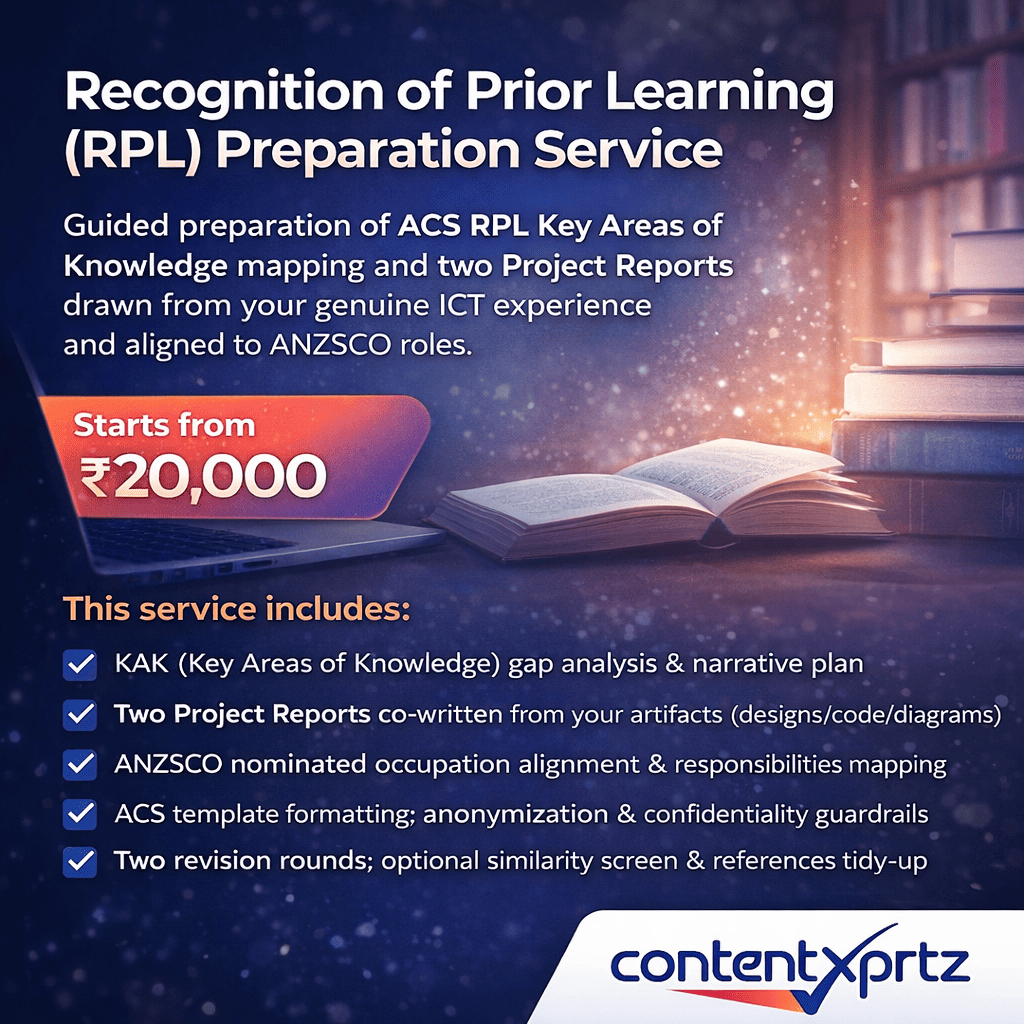
🎓 Recognition of Prior Learning (RPL) — Done Right
📘 Translate your real ICT experience into a strong, compliant ACS RPL application.
Our RPL Preparation Service helps you present your professional journey with clarity, structure, and accuracy—fully aligned to ACS requirements and ANZSCO roles, without compromising ethics or originality.
How we support you:
📄 Clear KAK (Key Areas of Knowledge) gap analysis & narrative planning
🧠 Two Project Reports developed from your genuine work evidence
📘 ANZSCO role alignment & responsibilities mapping
🔒 ACS-compliant formatting with anonymization & confidentiality safeguards
✍️ Two revision rounds + optional similarity screening & reference tidy-up
Ethical & transparent process
Your experience. Your ownership. No fabrication—only structured guidance that reflects your authentic ICT career.
Starts from ₹20,000
📩 Message us on WhatsApp to get started today
WhatsApp: https://wa.me/917065013200
Website: https://contentxprtz.com
#ContentXprtz #RPLPreparation #ACSAssessment #ICTProfessionals #PhDSupport #AcademicServices #HigherEducation #ResearchSupport #ProfessionalWriting #AcademicIntegrity #PublicationSupport #PhDScholars #PostdoctoralResearch #AcademicCareers #ANZSCO #ResearchWriting #ScholarlySupport #EthicalWriting #StudentSupport #AcademicConsulting #ResearchJourney #CareerMigration #Academia
Navigating Academic Recognition with Confidence: A Comprehensive Guide to RPL Preparation Service for Researchers and Scholars
Introduction
For students, PhD scholars, and academic researchers worldwide, the journey through higher education is both intellectually rewarding and structurally demanding. Beyond producing original research and meeting supervisory expectations, scholars today must navigate increasingly complex academic and professional frameworks. One such framework is Recognition of Prior Learning (RPL), a process that evaluates an individual’s existing academic, professional, and experiential learning against formal qualification standards. In this context, a RPL Preparation Service has emerged as a critical academic support mechanism, particularly for mid-career professionals, doctoral candidates, and international scholars seeking formal recognition of their scholarly and professional expertise.
In the first paragraph itself, it is essential to emphasize that an effective RPL Preparation Service is not merely about documentation. Instead, it is about academic positioning, evidence-based mapping, and scholarly articulation. For many researchers, especially those balancing doctoral work with teaching, industry roles, or funded projects, RPL becomes a strategic pathway to accelerate qualifications, reduce redundancy, and formalize years of intellectual labor.
Globally, doctoral education is under pressure. According to UNESCO, the number of PhD graduates has grown steadily over the last two decades, yet completion rates remain uneven across regions. Studies reported by the Organisation for Economic Co-operation and Development (OECD) indicate that nearly 30 percent to 50 percent of doctoral candidates fail to complete their PhD within the expected timeframe. Contributing factors include time constraints, publication pressure, funding limitations, and increasing institutional quality benchmarks. At the same time, journal acceptance rates continue to decline. Leading academic publishers such as Elsevier and Springer report average acceptance rates between 10 percent and 20 percent for reputable journals, making scholarly progression more competitive than ever.
Within this environment, RPL serves as both an academic and professional equalizer. It allows universities and accrediting bodies to formally recognize prior learning outcomes derived from research publications, teaching portfolios, professional practice, conference participation, and applied scholarship. However, while the concept of RPL is well established, its execution is academically rigorous. Candidates are expected to present structured evidence, reflective narratives, learning outcome mappings, and discipline-aligned justification. This is where a professional RPL Preparation Service becomes indispensable.
At ContentXprtz, a global academic support provider established in 2010, RPL preparation is approached with the same scholarly rigor as PhD thesis editing or journal publication support. With experience supporting researchers across more than 110 countries, ContentXprtz understands that RPL is not a shortcut. Instead, it is a formal academic process that demands precision, ethical compliance, and strategic academic writing. Through tailored guidance, academic editing, and evidence mapping, a well-structured RPL Preparation Service empowers scholars to translate experience into recognized academic value.
This comprehensive article is designed for students, PhD scholars, and academic researchers seeking clarity, authority, and trust in navigating RPL. It explains what RPL entails, why professional preparation matters, how academic standards are applied, and how expert support can significantly improve outcomes. Throughout, the discussion integrates best practices from leading academic institutions and publishers such as Elsevier, Springer, Emerald Insight, Taylor and Francis, and the American Psychological Association (APA), ensuring that the guidance provided is both credible and globally relevant.
Understanding RPL in the Academic and Research Context
What Is Recognition of Prior Learning (RPL)?
Recognition of Prior Learning refers to a formal assessment process through which universities and accrediting institutions evaluate an individual’s existing knowledge, skills, and competencies against the learning outcomes of a specific qualification. In academic settings, RPL often applies to postgraduate diplomas, doctoral coursework exemptions, professional doctorates, and credit transfers.
For researchers and PhD scholars, RPL typically draws on evidence such as:
-
Peer-reviewed journal publications
-
Conference papers and keynote presentations
-
Research grants and funded projects
-
Teaching portfolios and curriculum development
-
Industry research reports and white papers
-
Professional certifications aligned with academic outcomes
The challenge lies not in possessing this experience, but in presenting it in a structured, academically defensible manner. Universities require candidates to explicitly demonstrate how prior learning meets specific course or qualification outcomes. This is a scholarly exercise, not an administrative one.
Why RPL Has Become Increasingly Relevant
The globalization of education and the rise of interdisciplinary research careers have made linear academic pathways less common. Many scholars enter doctoral programs after years in industry or research roles. Others accumulate substantial academic output before formally enrolling in higher degrees. As a result, RPL has become an essential mechanism to avoid duplication of learning and recognize intellectual capital.
However, RPL applications are often rejected or delayed due to poor academic framing, insufficient evidence mapping, or lack of alignment with institutional criteria. A structured RPL Preparation Service addresses these gaps by ensuring that the submission meets both academic and procedural standards.
The Role of a Professional RPL Preparation Service
Beyond Documentation: Academic Strategy and Evidence Mapping
A common misconception among applicants is that RPL is simply about compiling documents. In reality, assessors evaluate the academic coherence, reflective depth, and outcome alignment of the submission. Each piece of evidence must be contextualized, critically explained, and mapped to formal learning descriptors.
A professional RPL Preparation Service supports scholars by:
-
Interpreting institutional RPL frameworks and rubrics
-
Structuring reflective narratives using academic conventions
-
Mapping experiential learning to qualification outcomes
-
Editing content for clarity, coherence, and scholarly tone
-
Ensuring compliance with ethical and referencing standards
At ContentXprtz, RPL preparation draws on the same editorial principles used in PhD thesis support and journal submission assistance. This ensures consistency, credibility, and academic defensibility.
Alignment with Global Academic Standards
Leading publishers such as Elsevier and Springer emphasize transparency, methodological rigor, and ethical clarity in scholarly communication. These same principles apply to RPL submissions. Universities increasingly expect RPL portfolios to demonstrate not only experience, but also reflective learning and theoretical grounding.
By integrating best practices from academic publishing, a professional RPL Preparation Service enhances the credibility of the application and aligns it with international academic expectations.
How RPL Preparation Intersects with PhD and Academic Support
RPL and Doctoral Coursework Exemptions
In many doctoral programs, especially professional doctorates and structured PhDs, candidates are required to complete coursework modules. RPL can be used to seek exemptions based on prior research training, teaching experience, or published work. However, exemptions are granted only when learning equivalence is clearly demonstrated.
Scholars seeking such exemptions benefit from expert academic guidance that frames their experience in outcome-based language. ContentXprtz integrates RPL preparation with broader PhD thesis help, ensuring that coursework exemptions align with long-term doctoral objectives.
RPL as a Strategic Academic Tool
When used strategically, RPL can:
-
Reduce time to qualification
-
Lower tuition and associated costs
-
Allow greater focus on original research
-
Strengthen academic profiles through reflective articulation
However, poorly prepared RPL submissions can have the opposite effect, leading to delays and rejections. This reinforces the value of professional academic editing services and structured support.
Ethical Considerations in RPL Preparation
Academic Integrity and Transparency
Ethical compliance is central to RPL. Institutions require assurance that evidence is authentic, learning claims are accurate, and reflective narratives are original. Professional RPL Preparation Service providers must adhere to strict ethical guidelines, avoiding misrepresentation or inflated claims.
ContentXprtz follows the ethical standards advocated by the American Psychological Association (APA) and leading academic publishers. This includes:
-
Proper citation and attribution
-
Clear distinction between evidence and reflection
-
Avoidance of ghostwriting or falsification
This ethical foundation is critical to building trust with institutions and assessors.
Internal Academic Support Pathways at ContentXprtz
RPL preparation does not exist in isolation. Many scholars seeking RPL support also require complementary academic services. ContentXprtz offers integrated pathways, including:
-
PhD thesis help and doctoral editing through its PhD and Academic Services
-
Comprehensive academic editing services and journal support via Writing and Publishing Services
-
Tailored support for early-career researchers and postgraduate students through Student Writing Services
-
Specialized assistance for monographs and edited volumes under Book Authors Writing Services
-
Research communication and documentation support for professionals through Corporate Writing Services
By integrating RPL Preparation Service with these offerings, ContentXprtz ensures holistic academic progression.
Frequently Asked Questions on RPL Preparation Service
1. What exactly does an RPL Preparation Service include for PhD scholars?
An RPL Preparation Service for PhD scholars typically includes academic consultation, evidence review, reflective narrative development, and alignment with institutional learning outcomes. The service goes beyond formatting documents. It involves analyzing the scholar’s academic and professional history, identifying relevant learning experiences, and translating them into structured academic arguments.
For doctoral candidates, this often means mapping publications, teaching experience, and research projects to doctoral-level competencies. The preparation process also includes academic editing to ensure clarity, coherence, and formal tone. Ethical compliance and proper referencing are integral components. When delivered professionally, an RPL Preparation Service significantly improves the likelihood of institutional approval.
2. Can RPL reduce the duration of a PhD or postgraduate program?
Yes, RPL can reduce program duration when institutions grant credit exemptions or coursework waivers. However, this outcome depends on the quality of the RPL submission and the alignment of prior learning with program requirements. A professionally prepared RPL submission demonstrates equivalence in learning outcomes, not just experience.
It is important to note that RPL does not bypass research requirements. Instead, it allows scholars to focus more intensively on original research by reducing redundant coursework. Expert guidance ensures that RPL claims are realistic, defensible, and strategically aligned with program goals.
3. Is RPL applicable only to industry professionals, or can academics apply as well?
RPL is applicable to both industry professionals and academics. Many academics accumulate substantial teaching, research, and publication experience before enrolling in formal qualifications. RPL allows this experience to be formally recognized.
For academics, evidence may include peer-reviewed publications, curriculum design, supervision records, and conference participation. A professional RPL Preparation Service helps academics articulate reflective learning and theoretical grounding, which are critical for successful assessment.
4. How do universities assess RPL submissions?
Universities assess RPL submissions against predefined learning outcomes and qualification frameworks. Assessors look for clear evidence of learning, reflective insight, and academic alignment. They also evaluate the authenticity and relevance of supporting documents.
Institutions often use national qualification frameworks and internal rubrics. Professional preparation ensures that submissions speak the language of assessors, increasing credibility and clarity.
5. What are common reasons for RPL application rejection?
Common reasons include poor alignment with learning outcomes, insufficient reflective analysis, unclear evidence mapping, and weak academic writing. Some applications fail because candidates underestimate the scholarly rigor required.
A structured RPL Preparation Service addresses these issues by providing academic framing, clarity, and coherence. This significantly reduces the risk of rejection.
6. How important is academic writing quality in RPL submissions?
Academic writing quality is critical. RPL submissions are assessed by academics who expect formal tone, logical structure, and theoretical awareness. Poor language quality can undermine otherwise strong evidence.
Professional academic editing services ensure that the submission meets scholarly standards. This includes sentence clarity, coherence, and adherence to referencing conventions.
7. Are RPL submissions subject to plagiarism checks?
Yes, many institutions subject RPL submissions to plagiarism screening. Reflective narratives must be original, and any referenced material must be properly cited. Ethical compliance is non-negotiable.
A reputable RPL Preparation Service emphasizes originality and proper attribution, aligning with guidelines from bodies such as the APA.
8. Can international scholars apply for RPL?
International scholars are eligible for RPL in many institutions, particularly where prior learning aligns with recognized qualification frameworks. However, documentation and academic framing must meet local standards.
Professional support is especially valuable for international candidates, as it bridges differences in academic conventions and expectations.
9. How long does RPL preparation typically take?
The duration varies depending on the complexity of the candidate’s background and institutional requirements. On average, professional RPL preparation may take several weeks, including consultation, drafting, review, and revision.
Early engagement with a RPL Preparation Service allows adequate time for refinement and alignment, reducing last-minute stress.
10. How does ContentXprtz ensure quality and ethical compliance in RPL preparation?
ContentXprtz applies the same quality assurance frameworks used in PhD thesis editing and journal publication support. This includes subject-specialist review, ethical checks, and academic editing aligned with international standards.
By grounding RPL preparation in established academic practices, ContentXprtz ensures that submissions are credible, transparent, and defensible.
Conclusion: Advancing Academic Recognition with Confidence
Recognition of Prior Learning is a powerful academic mechanism when approached with rigor, strategy, and ethical clarity. For students, PhD scholars, and researchers, a professional RPL Preparation Service transforms experience into formally recognized academic value. It reduces redundancy, accelerates progression, and strengthens scholarly identity.
At ContentXprtz, RPL preparation is not treated as an administrative task. Instead, it is approached as a scholarly exercise grounded in academic writing excellence, ethical integrity, and global publishing standards. By integrating RPL support with comprehensive PhD assistance services, ContentXprtz empowers scholars to navigate complex academic pathways with confidence.
If you are seeking expert guidance, structured academic support, and ethically grounded preparation, explore our PhD and Academic Services and discover how professional RPL preparation can support your academic journey.
At ContentXprtz, we don’t just edit, we help your ideas reach their fullest potential.
