
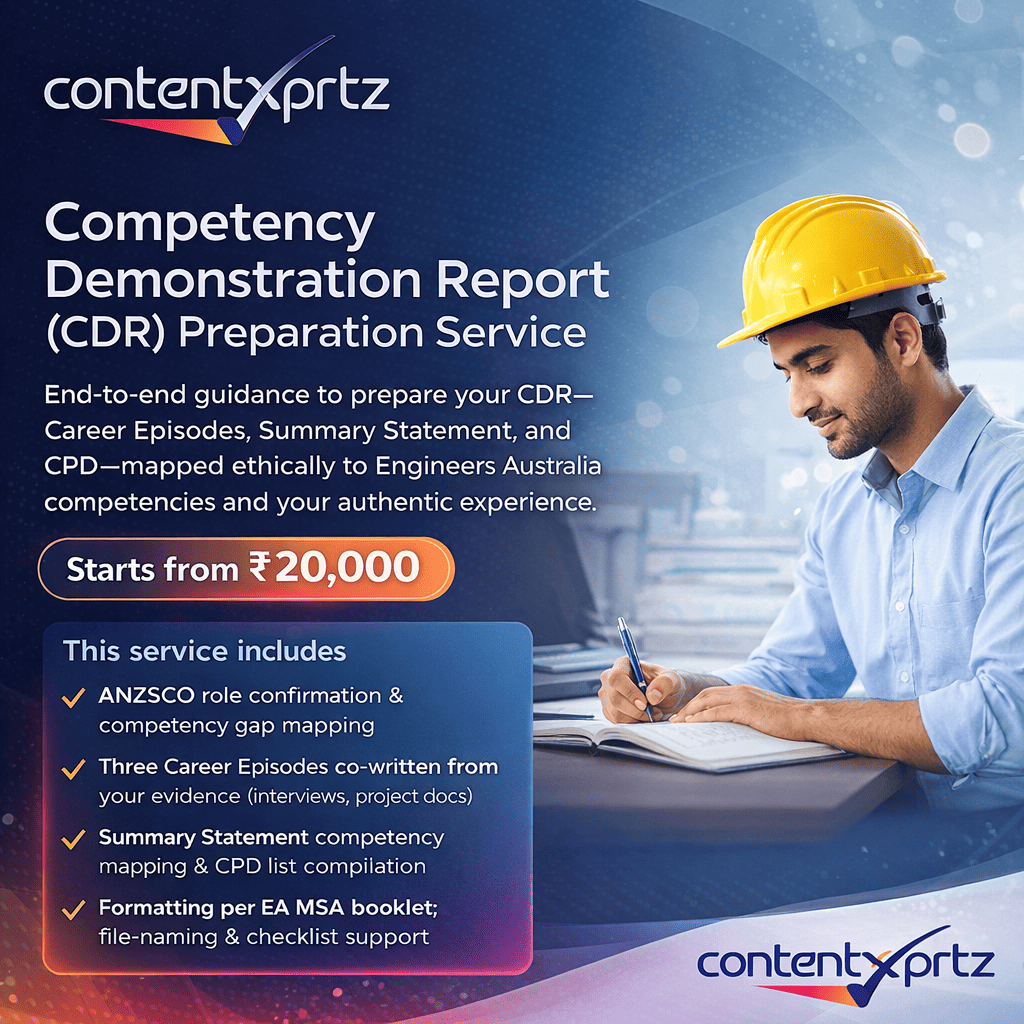
📘 CDR Preparation That Reflects Your True Engineering Competence
Professional, ethical, and Engineers Australia–aligned support you can trust.
Preparing a Competency Demonstration Report (CDR) requires clarity, structure, and precise competency mapping. ContentXprtz provides end-to-end guidance to help you present your Career Episodes, Summary Statement, and CPD accurately—based strictly on your authentic engineering experience.
🎓 Our CDR Preparation Service includes:
📄 ANZSCO role confirmation & competency gap mapping
📄 Three Career Episodes co-written from your real evidence (interviews, project documents)
📄 Summary Statement competency mapping & CPD list compilation
📄 Formatting as per EA MSA booklet, file-naming & checklist support
📄 Two revision rounds with optional similarity screening (Turnitin/iThenticate)
🧠 Ethical. Original. Author-owned.
We do not fabricate experience—your career story remains yours, strengthened with expert structure and compliance support.
💰 Starts from ₹20,000
👉 Message us on WhatsApp to get started today
WhatsApp: https://wa.me/917065013200
Website: https://contentxprtz.com
#CDRPreparation #EngineersAustralia #PhDSupport #AcademicWritingServices #ResearchSupport #HigherEducation #PhDScholars #PostdoctoralResearch #AcademicServices #PublicationSupport #ResearchWriting #EngineeringMigration #MSAAustralia #CareerEpisodes #SummaryStatement #CPD #EthicalAcademicSupport #StudentSupport #ResearchCareer #EngineeringProfessionals #PhDLife #AcademicExcellence #StudyAbroadSupport #ContentXprtz
From Competency to Approval: How a Professional CDR Preparation Service Shapes Engineering Careers Globally
Introduction
For many engineers, the dream of building a global career in countries such as Australia often depends on a single, decisive document: the Competency Demonstration Report. The process appears straightforward at first glance. However, once engineers begin preparing their documentation, the complexity becomes evident. This is where a CDR Preparation Service becomes not just helpful, but essential.
Engineers today operate in a highly competitive global environment. According to UNESCO, the number of globally mobile professionals has increased steadily over the past decade, driven by skills shortages in developed economies and globalization of technical expertise. Australia alone has identified engineering as a priority occupation group, with migration programs tightly linked to professional competency verification through Engineers Australia.
Yet, despite strong technical backgrounds, many engineers struggle to translate years of professional experience into a narrative that meets Engineers Australia standards. Academic training rarely prepares professionals for reflective, evidence-based competency writing. As a result, rejection rates remain high for self-prepared CDRs, often due to plagiarism risks, weak career episodes, or misalignment with competency indicators.
PhD scholars and research-oriented engineers face additional pressure. They balance academic deadlines, publication expectations, research funding constraints, and career transitions. Time scarcity, rising costs of international migration, and increasing scrutiny by assessing authorities add to this burden. A professionally guided CDR Preparation Service reduces these risks while preserving ethical authorship and technical integrity.
At ContentXprtz, established in 2010, we work with engineers and researchers across more than 110 countries. Our role extends beyond editing. We guide professionals through structured competency mapping, narrative clarity, and compliance with Engineers Australia guidelines. This article offers an in-depth, evidence-based guide to CDR preparation, outlining best practices, common pitfalls, and how expert academic support improves outcomes.
Understanding the Competency Demonstration Report Framework
What Is a CDR and Why It Matters
A Competency Demonstration Report is a formal document required by Engineers Australia to assess whether an engineer meets Australian professional standards. It evaluates not only technical competence but also communication, ethical practice, and professional development.
A complete CDR includes:
-
Three Career Episodes
-
Summary Statement
-
Continuing Professional Development list
Each section must align with Engineers Australia competency elements and indicators. Misalignment often leads to negative assessments, regardless of technical merit.
Common Reasons for CDR Rejection
Engineers Australia publishes strict assessment criteria. Based on publicly available guidance and migration consultancy reviews, frequent rejection causes include:
-
Excessive technical descriptions without reflective analysis
-
Plagiarism or similarity with sample CDRs
-
Poor mapping between career episodes and competency elements
-
Inconsistent writing tone and structure
-
Failure to demonstrate ethical engineering practice
A structured CDR Preparation Service addresses these challenges systematically.
Why Engineers Choose Professional CDR Preparation Support
Translating Experience into Competency Evidence
Technical expertise alone does not guarantee approval. Engineers must demonstrate how they applied knowledge, solved problems, and adhered to professional standards. This reflective approach mirrors academic research writing, where argumentation and evidence matter as much as results.
ContentXprtz applies academic editing principles commonly used in journals published by Elsevier, Springer, and Emerald Insight to ensure clarity, originality, and compliance.
Ethical Writing and Plagiarism Control
Engineers Australia uses advanced similarity detection tools. Ethical writing is non-negotiable. At ContentXprtz, every CDR is developed from scratch, supported by interviews, document analysis, and originality checks aligned with standards recommended by the American Psychological Association.
For reference, see:
-
Elsevier Research Ethics Guidelines: https://www.elsevier.com/about/policies/research-integrity
-
APA Ethical Writing Practices: https://www.apa.org/research/responsible
How ContentXprtz Delivers a High-Impact CDR Preparation Service
Step-by-Step Methodology
Our approach integrates academic rigor with professional engineering standards:
-
Competency assessment against Engineers Australia guidelines
-
Detailed engineer interview to extract experiential insights
-
Career episode structuring using STAR methodology
-
Technical and linguistic editing by subject specialists
-
Summary statement mapping and validation
-
Multi-layer quality checks and plagiarism screening
This mirrors best practices used in academic manuscript preparation for Springer Nature and Taylor and Francis publications.
Who Benefits Most from Professional CDR Support
-
Engineers transitioning from academia to industry
-
PhD holders applying for skilled migration
-
Professionals with multinational work experience
-
Engineers with gaps in documentation
-
Applicants facing reassessment or appeal
Explore our broader PhD thesis help and academic editing services here:
https://contentxprtz.com/phd-academic-services
Integrated FAQs on CDR Preparation and Academic Support
FAQ 1: Is using a CDR Preparation Service ethical and acceptable?
Using a professional CDR Preparation Service is ethical when the service focuses on guidance, editing, and structuring rather than ghostwriting false experiences. Engineers Australia permits professional assistance provided the content is original and based on the applicant’s real experience. Ethical services follow a consultative model, similar to academic editing for peer-reviewed journals. At ContentXprtz, engineers remain the authors of their CDRs, while experts ensure clarity, compliance, and originality. This approach aligns with publication ethics standards promoted by Elsevier and Emerald Insight.
FAQ 2: How is CDR writing different from academic writing?
CDR writing emphasizes reflective professional practice rather than theoretical contribution. However, both require structured argumentation, evidence-based narration, and ethical authorship. Academic editing techniques such as coherence, logical flow, and clarity significantly improve CDR quality. Engineers with research backgrounds often adapt well when guided properly.
FAQ 3: Can a PhD holder reuse thesis content in a CDR?
Direct reuse is strongly discouraged. Engineers Australia evaluates professional engineering practice, not academic research alone. While research experience may be relevant, it must be contextualized within applied engineering outcomes. Professional editing ensures appropriate transformation of academic material into competency-based narratives.
FAQ 4: How long does professional CDR preparation take?
Timelines vary based on experience complexity. On average, ethical CDR preparation requires four to six weeks. Rushed preparation often leads to weak narratives and higher rejection risk. Structured planning improves quality and compliance.
FAQ 5: What role does plagiarism detection play in CDR assessment?
Plagiarism is a leading cause of rejection. Engineers Australia applies similarity checks comparable to academic publishers. Professional services conduct multiple originality scans and rewrite sections to ensure authenticity, similar to journal submission protocols.
FAQ 6: Does Engineers Australia verify employment details?
Yes. Engineers Australia may request employment verification or additional documentation. CDR narratives must align with verifiable facts. Academic-style consistency between documents strengthens credibility.
FAQ 7: Can a rejected CDR be improved?
Yes. Reassessment cases benefit significantly from expert review. Identifying gaps in competency mapping and narrative depth often leads to successful resubmission. ContentXprtz has supported multiple reassessment cases globally.
FAQ 8: How does CPD documentation affect CDR outcomes?
Continuing Professional Development demonstrates lifelong learning, a core professional competency. Well-documented CPD activities aligned with industry standards strengthen applications.
FAQ 9: Are sample CDRs safe to use?
Public samples pose high plagiarism risk. Engineers Australia explicitly warns against copying templates. Professional services create personalized frameworks without replicating sample language.
FAQ 10: How does ContentXprtz differ from generic migration consultancies?
ContentXprtz operates as an academic-first organization. Our editors are trained in scholarly publishing standards used by Springer, Emerald, and Taylor and Francis. This ensures ethical rigor, narrative depth, and compliance beyond basic consultancy support.
Supporting Engineers Beyond CDR Preparation
While CDR preparation is a core service, ContentXprtz supports professionals across their academic and career lifecycle. Our services include:
-
Research paper writing support
https://contentxprtz.com/writing-publishing-services -
Student academic writing assistance
https://contentxprtz.com/student-career-academic-writing-services -
Book and technical authorship services
https://contentxprtz.com/book-authors-writing-services -
Corporate and technical documentation
https://contentxprtz.com/corporate-writing-services
This integrated support model ensures consistency, credibility, and long-term career impact.
Conclusion: Choosing the Right CDR Preparation Partner
A successful CDR is not about embellishment. It is about clarity, evidence, and ethical representation of professional competence. As global engineering migration becomes more competitive, expert-guided documentation significantly improves approval outcomes.
ContentXprtz combines academic precision, engineering domain expertise, and ethical writing practices trusted by researchers worldwide since 2010. Our global teams support engineers locally while maintaining international quality benchmarks.
If you are seeking reliable, ethical, and expert-led CDR Preparation Service, explore our PhD and Academic Assistance solutions today.
At ContentXprtz, we don’t just edit – we help your ideas reach their fullest potential.
